




Advertise here with Carbon Ads
This site is made possible by member support. 💞
Big thanks to Arcustech for hosting the site and offering amazing tech support.
When you buy through links on kottke.org, I may earn an affiliate commission. Thanks for supporting the site!
kottke.org. home of fine hypertext products since 1998.
Beloved by 86.47% of the web.
Entries for August 2004
Reminder: I’m slowly making progress on McSweeney’s #13,
Reminder: I’m slowly making progress on McSweeney’s #13, the first kottke.org book club book.
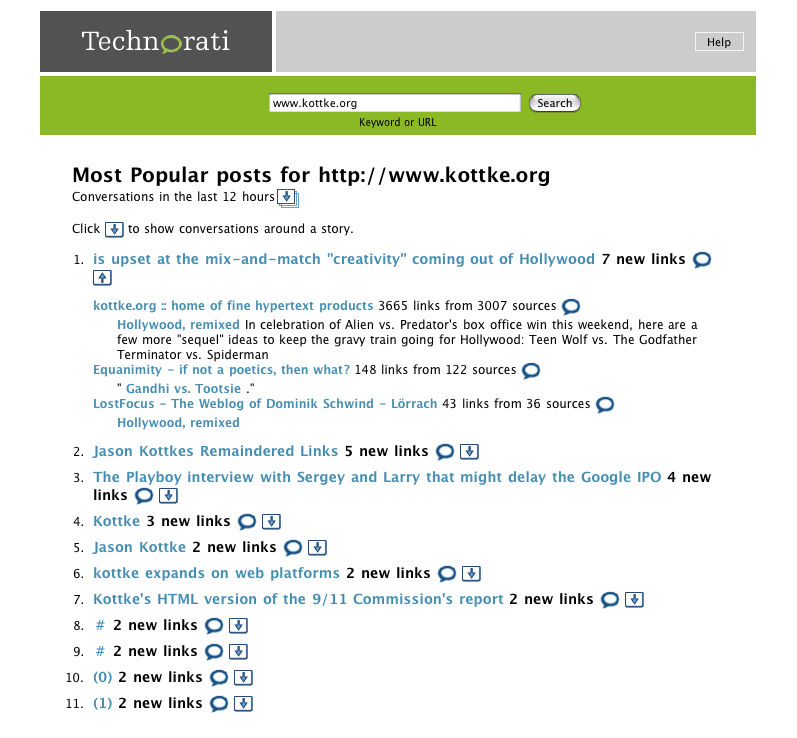
Technorati testing threaded “conversation” view?
Technorati testing threaded “conversation” view?. Took me about 10 times as long to find new links to my site compared to the old flat layout.
Implicit Association Tests
An IAT, or Implicit Association Test, attempts to measure people’s “conscious-unconscious divergences”. Basically, an IAT puts you in a situation with no time to think and compares your reaction with your behavior when you’ve had time to think things over. On the Project Implicit Web site (click on “Demonstration”), you can take a number of IATs to get an idea of your own divergences, including factors such as age, gender, race, sexuality, and religion.
I took the Race IAT:
This IAT requires the ability to distinguish faces of European and African origin. It indicates that most Americans have an automatic preference for white over black.
and the Arab-Muslim IAT:
This IAT requires the ability to distinguish names that are likely to belong to Arab-Muslims versus people of other nationalities or religions. It frequently reveals an automatic preference for other people compared to Arab-Muslims.
On the Race test, my data suggested “moderate automatic preference for White American relative to African American” which isn’t surprising because I spent the first 17 years of my life in northern Wisconsin where there weren’t any black people and all my associations were from what I saw on the news, TV, in the movies, or from what my friends and relatives told me. Of course, I’ve since come to believe that people of all races, while culturally and physically different in some ways, are deserving of the same level of respect. The IAT reveals that though that’s what I consciously believe, my subconscious mind still shows a preference for white people. From the Race FAQ:
Automatic White preference may be common among Americans because of the deep learning of negative associations to the group Black in this society. High levels of negative references to Black Americans in American culture and mass media may contribute to this learning. Such negative references may themselves be more the residue of the long history of racial discrimination in the United States than the result of deliberate efforts to discriminate in media treatments.
On the Arab-Muslim test, a more surprising result: “your data suggest a slight automatic preference for Arab Muslims relative to Other People”. Maybe I’m one of those self-hating white American liberals the neo-cons are always talking about. Growing up, I can’t really remember any positive or negative associations about Arabs or Muslims…I wasn’t really aware of them as a culture. And even with 9/11 and the American military action in the Middle East…those events aren’t something that I associate with any particular religious or cultural group.
Even though these tests are just demonstrations, the differences in what you believe and your mind’s true feelings are important to be aware of for many reasons, even though it may be uncomfortable to know — as I am — that you prefer whites to blacks or thin people to obese people. For those who wish to balance your conscious and subconscious minds and lessen your divergences, the site’s FAQ offers hope:
One solution is to seek experiences that could undo or reverse the patterns of experience that could have created the unwanted preference. But this is not always easy to do. A more practical alternative may be to remain alert to the existence of the undesired preference, recognizing that it may intrude in unwanted fashion into your judgments and actions. Additionally, you may decide to embark on consciously planned actions that can compensate for known unconscious preferences and beliefs.
If you’re interested, you can sign up on the site to participate in the research effort.
Gilmore v. Ashcroft, a story of security,
Gilmore v. Ashcroft, a story of security, indentification, and secret laws.
Hollywood, remixed
In celebration of Alien vs. Predator’s box office win this weekend, here are a few more “sequel” ideas to keep the gravy train going for Hollywood:
Teen Wolf vs. The Godfather
Terminator vs. Spiderman
Cujo vs. Annie
Gladiator vs. Amadeus
Dirty Harry vs. Mrs. Doubtfire
Popeye vs. Anchorman
Annie Hall vs. Donnie Darko
The Wizard of Oz vs. The Man who Wasn’t There
Gandhi vs. Tootsie
Nixon vs. All the President’s Men
Henry V vs. Lawrence of Arabia
Forrest Gump vs. Rain Man
Rambo vs. Rocky
Kramer vs. Kramer vs. The Princess Bride
Happy Gilmore vs. 12 Angry Men
Unbeknowst to me, Matthew Baldwin covered similar ground a few days ago with his Cinematic Supervillain Showdown. kottke.org: I may not get there first, but I get there eventually.
Seven out of the current top twenty
Seven out of the current top twenty most popular photos on Yahoo! News are of female Olympian asses. Current gold medalist in this particular competition is Sandra Pires, Brazilian beach volleyballer.
Warner Bros trying to use MP3 blogs
Warner Bros trying to use MP3 blogs to pimp their music. They also posted fake messages praising the song.
The New Yorker on Errol Morris’ political
The New Yorker on Errol Morris’ political ads for MoveOn and John Kerry.
Watch some of Errol Morris’ commercials supporting
Watch some of Errol Morris’ commercials supporting John Kerry for President.
This is the first level-headed thing I’ve
This is the first level-headed thing I’ve read about the Google IPO in weeks. “The success of a traditional IPO is often counted by the size of the pop but that is ridiculous. A pop means the firm left money on the table — money which was transferred to a handful of insiders who were allocated stock at the low IPO price.”
Surprise, surprise…NBC’s coverage of the Olympics already sucks
Surprise, surprise…NBC’s coverage of the Olympics already sucks. I can’t believe they talked over Bjork’s whole performance. What’s the sense of broadcasting it if they’re not really gonna show it?
Haven’t tried it, but Recall Toolbar looks
Haven’t tried it, but Recall Toolbar looks like a neat IE helper. “Recall Toolbar is a personal search engine that helps you instantly find that needle that you’re trying to find again in the haystack of pages you’ve already visited.”
Satellite photo of the thousands of planes
Satellite photo of the thousands of planes at the Oshkosh Airshow.

Alien vs. Predator
Alien vs. Predator. Alien wins in limericks, mechanical bull, and wet t-shirt contest, but Predator takes backgammon and folk music trivia.
European design trademark could reveal Apple’s plans
European design trademark could reveal Apple’s plans for a tablet PC. iTablet? iBook++? iCantTypeWithAPen?
The Playboy interview with Sergey and Larry
The Playboy interview with Sergey and Larry that might delay the Google IPO. Full text of the interview, taken from Google’s S-1.
“GDP matters most in predicting Olympic performance”
“GDP matters most in predicting Olympic performance” for a given country. Former Soviet republics are an exception.
The Killers, Hot Fuss
On a recommendation from Justin, I picked up Hot Fuss by a group called The Killers. It’s their debut album, but the band already seems to have it together. Here’s a favorite track of mine from the album: Mr. Brightside (mp3, 5.1Mb).
And if anyone out there in Kottkeland has an extra ticket to The Killers show on Monday in NYC, I’m so totally not doing anything that evening. (Kottkeland? WTF? (I know! Boo! I’ll take it out. (On second thought, I’m leaving it in, but I should probably erase this. (Nope, I’m leaving that in too. [please erase this self-indulgent crap or I’m killing the piece -ed] (Nice try, but it’s all self-indulgent, dumbass. (See!))))))
Repeat after me: inbound links do not
Repeat after me: inbound links do not indicate either readership or influence. Plus, Technorati’s top 100 data remains dirty.

Sad news: San Francisco same-sex marriages invalidated
Sad news: San Francisco same-sex marriages invalidated by CA Supreme Court.
Giant Argentinian ant colony in Australia threatening natural biodiversity
Giant Argentinian ant colony in Australia threatening natural biodiversity. Colony is 60 miles across. (My headline initially said “art colony”, which is funnier than “ant colony” by the width of a large Argentinian art or ant colony. Fixed now.)
NY Times on the growing number of
NY Times on the growing number of people who are switching from IE to browsers like Firefox. If you’re still using IE, you should give some serious thought to switching.
Olympic women cashing in on their 15 minutes
Olympic women cashing in on their 15 minutes of fame by posing for men’s magazines.
al-Qaeda’s TPS Reports
There’s some great reporting in this Atlantic Monthly article about the contents of an al-Qaeda computer taken during the US action in Afghanistan. The computer was used primarily by Ayman al-Zawahiri, Osama bin Laden’s right-hand man, and contains emails and memos to/from bin Laden, the leader of the Taliban, and other top al-Qaeda members. You should read the whole thing, but I’m going to quote a few interesting bits:
Perhaps one of the most important insights to emerge from the computer is that 9/11 sprang not so much from al-Qaeda’s strengths as from its weaknesses. The computer did not reveal any links to Iraq or any other deep-pocketed government; amid the group’s penury the members fell to bitter infighting. The blow against the United States was meant to put an end to the internal rivalries, which are manifest in vitriolic memos between Kabul and cells abroad.
Like the early Russian anarchists who wrote some of the most persuasive tracts on the uses of terror, al-Qaeda understood that its attacks would not lead to a quick collapse of the great powers. Rather, its aim was to tempt the powers to strike back in a way that would create sympathy for the terrorists. Al-Qaeda has so far gained little from the ground war in Afghanistan; the conflict in Iraq, closer to the center of the Arab world, is potentially more fruitful. As Arab resentment against the United States spreads, al-Qaeda may look less like a tightly knit terror group and more like a mass movement. And as the group develops synergy in working with other groups branded by the United States as enemies (in Iraq, the Israeli-occupied territories, Kashmir, the Mindanao Peninsula, and Chechnya, to name a few places), one wonders if the United States is indeed playing the role written for it on the computer.
And except from a text found on the computer, written post-9/11:
There are benefits … The operations have brought about the largest economic crisis that America has ever known. Material losses amount to one trillion dollars. America has lost about two thousand economic brains as a result of the operations. The stock exchange dropped drastically, and American consumer spending deteriorated. The dollar has dropped, the airlines have been crippled, the American globalization system, which was going to spoil the world, is gone …
Reading the article, you can’t help but develop a sense of dissonance between who we’re up against and who we’ve been told we’re up against (and our government’s response).
The article includes two sidebars, one contains two letters from a young suicide bomber (one to bin Laden and one to his wife) and the other contains tips for al-Qaeda operatives travelling abroad:
Don’t wear short pants that show socks when you’re standing up. The pants should cover the socks, because intelligence authorities know that fundamentalists don’t wear long pants …
Underwear should be the normal type that people wear, not anything that shows you’re a fundamentalist.
You should differentiate between men and women’s perfume. If you use women’s perfume, you are in trouble.
To paraphrase Jon Lovitz as Michael Dukakis playing opposite Dana Carvey as George H.W. Bush in an SNL Presidential debate skit: I can’t believe we’re losing to these guys.
Olympic officials are not allowing fans to
Olympic officials are not allowing fans to carry items bearing branding from non-Olympic sponsors into event venues. The idea of the Games are nice, but the Olympics are put on by a big, stupid, greedy, monolithic, corrupt, antiquated organization.
Interested in going to the Pop!Tech
Interested in going to the Pop!Tech conference? Get $300 off your registration fee..
Who knew that video game characters (from
Who knew that video game characters (from Soul Calibur) dancing to Hot in Herre by Nelly could be so funny?. This is pants-wettingly amusing.
A photographer’s journal of moments from the
A photographer’s journal of moments from the past few Presidential campaigns.
“Security” personnel on the NY Waterway ferry
“Security” personnel on the NY Waterway ferry from Hoboken to Manhattan hassled this guy over a book he was carrying. “Sir, I feel that I need to confiscate this book.”
Some “Web as platform” noodling
In the discussion of Flickr and Feedburner’s spliced RSS/Atom files, Harold said:
I’m beginning to think that feeds (and content tagging) should be the starting point, not an offshoot. Until now, our tools have produced web pages then feeds. I’m thinking we need tools that create feeds and then let us combine them into web pages.
To put this another way, a distributed data storage system would take the place of a local storage system. And not just data storage, but data processing/filtering/formatting. Taking the weblog example to the extreme, you could use TypePad to write a weblog entry; Flickr to store your photos; store some mp3s (for an mp3 blog) on your ISP-hosted shell account; your events calendar on Upcoming; use iCal to update your personal calendar (which is then stored on your .Mac account); use GMail for email; use TypeKey or Flickr’s authentication system to handle identity; outsource your storage/backups to Google or Akamai; you let Feedburner “listen” for new content from all those sources, transform/aggregate/filter it all, and publish it to your Web space; and you manage all this on the Web at each individual Web site or with a Watson-ish desktop client.
Think of it like Unix…small pieces loosely joined. Each specific service handles what it’s good at. Gmail for mail, iCal for calendars, TypePad for short bits of text, etc. Web client, desktop client, it doesn’t much matter…whatever the user is most comfortable with. Then you just (just! ha!) pipe all these together however you want with services (or desktop apps) handling any filtering/processing that you need, and output it to the file/device/service of your choice. New services can be inserted into the process as they become available. You don’t need to wait for Gmail to output RSS…just pipe your email to Feedburner and they’ll hook you up.
There are, of course, plenty of hurdles to overcome:
- Currently a bit hard on wallet. When you’re paying $5-20 per month for each one of these services (in addition to $50/mo for broadband and $45/mo for your cell phone), living the connected lifestyle is expensive. If a company like Google can offer bundles of these services, it might get cheaper.
- Data needs to be portable. If Flickr starts to suck, you should be able to easily move all of your photos to a better service.
- Redundancy and failing gracefully. What if Blogger is unavailable when I want to rebuild my Web site after my Flickr photostream has been updated (see my MTAmazon plug-in problem)? Does the rebuild just fail or is the data cached somewhere?
- You need to get everyone to agree on interop/formats/etc. Fortunately, it seems like companies are a lot more willing to do this than 4-5 years ago (Amazon, Google, Flickr, Upcoming, & TypePad all have APIs or allow data output via RSS/Atom).
- Security. Lots of passwords and personal information will have to be passed around for all this to work. How about some commitment from these companies to keep this data as secure as they can?
This, then, is the promise of Web services. Nothing new, but it’s nice to see things continue to head in this direction.
Related reading:
- GooOS, the Google Operating System (kottke.org)
- Inventing the Future (Tim O’Reilly)
- The Web as a Platform (John Battelle)
- Deepleap was an early attempt at some of this stuff (Lane Becker)
1966 speech by Robert McNamara on national and international security
1966 speech by Robert McNamara on national and international security. “The decisive factor for a powerful nation already adequately armed is the character of its relationships with the world.”
The effects of whitespace and leading on
The effects of whitespace and leading on reading speed and comprehension.
Socials & More