I'm hoping this will be a new option on Google Maps alongside "satellite" soon: thermographic view. It's basically a heat map of all the buildings on a map...pop in your address and see how energy efficient your roof is. Belgium only. Unfortunately...unless you live in Belgium. (via infosthetics)
Locals and Tourists is a set of maps showing where people take photos in various cities around the world. The results are broken down into tourist photos and photos taken by locals. Here's NYC:
Blue points on the map are pictures taken by locals (people who have taken pictures in this city dated over a range of a month or more). Red points are pictures taken by tourists (people who seem to be a local of a different city and who took pictures in this city for less than a month).
If you're travelling abroad with the iPhone and understandably wish to avoid AT&T's ridiculously high data roaming charges when trying to find the train station in a new city, I would highly recommend OffMaps.
OffMaps lets you take your maps offline. It is the ideal companion for any iPhone and iPod Touch user, who wants to access maps when travelling abroad (and avoid data roaming charges) and who wants to have fast access to maps at all times. This app (and the icon) just has to be on the right hand side of Apple's built-in maps app.
OffMaps uses OpenStreetMap that include a lot more information than simple road maps: from ATMs and train stations to restaurants and pubs! You choose which areas to download instead of buying a new app for every city you want to visit.
I used it for a week in Paris and it worked great; the GPS and compass both still work when data is off so locating yourself isn't a problem. Just download the proper maps before you leave for your trip and you're good to go.
The new subway map makes Manhattan even bigger, reduces Staten Island and continues to buck the trend of the angular maps once used here and still preferred in many other major cities. Detailed information on bus connections that was added in 1998 has been considerably shortened.
Manhattan will be shown on the map as nearly twice as wide as in real life. Cut back on the chili-cheese fries, my friend!
5. Google Earth. Google Earth presents a world in which the area of most concern to you (in this instance, Avebury in Wiltshire) can be at the centre, and which - with mapped content overlaid - can contain whatever you think is important. Almost for the first time, the ability to create an accurate map has been placed in the hands of everyone, and it has transformed the way we view the world.
Until we see that the iPhone is as thoroughly entangled into a network of landscapes as any more obviously geological infrastructure (the highway, both imposing carefully limited slopes across every topography it encounters and grinding/crushing/re-laying igneous material onto those slopes) or industrial product (the car, fueled by condensed and liquefied geology), we will consistently misunderstand it.
In Britain's place should come Poland, which has suffered quite enough in its location between Russia and Germany and deserves a chance to enjoy the bracing winds of the North Atlantic and the security of sea water between it and any potential invaders.
The Beauty of Maps is a BBC series that "[looks] at maps in incredible detail to highlight their artistic attributions and reveal the stories that they tell". The site also links to another maps blog: Amazing Maps. (via junk_deluxe)
Stretching from New York to Minnesota, [Stayathomia's] defining feature is how near most people are to their friends, implying they don't move far. In most cases outside the largest cities, the most common connections are with immediately neighboring cities, and even New York only has one really long-range link in its top 10. Apart from Los Angeles, all of its strong ties are comparatively local.
The interactive map on the NYC govt site has hi-resolution aerial photos from 1924 (click the camera and move the slider to 1924). Check out all the piers, the Brooklyn Navy Yard, the old baseball stadiums, the LES (and everywhere else they built housing projects), Penn Station, and the skyscraperless Midtown. This is hours of fun.
Update:The NYC Oasis map features a satellite view from 1996 and an imagined sat view from 1609. (thx, steve)
Fascinating map of Netflix rental patterns for NYC, Atlanta, Miami, and nine other US cities. I wonder if you could predict voting patterns according to where people rent Paul Blart: Mall Cop or Frost/Nixon. I wonder what the map for Napoleon Dynamite looks like?
Most of the interesting trends occurred on a local scale -- stark differences between the South Bronx and Lower Manhattan, for example, or the east and west sides of D.C. -- and weren't particularly telling at a national scale. (We actually generated U.S. maps in PDF form that showed all 35,000 or so ZIPs, but when we flipped through them, with a few exceptions, we found the nationwide patterns weren't nearly as interesting as the close-in views.)
The Known Universe zooms out from Tibet to the limits of the observable universe. Dim the lights, full-screen it in HD, and you're in for a treat.
Like Powers of Ten, except astronomically accurate. It's not a dramatization, it's a map; the positioning data was pulled from Hayden Planetarium's Digital Universe Atlas, which is available for free download.
Since 1998, the American Museum of Natural History and the Hayden Planetarium have engaged in the three-dimensional mapping of the Universe. This cosmic cartography brings a new perspective to our place in the Universe and will redefine your sense of home. The Digital Universe Atlas is distributed to you via packages that contain our data products, like the Milky Way Atlas and the Extragalactic Atlas, and requires free software allowing you to explore the atlas by flying through it on your computer.
The Strange Maps book is out today. The book is based on the awesome Strange Maps blog, one the very few sites I have to exercise restraint in not linking to every single item posted there. The content of the book is adapted from the site, so of course it's top shelf.
My only reservation in recommending the book is the design. When I cracked it open, I was expecting full-bleed reproductions of the maps, large enough to really get a detailed look at them. The maps *are* the book, after all. But that's not the case...only a few of the maps get an entire non-full-bleed page and some of the maps are stuck in the corner of a page of text, like small afterthoughts. The rest of the design is not much better, cheesy at best and distracting at worst. I wasn't expecting Taschen-grade production values, but something more appropriate to the subject matter would have been nice.
This was my present to my nephew for his 3rd birthday. He loves, loves, loves the subway so my sister asked me if I could make a custom map with all the places that mean something to him on the poster.
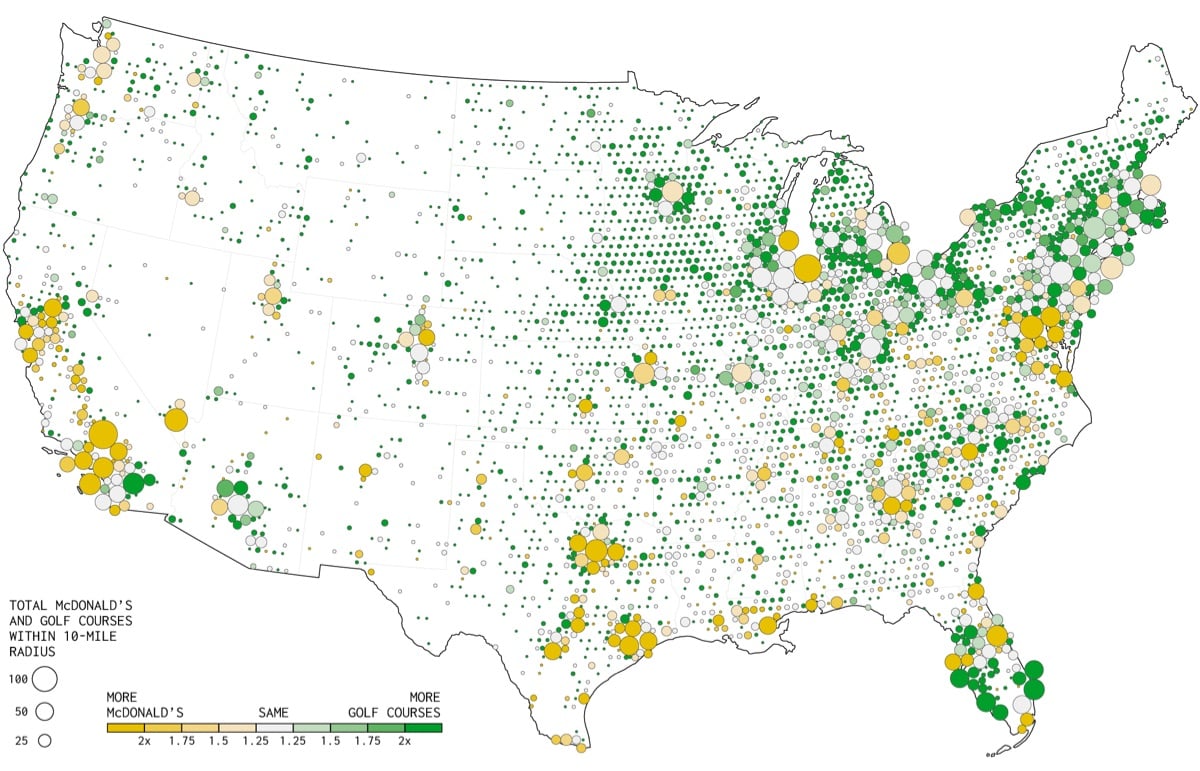
For maximum McSparseness, we look westward, towards the deepest, darkest holes in our map: the barren deserts of central Nevada, the arid hills of southeastern Oregon, the rugged wilderness of Idaho's Salmon River Mountains, and the conspicuous well of blackness on the high plains of northwestern South Dakota.
Among this list of 20 fascinating ancient maps, you'll find the island of California, a would-be beautification of Paris circa-1789, and the Modern and Completely Correct Map of the Entire World, which turned out to be nothing of the sort. (thx, john)
Initially, I was attracted to the noisy amateur aesthetic of the raw images. Street Views evoked an urgency I felt was present in earlier street photography. With its supposedly neutral gaze, the Street View photography had a spontaneous quality unspoiled by the sensitivities or agendas of a human photographer. It was tempting to see the images as a neutral and privileged representation of reality -- as though the Street Views, wrenched from any social context other than geospatial contiguity, were able to perform true docu-photography, capturing fragments of reality stripped of all cultural intentions.
Strange Maps has a map of What's On Earth Tonight, basically a TV Guide for the Milky Way. The map is not that big yet because TV signals have only been sent out from Earth since the late 1920s.
The first tv images of World War II are about to hit Aldebaran star system, 65 light years [ly] away. If there's anybody out there alive and with eyes to see it, the barrage of actual and dramatised footage of WW2 will keep them shocked and/or entertained for decades to come. Which is just as well, for they'll have to wait quite a few years to catch the first episodes of such seminal series as The Twilight Zone and Bonanza (both 1959), just about now hitting the (putative) extraterrestrial biological entities of the Mu Arae area (appr. 50 ly). The Cosby Show, Miami Vice and Night Court (all 1984) should be all the rage on Fomalhaut (25 ly). Meanwhile, the sentient, tv-watching creatures near Alpha Centauri (4.4 ly), our closest extrasolar star, are just recovering from the infamous "wardrobe malfunction" during Janet Jackson and Justin Timberlake's halftime show during the 2004 Superbowl.
One thing that's very interesting to us that is using this rapidly-produced thing then becomes a 'social object': creating conversations, collecting scribbles, instigating adventures - which then get collected and redistributed.
In some places, participants are creating the first freely-available maps by GPS survey. In other places, such as the United States, basic roads exist, but lack local detail: locations of traffic signals, ATMs, caf'es, schools, parks, and shops. What such partially-mapped places need is not more GPS traces, but additional knowledge about what exists on and around the street. Walking Papers is made to help you easily create printed maps, mark them with things you know, and then share that knowledge with OpenStreetMap.
Only sealers, shipwrecked sailors and salvagers made their homes on Sable Island, impermanent ones at best. The salvagers must have had some pretty good times -- over the last few centuries, more than 350 vessels were shipwrecked on what became known as the "Graveyard of the Atlantic". Located in shallow, often stormy and foggy waters, the elongated Sable Island (44 km long but never more than 2 km wide) might have been predestined as a catchment area for ships treading these Atlantic latitudes -- a self-fulfilling curse for captains igorant or oblivious of this huge, constantly shifting sandbar.
The waters off North Carolina's Outer Banks entomb thousands of vessels and countless mariners who lost a desperate struggle against the forces of war, piracy and nature. The Graveyard of the Atlantic, with one of the highest densities of shipwrecks in the world, holds some of America's most important maritime history.
More than 35,000 people have downloaded Mr. Melvin's file, North Korea Uncovered. It has grown to include thousands of tags in categories such as "nuclear issues" (alleged reactors, missile storage), dams (more than 1,200 countrywide) and restaurants (47). Its Wikipedia approach to spying shows how Soviet-style secrecy is facing a new challenge from the Internet's power to unite a disparate community of busybodies.
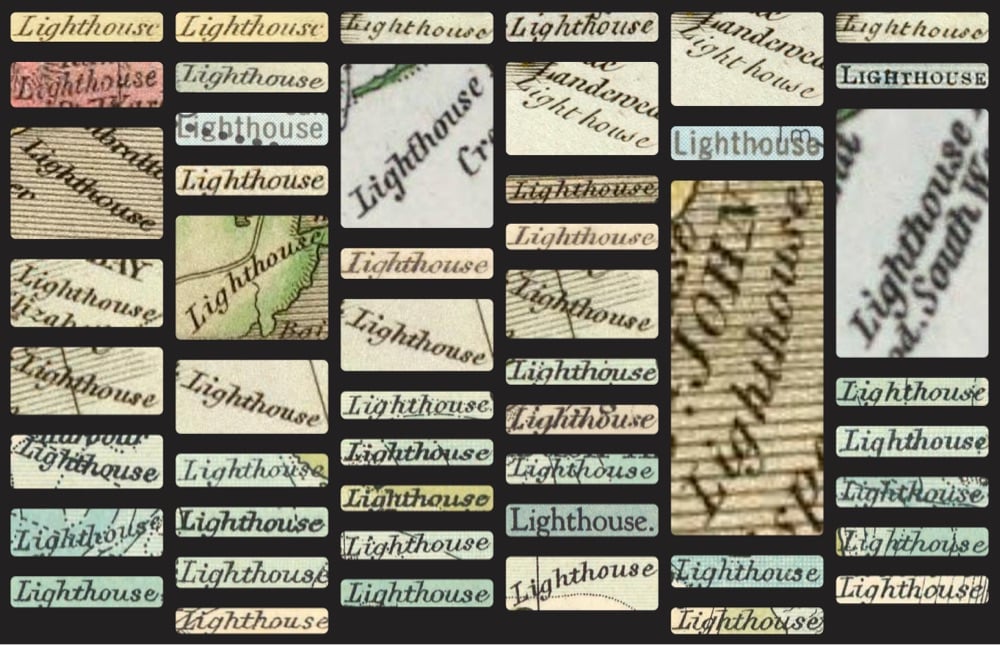
"Here is one of the most closed countries in the world and yet, through this effort on the Internet by a bunch of strangers, the country's visible secrets are being published," says Martyn Williams, a Tokyo-based technology journalist who recently sent Mr. Melvin the locations of about 30 North Korean lighthouses.
I really like the subway travel time heatmaps on Triptrop NYC.
Put in an address and you get a map of how far away everything is using the subway. 15 minutes, forty minutes, two hours -- all set up with nice little colors. That's pretty easy, I think. Triptrop can help you find a convenient place to live. It's also a nice way to tell your friend to stop inviting you to the purple part of the Bronx, or to prove that the G isn't actually that bad.
The result, after much whacking, is, I think, compelling, but you'll have to see for yourself. The general idea it that the history of subway ridership tells a story about the history of a neighborhood that is much richer than the overall trend. An example, below, shows the wild comeback of inner Williamsburg, and how the growth decays at each successive stop away from Manhattan on the L train.
This is a little bit brilliant. Here and There are a pair of maps of Manhattan that start from an on-the-street viewpoint and curl up as you gaze uptown or downtown until you see the rest of the island from a traditional "flat map" view.
As the model bends from sideways to top-down in a smooth join, more distant parts of the city are revealed in plan view. The projection connects the viewer's local environment to remote destinations normally out of sight.
Prints are available. This is like a 3-D version of the spider maps for London buses, in which a local street grid relays information about the immediate vicinity while the surrounding schematic shows connections to the rest of the system.
Update: Ooh, these science illustrations from NISE use a similar technique to simultaneously show the internal and external structure of their subjects.
These illustrations show familiar objects across ten orders of magnitude-from familiar aspects down to the level of their constituent atoms. Vast scale differences are usually shown through separate images (e.g., the Eames' Powers of Ten). This illustration employs the artistic convention of perspective-typically used by landscape painters-to show multiple scales in one frame.
In 1879, Brooklyn papermaker Robert Gair developed a process for mass producing foldable cardboard boxes. One of the paper-folding machines in his factory malfunctioned and sliced through the paper, leading Gair to the realization that cutting, creasing, and folding in the same series of steps could transform a flat piece of cardboard into a box.
Gair's box, a cheap, light alternative to wood, became "the swaddling clothes of our metropolitan civilization," Lewis Mumford wrote. Eventually, the National Biscuit Compnay introduced its first crackers that stayed crispy in a sealed paper box, and an avalanche of manufacturers followed. Gair expanded to ten buildings on the Brooklyn waterfront. Massive migration from Europe to the United States created a manufacturing workforce in Brooklyn, to curn out ale, coffee, soap, and Brillo pads -- and Gair made boxes right beside them.
Gair's concentrated collection of buildings eventually led the area between the Brooklyn and Manhattan Bridges to be called Gairville. That area is now known as Dumbo and, in addition to tons of residential space, the neighborhood is home not to manufacturing but to architecture firms, web companies, and other creative industries.
The Gair Company's most iconic building was also its last: the Clocktower Building, also known as Gair Building No. 7. I tracked down several of the other Gair buildings and put them on this Google Map.
This was true for me, at least, while I was making these; Hand erasing buildings through SoHo, TriBeCa, and the LES was an eery experience as I tried to imagine what these places would really look like if my brush was a bulldozer.
Pew Research Center's interactive maps of migration flows in the US are pretty interesting. The region map makes it seem as though the Northeast is rapidly losing population to the South but the states map clarifies the picture...the flow looks to be hundreds of thousands of retirees moving to Florida and Georgia.
So why did the Paris Metro (now operated by the RATP) reject Beck's clear simplification of their beloved system? One reason is visible at each station entrance; Parisians use the maps here as a free public service to help them find their way round the city - the ubiquitous geographic wall map is more than just a Metro plan.
Now you're probably wondering where the rest of the depth data comes from if there are such big gaps from echosounding. We do our best to predict what the sea floor looks like based on what we can measure much more easily: the water surface. Above large underwater mountains (seamounts), the surface of the ocean is actually higher than in surrounding areas. These seamounts actually increase gravity in the area, which attracts more water and causes sea level to be slightly higher. The changes in water height are measurable using radar on satellites.
More specifically, he found a 90 percent chance that bin Laden is in Kurram province in Pakistan's Federally Administered Tribal Areas, most likely in the town of Parachinar which gave shelter to a larger number of Mujahedin during the 1980s. [...] Gillespie even identified three buildings in Parachinar that would make the most likely shelters for Bin Laden and his entourage.
First the videos. Someone visiting the Bronx Zoo caught the plane on video, flying low in the sky just after the bird strike. A Coast Guard video monitoring station got a shot of the plane just after it splashed down...you can see the spray from the impact flying in from the left of the video just after the 2:00 mark.
Soon after the plane hits, the camera zooms in and you can see just how quickly people get out and onto the wings. And then this video shows it most clearly:
Look how low and level and steady Sully guided that thing in! Amazing!
The life raft attached to the plane was upside down in the river, just out of reach. Mr. Wentzell turned and found another passenger, Carl Bazarian, an investment banker from Florida who, at 62, was twice his age. Mr. Wentzell grabbed the wrist of Mr. Bazarian, who grabbed a third man who held onto the plane. Mr. Wentzell then leaned out to flip the raft. "Carl was Iron Man that day," Mr. Wentzell said. "We got the raft stabilized and we got on." A man went into the water, and the door salesman and the banker hauled him aboard. He curled in a fetal position, freezing.
The Times also comes through with the 3-D flight graphic I asked for the other day but they upped the ante with a seating chart of the plane where you can click on certain passengers' seats to read their thoughts. Mark Hood in seat 2A described the landing:
When we touched down, it was like a log ride at Six Flags. It was that smooth.
I was re-reading Carl Sagan's novel Contact recently, essentially a series of arguments about SETI wrapped into a story, and he alludes to some sort of cosmic Grand Central Station. That, coupled with my longtime interest in transit maps, got me thinking about all of this.
[I removed the map temporarily because it wasn't loading.]
To construct the map, outside.in scrapes kottke.org's RSS feed, looks for names of specific places, and plots the related blog entries on a map. There's not a lot of local content on kottke.org but the results are still pretty good; it works a lot better on a local site like Gothamist. [Disclosure: I am an advisor to outside.in.]
Our Dumb World is an atlas of the World presented by The Onion. It manages to inform (poorly) and entertain at the same time. For instance, here's their description of Israel:
Home to one-third of the world's Jews and two-thirds of the world's anti-Semites, the nation of Israel is a place so holy that merely walking in it can gain you a place in the World to Come, nowadays often within minutes.
And about the US, "The Land Of Opportunism":
The United States was founded in 1776 on the principles of life, liberty, and the reckless pursuit of happiness at any cost -- even life and liberty.
With Google Map Maker, you can become a citizen cartographer and help improve the quality of maps and local information in your region. You are invited to map the world with us!
Update: Several people wrote in to recommend OpenStreetMap instead because Google doesn't make the data available in a raw form whereas the OSM data is under a CC license available for derivative works like OpenCycleMap. (thx, mike and everyone)
Called the "Atlas of True Names," the new map traces the etymological roots of European and global place names and then translates them into English. The "City of Boatmen" is also known as Paris. Should you travel to the Land of the Fire Keepers, you'd find yourself in Azerbaijan. And Italy comes from the Latin word vitulus, which means "calf."
New York is "Wild Boar Village", Chicago is "Stink Onion", Great Britain is "Great Land of the Tattooed", and Grozny is "The Awesome". However, Language Log notes that some of the translations should be taken with a grain of salt. (thx, andreas)
This is not a political blog. However, this is a story I couldn't pass up: the story of how voting patterns in the 2008 election were essentially determined 85 million years ago, in the Cretaceous Period. It's also a story about how soil science relates to political science, by way of historical chance.
Headline I'd like to see in 96 pt. type in the NY Times: Obama Elected By Rich Loamy Soils of Cretaceous Seas.
The western Great Plains are emptying of people. Some 322 of the 443 Plains counties have lost population since 1930 and a majority have lost population since 1990. Now is the time for the Federal government to sell high-priced land in the West, use some of the proceeds to deal with current problems and use some of the proceeds to buy low-priced land in the Plains creating the world's largest nature park, The Buffalo Commons.
According to this map, the US government owns more than 50% of the land in some western states (Nevada 84.5%, Utah 57.4%, Oregon 53.1%, Arizona 48.1%, California 45.3%).
Hopefully I'll have some time this afternoon to update the 2008 Election Maps page; I've got lots of good submissions waiting in my inbox. Thanks to everyone who sent in links and screenshots.
Idea for the Obama administration: fireside chats. On the radio, on satellite radio, as a podcast, transcripts available online soon after airing. Done live if possible, a genuine lightly scripted chat. Maybe Obama could have special guests on to talk about different aspects of policy and government. Bush does weekly radio addresses but they're short, boring, and scripted.
And I gotta tell you, if change.gov is indicative of how the Obama administration is going to use the web to engage with Americans, this is going to be an interesting four years.
Ok, that's probably the last Obama post for a bit. Back to your irregularly unscheduled programming.
Last night as the election results were coming in online, I took screenshots of a bunch of the now-familiar red/blue electoral maps being used by the larger media sites to show election results and posted them all on this page. (There are currently 25 maps...I'm adding more in a few minutes.)
1. No one strayed from the red and blue. The red/blue combo is overwhelmingly symbolic but there are plenty of other colors in the crayon box; I would like to have seen someone try something different.
2. In the 2000 and 2004 elections, the red/blue map was the focal point of the media coverage. People were fixated by it. This time around, it didn't matter so much. The maps were interesting for 3-4 hours until the overwhelming nature of Obama's victory became apparent and then, not so much. By this morning, the maps are already shrinking or disappearing from the home pages of the Times, CNN, and the like.
3. Nate Silver and the rest of the 538 guys nailed it. They got Indiana wrong and there are a couple more states that are still too close to call, but they got the rest of the map right. Their final projection had Obama getting 348.6 electoral votes and they currently have him at 349.
When we were up in Vermont earlier this month, we rode the single chair to the top of the mountain at Mad River Glen and then hiked down. Before we left, we installed iTrail on Meg's phone. iTrail uses the iPhone's GPS capability to track your progress along a trail, jogging path, etc. The reviews at the iTunes Store aren't glowing but we found that it worked pretty well for us. Here are a couple of graphs generated by iTrail of our hike:
iTrail also allows data export to a Google Docs speadsheet. From there, you can import that data into Google Maps, like so:
It's not perfect (we weren't doing 8.2 mph at the beginning of the hike) and GPS mapping apps are hardly new, but I've never done this before and it feels like living in the future.
Philip Kromer took the newspaper endorsement data from the Editor and Publisher page I linked to this morning and mapped the results. The states are colored according to FiveThirtyEight's current projections and those newspapers with larger circulations have larger circles. From Kromer's blog post:
This seems to speak of why so many on the right feel there's a MSM bias - 50% of the country is urban, 50% rural, but newspapers are located exclusively in urban areas. So, surprisingly, the major right-leaning papers are all located in parts of the country we consider highly leftish. The urban areas that are the largest are thus both the most liberal and the most likely to have a sizeable conservative target audience.
Whenever I rode the subway with my two older boys, I tried to hold on to their hands at all times. In the process, I developed a special move. I think anyone who saw it must have been impressed.
I would hold the boys' hands as we briskly made our way out of the station, then, just as we reached the turnstiles, I would let go. We would pass through the turnstiles simultaneously, and so smoothly that the boys' hands would still be up in the air when we got to the other side, where I would grab their little fingers again in one fluid motion. (Requires practice.)
This fantastic contraption, called the 'Routefinder', showed 1920s drivers in the UK the roads they were travelling down, gave them the mileage covered and told them to stop when they came at journey's end. The technology -- a curious cross between the space age and the stone age -- consisted of a little map scroll inside a watch, to be 'scrolled' (hence the word) as the driver moved along on the map. A multitude of scrolls could be fitted in the watch to suit the particular trip the driver fancied taking.
We've just added comprehensive transit info for the entire New York metro region, encompassing subway, commuter rail, bus and ferry services from the Metropolitan Transit Agency (MTA), the Port Authority of New York and New Jersey, New Jersey Transit and the City of New York.
One feature I'd like: a quick at-a-glance comparison of the three travel methods (walking, subway/train, driving) to see which is going to take less time.
Outside.in has launched a new feature called StoryMaps. When you sign up, they crawl your blog looking for mentions of places and then make a map of your posts. It doesn't work so well for my site (mostly because -- giggedy -- kottke.org is all over the map, har har), but for sites that post about a lot of local stuff, it works pretty well. See Gothamist's implementation, for instance. More on the outside.in blog. (Disclosure: I am an advisor to outside.in.)
New for the 2008 NFL season: the NFL TV distribution maps that tell you which football games are going to be broadcast is which parts of the country. They're using zoomable Google Maps this year...here's what a typical coverage map looks like:
During football season in a TV market like NYC, which is dominated by coverage of two local teams (Giants and Jets), this is an essential tool for determining if you're actually gonna get to watch the game you want to on Sunday.
Kristin Armstrong, the Olympic gold medalist in the women's individual time trial in road cycling, took a GPS unit along with her when she previewed the road course in Beijing in December 2007. When she got home to Idaho, she d/led the data, put it into Google Earth, and found a similar local loop on which to train.
This capability along with having the elevation profile proved invaluable in my preparation for my Gold Medal race.
It occurred to me that you could make a map -- a whole book of maps -- detailing all possible routes of bank robbery within the underground foundations of a city. What basements to tunnel through, what walls can be hammered down: you make a labyrinth of well-placed incisions and the city is yours. Perforated from below by robbers, it rips to pieces. The city is a maze of unrealized break-ins.
A map of the world as reported by the New York Times. Countries are color coded by the amount of times they are mentioned in the Times, per capita. Greenland, Iraq, New Zealand, Iceland, and Panama are disproportionally represented.
The border is so complicated that there are some houses that are divided between the two countries. There was a time when according to Dutch laws restaurants had to close earlier. For some restaurants on the border it meant that the clients simply had to change their tables to the Belgian side.
So for the last two years I've been taking pictures of Britain on world maps. Not accurate maps, but drawings or illustrations of maps. The differences are amazing. You might assume that all maps were accurate, or at least accurate-ish. But no, designers play fast and loose with the truth making the host country bigger, more important or more central. Look at Britain in these photos. Look at the size of it compared to Europe. It's the same, but different.
I love the averaged England near the bottom of the post. (via migurski)
This site lets you track the International Space Station, the Space Shuttle (when in orbit), and all sorts of other satellites in relation to their position over the earth with a familiar Google Maps interface. Very cool.
Perhaps most exaggerated of all though has to be the images that are typically given to show the accumulation of "space junk" -- remnants of space flights and defunct satellites, etc. In this image each pixel represents approximately 114 miles; so a piece of debris the size of a car is marked with a point the size of Long Island -- easily a 6 order of magnitude exaggeration.
In Raiders of the Lost Ark (1981) which is set in 1936, we see ITC Serif Gothic (designed in 1972). The wide spacing feels right, and it does have an art deco feel, but it's 1970s art deco.
I wish this map of current US gas prices factored out the taxes included in the pump price. It seems like what the map mostly shows is the differences in taxes between states (PDF map) and not, for instance, how the distance from shipping ports or local demand affects prices. (via what i learned today)
It turns out there are multiple "longest drives", because the Google Maps World is partitioned (many countries don't support driving directions), and sometimes ferries are included, and sometimes they are not.
The longest he's found so far is from the Aleutian Islands to the tip of Newfoundland, a distance of over 7,200 miles. You can drag the path around to make it a lot longer (more than 11,000 miles) but that's cheating.
(Today is Ben Fry day on kottke.org. Apparently.) All Streets is a map of the US with all 26 million roads displayed on it. The best part is that features like mountains and rivers emerge naturally from the road system.
No other features (such as outlines or geographic features) have been added to this image, however they emerge as roads avoid mountains, and sparse areas convey low population. The pace of progress is seen in the midwest where suburban areas are punctuated by square blocks of area that are still farm land.
The newest version of Google Earth includes 3-D photorealistic buildings, sunlight (with shadows on those realistic 3-D buildings), and a Spiderman-esque swooping action. Here's a "photo" I snapped of downtown San Francisco.
I read a lot of news by surfing the Internet, as do many of my colleagues and friends, and I've always dreamed of a way to browse news based on geography. What's happening in Paris today? What are the top headlines in Japan?
The maps visually represent the rhythm and structure of Kerouac's literary space, creating works that are not only gorgeous from the point of view of graphic design, but also exhibit scientific rigor and precision in their formulation: meticulous scouring the surface of the text, highlighting and noting sentence length, prosody and themes, Posavec's approach to the text is not unlike that of a surveyor. And similarly, the act is near reverential in its approach and the results are stunning graphical displays of the nature of the subject. The literary organism, rhythm textures and sentence drawings are truly gorgeous pieces.
The sentence drawings are really worth checking out.
Update: Posavec's analysis of Walter Benjamin's The Work of Art in the Age of Mechanical Reproduction is available for sale at 20x200. Apropos!
In the past few decades, individuals have experienced dramatic changes in some of the most established dimensions of human life: time, space, matter, and individuality. Working across several time zones, traveling with relative ease between satellite maps and nanoscale images, gleefully drowning in information, acting fast in order to preserve some slow downtime, people cope daily with dozens of changes in scale. Minds adapt and acquire enough elasticity to be able to synthesize such abundance. One of design's most fundamental tasks is to stand between revolutions and life, and to help people deal with change.
I was surprised at how many of the show's ideas and objects I'd seen or even featured on kottke.org already. But getting there first isn't the point. The show was super-crowded and I didn't have a lot of time to look around, but here are a couple of things that caught my eye.
Using eight of my favourite films from eight of my most admired directors including Sidney Lumet, Francis Ford Coppola and John Boorman, each film is processed through a Java program written with the processing environment. This small piece of software samples a movie every second and generates an 8 x 6 pixel image of the frame at that moment in time. It does this for the entire film, with each row representing one minute of film time.
Update: I misread the text associated with the second link...the music does not correspond to the notes on the map. But anyone wants to give it a shot, send along an MP3 of your recording. (thx, bill)
In a map of the Republik van Nieuw Nederland, Paul Burgess imagines that the Dutch never gave up their New World possessions and a republic formed centered around New Amsterdam.
New Amsterdam never gave way to New York. The Dutch kept the whole of their North American colony out of the hands of the perfidious English, in fact. New Netherland today constitutes a thriving Republic stretching from the Atlantic coast to Quebec, dividing New England from the rest of the United States.
Web Trend Map 2008 Beta, which is basically 300 influential web sites mapped onto a Tokyo train map. It's very pretty, but once again, kottke.org gets no love.
Next, it is clearly no good to be told that a location is very convenient for your work if you can't afford to live there. So we have produced some interactive maps that allow users to set both the maximum time they're willing to commute, and the median house price they're willing or able to pay.
The commute time slider makes a lovely Mandelbrot-esque pattern as you pinch the times together. (via o'reilly radar)
This post about the carbon footprint of wine contains an interesting map at the bottom. It's a map of the US with a line splitting the country in two. West of the line, it is more carbon efficient to drink Napa wine while to the east of the line it is more carbon efficient to drink French Bordeaux. You can almost see the coastline of the eastern and Gulf states struggling westward against the trucking route from California. The Vinicultural Divide?
19.20.21 (19 cities in the world with 20 million people in the 21st century) is a nice site for an effort to undertake "a five-year study that will encompass all aspects of the phenomenon of supercities" but the real attraction are the maps of the world's largest cities through time (Menu/10 Largest Cities). In 1000, the largest city in the world was Cordova, Spain and by 1500, 4 of the top 10 were in China and one was in Nepal. (via snarkmarket)
Transit Maps of the World is the first and only comprehensive collection of historic and current maps of every rapid-transit system on earth. Using glorious, colorful graphics, Mark Ovenden traces the history of mass transit-including rare and historic maps, diagrams, and photographs, some available for the first time since their original publication. Transit Maps is the graphic designer's new bible, the transport enthusiast's dream collection, and a coffee-table essential for everyone who's ever traveled in a city.
Update: Oops, that didn't take long. RC is a little slow right now because everyone's trying to d/l the 3.8 MB png file of the map. Maybe check back a little later?
Statetris: "Instead of positioning the typical Tetris blocks, you position states/countries at their proper location." There are versions for the US, Africa, Europe, the UK, and more.
Update: Just to be clear, this is my second time through the book. (Last time was, what, 4 years ago?) Trying to make more of a study of it this time.
Update: Suggestion from Ian: "Get 3 bookmarks. 1 for where you are reading, 1 for the footnotes, 1 to mark the page that lists the subsidized years in order." I'm currently using two bookmarks...will get a third for the sub. years list.
I've been keeping up with the latest iPhone news but I haven't been telling you about it...partially because my poor pal Merlin is about to pop an artery due to all the hype. Anyway, it's Friday and he's got all weekend to clean that up, so here we go. The big thing is a 20-minute guided tour of the device, wherein we learn that there's a neat swiping delete gesture, you can view Word docs, it's thumb-typeable, the earbuds wires house the world's smallest remote control, Google Maps have driving directions *and* traffic conditions, and there's an "airplane mode" that turns off all the wifi, cell, and Bluetooth signals for plane trips. It looks like the iPhone will be available online...here's the page at the Apple Store. What else? It plays YouTube videos. iPhone setup will be handled through iTunes: "To set up your iPhone, you'll need an account with Apple's iTunes Store."
Pirate myths uncovered: they never said "arrr", there was no plank walking, and no treasure maps. The "arrr" and the pirate accent "originated with Robert Newton, the actor who played Long John Silver in the movies and on TV through much of the 1950s".
I'm sure this functionality is coming, but when using the new Street View feature in combination with driving directions on Google Maps, I want a play button that drives me from the starting point to my destination, showing me the street-level view along the way.
Stamen delivers another lovely project: Trulia Hindsight. It's an animated map of the US which shows new home construction over a period of years "with an eye towards exposing patterns of expansion and development". As you might expect, the growth of a city like Las Vegas is interesting to watch. More on the project from Stamen and on the Trulia Hindsight blog.
New Google Maps feature: Street View. Just place your little guy on a street on the map and up pops a 3-D panorama of what you'd see on the street. For instance, here's a view into oncoming traffic on the Brooklyn Bridge. Only major US cities are supported for now. I remember Amazon's A9 came out with something like this a couple of years ago, but Google's implementation of it is fantastic. (thx, mark)
Projected climate map of Europe in 2071. The map is a bit confusing...the cities are placed on the map according to their projected new climate, not their geographical location. So, in 2071, Berlin will find itself in the same climate as circa-2007 North Africa.
It's been awhile since I've done one of these. Here are some updates on some of the topics, links, ideas, posts, people, etc. that have appeared on kottke.org recently:
Two counterexamples to the assertion that cities != organisms or ecosystems: cancer and coral reefs. (thx, neville and david)
In pointing to the story about Ken Thompson's C compiler back door, I forgot to note that the backdoor was theoretical, not real. But it could have easily been implemented, which was Thompson's whole point. A transcript of his original talk is available on the ACM web site. (thx, eric)
are those twitter updates on your blog updated automatically when you update your twitter? if so, how did you do it?
A couple of weeks ago, I added my Twitter updates and recent music (via last.fm) into the front page flow (they're not in the RSS feed, for now). Check out the front page and scroll down a bit if you want to check them out. The Twitter post is updated three times a week (MWF) and includes my previous four Twitter posts. I use cron to grab the RSS file from Twitter, some PHP to get the recent posts, and some more PHP to stick it into the flow. The last.fm post works much the same way, although it's only updated once a week and needs a splash of something to liven it up a bit.
In case someone in the back didn't hear it, this map is not from Dungeons and Dragons but from Zork/Dungeon. (via a surprising amount of people in a short period of time)
When reading about how low NYC's greenhouse gas emissions are relative to the rest of the US, keep in mind the area surrounding NYC (kottke.org link). "Think of Manhattan as a place which outsources its pollution, simply because land there is so valuable." (thx, bob)
I'm ashamed to say I'm still hooked on DesktopTD. The problem is that the creator of the game keeps updating the damn thing, adding new challenges just as you've finally convinced yourself that you've wrung all of the stimulation out of the game. As Robin notes, it's a brilliant strategy, the continual incremental sequel. Version 1.21 introduced a 10K gold fun mode...you get 10,000 gold pieces at the beginning to build a maze. Try building one where you can send all 50 levels at the same time and not lose any lives. Fun, indeed.
Regarding the low wattage color palette, reader Jonathan notes that you should use that palette in conjunction with a print stylesheet that optimizes the colors for printing so that you're not wasting a lot of ink on those dark background colors. He also sent along an OS X trick I'd never seen before: to invert the colors on your monitor, press ctrl-option-cmd-8. (thx, jonathan)
In reviewing all of this, the following seem related in an interesting way: Nickelback's self-plagiarism, continual incremental sequels, digital photo alteration, Tarantino and Rodriquez's Grindhouse, and the recent appropriation of SimpleBits' logo by LogoMaid.
Update: The map is not from Dungeons and Dragons but from the "original mini-computer" version of Zork, then called Dungeon. (thx, everyone in the world)
A French map shows that the Portuguese were the first Europeans to discover Australia in the early 1520s, almost 250 years before Captain Cook claimed them for Britain. "'The Vallard cartographer has put these individual charts together like a jigsaw puzzle. Without clear compass markings its possible to join the southern chart in two different ways. My theory is it had been wrongly joined.' Using a computer Trickett rotated the southern part of the Vallard map 90 degrees to produce a map which accurately depicts Australia's east coast."
The must-see link for today is Social Explorer. Jump right to the maps section or to the New York City % White 1910-2000 and the the New York City % Black 1910-2000 slideshows. Running the shows forward, you can see blacks settling into Harlem, Brooklyn, and Queens and then spreading out from there. I wish it were slightly easier to make slideshows, but it's still really fun to play around with all the maps. (via vsl)
Lori Napoleon collects "personal maps" from various people. This tactical guide for nourishing yukio includes directions to the owner's house, outlines of the two different keys (outside door, inside door), and what to feed the cat and when.
Also slightly related is the Fool's World Map, a deliberately addled world map prompted by a question asked of the map-maker by a Texan: "How many hours does it take to go to Japan by car?"
If Strangemaps wasn't such a reliable source, I'd think this was a hoax. A small part of East Germany lives on in the Caribbean. Cuba gave the tiny island to the GDR in 1972 while on a state visit to East Berlin and it wasn't mentioned in the German unification treaties. Commenters on the thread have found satellite images of the island in question, including this one.
Not sure when these features were added, but Google Maps now displays public transportation stops (NYC subway, the T in Boston, the L in Chicago) and building outlines for metropolitan areas. Here's a shot of the West Village in NYC:
World map of driving orientations. "An estimated 66% of people worldwide live in right-hand side countries, and 72% of all distances are completed while driving on the right side of the road."
Map of the Land of Oz. "Oz is completely surrounded by deserts, insulating the country from invasion and discovery. The isolation may be splendid, it is not total: children from our world got through, as well as the Wizard of Oz and the more sinister Nome King. To prevent further incursions, Glinda created a barrier of invisibility around Oz."
Strange Maps post about the Vinland Map, a document proported to have been drawn in the 15th century from a 13th century map. The Vinland Map depicts an unknown land across the Atlantic Ocean called Vinland which some think is the part of North America visited by the Vikings in the 11th century.
A pair of trend maps for 2007, both based on subway maps. The top one depicts the top online companies/brands & how they're connected while the bottom one deals with ideas (with the River of Consciousness standing in for the Thames).
Both maps were found in this article about internet predictions in 2007. I don't know about you, but I find these types of maps fun to look at, but completely inscrutable informationally speaking. Surely there's a more enlightening way to present this information than in Tube map form.
The Orthodox and other observant Jews living within this 'home' are permitted certain actions outside their literal homes -- pushing a stroller to the synagogue, carrying keys, walking a dog on a leash -- that would otherwise be forbidden on the Sabbath.
Prewalking: walking down the subway platform so that when you board the train, you'll be close to the exit or transfer point when the train reaches its destination.
Update:Photo of the Way Out -> tube map, which marks which side of the train to exit from and where exits/transfers are for each station. (thx, tom)
Update: Exit maps are available for the Toronto and Toyko subways. (thx, adam)
NFL TV distribution maps: where in the US certain football games are broadcast...a visual representation of why you'll almost never see a Vikings game in Maine. (via fakeisthenewreal)
The Time-Gun Map of Edinburgh "was produced in 1861 to show the time taken for the sound of the one o'clock gun to travel from Edinburgh Castle to different parts of Edinburgh and Leith". (via moon river)
Google Earth recently added some maps from the David Rumsey Historical Map Collection to their software, so you can just click them on and off on the globe. Included are a US map from 1833, a 1680 map of Tokyo, Paris from 1716, and a world map from 1790. I spent some time exploring the map of New York from 1836. Here's a screenshot of the southern tip of Manhattan with the present-day buildings turned on:
A larger version is available on Flickr. Google Earth continues to be a fantastic software product. It's almost more of a game than an atlas or educational program...so much fun.
From Strange Maps, a great new blog I stumbled across the other day, comes a map originally done by the Boston Globe of the 10 regions of American politics.
Genealogy of Influence: "a graph of biographical entries at Wikipedia with connections denoting creative influence between philosophers, social scientists, writers, artists, scientists, mathematicians". Reminds me peripherally of Simon Patterson's The Great Bear (a print of which is hanging behind me right now).
- a bacterium
- the human body
- a geographical map
- a man
- a working friendship
- a household
- a city government
- a neighborhood
- a waste management system1
- an epidemic
- a city
- human civilization
You hooked yet? Well, you should be. As the narrative unfolds around the 1854 London cholera epidemic, author Steven Johnson weaves all of these social, geographical, and biological structures/webs/networks into a scientific parable for the contemporary world. The book is at its best when it zooms among these different scales in a Powers of Ten-like fashion (something Johnson calls The Long Zoom), demonstrating the interplay between them: the way the geography of a neighborhood affected the spread of a virus, how ideas spreading within a social context are like an epidemic, or the comparison between the organism of the city and the geography of a bacterial colony within the human colon. None of this is surprising if you've read anything about emergence, complexity, or social scale invariance, but Johnson effectively demonstrates how tightly coupled the development of (as well as our understanding of) viral epidemics and large cities were across all of these scales.
The other main theme I saw in the book is how inherently messy science is. Unlike many biographies, The Ghost Map doesn't try to tie everything up into a nice little package to make a better story. The cholera epidemic and its resolution was sloppy; there was no aha! moment where everyone involved understood what was going on and knew what had to be done. But the scientific method applied by John Snow to the situation was solid and as more evidence became available over the years, his theory of and solution to cholera epidemics were revealed as actual fact. Johnson reminds us that that's how science works most of the time; science is a process, not a set of facts and theories. During the recent debate in the US over evolution and intelligent design, I felt a reluctance on the part of scientists to admit to this messiness because it would give an opening to their detractors: "haha, so you admit you don't know what's going on at all!" Which is unfortunate, because science is powerful in its nuance and rough edges (in some ways, science is what happens at the margins) in helping us understand ourselves and the world we live in.
[1] Had Mark Kurlansky written this book, it would have been called "Shit: How Human Effluence Changed the World". ↩
It's that time of year again in the Northern Hemisphere: the leaves are changing. Here's a map of the peak foliage times for the US. The Northeast had better get a cold snap soon or the leaves will be as lackluster as last year.