kottke.org posts about journalism
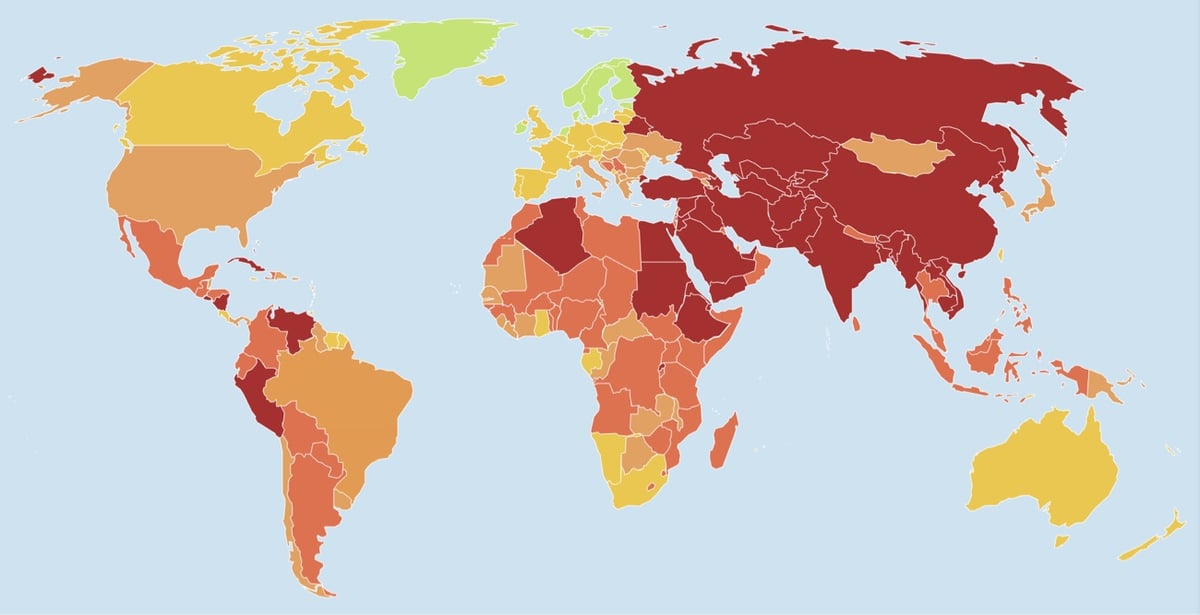
Since Reporters Without Borders started tracking their World Press Freedom Index 25 years ago, the global rating has never been lower than the 2026 score. From a summary of their analysis:
For the first time in the history of the Reporters Without Borders (RSF) World Press Freedom Index, over half of the world’s countries now fall into the “difficult” or “very serious” categories for press freedom. In 25 years, the average score of all 180 countries and territories surveyed in the Index has never been so low. Since 2001, the expansion of increasingly restrictive legal arsenals — particularly those linked to national security policies — has been steadily eroding the right to information, even in democratic countries. The Index’s legal indicator has declined the most over the past year, a clear sign that journalism is increasingly criminalised worldwide. In the Americas, the situation has evolved significantly, with the United States dropping seven places and several Latin American countries sliding deeper into a spiral of violence and repression.
The United States ranks 64th out of 180 countries, a pathetic showing for a country that claims to value the First Amendment:
US President Donald Trump has turned his repeated attacks on the press and journalists into a systematic policy, pushing the US down to 64th place (-7). The detention of Salvadoran journalist Mario Guevara, who was later deported, has contributed to the deterioration of an already tense security environment marked by police violence. The drastic cuts to the US Agency for Global Media (USAGM) workforce had global repercussions, leading to the closure, suspension and downsizing of international broadcasters such as Voice of America (VOA), Radio Free Europe/Radio Liberty (RFE/RL) and Radio Free Asia (RFA) in countries where they were some of the last reliable sources of information.
Some other takeaways from the 2026 report:
Post-Assad Syria has seen the biggest improvement in press freedom of all the countries and territories in the 2026 Index, climbing 36 places in the ranking.
In 2002, 20% of the global population lived in a country where the state of press freedom was categorised as “good.” Twenty-five years later, less than 1% of the world’s population lives in a country that falls under this category.
In some countries, the information space has shrunk over the past 25 years due to political changes and increasingly draconian regimes. This has notably been the case in Hong Kong (140th, -122) since Beijing tightened its control on the territory; in El Salvador (143rd), which dropped 105 places since 2014 and the start of the war on maras, or “gangs”; and in Georgia (135th), which has dropped 75 places as the crackdown on the press has intensified in recent years.
Twenty-five years after the attacks of 11 September 2001 in the United States, expanding the scope of defence secrets and national security has become a means to prohibit coverage of issues of public interest in many countries. This trend, which is particularly prevalent in authoritarian regimes, has also gained traction in democracies and typically goes hand in hand with abusive applications of the law against journalists, notably in the name of combatting terrorism.
(thx, margaret)
Using the NY Times Archive API, journalist Ted Alcorn built Below the Fold, a dashboard through which you can explore the last 25 years of Times coverage: 2.2 million articles containing 1.5 billion words. You can slice and dice this data in a bunch of different ways — it’s a fantastic resource.
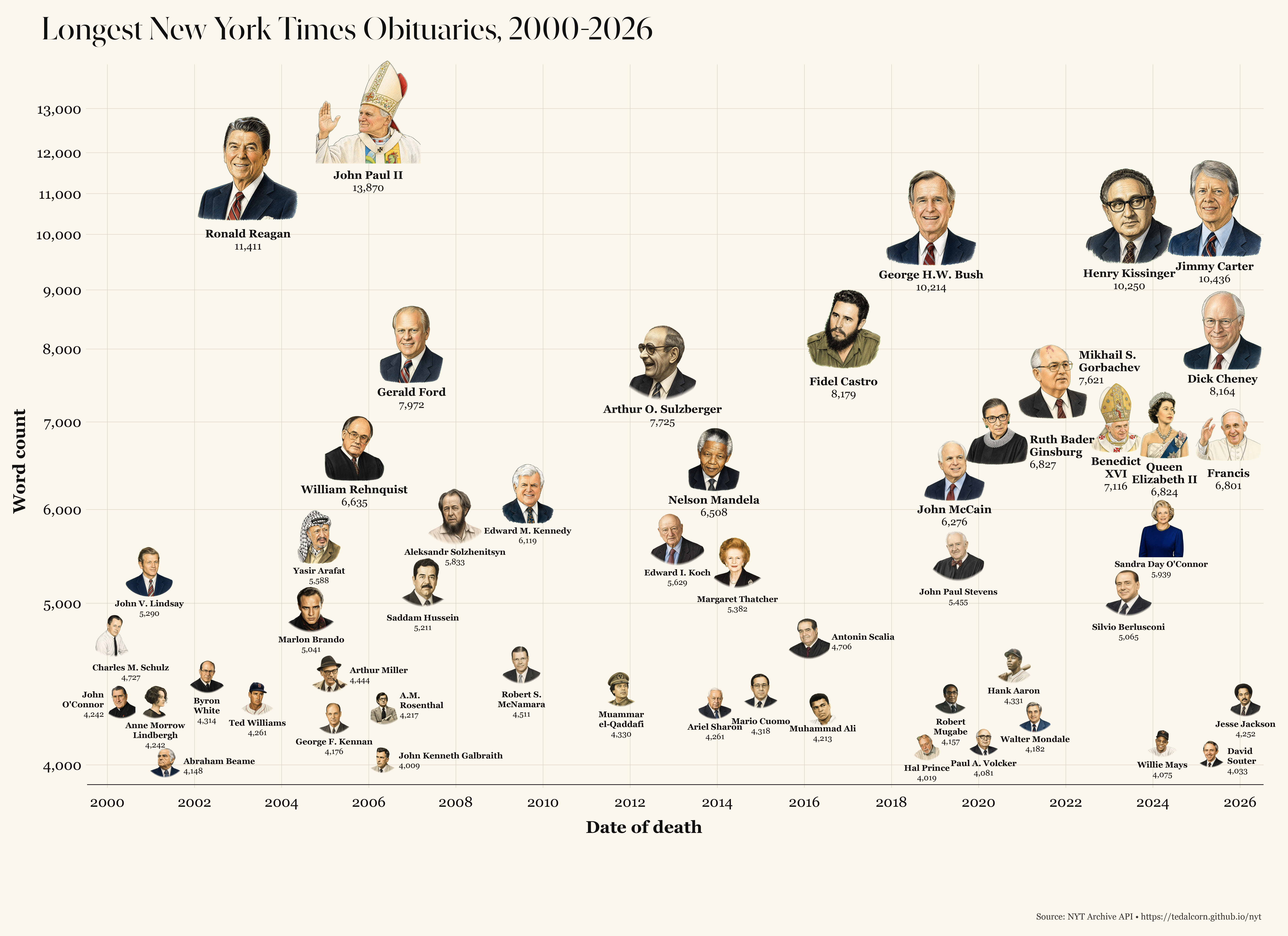
One of the site’s sections is about obituaries. From that data, Alcorn produced this infographic of whose obits contained the highest word count:
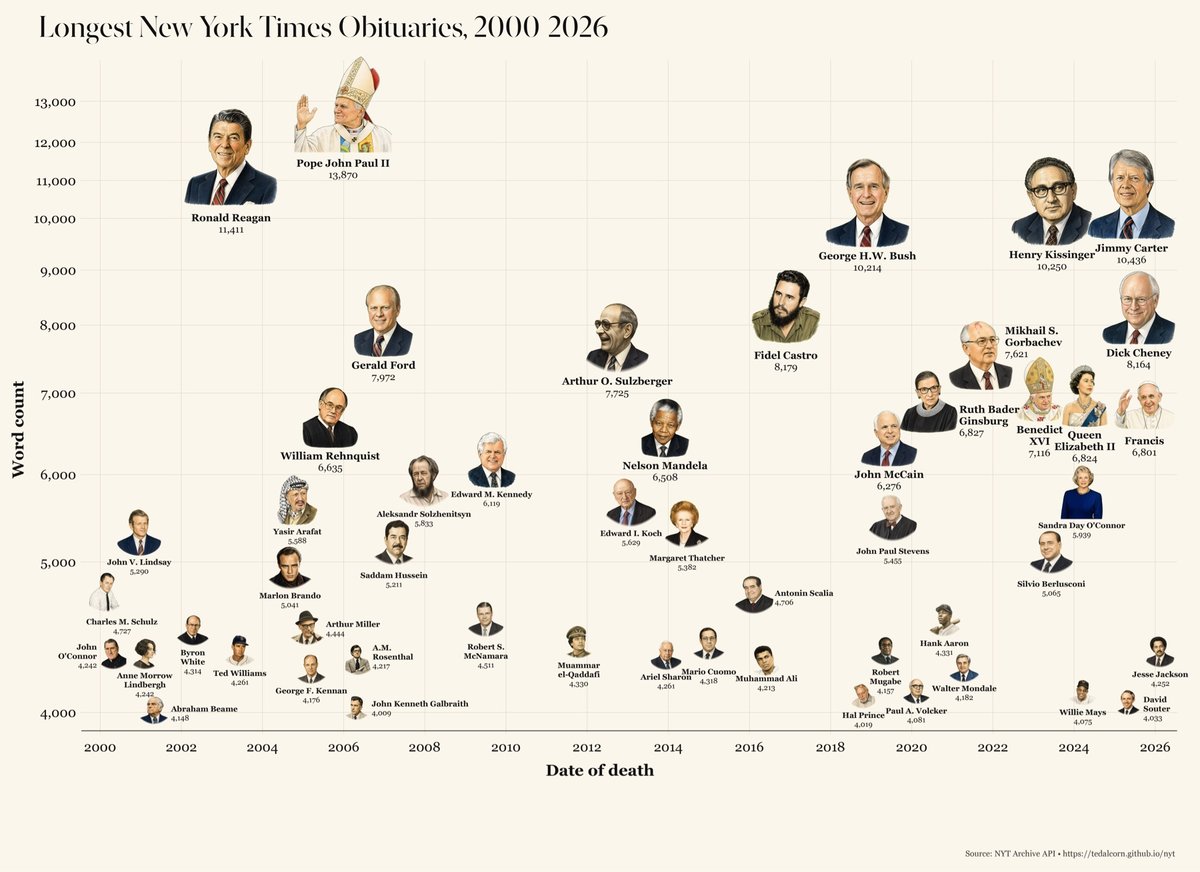
As you can see, it’s a lot of world leaders, religious leaders, politicians, and white men. There only appear to be five women on the list. Notable non-politicians include Aleksandr Solzhenitsyn, Muhammad Ali, and Charles Schulz.
The whole dashboard is fun/enlightening to explore.
Greg Sargent writing for The New Republic:
There’s no clean way to hive off terms like fascism or authoritarianism from Trump’s policies. Even if you disagree that the words apply, their use is backed up by a genuine attempt at intellectual justification for it. The use of these terms just is deeply linked to assessments of Trump’s actual policies, from the lawless renditions to foreign gulags to the unleashing of heavily armed militias in American cities to the naked intimidation of large swaths of civil society.
By contrast, when Trump and MAGA media figures call Democrats “Communists” or “antifa,” all of that is entirely disconnected from any policy realities. Many press figures would like it if there were an Archimedean midpoint between the two parties on all these matters. But there isn’t. At the most basic level, one party continues to function as an actor in a liberal democracy, whereas Trump and much of his movement, with the eager participation of many Republicans, simply do not. Dispensing with harsh but accurate descriptions of his real goals would whitewash them.
See also Republican Extremism and the Myth of “Both Sides” in American Politics.
Former Washington Post opinion columnist Karen Attiah this morning on Bluesky: “I’ve been fired from the Washington Post in the aftermath of the Charlie Kirk shooting.” Until the Post’s relatively recent shift towards the right, Attiah had been a pivotal figure at the paper:
I am perhaps most proud of starting Washington Post’s Global Opinions section.
As its founding editor, I helped build a journalistic home for diverse writers from around the world, many of them censored for their views in their countries.
I hired Saudi journalist Jamal Khashoggi in 2017, and worked with him closely until he was murdered by the Saudi regime in Istanbul — simply for expressing himself.
I put my safety on the line for years to push publicly for justice and accountability in his murder.
But now, she’s one of the dozens of people who have been fired or forced to resign over their comments in the aftermath of Kirk’s murder:
Now I am being silenced by the Washington Post for — *checks notes*
Lamenting America’s acceptance of apathy towards political violence and gun deaths — especially when the violence is encouraged and carried out by white men.
You can read what was so objectionable to the Post in Attiah’s newsletter, e.g.:
I wish I had hope for gun control and that I could believe “political violence has no place in this country”.
But we live in a country that accepts white children being massacred by gun violence.
Not just accepts, but worships violence.
She made only one direct reference to Kirk, quoting his own words:
“Black women do not have the brain processing power to be taken seriously. You have to go steal a white person’s slot”.
-Charlie Kirk
For this, the Post fired her:
And yet, the Post accused my measured Bluesky posts of being “unacceptable”, “gross misconduct” and of endangering the physical safety of colleagues — charges without evidence, which I reject completely as false. They rushed to fire me without even a conversation.
I’m very glad we’ve put this cancel culture business behind us and that we once again have free speech. 🇺🇸
On April 9, 2016, several months before Donald Trump was elected President for the first time, the Boston Globe ran an editorial entitled “The GOP must stop Donald Trump”.
Donald J. Trump’s vision for the future of our nation is as deeply disturbing as it is profoundly un-American.
It is easy to find historical antecedents. The rise of demagogic strongmen is an all too common phenomenon on our small planet. And what marks each of those dark episodes is a failure to fathom where a leader’s vision leads, to carry rhetoric to its logical conclusion. The satirical front page of this section attempts to do just that, to envision what America looks like with Trump in the White House.
It is an exercise in taking a man at his word. And his vision of America promises to be as appalling in real life as it is in black and white on the page. It is a vision that demands an active and engaged opposition. It requires an opposition as focused on denying Trump the White House as the candidate is flippant and reckless about securing it.
As part of the editorial, they imagined a Globe front page one year into a future Trump presidency:

Some of the headlines read “Deportations to Begin: President Trump calls for tripling of ICE force; riots continue” and “Markets sink as trade war looms”. They may have gotten the timeline and some of the details wrong, but many of the Globe’s fake headlines now read as tame.
In his second term, Trump has removed any pretense of governing and is full steam ahead on indulging his bigotry, filling his coffers, playing Big Boy Diplomat, and replacing the American system of democracy with a conservative authoritarian government. And as the editorial notes, all you had to do to predict it was to take Trump at his word. (via @epicciuto.bsky.social)

Yesterday, the NY Times published an article about Donald Trump’s threat to take away citizenship from a US-born citizen: Trump threatens to strip Rosie O’Donnell of U.S. citizenship. The Times Bluesky account posted a link to the article accompanied by this text:
President Trump said on Saturday he was considering revoking Rosie O’Donnell’s U.S. citizenship. Trump has feuded with the comedian and actress since before he became president. Experts said the president does not have the power to take away the citizenship of a U.S.-born citizen.
Large media companies, and the NY Times in particular these days, like to use the phrase “experts said” instead of simply stating facts. The thing is, many other statements of plain truth in that brief Times post lack the confirmation of expertise. To aid the paper in steering their readers away from notions of objective truth, here’s a suggested rewrite of that Bluesky post:
Donald Trump, who experts said is president of the United States, which experts said is a sovereign state on the planet Earth, which experts said is an oblate spheroid and revolves around the Sun, which experts said is a G-type main-sequence star about 93 million miles from us, said on what experts said was Saturday that he was considering revoking (which experts said is a process of making invalid) the U.S. citizenship of a person with the last name of O’Donnell, who experts said is a living human person and U.S. citizen with the first name of Rosie (which experts said is a diminutive of Roseann). Trump, who experts said has feuded with the person who experts said is a comedian and actress since, experts said, before he became president (again, experts said this, that Trump is the president and that also there exists a time (which experts said i— {Do we really need to cite someone on the concept of time here? Surely, time is just time and everyone kinda sorta gets that? -ed}) before he was president). Experts said the president, who experts said doesn’t simply float away into the cosmos because of the mutually attractive force of gravity between him and the Earth, does not have the power (which experts said is whatever Robert Caro said it was in that heavy book about Robert Moses; the experts honestly did not make it through the whole thing) to take away the citizenship of a U.S.-born citizen.
Or, I guess you could do it the easy way:
President Trump said on Saturday he was considering revoking Rosie O’Donnell’s U.S. citizenship. Trump has feuded with the comedian and actress since before he became president. Experts said The president does not have the power to take away the citizenship of a U.S.-born citizen.
Thank you for your attention to this matter!
PS. Rolling Stone did waaay better with this story: Trump Thinks He Can Take Away Citizenship From Anyone He Doesn’t Like. And see also the NY Times Pitchbot if you are unaware of its existence.
PPS. The image is a political cartoon from 1894 — you can see the full version at the Library of Congress.
Sherrilyn Ifill on those who got it wrong about Trump and the Republicans:
If you have a public platform & spent years calming everyone down, telling us Trump was not a danger, was not racist, & arguing that the best way to deal w/Trump was to laugh at him, berated ppl who used the word fascist, insisted that the two parties are the same, admit YOU WERE WRONG.
We need to fight the [threat] arm-in-arm. But we need leadership w/discernment. If you misdiagnosed this threat, you should not take a front seat in analyzing the current moment or providing the strategy for how we confront what we are facing w/o admitting how badly you misjudged the threat. And LISTEN.
100%. I’m glad more and more people are waking up to the reality of Trump, but if the danger wasn’t plain to you until now, you should definitely let others lead the way from here — listen more, talk less. And for the rest of us, we should be more choosy in deciding who to listen to. For me, the “ope, maybe this is fascism after all” latecomers, particularly the “rational” “centrists” insistent on both-sidesing this whole situation since 2016, are not getting a lot of my attention these days.
This is a great post from Mike Masnick about why Techdirt is writing more or less full-time about the Trump regime’s attack on democracy: Why Techdirt Is Now A Democracy Blog (Whether We Like It Or Not).
I agree with every word of it. One of the points he makes is that media outlets like Techdirt (and Wired and 404 Media, etc) and reporters like Masnick that cover tech and the law are uniquely positioned to understand what has been going on, particularly w/r/t to Musk’s seizure of the government’s computer systems:
This is the kind of thing tech and law reporters spot immediately, because we’ve seen this all play out before. When someone talks about “free speech” while actively working to control speech, that’s not a contradiction or a mistake — it’s the point. It’s about consolidating power while wrapping it in the language of freedom as a shield to fool the gullible and the lazy.
This is why it’s been the tech and legal press that have been putting in the work, getting the scoops, and highlighting what’s actually going on, rather than just regurgitation of administration propaganda without context or analysis (which hasn’t stopped the administration from punishing them).
I’m not a legal expert or a reporter, but I have been covering & writing about technology for almost 30 years and when I saw what Musk was doing (in conjunction with Trump’s EOs and what Project 2025 promised), I recognized exactly what was going on and started to cover it almost exclusively:
I keep hearing people saying this is a five-alarm fire but I feel like it’s a 500-alarm fire…we need metaphorical fire trucks coming from thousands of miles away to fight this blaze.
Masnick’s other main point is even closer to my heart:
When the very institutions that made American innovation possible are being systematically dismantled, it’s not a “political” story anymore. It’s a story about whether the environment that enabled all the other stories we cover will continue to exist.
We’ve always covered the intersection of technology, innovation, and policy (27+ years and counting). Sometimes that meant writing about patents or copyright, sometimes about content moderation, sometimes about privacy. But what happens when the fundamental systems that make all of those conversations possible start breaking down? When the people dismantling those systems aren’t even pretending to replace them with something better?
This x 10000. Like Masnick, I’ve gotten lots of feedback about my pivot to covering the coup, the overwhelming majority of it supportive — even the people who have told me they need to tap out from reading (I totally get it!) are generally approving. But there have been a few disapprovals as well, in the vein of “shut up and dribble” or “keep politics out of it” — which I also understand. To an extent. They want the Other Stuff back, the art and beauty and laughter and distraction, and for me to cool it with the politics.
But echoing Masnick, I believe that covering the rapid disassembly of American democracy is not some separate thing from the Other Stuff and never has been. The reason I have been able to write freely about those things for the last 27 years is because the US has had a relatively stable democracy1 under which people feel free to innovate, create art, take risks, and be themselves. Those things become much more difficult under fascist and autocratic rule. In a recent piece, Masha Gessen describes how autocracy stifles creativity:
Life under autocracy can be terrifying, as it already is in the United States for immigrants and trans people. But those of us with experience can tell you that most of the time, for most people, it’s not frightening. It is stultifying. It’s boring. It feels like trying to see and breathe under water — because you are submerged in bad ideas, being discussed badly, being reflected in bad journalism and, eventually, in bad literature and bad movies.
I’m covering politics in this particular moment *because* the actions of the Trump administration are threatening all of that Other Stuff, because I want to be able to go back to covering design & photography & movies & science & food & travel & cities & all the cool things humans can do, and because I want my kids and everyone else’s kids to live in a stable, free society where they can make art, pursue scientific truth, be freely gay or trans, have health care, be able to have families, have a place to live, and, if they want to, write about frivolities on their websites. All of that becomes much more difficult if Trump/Musk get their way, and if I can help push back on their efforts in some small way with this platform that I have, I’m gonna do it. ✊✌️
Karen Attiah wrote a short opinion piece about how the nationwide assault on diversity, equity and inclusion led by conservatives is actually aimed at resegregation and how being precise in our language about what’s happening is crucial.
These facts, taken together, point to the removal of Black people from academic, corporate and government spaces: resegregation.
People are vowing to push back with their wallets — to shop at Costco and boycott Target, for example. But I believe the fight starts with language. Journalists have a role and an obligation to be precise in naming what we are facing.
Frankly, I wish the media would stop using “DEI” and “diversity hiring” altogether. Any official, including the president, who chooses to blame everything from plane crashes to wildfires on non-White, non-male people should be asked whether they believe that desegregation is to blame. Whether they believe resegregation is the answer. We need to bring back the language that describes what is actually happening.
When I write about difficult or contentious topics where I want to take great care to not be misunderstood and to be as accurate as I can be, I always think about this piece by history professor Michael Todd Landis on the language we use to talk about the Civil War & slavery.
Specifically, let us drop the word “Union” when describing the United States side of the conflagration, as in “Union troops” versus “Confederate troops.” Instead of “Union,” we should say “United States.” By employing “Union” instead of “United States,” we are indirectly supporting the Confederate view of secession wherein the nation of the United States collapsed, having been built on a “sandy foundation” (according to rebel Vice President Alexander Stephens). In reality, however, the United States never ceased to exist. The Constitution continued to operate normally; elections were held; Congress, the presidency, and the courts functioned; diplomacy was conducted; taxes were collected; crimes were punished; etc. Yes, there was a massive, murderous rebellion in at least a dozen states, but that did not mean that the United States disappeared.
Landis notes that scholar Edward Baptist also uses different language:
In his 2014 book The Half Has Never Been Told: Slavery and the Making of American Capitalism (Basic Books), he rejects “plantations” (a term pregnant with false memory and romantic myths) in favor of “labor camps”; instead of “slave-owners” (which seems to legitimate and rationalize the ownership of human beings), he uses “enslavers.” Small changes with big implications. These far more accurate and appropriate terms serve his argument well, as he re-examines the role of unfree labor in the rise of the United States as an economic powerhouse and its place in the global economy. In order to tear down old myths, he eschews the old language.
German museums and public remembrances of the Holocaust use similarly precise language:
Just as important, the language they used on the displays in these places was clear and direct, at least in the English translations. It was almost never mealy-mouthed language like “this person died at Treblinka”…like they’d succumbed to natural causes or something. Instead it was “this person was murdered at Treblinka”, which is much stronger and explicitly places blame on the Nazis for these deaths.
This is why I’ve been so insistent on describing the events of January 6, 2021 as an attack on Congress and as a coup attempt:
This was not an attack on the Capitol Building. This was an attack on Congress, the United States Government, and elected members of our government. It was a coup attempt. Can you imagine what the mob in those videos would have done had they found Nancy Pelosi? Kidnapping or a hostage situation at the very least, assassination in the worst case. Saying that this was an “attack on the Capitol” is such an anodyne way of describing what happened on January 6th that it’s misleading. Words matter and we should use the correct ones when describing this consequential event.
In writing about the 2025 Coup, I’ve been careful to call it a coup because it is. I’ve been repeating words like “illegal” and “unconstitutional” because these actions attacks by Trump and Musk are just that. Our government’s computing systems have been “seized” or “broken into to” or “hacked” (illegal!) rather than “accessed” (sounds routine). In his piece yesterday, Jamelle Bouie argued for more precision in how we describe the coup:
To describe the current situation in the executive branch as merely a constitutional crisis is to understate the significance of what we’re experiencing. “Constitutional crisis” does not even begin to capture the radicalism of what is unfolding in the federal bureaucracy and of what Congress’s decision not to act may liquidate in terms of constitutional meaning.
One of the reason people get so upset at media like the NY Times and Washington Post is because the language they often use is so watered down that it’s actually not truthful. Take the initial opening paragraph to this NYT piece about Trump’s statement about wanting to ethnically cleanse Gaza:
President Trump declared on Tuesday that he would seek to permanently displace the entire Palestinian population of Gaza and take over the devastated seaside enclave as a U.S. territory, one of the most audacious ideas that any American leader has advanced in years.
(They later changed “audacious” to “brazen”.) Audacious? Brazen? Advanced? Ideas? These words all have meanings! And when you put them together, it makes Trump sound like some genius superhero statesman. And “seaside enclave”? That is technically correct but it sounds like they’re talking about fucking Montauk. This is terrible writing that fails to communicate the truth of the situation.
Here’s why this matters: imprecise and euphemistic language is the language of fascists, authoritarians, and oppressors — power-craving leaders who either don’t want people to know what they are doing or don’t want them to think too hard about the illegality or immorality of their actions. The Nazis had all kinds of euphemisms — the “Final Solution to the Jewish Question”, “protective custody”, “work-shy”, “enhanced interrogation” — to mask their mass imprisonment activities and mass murder.
In 1946, Nineteen Eighty-Four author George Orwell published an essay called Politics and the English Language in which he decried the “lack of precision” of political writing:
Each of these passages has faults of its own, but, quite apart from avoidable ugliness, two qualities are common to all of them. The first is staleness of imagery; the other is lack of precision. The writer either has a meaning and cannot express it, or he inadvertently says something else, or he is almost indifferent as to whether his words mean anything or not. This mixture of vagueness and sheer incompetence is the most marked characteristic of modern English prose, and especially of any kind of political writing. As soon as certain topics are raised, the concrete melts into the abstract and no one seems able to think of turns of speech that are not hackneyed: prose consists less and less of words chosen for the sake of their meaning, and more and more of phrases tacked together like the sections of a prefabricated hen-house.
And from his concluding paragraph:
…one ought to recognize that the present political chaos is connected with the decay of language, and that one can probably bring about some improvement by starting at the verbal end. If you simplify your English, you are freed from the worst follies of orthodoxy. You cannot speak any of the necessary dialects, and when you make a stupid remark its stupidity will be obvious, even to yourself. Political language — and with variations this is true of all political parties, from Conservatives to Anarchists — is designed to make lies sound truthful and murder respectable, and to give an appearance of solidity to pure wind. One cannot change this all in a moment, but one can at least change one’s own habits…
You can read Orwell’s whole essay here.
I don’t always succeed, but I try really hard to use precise, concrete language in my writing. As Attiah urges, we should want and expect our media to do the same — anything less is an abdication of their duty to their readers to tell them the truth.
Hey, everyone. I just wanted to update you on what’s been happening here at KDO HQ. As you might have noticed (and if my inbox is any indication, you have), I have pivoted to posting almost exclusively about the coup happening in the United States right now. My focus will be on this crisis for the foreseeable future. I don’t yet know to what extent other things will make it back into the mix. I still very much believe that we need art and beauty and laughter and distraction and all of that, but I also believe very strongly that this situation is too important and potentially dangerous to ignore. And it is largely being ignored by a mainstream press that has been softened up by years of conservative pushback, financial pressures, and hollowing out by Facebook & Google. But I have an independent website and a platform, and I’m going to use it the way that I have always used it: to inform people about the truth of the world (as best as I understand it) and what I feel is important.
I have pivoted like this a couple of times before: in the aftermath of 9/11 and during the pandemic. This situation feels as urgent now as those events did then. Witnessing the events of this past weekend, I felt very much like I did back in March 2020, before things shut down here in the US — you could see this huge tidal wave coming and everyone was still out on the beach sunbathing because the media and our elected officials weren’t meeting the moment. I believe that if this coup is allowed to continue and succeed, it will completely alter the course of American history — so I feel like I have no choice but to talk about it.
If you need to check out, I totally understand. I’ve heard from many readers over the years that some of you come to the site for a break from the horrible news of the world, and I know this pivot goes against that. I expect I will lose some readers and members over this — the membership page is right here if you’d like to change your status. For those who choose to continue to support the site, no matter what, my deep thanks and appreciation to you.
I’ll end on a personal note. I’ve talked a little about the impact that covering the pandemic for two years had on me, particularly in this post about Ed Yong’s talk at XOXO:
It was hard to hear about how his work “completely broke” him. To say that Yong’s experience mirrored my own is, according to the mild PTSD I’m experiencing as I consider everything he related in that video, an understatement. We covered the pandemic in different ways, but like Yong, I was completely consumed by it. I read hundreds(/thousands?) of stories, papers, and posts a week for more than a year, wrote hundreds of posts, and posted hundreds of links, trying to make sense of what was happening so that, hopefully, I could help others do the same. The sense of purpose and duty I felt to my readers — and to reality — was intense, to the point of overwhelm.
Like Yong, I eventually had to step back, taking a seven-month sabbatical in 2022. I didn’t talk about the pandemic at all in that post, but in retrospect, it was the catalyst for my break. Unlike Yong, I am back at it: hopefully more aware of my limits, running like it’s an ultramarathon rather than a sprint, trying to keep my empathy for others in the right frame so I can share their stories effectively without losing myself.
Covering the pandemic broke me. I spent the weekend and most of Monday wrestling with myself and asking, “Do you really want to put yourself through that again?” I could easily just go on posting like this existential threat to the United States isn’t happening. Like I said before, I believe we need — like they are actually necessary for life — art and beauty and laughter and distraction…and continuing to cover them would be a noble and respectable undertaking. But I eventually realized, thanks in part ot an intense session with my therapist on Tuesday, that in order to be true to myself, I need to do this.
Thankfully, I am in a much better place, mental health-wise, than I was 5 years ago. I know myself better and know how to take care of myself when I am professionally stressed out. There may be times when I need to step away and I thank you for your patience in advance. I hope that you’re doing whatever it is you need to do to take yourselves. 💞
Regarding comments: I haven’t been turning them on for any of the posts about the coup. I am trying to figure out how to turn them back on and not have the discussions mirror the sorts of unhelpful patterns that social media has conditioned us into following when discussing political issues online. I have turned them on for this post, but would encourage you to reflect on kottke.org’s community guidelines if you choose to participate; the short version: “be kind, generous, & constructive, bring facts, and try to leave the place better than you found it”. Thanks.
Will Stancil on Bluesky:
I don’t know how to say this any louder
THE TRUMP ADMINISTRATION IS MORE RADICAL, MORE FASCIST, MORE VIOLENT THAN ANYONE IN MAINSTREAM POLITICS OR MEDIA IS WILLING TO ADMIT OUT LOUD
THEY ARE FULLY IN THRALL TO A MOVEMENT OF ONLINE NAZIS THAT WANT TO END AMERICA AND KILL MANY, MANY PEOPLE
They do not care about fixing anything. They do not care about running the government. They want to set the Constitution on fire, destroy the federal government, and torture and murder their enemies for fun. This is their only true political commitment
It’s beyond insane - it’s suicidal - that our leaders and our commentators and our media won’t talk about what’s really going on here. They maintain the pretense that this is all about policy differences, but MAGA is barely even bothering with the pretense of a mask anymore
I agree 100% with Stancil here — it is so completely obvious what Trump and the Republicans are trying to do (they are not hiding it!) and it’s maddening to watch the media and Democratic politicians treat this like any other political situation: “that this is all about policy differences”. They are trying to destroy American democracy and amass power for themselves and the oligarchs that support them — that’s what autocracies are for and it’s why Trump and Republicans want one.
We’ve seen this happen with brittle governments all over the world for the past century — it’s not a novel situation — and Republicans have decided that now is the moment to strike our teetering democracy. They convinced voters to roll a wooden horse covered in MAGA stickers inside the city walls and now they are going to hollow it out from within. That’s the game and the sooner everyone wakes up to this truth, the sooner we can try to fix the situation.
Update: Jamelle Bouie: If All This Sounds Delusional, That’s Because It Is.
Put another way, the American system of government is not one in which the people imbue the president with their sovereign authority. He is a servant of the Constitution, bound by its demands. Most presidents in our history have understood this, even as they inevitably pushed for more and greater authority. Not Trump. He sees no distinction between himself and the office, and he sees the office as a grant of unlimited power, or as he once said himself, “I have an Article 2 where I have the right to do whatever I want as president.”
The freeze, then, is Trump’s attempt to make this fanciful claim to limitless power a reality. He wants to usurp the power of the purse for himself. He wants to make the Constitution a grant of absolute and unchecked authority. He wants to remake the government in his image. He wants to be king.
💯 Bouie is one of the few traditional media folks who sees this situation clearly.
Title quote courtesy of Bishop Mariann Budde.
Marisa Kabas correctly asserts that Substack’s latest announcement reaffirms their status as a publication (and not a platform) and as a place that will publish disinformation and hate under the guise of “free speech”.
As we wrote in the Substackers Against Nazis letter, “there’s a difference between a hands-off approach and putting your thumb on the scale.” And by championing Bari Weiss and her worldview, Substack is once again putting its thumb on the scale.
But this is the bit that really caught my eye (italics mine…and imagine me pumping my fist as well):
Substack has managed to convince some that there is no life for a newsletter beyond them. This is simply untrue.
Since I left Substack for beehiiv in January, I went from making a little bit of money to actually making a living as an independent journalist with my own publication. I didn’t need Substack’s Twitter-esque Notes feature or its recommendation network to grow; I used social networks — mostly Bluesky — to successfully promote my work. That personal engagement created, I believe, deeper relationships with my readers than passive subscriptions via an algorithm. Most importantly, I’ve remained committed to producing work that I’m proud of, and publishing it via a platform that doesn’t force me to compromise my values.
Leaving aside all of the arguments about publication vs platform and whether Substack is a Nazi bar or not, the unfortunate truth for publications on Substack is that in order to amass the money necessary to recoup the investment pumped into the company by the likes of Andreessen Horowitz (Trump supporting billionaire oligarch wannabes who would ruin anything and everything to make one more dollar), they will continue to wedge themselves in between publications and their readers. And at some point, what you thought of as your publication turns out to merely be a tiny fraction of theirs. As Kabas says:
There is no such thing as a perfect place on the internet. But it’s possible to avoid the ones that aren’t even pretending to try to be better. The best time to leave Substack was a long time ago. The second best time is now.
The NY Times has had a difficult time covering the 2024 election in a clear, responsible manner. But I wanted to highlight this short opinion piece from the paper’s editorial board, which I’m reproducing here in its entirety:
You already know Donald Trump. He is unfit to lead. Watch him. Listen to those who know him best. He tried to subvert an election and remains a threat to democracy. He helped overturn Roe, with terrible consequences. Mr. Trump’s corruption and lawlessness go beyond elections: It’s his whole ethos. He lies without limit. If he’s re-elected, the G.O.P. won’t restrain him. Mr. Trump will use the government to go after opponents. He will pursue a cruel policy of mass deportations. He will wreak havoc on the poor, the middle class and employers. Another Trump term will damage the climate, shatter alliances and strengthen autocrats. Americans should demand better. Vote.
What makes this piece so effective is its plain language and its information density. This density is a real strength of hypertext that is often overlooked and taken for granted. Only 110 words in that paragraph but it contains 27 links to other NYT opinion pieces published over the last several months that expand on each linked statement or argument. If you were inclined to follow these links, you could spend hours reading about how unfit Trump is for office.
A simple list of headlines would have done the same basic job, but by presenting it this way, the Times editorial board is simultaneously able to deliver a strong opinion; each of those links is like a fist pounding on the desk for emphasis. Lies, threat, corruption, cruel, autocrats — bam! bam! bam! bam! bam! Here! Are! The! Fucking! Receipts!
How the links are deployed is an integral part of how the piece is read; it’s a style of writing that is native to the web, pioneered by sites like Suck in the mid-90s. It looks so simple, but IMO, this is top-notch, subtle information design.
My favorite presentation at XOXO this year was Ed Yong’s talk about the pandemic, journalism, his work over the past four years, and the personal toll that all those things took on him. I just watched the entire thing again, riveted the whole time.
Hearing how thoughtfully & compassionately he approached his work during the pandemic was really inspirational: “My pillars are empathy, curiosity, and kindness — and much else flows from that.” And his defense of journalism, especially journalism as “a caretaking profession”:
For people who feel lost and alone, we get to say through our work: you are not. For people who feel like society has abandoned them and their lives do not matter, we get to say: actually, they fucking do. We are one of the only professions that can do that through our work and that can do that at scale — a scale commensurate with many of the crises that we face.
Then, it was hard to hear about how his work “completely broke” him. To say that Yong’s experience mirrored my own is, according to the mild PTSD I’m experiencing as I consider everything he related in that video, an understatement. We covered the pandemic in different ways, but like Yong, I was completely consumed by it. I read hundreds(/thousands?) of stories, papers, and posts a week for more than a year, wrote hundreds of posts, and posted hundreds of links, trying to make sense of what was happening so that, hopefully, I could help others do the same. The sense of purpose and duty I felt to my readers — and to reality — was intense, to the point of overwhelm.
Like Yong, I eventually had to step back, taking a seven-month sabbatical in 2022. I didn’t talk about the pandemic at all in that post, but in retrospect, it was the catalyst for my break. Unlike Yong, I am back at it: hopefully more aware of my limits, running like it’s an ultramarathon rather than a sprint, trying to keep my empathy for others in the right frame so I can share their stories effectively without losing myself.1
I didn’t get a chance to meet Yong in person at XOXO, so: Ed, thank you so much for all of your marvelous work and amazing talk and for setting an example of how to do compassionate, important work without compromising your values. (And I love seeing your bird photos pop up on Bluesky.)
Rebecca Solnit writes about how the mainstream political press is failing the American public they claim to serve.
These critics are responding to how the behemoths of the industry seem intent on bending the facts to fit their frameworks and agendas. In pursuit of clickbait content centered on conflicts and personalities, they follow each other into informational stampedes and confirmation bubbles.
They pursue the appearance of fairness and balance by treating the true and the false, the normal and the outrageous, as equally valid and by normalizing Republicans, especially Donald Trump, whose gibberish gets translated into English and whose past crimes and present-day lies and threats get glossed over. They neglect, again and again, important stories with real consequences. This is not entirely new — in a scathing analysis of 2016 election coverage, the Columbia Journalism Review noted that “in just six days, The New York Times ran as many cover stories about Hillary Clinton’s emails as they did about all policy issues combined in the 69 days leading up to the election” — but it’s gotten worse, and a lot of insiders have gotten sick of it.
It’s really disheartening and maddening to witness how the press has failed to meet this important moment in history.
See also Jamelle Bouie’s NY Times piece this morning, straining against the normalizing currents at his own publication to actually call out Trump’s “incoherence” and “gibberish” and parse out what he’s actually trying to tell us about his plans for a second term:
Trump, in his usual, deranged way, is elaborating on one of the key promises of his campaign: retribution against his political enemies. Elect Trump in November, and he will try to use the power of the federal government to threaten, harass and even arrest his opponents. If his promise to deport more than 20 million people from the United State is his policy for rooting out supposedly “foreign” enemies in the body politic, then this promise to prosecute his opponents is his corresponding plan to handle the nation’s domestic foes, as he sees them. Or, as he said last year in New Hampshire, “We pledge to you that we will root out the communists, Marxists, fascists and the radical left thugs that live like vermin within the confines of our country.”
From Heather Cox Richardson, writing on the night of the debate, a reminder of just how bad Trump’s performance was, a shambolic spectacle that was met with shrugs because that’s what we expect of him:
In contrast, Trump came out strong but faded and became less coherent over time. His entire performance was either lies or rambling non-sequiturs. He lied so incessantly throughout the evening that it took CNN fact-checker Daniel Dale almost three minutes, speaking quickly, to get through the list.
Trump said that some Democratic states allow people to execute babies after they’re born and that every legal scholar wanted Roe v. Wade overturned — both fantastical lies. He said that the deficit is at its highest level ever and that the U.S. trade deficit is at its highest ever: both of those things happened during his administration. He lied that there were no terrorist attacks during his presidency; there were many. He said that Biden wants to quadruple people’s taxes — this is “pure fiction,” according to Dale — and lied that his tax cuts paid for themselves; they have, in fact, added trillions of dollars to the national debt.
Richardson also quotes Monique Pressley’s debate night tweet, which is perhaps the most crisp and concise summary of the whole thing:
The proof of Biden’s ability to run the country is the fact that he is running it. Successfully. Not a debate performance against a pathological lying sociopath.
Maybe this is just me, but I immediately thought of Allen Iverson’s response to a question about practice from the media:
Listen, we talking about practice. Not a game, not a game, not a game. We talking about practice. Not a game, not the game that I go out there and die for and play every game like it’s my last. Not the game. We talking about practice, man.
While he might be fine at blustering his way through debates (practice), Trump, famously, was bad at being president and actually didn’t like the job (the game). Like, we don’t have to imagine how Trump would perform as president because he did the job, poorly & ruinously, for four years. Biden has logged 3.5 years as president and has been very productive on behalf of the American people. We can directly compare them! And their teams! Politics & governance is a team sport, and Trump’s team is a flaming dumpster fire. So let’s stop talking about practice (and the media’s horse race coverage) and start focusing on the game.
Rebecca Solnit: Why is the pundit class so desperate to push Biden out of the race?
I am not usually one to offer diagnoses of people I’ve never met, but it does seem like the pundit class of the American media is suffering from severe memory loss. Because they’re doing exactly what they did in the 2016 presidential race — providing wildly asymmetrical and inflammatory coverage of the one candidate running against Donald J Trump.
They have become a stampeding herd producing an avalanche of stories suggesting Biden is unfit, will lose and should go away, at a point in the campaign in which replacing him would likely be somewhere between extremely difficult and utterly catastrophic. They do this while ignoring something every scholar and critic of journalism knows well and every journalist should. As Nikole Hannah-Jones put it: “As media we consistently proclaim that we are just reporting the news when in fact we are driving it. What we cover, how we cover it, determines often what Americans think is important and how they perceive these issues yet we keep pretending it’s not so.” They are not reporting that he is a loser; they are making him one.
I’ve been watching this play out over the last few weeks and whatever the media (especially the NY Times) and pundits are doing here is much more alarming to me than Biden’s poor debate performance. Especially considering:
Speaking of coups, we’ve had a couple of late, which perhaps merit attention as we consider who is unfit to hold office. This time around, Trump is not just a celebrity with a lot of sexual assault allegations, bankruptcies and loopily malicious statements, as he was in 2016. He’s a convicted criminal who orchestrated a coup attempt to steal an election both through backroom corruption and public lies and through a violent attack on Congress. The extremist US supreme court justices he selected during his last presidential term themselves staged a coup this very Monday, overthrowing the US constitution itself and the principle that no one is above the law to make presidents into kings, just after legalizing bribery of officials, and dismantling the regulatory state by throwing out the Chevron deference.
*hair-tearing-out sounds*
I didn’t know what to expect from this 1937 video explanation of how wire photos were transmitted to newspapers, but a double stunt sequence featuring an airplane and a death-defying photographer was not anywhere on my bingo card. This starts kinda slow but it picks up once they get into the completely fascinating explanation of how they sent photographs across the country using ordinary telephone lines. The whole setup was portable and they just hacked into a wire on a telephone pole, asked the operator to clear the line, and sent a photo scan via an analog modem. Ingenious!
The Wikipedia page about wire photos is worth a read — French designers argued that the technology was responsible for an early form of fast fashion.
After World War II at haute couture shows in Paris, Frederick L. Milton would sketch runway designs and transmit his sketches via Bélinographe to his subscribers, who could then copy Parisian fashions. In 1955, four major French couturiers (Lanvin, Dior, Patou, and Jacques Fath) sued Milton for piracy, and the case went to the Appellate Division of the New York Supreme Court. Wirephoto enabled a speed of transmission that the French designers argued damaged their businesses.
(via the kid should see this)
This is an interesting point by Chris Hayes about the difference between institutions (the NY Times, the Dept. of Justice, Facebook) trying to be independent and trying to be perceived as independent:
But here’s the rub, if your goal is to be perceived as independent, then you are wholly *dependent* on the perceptions of some group of people (in both cases conservatives/Republicans). And now, if you’re just courting their perceptions, then you’re no longer independent! In fact you’re the opposite; you’re entirely dependent on how they perceive you. You’ve just traded one form of audience or partisan capture for another!
Yesterday, there was yet another school shooting on a college campus, this time at the University of North Carolina at Chapel Hill. A UNC graduate student walked into a classroom building and murdered a science professor with a gun. The campus was on lockdown for hours. The front page of The Daily Tar Heel today consists of text messages sent to and from students during the lockdown:
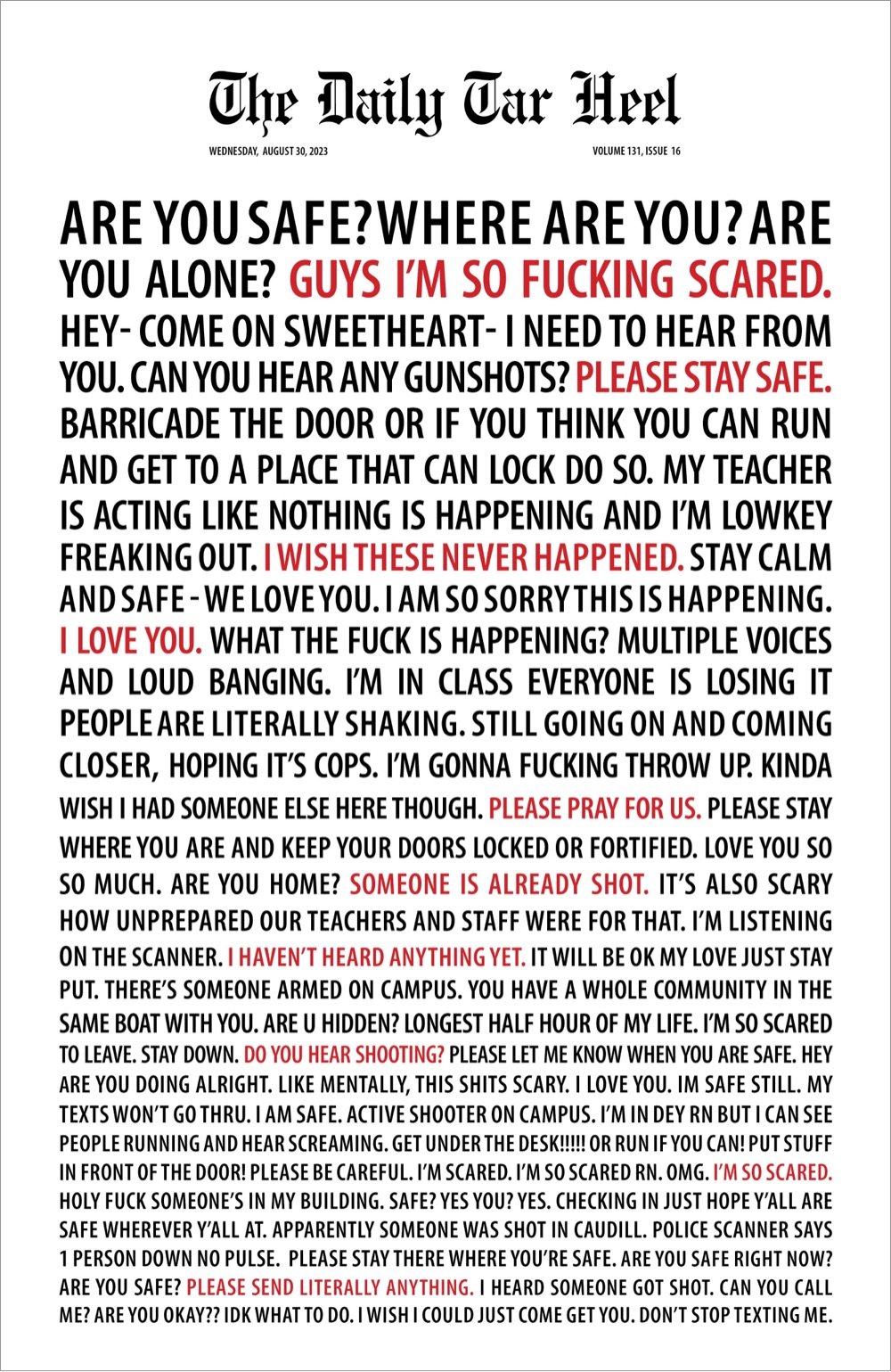
An incredible and powerful design — on Mastodon, Steve Silberman called it “the tombstone of democracy, courtesy of the NRA”. As a nation, we’ve spent more than 20 years and trillions of dollars fighting the “War on Terror” but won’t do a damn thing about the self-imposed terrorism of gun violence. The people sending and receiving those texts — they are TERRIFIED. And this happens regularly in the US, in pre-schools and on college campuses alike. We are a sick nation.
Now that the 2024 election campaigns have ramped up in earnest (absurdly & obscenely more than a year before the actual election), a good thing to keep in mind is NYU journalism professor Jay Rosen’s guidance for how journalists should cover the election:1
“Not the odds, but the stakes.”
That’s my shorthand for the organizing principle we most need from journalists covering the 2024 election. Not who has what chances of winning, but the consequences for our democracy. Not the odds, but the stakes.
Rosen first articulated this principle more than a decade ago and ever since reading about it a few years ago, I’ve all but stopped reading and linking to political horse race coverage. Who scored more “points” in the latest debate? Which candidate seems the most Presidential? Will his mugshot bolster his campaign? Come on, this isn’t the goddamned Oscars red carpet. Tell us what the candidates’ plans are and how they will affect how Americans live their lives. What experience do they have in governance? Or if not governance, in leadership? What do they believe, what actions have they taken in the past and what consequences have those actions had on actual people? What motivates them…power, money, fame, service? Many many people will not give a shit about any of this, but if we want to retain a functioning democracy with a press that’s not primarily about entertainment, voters need to know what they are getting into.

I enjoyed this Nieman Lab interview with Holden Foreman, the first-ever Accessibility Engineer at the Washington Post. I’m particularly pleased to see that Foreman is thinking about accessibility as, well, not solely a problem that can be solved by better engineering:
The coding is the easy part. Centering our work in listening, and elevating voices that have long been marginalized, is essential to improving accessibility in journalism. Trust has to be earned, and I think this is the biggest opportunity and challenge of being the first in this role. It’s counterproductive for accessibility work to be siloed from broader audience engagement and DEI work. Keeping that in mind, a lot of my initial work has included conversations with various stakeholders to get a better understanding of where and how engineering support, education, and documentation are needed. Accessibility may be viewed as a secondary concern or just a technical checklist if we don’t engage with real people in this area just as we do in others…
It’s essential to think about accessibility not just in the context of disability but also in the context of other inequities affecting news coverage and access to news. For instance, writing in plain language for users with cognitive disabilities can also benefit users with lower reading literacy. [The Post published a plain language version of Foreman’s introductory blog post.] Making pages less complex can make them more user-friendly and also possible to load in the first place for folks in areas with bad internet, etc…
There are nuances specific to the accessibility space. Not everyone with a disability has access to the same technology. Screen reader availability varies by operating system. JAWS, one of the popular screen readers, is not free to use. And there are many different types of disability. We cannot focus our work only on disabilities related to vision or hearing. We need separate initiatives to address separate accessibility issues.
Ultimately, better accessibility tools for disabled users translates to better services for everyone. That’s not the only reason to do it, but it is an undeniable benefit.
Paul Fairie has compiled a list of contenders for the best headline of 2022. They include:
‘How to Murder Your Husband’ writer guilty of murdering her husband
Started Out as a Fish. How Did It End Up Like This?
Monkey that was flushed down toilet, fed cocaine now has a boyfriend
The City of Ottawa wants to hear your garbage opinions
You can click through to see the rest and vote for the winners.
Michael Hobbes, late of You’re Wrong About, has made a video essay arguing that “cancel culture” is a moral panic and not some huge new problem in our society. He says you can tell it’s a moral panic because of the shifting definitions of the term, the stories are often exaggerated or untrue, the stakes are often low, and it’s fueling a reactionary backlash.
Even if you think that cancel culture really is a nationwide problem, I don’t see why we should focus on random college students and salty Twitter users rather than elected officials and actual legislation. Look, I’m not gonna sit here and pretend there haven’t been genuinely ugly internet pile-ons. Social media makes it easy to gang up on random people and ruin their lives over dumb jokes and honest mistakes.
But for two years now, right-wing grifters and the liberal rubes who launder them into the mainstream have cast cancel culture as a problem for the American left and a sign of creeping authoritarianism. They’re wrong. Internet mobs are not a left-wing phenomenon and historically speaking, the threat of authoritarianism usually comes from political parties that try to overturn elections, make it harder to vote, and censor ideas they don’t like. All of this is obvious, but that’s what moral panics do: they distract you from an obvious truth and make you believe in a stupid lie.
Back in October, Hobbes wrote a piece on The Methods of Moral Panic Journalism that pairs well with this video.
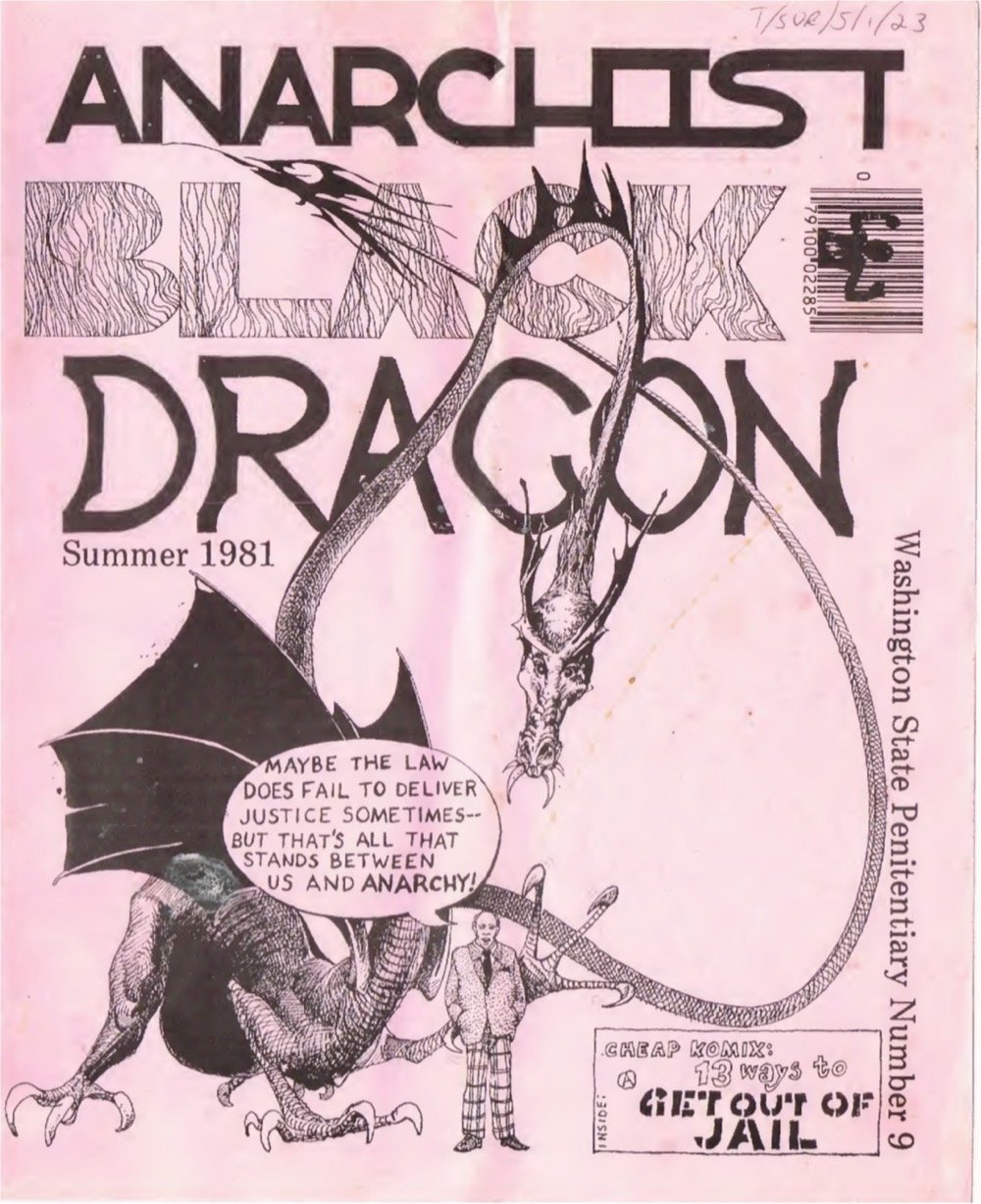
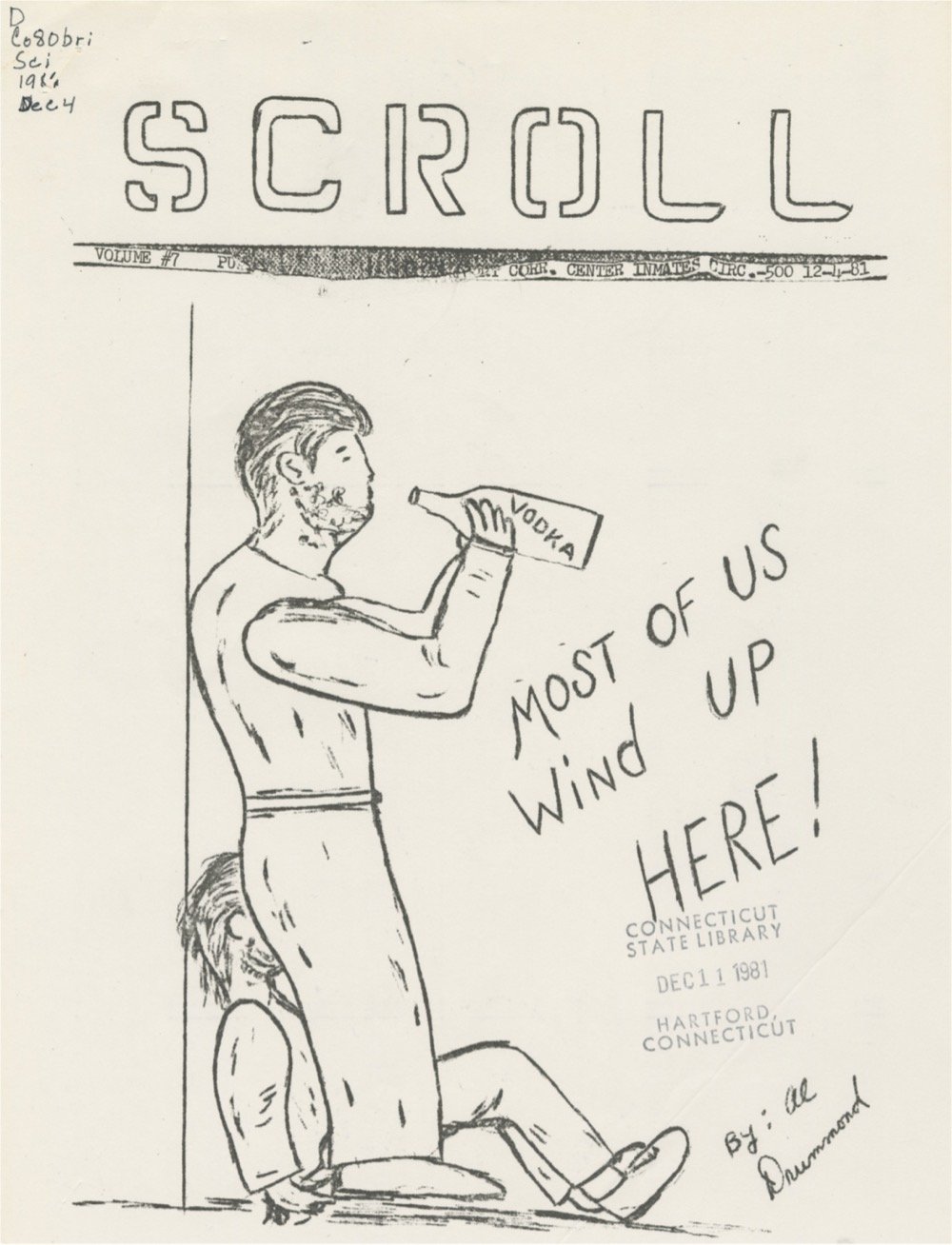

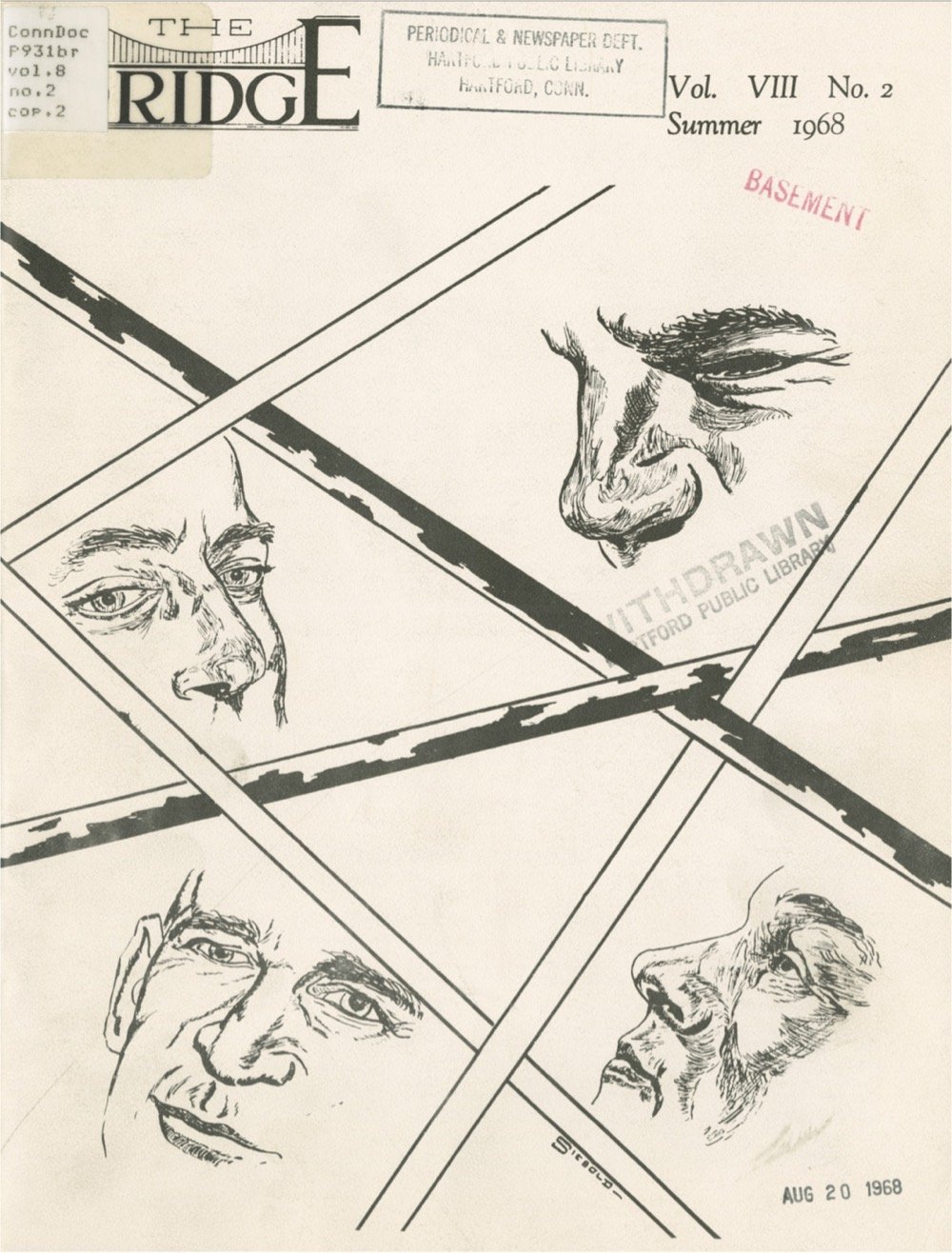
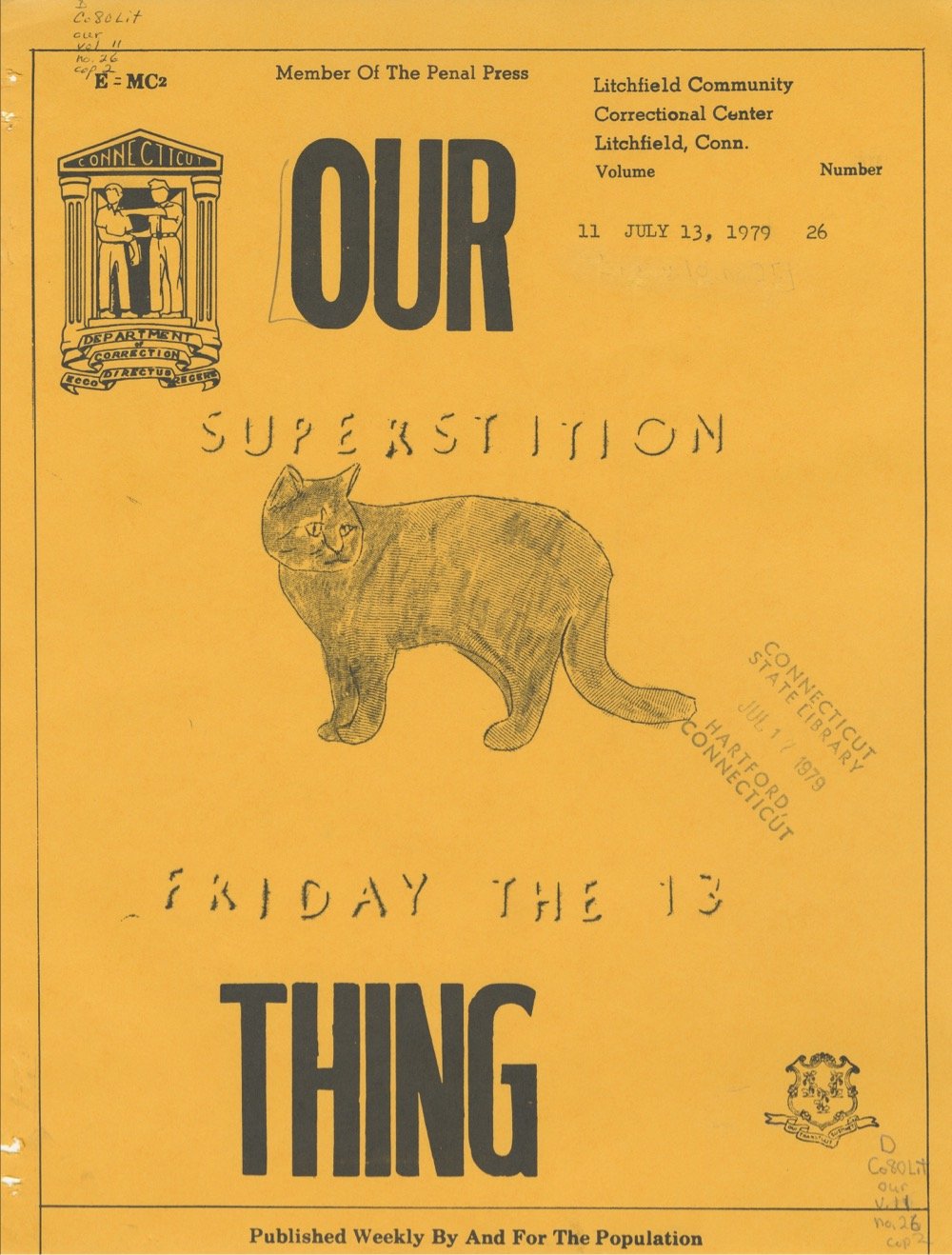
Since 1800, when the first newspaper was published in a NYC prison, over 500 newspapers have been published in prisons around the country. JSTOR is hosting a growing archive of such publications: American Prison Newspapers 1800-2020: Voices from the Inside.
With the United States incarcerating more individuals than any other nation — over 2 million as of 2019 — these publications represent a vast dimension of media history. These publications depict and report on all manner of life within the walls of prisons, from the quotidian to the upsetting. Incarcerated journalists walk a tightrope between oversight by administration — even censorship-and seeking to report accurately on their experiences inside. Some publications were produced with the sanction of institutional authorities; others were produced underground.
(thx, caroline)
Sarah Miller, author of this 2019 article on Miami real estate & rising oceans, recently wrote this resonant piece, All The Right Words On Climate Have Already Been Said.
I told her I didn’t have anything to say about climate change anymore, other than that I was not doing well, that I was miserable. “I am so unhappy right now.” I said those words. So unhappy. Fire season was not only already here, I said, but it was going to go on for at least four more months, and I didn’t know what I was going to do with myself. I didn’t know how I would stand the anxiety. I told her I felt like all I did every day was try to act normal while watching the world end, watching the lake recede from the shore, and the river film over, under the sun, an enormous and steady weight.
There’s only one thing I have to say about climate change, I said, and that’s that I want it to rain, a lot, but it’s not going to rain a lot, and since that’s the only thing I have to say and it’s not going to happen, I don’t have anything to say.
Miller continued:
Also, for what? Let’s give the article (the one she was starting to maybe think about asking me to write that I was wondering if I could write) the absolute biggest benefit of the doubt and imagine that people read it and said, “Wow, this is exactly how I feel, thanks for putting it into words.”
What then? What would happen then? Would people be “more aware” about climate change? It’s 109 degrees in Portland right now. It’s been over 130 degrees in Baghdad several times. What kind of awareness quotient are we looking for? What more about climate change does anyone need to know? What else is there to say?
This is where I am on the climate emergency most days now (and nearly there on the pandemic). Really, what the fuck else is there to say?
Zeynep Tufekci has written an important piece for The Atlantic on the mistakes that the media, public health officials, and the public keep making during the pandemic and how we can learn from them. A big one for me is how scientists & other public health officials and agencies communicate their knowledge to the public and how the media interprets and amplifies those messages.
Thus, on January 14, 2020, the WHO stated that there was “no clear evidence of human-to-human transmission.” It should have said, “There is increasing likelihood that human-to-human transmission is taking place, but we haven’t yet proven this, because we have no access to Wuhan, China.” (Cases were already popping up around the world at that point.) Acting as if there was human-to-human transmission during the early weeks of the pandemic would have been wise and preventive.
Later that spring, WHO officials stated that there was “currently no evidence that people who have recovered from COVID-19 and have antibodies are protected from a second infection,” producing many articles laden with panic and despair. Instead, it should have said: “We expect the immune system to function against this virus, and to provide some immunity for some period of time, but it is still hard to know specifics because it is so early.”
Similarly, since the vaccines were announced, too many statements have emphasized that we don’t yet know if vaccines prevent transmission. Instead, public-health authorities should have said that we have many reasons to expect, and increasing amounts of data to suggest, that vaccines will blunt infectiousness, but that we’re waiting for additional data to be more precise about it. That’s been unfortunate, because while many, many things have gone wrong during this pandemic, the vaccines are one thing that has gone very, very right.
This pair of statements she highlights — “no clear evidence of human-to-human transmission” and “There is increasing likelihood that human-to-human transmission is taking place, but we haven’t yet proven this, because we have no access to Wuhan, China” — are both factually true but the second statement is so much more helpful, useful, and far less likely to be misinterpreted by people who aren’t scientists that making the first statement is almost negligent.
Press Watch’s Dan Froomkin imagines a speech that new editoral leadership at large American newspapers should give to their political reporters.
It’s impossible to look out on the current state of political discourse in this country and think that we are succeeding in our core mission of creating an informed electorate.
It’s impossible to look out at the looming and in some cases existential challenges facing our republic and our globe — among them the pandemic, climate change, income inequality, racial injustice, the rise of disinformation and ethnic nationalism — and think that it’s OK for us to just keep doing what we’ve been doing.
He continues:
First of all, we’re going to rebrand you. Effective today, you are no longer political reporters (and editors); you are government reporters (and editors). That’s an important distinction, because it frees you to cover what is happening in Washington in the context of whether it is serving the people well, rather than which party is winning.
Historically, we have allowed our political journalism to be framed by the two parties. That has always created huge distortions, but never like it does today. Two-party framing limits us to covering what the leaders of those two sides consider in their interests. And, because it is appropriately not our job to take sides in partisan politics, we have felt an obligation to treat them both more or less equally.
Both parties are corrupted by money, which has badly perverted the debate for a long time. But one party, you have certainly noticed, has over the last decade or two descended into a froth of racism, grievance and reality-denial. Asking you to triangulate between today’s Democrats and today’s Republicans is effectively asking you to lobotomize yourself. I’m against that.
Defining our job as “not taking sides between the two parties” has also empowered bad-faith critics to accuse us of bias when we are simply calling out the truth. We will not take sides with one political party or the other, ever. But we will proudly, enthusiastically, take the side of wide-ranging, fact-based debate.
Government reporters. Yes, exactly. Worth reading in its entirety.
NY Times reporter Neil Sheehan, who was a Vietnam War correspondent, won a Pulitzer Prize, and obtained the Pentagon Papers for the Times, died yesterday at the age of 84. In an interview to be published posthumously, Sheehan revealed for the first time how he obtained the classified report on the Vietnam War from Daniel Ellsberg.
He also revealed that he had defied the explicit instructions of his confidential source, whom others later identified as Daniel Ellsberg, a former Defense Department analyst who had been a contributor to the secret history while working for the Rand Corporation. In 1969, Mr. Ellsberg had illicitly copied the entire report, hoping that making it public would hasten an end to a war he had come passionately to oppose.
Contrary to what is generally believed, Mr. Ellsberg never “gave” the papers to The Times, Mr. Sheehan emphatically said. Mr. Ellsberg told Mr. Sheehan that he could read them but not make copies. So Mr. Sheehan smuggled the papers out of the apartment in Cambridge, Mass., where Mr. Ellsberg had stashed them; then he copied them illicitly, just as Mr. Ellsberg had done, and took them to The Times.
Over the next two months, he strung Mr. Ellsberg along. He told him that his editors were deliberating about how best to present the material, and he professed to have been sidetracked by other assignments. In fact, he was holed up in a hotel room in midtown Manhattan with the documents and a rapidly expanding team of Times editors and reporters working feverishly toward publication.
What a wild tale. Read the whole thing…the kicker is worth it. Thanks to the efforts of Ellsberg, Sheehan, and other journalists, you can now read the complete non-redacted report on the National Archives website.
Caliphate, Rukmini Callimachi’s podcast for the NY Times about ISIS, was one of my favorite podcasts of 2018 — I recommended it in a post in June of that year. The NY Times has now retracted a central story in the podcast, that of an alleged ISIS executioner from Canada named Abu Huzayfah.
During the course of reporting for the series, The Times discovered significant falsehoods and other discrepancies in Huzayfah’s story. The Times took a number of steps, including seeking confirmation of details from intelligence officials in the United States, to find independent evidence of Huzayfah’s story. The decision was made to proceed with the project but to include an episode, Chapter 6, devoted to exploring major discrepancies and highlighting the fact-checking process that sought to verify key elements of the narrative.
In September — two and a half years after the podcast was released — the Canadian police arrested Huzayfah, whose real name is Shehroze Chaudhry, and charged him with perpetrating a terrorist hoax. Canadian officials say they believe that Mr. Chaudhry’s account of supposed terrorist activity is completely fabricated. The hoax charge led The Times to investigate what Canadian officials had discovered, and to re-examine Mr. Chaudhry’s account and the earlier efforts to determine its validity. This new examination found a history of misrepresentations by Mr. Chaudhry and no corroboration that he committed the atrocities he described in the “Caliphate” podcast.
As a result, The Times has concluded that the episodes of “Caliphate” that presented Mr. Chaudhry’s claims did not meet our standards for accuracy.
From a Times piece about Chaudhry’s hoax:
Before “Caliphate” aired, two American officials told The Times that Mr. Chaudhry had, in fact, joined ISIS and crossed into Syria. And some of the people who know and have counseled Mr. Chaudhry say they have no doubt that he holds extremist, jihadist views.
But Canadian law enforcement officials, who conducted an almost four-year investigation into Mr. Chaudhry, say their examination of his travel and financial records, social media posts, statements to the police and other intelligence make them confident that he did not enter Syria or join ISIS, much less commit the grievous crimes he described.
You can read more about this on NPR. Callimachi has been reassigned by the Times; the paper’s editor in chief Dean Baquet said, “I do not see how Rukmini could go back to covering terrorism after one of the highest profile stories of terrorism is getting knocked down in this way.”
Update: Here’s a statement from Callimachi on the retraction. It reads, in part:
Reflecting on what I missing in reporting our podcast is humbling. Thinking of the colleagues and the newsroom I let down is gutting. I caught the subject of our podcast lying about key aspects of his account and I reported that. I also didn’t catch other lies he told us, and I should have. I added caveats to try to make clear what we knew and what we didn’t. It wasn’t enough.
There are several listeners of the podcast in her mentions that do not feel as though they were misled. I’d have to go back and listen to the whole thing again to have an opinion, but I would like to note that Caliphate told a story and showed the behind-the-scenes at the same time. That non-traditional approach was really compelling, a key aspect of the show’s success IMO. Because you’re dealing with violent organizations and sealed investigations (neither ISIS nor government groups like the FBI want their information out there), there are limits on how stories like this can even be told. Callimachi and her colleagues creatively found a way to tell this one: by being upfront and transparent about those limitations and explicitly showing their work, misgivings and all. But perhaps, as she said, it wasn’t enough.
Older posts





Socials & More