Because Flickr wasn't as profitable as some of the other bigger properties, like Yahoo Mail or Yahoo Sports, it wasn't given the resources that were dedicated to other products. That meant it had to spend its resources on integration, rather than innovation. Which made it harder to attract new users, which meant it couldn't make as much money, which meant (full circle) it didn't get more resources. And so it goes.
As a result of being resource-starved, Flickr quit planting the anchors it needed to climb ever higher. It missed the boat on local, on real time, on mobile, and even ultimately on social-the field it pioneered. And so, it never became the Flickr of video; YouTube snagged that ring. It never became the Flickr of people, which was of course Facebook. It remained the Flickr of photos. At least, until Instagram came along.
Then he looked at everything Patagonia made, shipped or processed, and resolved to do it all more responsibly. He changed materials, switching in 1996 from conventional to organic cotton-despite the fact that it initially tripled his supply costs-because it was less harmful to the environment. He created fleece jackets made entirely from recycled soda bottles. He vowed to create products durable enough and timeless enough that people could replace them less often, reducing waste. He put "The Footprint Chronicles" up on Patagonia's website, exhaustively cataloging the environmental damage done by his own company. He now takes responsibility for every item Patagonia has ever made -- promising either to replace it if the customer is dissatisfied, repair it (for a reasonable fee), help resell it (Patagonia facilitates exchanges of used clothes on its website), or recycle it when at last it's no longer wearable.
Posting this partially for my wife, who is a life-long Patagonia customer.
When talking about Zuckerberg's most valuable personality trait, a colleague jokingly invokes the famous Stanford marshmallow tests, in which researchers found a correlation between a young child's ability to delay gratification -- devour one treat right away, or wait and be rewarded with two -- with high achievement later in life. If Zuckerberg had been one of the Stanford scientists' subjects, the colleague jokes, Facebook would never have been created: He'd still be sitting in a room somewhere, not eating marshmallows.
To summarize: after the deal, Apple will immediately become a giant payments company, with an installation base that is expected to encompass half of all mobile devices sold. The company will have the best local search abilities, far exceeding any existing recommendation engine. And due to its enormous reach, it will possess a payment system that merchants will line up to support.
Dykstra ordered a Coke and French fries with ketchup: "And I'm actually going to have that as my meal-might be the oddest order of the day." (Healthy living was never his specialty.) When the Coke arrived, he sent it back, believing it to be Diet. After the fries were delivered, he made a show of extracting a "You're welcome" from the waiter, who had since moved on to another table. "I pay a thousand bucks a night -- actually, three thousand bucks a night -- and people are discourteous," he said, shaking his head. "There's some point in life when you have to grow up."
For many ballplayers, the growing-up point does not arrive until after retirement, when all the freebies vanish and equipment managers and hotel maids can no longer be relied upon for regular laundry service. Dykstra last played in the majors in 1996, at age thirty-three. Improbably, he has since become a successful day trader, and he let me know that he owns both a Maybach ("the best car") and a Gulfstream ("the best jet"). The occasion for our lunch, however, was a new venture: Dykstra is launching a magazine, intended specifically for pro athletes, called The Players Club. An unfortunate number of his former teammates have ended up broke, or divorced, or worse. The week before we met, the ex-Yankee Jim Leyritz, himself twice divorced and underemployed, had hit a woman while driving home from a bar. He never grew up.
"You've got the ten per cent who are going to find their way no matter what," Dykstra said of the athlete population. "And you get the ten per cent that are fuckheads no matter what-- we'll paste an 'L' to 'em." The rest need guidance, and Dykstra, who will write a regular column called "The Game of Life," is prepared to give it. "This will be the world's best magazine," he said.
Since then, Dykstra has declared bankruptcy, divorced from his wife, was sentenced to three years in state prison for grand theft auto (and several other charges), and most recently was sentenced to nine months in jail for assault and indecent exposure. He's also awaiting trial on federal bankruptcy fraud charges.
Brent Schlender interviewed Steve Jobs many times over the past 25 years and recently rediscovered the audio tapes of those interviews. What he found was in those years between his departure from Apple in 1985 to his return in 1996, Jobs learned how to become a better businessman and arguably a better person.
The lessons are powerful: Jobs matured as a manager and a boss; learned how to make the most of partnerships; found a way to turn his native stubbornness into a productive perseverance. He became a corporate architect, coming to appreciate the scaffolding of a business just as much as the skeletons of real buildings, which always fascinated him. He mastered the art of negotiation by immersing himself in Hollywood, and learned how to successfully manage creative talent, namely the artists at Pixar. Perhaps most important, he developed an astonishing adaptability that was critical to the hit-after-hit-after-hit climb of Apple's last decade. All this, during a time many remember as his most disappointing.
The discussion of the lessons he took from Pixar and put into Apple was especially interesting.
And just as he had at Pixar, he aligned the company behind those projects. In a way that had never been done before at a technology company--but that looked a lot like an animation studio bent on delivering one great movie a year--Jobs created the organizational strength to deliver one hit after another, each an extension of Apple's position as the consumer's digital hub, each as strong as its predecessor. If there's anything that parallels Apple's decade-long string of hits--iMac, PowerBook, iPod, iTunes, iPhone, iPad, to list just the blockbusters--it's Pixar's string of winners, including Toy Story, Monsters, Inc., Finding Nemo, The Incredibles, WALL-E, and Up. These insanely great products could have come only from insanely great companies, and that's what Jobs had learned to build.
Michael Abrash discusses how he came to work for Valve Software (he coauthored Quake with John Carmack back in the day) and, more interestingly, what Valve is like as a company.
The idea that a 10-person company of 20-somethings in Mesquite, Texas, could get its software on more computers than the largest software company in the world told him that something fundamental had changed about the nature of productivity. When he looked into the history of the organization, he found that hierarchical management had been invented for military purposes, where it was perfectly suited to getting 1,000 men to march over a hill to get shot at. When the Industrial Revolution came along, hierarchical management was again a good fit, since the objective was to treat each person as a component, doing exactly the same thing over and over.
The success of Doom made it obvious that this was no longer the case. There was now little value in doing the same thing even twice; almost all the value was in performing a valuable creative act for the first time. Once Doom had been released, any of thousands of programmers and artists could create something similar (and many did), but none of those had anywhere near the same impact. Similarly, if you're a programmer, you're probably perfectly capable of writing Facebook or the Google search engine or Twitter or a browser, and you certainly could churn out Tetris or Angry Birds or Words with Friends or Farmville or any of hundreds of enormously successful programs. There's little value in doing so, though, and that's the point - in the Internet age, software has close to zero cost of replication and massive network effects, so there's a positive feedback spiral that means that the first mover dominates.
If most of the value is now in the initial creative act, there's little benefit to traditional hierarchical organization that's designed to deliver the same thing over and over, making only incremental changes over time. What matters is being first and bootstrapping your product into a positive feedback spiral with a constant stream of creative innovation. Hierarchical management doesn't help with that, because it bottlenecks innovation through the people at the top of the hierarchy, and there's no reason to expect that those people would be particularly creative about coming up with new products that are dramatically different from existing ones - quite the opposite, in fact. So Valve was designed as a company that would attract the sort of people capable of taking the initial creative step, leave them free to do creative work, and make them want to stay. Consequently, Valve has no formal management or hierarchy at all.
I wonder if Tim Cook's recent visit to Valve is less about collaboration on specific products and more about Apple's curiosity about their process. (Probably not, but fun to think about.)
Out today: Mike Monteiro's Design is a Job. The book is an important reminder that how effective you are as a designer depends on many things aside from what you can do in Photoshop or InDesign. You need to build a stable environment for yourself (and your employees) to do your best work: you need to get clients, know how to talk to them, set up a stable and sustainable business, collaborate with others, etc. etc. For a taste of what the book has to offer, A List Apart has an excerpt of the second chapter, Getting Clients.
The biggest lie in this book would be if I told you I don't worry about where the next client is coming from. I could tell you that once you build up enough of a portfolio, or garner enough experience, or achieve a certain level of notoriety in the industry, this won't be a concern anymore. I could tell you I sleep soundly, not bolting out of bed at 4 a.m. to run laps around the local high school track. I could tell you that I never worry about enough presents under the tree. I could tell you these things, but I'd be lying. And I don't want to lie to you. Getting clients is the most petrifying and scary thing I can think of in the world. I'd rather wrestle lady Bengal tigers in heat with meat strapped to my genitals than look for new clients.
If putting in the work to get the kind of work you want to do sounds too daunting, then close this book right now. Walk away. Rethink your life choices and take up a less stressful craft, like cleaning out cobra pits. Do it. No one will think less of you. Cover yourself in sackcloth and pray to your god for penance.
The big challenge for any retailer is to make sure that the people coming into the store actually buy stuff, and research suggests that not scrimping on payroll is crucial. In a study published at the Wharton School, Marshall Fisher, Jayanth Krishnan, and Serguei Netessine looked at detailed sales data from a retailer with more than five hundred stores, and found that every dollar in additional payroll led to somewhere between four and twenty-eight dollars in new sales. Stores that were understaffed to begin with benefitted more, stores that were close to fully staffed benefitted less, but, in all cases, spending more on workers led to higher sales. A study last year of a big apparel chain found that increasing the number of people working in stores led to a significant increase in sales at those stores.
There seems to be something in the air. Within the last day or so, three ex-employees have written about why their feelings have changed about three formerly beloved companies. James Whittaker recently left Google:
The Google I was passionate about was a technology company that empowered its employees to innovate. The Google I left was an advertising company with a single corporate-mandated focus. [...] Suddenly, 20% meant half-assed. Google Labs was shut down. App Engine fees were raised. APIs that had been free for years were deprecated or provided for a fee. As the trappings of entrepreneurship were dismantled, derisive talk of the "old Google" and its feeble attempts at competing with Facebook surfaced to justify a "new Google" that promised "more wood behind fewer arrows."
The days of old Google hiring smart people and empowering them to invent the future was gone. The new Google knew beyond doubt what the future should look like. Employees had gotten it wrong and corporate intervention would set it right again.
The whole thing is worth a read, what with damning phrases like "social isn't a product, social is people and the people are on Facebook" sprinkled liberally about.
In the NY Times this morning, Greg Smith writes that it's his last day at Goldman Sachs after almost 12 years at the firm.
To put the problem in the simplest terms, the interests of the client continue to be sidelined in the way the firm operates and thinks about making money. Goldman Sachs is one of the world's largest and most important investment banks and it is too integral to global finance to continue to act this way. The firm has veered so far from the place I joined right out of college that I can no longer in good conscience say that I identify with what it stands for.
It might sound surprising to a skeptical public, but culture was always a vital part of Goldman Sachs's success. It revolved around teamwork, integrity, a spirit of humility, and always doing right by our clients. The culture was the secret sauce that made this place great and allowed us to earn our clients' trust for 143 years. It wasn't just about making money; this alone will not sustain a firm for so long. It had something to do with pride and belief in the organization. I am sad to say that I look around today and see virtually no trace of the culture that made me love working for this firm for many years. I no longer have the pride, or the belief.
There's that saying: "If you're not paying for something, you're not the customer; you're the product being sold." Google's product has always been the people using their products and it sounds like Goldman has made a sizable shift in that direction.
Yahoo's lawsuit against Facebook is an insult to the talented engineers who filed patents with the understanding they wouldn't be used for evil. Betraying that trust won't be forgotten, but I doubt it matters anymore. Nobody I know wants to work for a company like that.
I'm embarrassed by the patents I filed, but I've learned from my mistake. I'll never file a software patent again, and I urge you to do the same.
For years, Yahoo was mostly harmless. Management foibles and executive shuffles only hurt shareholders and employee morale. But in the last few years, the company's incompetence has begun to hurt the rest of us. First, with the wholesale destruction of internet history, and now by attacking younger, smarter companies.
Yahoo tried and failed, over and over again, to build a social network that people would love and use. Unable to innovate, Yahoo is falling back to the last resort of a desperate, dying company: litigation as a business model.
Yahoo seems to be in a different stage in its lifecycle than Google or Goldman. In the mid-to-late 2000s, they tried what Google is trying now and failed and now, as Baio notes, they are trying everything they can to survive, like the T-1000 writhing in the molten steel at the end of Terminator 2. Perhaps a harbinger of things to come for Google and Goldman?
Sara Blakely is one of the few women who has joined the Forbes Billionaires list without help from a spouse or an inheritance. She came up with the idea for Spanx and spent two years and $5000 developing it and the $1 billion company it would become.
Blakely, then 27, moved to Atlanta, set aside her entire $5,000 savings and spent the next two years meticulously planning the launch of her product while working nine to five at Danka. She spent seven nights straight at the Georgia Tech library researching every hosiery patent ever filed. She visited craft stores like Michaels to find the right fabrics. She sought out hosiery mills in the Yellow Pages and started cold calling, only to be told no repeatedly. Immune to rejection thanks to years selling door-to-door, she decided just to show up. At the Acme-McCrary hosiery factory in Asheboro, N.C., she was turned away, only to receive a call from the manager two weeks later. He had daughters, he told her, who wouldn't let him pass up her invention.
Over at The Speculist, Stephen Gordon argues that with the ever increasing availability of online goods and services, universities, book stores, retail shops, and offices will all shrink to the size of coffee shops.
My Christmas shopping this year was 90% through Amazon Prime. Not having to fight the crowds and having it delivered free of charge to my home is a big plus, but as with the Kindle store, the online retail selection is much better that even the largest retail outlet.
Which is more enjoyable: Starbucks or Walmart? For the sane: Starbucks. So if you can accomplish your Walmart shopping at Starbucks, why do it any other way?
Also, imagine the 3D print shop of the future. You put in your order, probably from your smart phone, and then go pick it up. What does the lobby of such a business look like? Again: a coffee shop.
Much of rap is about business, whether the drug business, the music industry or work ethic, said Adam Bradley, an associate professor specializing in African-American literature at the University of Colorado at Boulder who wrote "Book of Rhymes: The Poetics of Hip Hop" and co-edited "The Anthology of Rap."
"It comes out of the fact that rap is such a direct mode of expression, maybe more so than any other music lyric, because of the emphasis on language, of words above melody or harmony," Mr. Bradley said.
People think of rap lyrics as being only about money, women, status and cocaine, he said, but more pervasive themes are leadership, collaboration and the vulnerability beneath the swagger -- all relevant in business.
"Remember, you're not selling out," Jonah Peretti, a co-founder of the Huffington Post, told Denton. "You're blowing up. Think in terms of hip-hop, not indie rock."
According to the National Pawnbrokers Association, a trade group, there are now more than 30 million pawnshop customers per year. The value of the average loan in 2009 was $100, up 20 percent from the previous year. About 80 percent of pawners pay off their loans and redeem their collateral, though redemptions are on the decline.
It turns out that if you didn't grow up with Oreos and develop an emotional attachment to the cookie, it can be a weird-tasting little thing. And this started a whole process in the Chinese division of Kraft of rethinking what the essence of an Oreo really is.
Key terms in this article include "the essence of Oreoness" and "Twist, Lick, Dunk".
This is the story of the worst project I've funded on Kickstarter. I am posting this not to single out the creators behind it, or bad mouth their business, but to go over my disappointment in the hopes that future Kickstarter project creators can learn from it. It's all about communication with your funders, setting up and delivering on expectations for funders, and doing the right thing when things go wrong.
Shipping a product or app is hard. It requires experience, hard work, and a little luck. But providing effective and genuine customer service might be even harder because you just have sit there, take it, and react well under pressure over and over and over. The entrepreneur side of your brain is saying "this is a great product and I am proud of it and anyone who says otherwise is wrong and I will show them and succeed" and sometimes customer service is acknowledging publicly and repeatedly the exact opposite thing...that the product isn't meeting needs, you are right, we will fix it, and thank you sir may I have another? That's a lot of potential cognitive dissonance! The best teams and companies deflect that dissonance and turn customer service problems into opportunities to improve their products, their teams, and their relationships with their customers (current and potential). That's when the magic happens.
The New Groupthink has overtaken our workplaces, our schools and our religious institutions. Anyone who has ever needed noise-canceling headphones in her own office or marked an online calendar with a fake meeting in order to escape yet another real one knows what I'm talking about. Virtually all American workers now spend time on teams and some 70 percent inhabit open plan offices, in which no one has "a room of one's own." During the last decades, the average amount of space allotted to each employee shrank 300 square feet, from 500 square feet in the 1970s to 200 square feet in 2010.
The new offices of Foursquare and Buzzfeed (where I work from) are a perfect example of the New Groupthink Cain refers to....rows and rows of people sitting next to each other in open spaces. Much of this is because of NYC's insane rental market, but Fog Creek's offices are a nice counterexample:
Every developer, tester, and program manager is in a private office; all except two have direct windows to the outside (the two that don't get plenty of daylight through two glass walls).
Interesting things happen when we cut out the middleman. In addition to reducing cost, we often end up creating an internal byproduct that can be productized and sold to a completely new customer. (Amazon Web Services is an example of this.) Sometimes the middleman's market is so huge, that a freaking enormous business can be built simply by providing their customers a lower cost and more efficient option.
The message I get is that Americans love the movies as much as ever. It's the theaters that are losing their charm. Proof: theaters thrive that police their audiences, show a variety of titles and emphasize value-added features. The rest of the industry can't depend forever on blockbusters to bail it out.
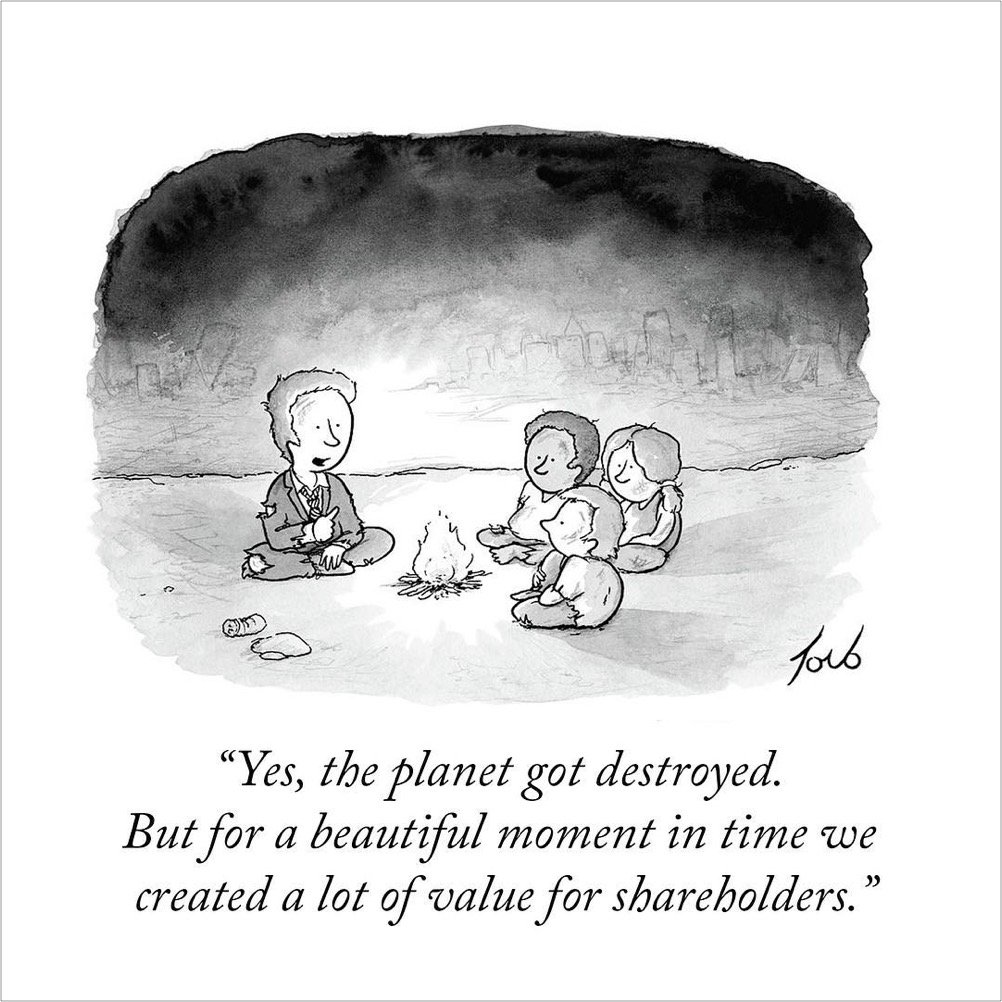
In today's paradoxical world of maximizing shareholder value, which Jack Welch himself has called "the dumbest idea in the world", the situation is the reverse. CEOs and their top managers have massive incentives to focus most of their attentions on the expectations market, rather than the real job of running the company producing real products and services.
In Fixing the Game, Roger Martin reveals the culprit behind the sorry state of American capitalism: our deep and abiding commitment to the idea that the purpose of the firm is to maximize shareholder value. This theory has led to a massive growth in stock-based compensation for executives and, through this, to a naive and wrongheaded linking of the real market -- the business of designing, making, and selling products and services -- with the expectations market -- the business of trading stocks, options, and complex derivatives. Martin shows how this tight coupling has been engineered and lays out its results: a single-minded focus on the expectations market that will continue driving us from crisis to crisis -- unless we act now.
I've never had a million dollars all of a sudden. and since we're all sharing this experience and since it's really your money, I wanted to let you know what I'm doing with it. People are paying attention to what's going on with this thing. So I guess I want to set an example of what you can do if you all of a sudden have a million dollars that people just gave to you directly because you told jokes.
Amazon is somewhat of an unusual company for American investors because it focuses on the long-term (10- 20-year timelines) instead of the short-term (quarterly earnings).
"If everything you do needs to work on a three-year time horizon, then you're competing against a lot of people," Mr. Bezos told reporter Steve Levy last month in an interview in Wired. "But if you're willing to invest on a seven-year time horizon, you're now competing against a fraction of those people, because very few companies are willing to do that. Just by lengthening the time horizon, you can engage in endeavors that you could never otherwise pursue. At Amazon we like things to work in five to seven years. We're willing to plant seeds, let them grow-and we're very stubborn."
Like Apple, Amazon is one of those large market cap growth stocks that investors don't really know what to do with. Both stocks are still undervalued compared to much of the rest of the market, IMO.
At this volume, and with the impermanence of the sandwich, it only makes sense for McDonald's to treat the sandwich as a sort of arbitrage strategy: at both ends of the product pipeline, you have a good being traded at such large volume that we might as well forget that one end of the pipeline is hogs and corn and the other end is a sandwich. McDonald's likely doesn't think in these terms, and neither should you.
Oh and speaking of pipelines:
And for its part, the McRib makes a mockery of this whole terribly labor-intensive system of barbecue, turning it into a capital-intensive one. The patty is assembled by machinery probably babysat by some lone sadsack, and it is shipped to distribution centers by black-beauty-addicted truckers, to be shipped again to franchises by different truckers, to be assembled at the point of sale by someone who McDonald's corporate hopes can soon be replaced by a robot, and paid for using some form of electronic payment that will eventually render the cashier obsolete.
There is no skilled labor involved anywhere along the McRib's Dickensian journey from hog to tray, and certainly no regional variety, except for the binary sort -- Yes, the McRib is available/No, it is not -- that McDonald's uses to promote the product. And while it hasn't replaced barbecue, it does make a mockery of it.
More than a year ago, Facebook engineer Andrew Bosworth wrote a post about how best to work with Facebook CEO Mark Zuckerberg.
I think one of the biggest mistakes people make when first working with Zuck is feeling that they can't push back. As long as I have been at Facebook, I have been impressed with how much he prefers to be part of an ongoing discussion about the product as opposed to being its dictator. There are a number of exceptions to this, of course, but that comes with the territory. In those instances where he is quite sure what he wants, I find he is quite good at making his decisions clear and curtailing unneeded debate.
Barring that, you should feel comfortable noting potential problems with a proposal of his or, even better, suggesting alternative solutions. You shouldn't necessarily expect to change his mind on the spot, but I find it is common for discussions to affect his thinking over a longer time period. Don't necessarily expect acknowledgment for your role in moving the discussion forward; getting the product right should be its own reward. If you do that, you'll find you are invited back more and more to the debate.
Facebook is certainly an interesting company...they're a large company that appears to operate much like a small company. Will be interesting to see if they can keep that up as they get larger, go public, etc.
I'd never heard the story of how Richard Branson started Virgin Atlantic...interesting story.
In '79, when Joan, my fiancee and I were on a holiday in the British Virgin Islands, we were trying to catch a flight to Puerto Rico; but the local Puerto Rican scheduled flight was cancelled. The airport terminal was full of stranded passengers. I made a few calls to charter companies and agreed to charter a plane for $2000 to Puerto Rico. Cheekily leaving out Joan's and my name, I divided the price by the remaining number of passengers, borrowed a blackboard and wrote: VIRGIN AIRWAYS: $39 for a single flight to Puerto Rico.
An analysis by complex systems theorists at the Swiss Federal Institute of Technology reveals that a "super-entity" of just 147 companies that controls 40% of the wealth among the world's transnational corporations. And even worse is how tightly integrated these companies are...large pieces tightly coupled is a recipe for economic disaster.
John Driffill of the University of London, a macroeconomics expert, says the value of the analysis is not just to see if a small number of people controls the global economy, but rather its insights into economic stability.
Concentration of power is not good or bad in itself, says the Zurich team, but the core's tight interconnections could be. As the world learned in 2008, such networks are unstable. "If one [company] suffers distress," says Glattfelder, "this propagates."
"It's disconcerting to see how connected things really are," agrees George Sugihara of the Scripps Institution of Oceanography in La Jolla, California, a complex systems expert who has advised Deutsche Bank.
Here's the idea they came up with: Americans themselves would start lending to small businesses, with Starbucks serving as the middleman. Starbucks would find financial institutions willing to loan to small businesses. Starbucks customers would be able to donate money to the effort when they bought their coffee. Those who gave $5 or more would get a red-white-and-blue wristband, which Schultz labeled "Indivisible." "We are hoping it will bring back pride in the American dream," he says. The tag line will read: "Americans Helping Americans."
This should be a bigger story, shouldn't it? Banks seem less and less interested in lending money to people as their primary business and things like Kickstarter and this Starbucks initiative are taking their place.
A common reaction to Apple's announcement of the iPhone 4S yesterday was disappointment...Mat Honan's post at Gizmodo for instance.
I was hoping for something bold and interesting looking. The iPhone 4 was just that when it shipped. So too were the original iPhone and the iPhone 3G. If I'm going to buy a new phone, of course I want it to look new. Because of course we care about having novel designs. If we didn't we'd all be lugging around some 10-inch thick brick with a 12 day battery life.
Mat's is an understandable reaction. After I upgraded my iPhone, Macbook Pro, and OS X all at once two years ago, I wrote about Apple's upgrade problem:
From a superficial perspective, my old MBP and new MBP felt exactly the same...same OS, same desktop wallpaper, same Dock, all my same files in their same folders, etc. Same deal with the iPhone except moreso...the iPhone is almost entirely software and that was nearly identical. And re: Snow Leopard, I haven't noticed any changes at all aside from the aforementioned absent plug-ins.
So, just having paid thousands of dollars for new hardware and software, I have what feels like my same old stuff.
Deep down, when I stop to think about it, I know (or have otherwise convinced myself) that these purchases were worth it and that Apple's ease of upgrade works almost exactly how it should. But my gut tells me that I've been ripped off. The "newness" cognitive jolt humans get is almost entirely absent.
For me, yesterday's event, Apple's continued success in innovation *and* business, and the recent CEO change provided a different perspective: that Apple makes two very complementary types of products and we should be excited about both types.
The first type of product is the most familiar and is exemplified by Steve Jobs: Apple makes magical products that shape entire industries and modify social structures in significant ways. These are the bold strokes that combine technology with design in a way that's almost artistic: Apple II, Macintosh, iPod, iPhone, and iPad. When they were introduced, these products were new and exciting and no one quite knew where those products were going to take us (Apple included). That's what people want to see when they go to Apple events: Steve Jobs holding up a rainbow-hued unicorn that you can purchase for your very own.
The second type of product is less noticed and perhaps is best exemplified by Apple's new CEO, Tim Cook: identify products and services that work, continually refine them, innovate at the margins (the addition of Siri to the iPhone 4S is a good example of this), build interconnecting ecosystems around them, and put processes and infrastructure in place to produce ever more of these items at lower cost and higher profit. The wheel has been invented; now we'll perfect it. This is where Apple is at with the iPhone now, a conceptually solved problem: people know what they are, what they're used for, and Apple's gonna knuckle down and crank out ever better/faster/smarter versions of them in the future. Many of Apple's current products are like this, better than they have ever been, more popular than they have ever been, but there's nothing magical about them anymore: iPhone 4S, iPod, OS X, iMacs, Macbooks, etc.
The exciting thing about this second type of product, for investors and consumers alike, is Apple is now expert at capturing their lightning in a bottle. 'Twas not always so...Apple wasn't able to properly capitalize on the success of the Macintosh and it almost killed the company. What Tim Cook ultimately held up at Apple's event yesterday is a promise: there won't be a return to the Apple of the 1990s, when the mighty Macintosh devolved into a flaky, slow, and (adding insult to injury) expensive klunker and they couldn't decide on a future direction for their operating system (remember Copland?). There will be an iPhone 5 in the future and it will be better than the iPhone 4S in significant & meaningful ways but it will also *just work*. And while that might be a bit boring to Apple event watchers, this interconnected web of products is the thing that makes the continued development of the new and magical products possible.
New Tumblr: Things Apple is Worth More Than. Such as: the GDP of Singapore, every single home in Atlanta, Georgia, and all the illegal drugs in the world.
Qwikster will rent you DVDs and Netflix will rent you streaming movies. Two separate sites/companies, no interop, you have to sub to both separately, etc. Here's the explanation from Netflix CEO Reed Hastings. This seems amazingly dumb at first blush. (ps. Qwikster?!!)
Netflix's holy grail is to get each person, not each household, to have a separate streaming subscription, the way everyone also has a separate Facebook account. Separating a per-household service like DVD rentals-by-mail helps simplify that eventual transition.
Speaking of fruit, you may think a banana is just a banana, but it's not. Dole and other banana growers have turned the creation of a banana into a science, in part to manipulate perceptions of freshness. In fact, they've issued a banana guide to greengrocers, illustrating the various color stages a banana can attain during its life cycle. Each color represents the sales potential for the banana in question. For example, sales records show that bananas with Pantone color 13-0858 (otherwise known as Vibrant Yellow) are less likely to sell than bananas with Pantone color 12-0752 (also called Buttercup), which is one grade warmer, visually, and seems to imply a riper, fresher fruit. Companies like Dole have analyzed the sales effects of all varieties of color and, as a result, plant their crops under conditions most ideal to creating the right 'color.'
TO SEE how profoundly the book business is changing, watch the shelves. Next month IKEA will introduce a new, deeper version of its ubiquitous "BILLY" bookcase. The flat-pack furniture giant is already promoting glass doors for its bookshelves. The firm reckons customers will increasingly use them for ornaments, tchotchkes and the odd coffee-table tome-anything, that is, except books that are actually read.
In the first five months of this year sales of consumer e-books in America overtook those from adult hardback books. Just a year earlier hardbacks had been worth more than three times as much as e-books, according to the Association of American Publishers. Amazon now sells more copies of e-books than paper books. The drift to digits will speed up as bookshops close. Borders, once a retail behemoth, is liquidating all of its American stores.
By 1941, The advertising agency reported to [De Beers] that it had already achieved impressive results in its campaign. The sale of diamonds had increased by 55 percent in the United States since 1938, reversing the previous downward trend in retail sales. N. W. Ayer noted also that its campaign had required "the conception of a new form of advertising which has been widely imitated ever since. There was no direct sale to be made. There was no brand name to be impressed on the public mind. There was simply an idea -- the eternal emotional value surrounding the diamond." It further claimed that "a new type of art was devised ... and a new color, diamond blue, was created and used in these campaigns.... "
In its 1947 strategy plan, the advertising agency strongly emphasized a psychological approach. "We are dealing with a problem in mass psychology. We seek to ... strengthen the tradition of the diamond engagement ring -- to make it a psychological necessity capable of competing successfully at the retail level with utility goods and services...." It defined as its target audience "some 70 million people 15 years and over whose opinion we hope to influence in support of our objectives." N. W. Ayer outlined a subtle program that included arranging for lecturers to visit high schools across the country. "All of these lectures revolve around the diamond engagement ring, and are reaching thousands of girls in their assemblies, classes and informal meetings in our leading educational institutions," the agency explained in a memorandum to De Beers. The agency had organized, in 1946, a weekly service called "Hollywood Personalities," which provided 125 leading newspapers with descriptions of the diamonds worn by movie stars. And it continued its efforts to encourage news coverage of celebrities displaying diamond rings as symbols of romantic involvement. In 1947, the agency commissioned a series of portraits of "engaged socialites." The idea was to create prestigious "role models" for the poorer middle-class wage-earners. The advertising agency explained, in its 1948 strategy paper, "We spread the word of diamonds worn by stars of screen and stage, by wives and daughters of political leaders, by any woman who can make the grocer's wife and the mechanic's sweetheart say 'I wish I had what she has.'"
It's fascinating to watch the advertising beast change its tactics as the diamond monopoly's needs shift with new supply, new markets, and unexpected success.
There's been a lot written about Steve Jobs in the past week, a lot of it worthy of reading, but one piece you probably didn't see is David Galbraith's piece on Jobs' similarity to architect Norman Foster. The essay is a bit all over the place, which replicates the experience of talking to David in person, but it's littered with insight and goodness (ditto).
The answer is what might be called the sand pile model and it operated at Apple and Fosters, the boss sits independently from the structural hierarchy, to some extent, and can descend at random on a specific element at will. The boss maintains control of the overall house style by cleaning up the edges at the same time as having a vision for the whole, like trying to maintain a sand pile by scooping up the bits that fall off as it erodes in the wind. This is the hidden secret of design firms or prolific artists, the ones where journalists or historians agonize whether a change in design means some new direction when it just means that there was a slip up in maintaining the sand pile.
And I love this paragraph, which integrates Foster, Jobs, the Soviet Union, Porsche, Andy Warhol, Lady Gaga, and even an unspoken Coca-Cola into an extended analogy:
Perfecting the model of selling design that is compatible with big business, Foster simultaneously grew one of the largest architecture practices in the world while still winning awards for design excellence. The secret was to design buildings like the limited edition, invite only Porsches that Foster drove and fellow Porsche drivers would commission them. Jobs went further, however, he managed to create products that were designed like Porsches and made them available to everyone, via High Tech that transcended stylistic elements. An Apple product really was high technology and its form followed function, it went beyond the Porsche analogy by being truly fit for purpose in a way that a Porsche couldn't, being a car designed for a speed that you weren't allowed to drive. Silicon Valley capitalism had arguably delivered what the Soviets had dreamed of and failed, modernism for the masses. An iPhone really is the best phone you can buy at any price. To paraphrase Andy Warhol: Lady Gaga uses an iPhone, and just think, you can have an iPhone too. An iPhone is an iPhone and no amount of money can get you a better phone. This was what American modernism was about.
And as usual, the definitive review of any new version of OS X is John Siracusa's for Ars Technica. This time around, it runs 19 pages. If that's not to your liking, you can just download Lion right now from the Mac App Store for $30.
Two other misc Apple thoughts: 1) They appear to have discontinued the MacBook. There are Airs and Pros but no plain-old MacBooks. 2) Apple Inc, already among the largest companies in the world in terms of market cap, announced yesterday that the company's "revenue [is] up 82 percent and profits [are] up 125 percent" over the same quarter last year. That level of growth in such a big company...that's just astounding. And much of the revenue and profit are from products that didn't exist even five years ago...the iPad alone was a ~$5 billion business in Q3 (for comparison, Google had $9 billion in total revenues in Q2). If that's not unprecedented, it's damn close.
From 1990, a NY Times article on a new factory built by Next, the company Steve Jobs started after he left Apple. The more you learn about Next, the more you realize just how much Next DNA there is in the current incarnation of Apple. The story of Apple's second coming could easily be written as the triumph of Next. This section from the middle of the article articulates perfectly Apple's current approach to manufacturing:
Indeed, critics of Mr. Jobs, who is 35 years old, say he is wasting his money by building a factory at this point. With the small number of machines he is building today, it would have been cheaper simply to contract with other companies to assemble the computers, they say.
But Dr. Piszczalski said the initial high investment in an automated factory may permit Next more control of its expenses while volumes are low.
And backers of Mr. Jobs note that he has a long-term strategy in which manufacturing makes sense. "Steve will be in business for the long pull," said H. Ross Perot, one of Next's investors. "He's not in business for six months."
Next's products have yet to gain a significant share of the marketplace, but Mr. Jobs, who has a reputation for painstaking attention to detail and a passion for the importance of manufacturing, argues that by linking this flexible factory more closely than ever to Next's research and development process, his company can gain a strategic advantage in the industry that will eventually pay off in larger sales.
In Mr. Jobs's view, the factory testifies to the fact that the United States can still compete as both a low-cost and a world-class manufacturer when it sets its mind to the task.
Mr. Jobs said he modeled the factory after those of Japanese corporations like the Sony Corporation that have perfected a design-for-manufacturing strategy that transforms the factory floor into an extension of the company research and development center.
Update: Next made a documentary on how computers are made at the new factory.
That's got to be a Hans Zimmer soundtrack, yes? (via @mgrdcm)
UBS: If we were playing Russian roulette and had one bullet, I randomly spun the chamber and fired but nothing was fired. Would you rather fire the gun again or respin the chamber and then fire on your turn?
I'd rather get the fuck out of your office and run away very fast. What the hell are you people on? Haven't you heard of email? Or official dispute procedures? Jesus.
Based on his answer to P&G's "sell me an invisible pen", I'd hire Turnbull in a second if I were selling invisible pens.
We get a much clearer picture of the real standing of countries if we consider economic growth and GDP per capita. Western Europe GDP per capita was higher than that of both China and India by 1500; by 1600 it was 50% higher than China's. From there, the gap kept growing. Between 1350 and 1950 -- six hundred years -- GDP per capita remained roughly constant in India and China (hovering around $600 for China and $550 for India). In the same period, Western European GDP per capita went from $662 to $4,594, a 594 percent increase.
But in the future, corporations will find it more difficult to achieve such easy growth:
Attention behaves the same way. Take an average housewife, the target of much time mining early in the 20th century. It was clear where her attention was directed. Laundry, cooking, walking to the well for water, cleaning, were all obvious attention sinks. Washing machines, kitchen appliances, plumbing and vacuum cleaners helped free up a lot of that attention, which was then immediately directed (as corporate-captive attention) to magazines and television.
But as you find and capture most of the wild attention, new pockets of attention become harder to find. Worse, you now have to cannibalize your own previous uses of captive attention. Time for TV must be stolen from magazines and newspapers. Time for specialized entertainment must be stolen from time devoted to generalized entertainment.
[...]
Each new pocket of attention is harder to find: maybe your product needs to steal attention from that one TV obscure show watched by just 3% of the population between 11:30 and 12:30 AM. The next displacement will fragment the attention even more. When found, each new pocket is less valuable. There is a lot more money to be made in replacing hand-washing time with washing-machine plus magazine time, than there is to be found in replacing one hour of TV with a different hour of TV.
Groupon has filed its S-1 and hopes to raise $750M in its initial public offering. Given they're currently losing a staggering $117M per quarter, despite revenues of $644M, they'll be burning through that cash almost as soon as it hits their account.
At the moment, it's costing them $1.43 to make $1, and it doesn't look like it's getting any cheaper. They're already projected to make close to three billion dollars in revenues this year. If you can't figure out how to make money on three billion in revenue, when exactly will the profit magic be found? Ten billion? Fifty billion?
I feel like the Groupon IPO is an elaborate practical joke.
It was a different time and (as DHH notes) a different company, but when Amazon IPOed in 1997, they lost $27.6 million that year on net sales of $147.8 million. That's an 18% loss for Amazon compared to Groupon's, hey, 18% loss. Amazon didn't report their first profit until Q4 2001. No guarantee whether Groupon will ever turn a profit but something to consider anyway. Oh, and probably not relevant but interesting nonetheless: Amazon CEO Jeff Bezos is an investor in DHH's company, 37signals...and until recently, 37signals co-founder Jason Fried was on Groupon's board of directors.
My situation is blessed and I rarely let a day go by that I don't say a silent prayer in thanks for the position in which I've found myself, but good gracious is this hard.
The most frustrating part is that it is difficult to get into a rhythm in your work when you have no real understanding of the next steps you need to take. There's no opportunity for flow if both outcome and process are foreign experiences. There's just a lot of poking around and mystery and inadvertent negligence.
Svpply has been open to the public for six months now. Our progress has been slow for a variety of reasons. We have not launched as many new features as I would expect, or even drastically improved the ones we launched with. I own these problems, they can be traced directly back to my inabilities and inexperience, sometimes directly, other times in the form of my not having anticipated or recognized situations for what they were as soon as I could have.
James Somers noticed that his equity derivative-trading roommate was the only one of his young professional friends who comes home from work "buoyant and satisfied", so he accompanied him to work one day to see what his job entailed. Turns out he basically plays video games all day.
A trader's job is to be smarter than the market. He converts a mess of analysis and intuition into simple bets. He makes moves. If his predictions are better than everyone else's, he wins money; if not, he loses it. At every moment he has a crystalline picture of his bottom line, the "P and L" (profit and loss) that determines how much of a bonus he'll get and, more importantly, where he stands among his peers. As my friend put it, traders are "very, very, very competitive." At the end of the day they ask each other "how did you do today?" Trading is one of the few jobs with an actual leaderboard, which, if you've ever been on one, or strived to get there, you'll recognize as being perhaps the single most powerful driver of a gamer's engagement.
That seems to be the core of it, but no doubt there are other game-like features in play here: the importance of timing and tactile dexterity; the clear presence of two abstract levels of attention and activity, one long-term and strategic, the other fiercely tactical, localized in bursts a minute or two long; the need for teams and ceaseless chatter; and so on.
Athleticism and competitiveness are often downplayed when we talk about white collar careers but are essential in many disciplines. Doctors (surgeons in particular) have both those traits, founding a startup company is definitely competitive and can be as physically demanding as running, teachers are standing or walking all day long, and even something like programming requires manual dexterity with the mouse & keyboard and the stamina to sit in a chair paying single-minded attention to a task for 10-12 hours a day. (via @tcarmody)
Why has Yahoo! chosen to transition Delicious to AVOS? While we love Delicious (and our users love Delicious), we wanted to find a home for the product where it can receive more love and attention. We think AVOS is that place.
When will AVOS officially start running Delicious? We anticipate Delicious in its current form will be available until approximately July 2011. By agreeing to AVOS's terms of service upfront, you will allow us to move your data when the time comes to transfer control to AVOS.
In the near term, companies making iPhone and iPad competitors are never going to beat Apple at their own game. Apple has supply chain advantages, a massive number of their customers' credit card numbers (why do you think Jobs brings this up at every single Apple event...it's important!), key patents, one-in-lifetime personnel like Steve Jobs and Jony Ive, solid relationships with key media companies, and an integrated ecosystem of stores, apps, applications, and hardware. They are an imposing competitor.
But Apple also has some weak spots which a canny competitor should be able to exploit to make compelling products that Apple won't be able to duplicate or directly compete with.
1. Apple doesn't do social well on a large scale. Ping? Game Center? Please. Social applications don't seem to be in Apple's DNA...their best applications are still single-player or 2/3/4-player. Someone should figure out how to leverage Facebook's social graph to make the phone/app/gaming/music/video experience significantly better than on the iPhone/iPad and then partner exclusively with Facebook to make it happen. The Facebook Fone would be a massive hit if done right.
2. Apple can't do the cloud either. Mobile Me has been around since January 2000 (when it was called iTools) and the service is still not as compelling as newcomer Dropbox. iPods, iPhones, and iPads are still very much tethered to plain-old desktop/laptop computers and iTunes...there's an opportunity here for a better way.
3. iTunes is getting long in the tooth. The cloud and social are the two Apple weaknesses, but iTunes is showing its age and over the years has become a bloated collection of functionalities...music store, video store, app store, mobile device manager, "social" network, and, oh, by the way, you can also use it to play your music. Spotify, Pandora, and Rd.io point the way to a different approach.
4. I can't remember if this is my own theory or I read about this on Daring Fireball or something, but the Apple products & services that Apple does well are the ones that Steve Jobs uses (or cares about) and the ones he doesn't use/care about are less good (or just plain bad). Jobs uses Keynote and it's very good...but I'm pretty sure Jobs never has had to schedule his own appointments with iCal so that program is less good. Cloud apps and social apps are at the top of this list for a reason...I just don't think Jobs cares about those things. I mean, he cares, but there's not a lot of passion there...they aren't a priority for him so he doesn't really know how to think about them and attack those problems.
And then there are a couple of Apple weaknesses that actually aren't weaknesses at all:
1. Price. Everyone still thinks that Apple products are expensive, or, more to the point, overpriced. But no one else has made a compelling tablet for under $500 yet. And if you attack Apple on price, potential gothchas lurk: Apple is absurdly profitable and cash-rich; if they feel the need to compete with anyone on price in order to protect their business interests, they can do so with price cuts deep enough and long enough to drive most potential competitors out of business.
2. Openness and secrecy. Competitors should take a page from Apple's playbook here and be open about stuff that will give you a competitive advantage and shut the hell up about everything else. Open is not always better.
Business Insider has a pair of articles about what they say is the real story about the founding of Twitter. The first is a general outline of the unofficial history of the company versus what you generally hear from the company and its founders.
Glass insists that he is not Twitter's sole founder or anything like it. But he feels betrayed that his role has basically been expunged from Twitter history. He says Florian Webber doesn't get enough credit, either.
"Some people have gotten credit, some people haven't. The reality is it was a group effort. I didn't create Twitter on my own. It came out of conversations."
"I do know that without me, Twitter wouldn't exist. In a huge way."
The second is an interview with Noah Glass, who many people who were there at the beginning of the service consider one of the true cofounders of Twitter.
Jack [Dorsey] was someone who was one of the stars of the company and I got the impression he was unhappy with what he was working on. He was doing a lot of cleanup work on Odeo. He and I had become pretty close friends and were spending time together.
He started talking to me about this idea of status and how he was really interested in status. He developed this bicycle messenger status system in the past. I was trying to figure out what it was he found compelling about it. At the same time, we were looking at 'groups' models and how groups were formed and put a couple things together to look at this idea of status and to look at this idea of grouping and it sort of hit me - the idea for this product. This thing that would be called Twitter, what it would look like. This ad hoc grouping mechanism with non-realtime status updates all based on mobile phones.
There was a moment when I was sitting with Jack and I said, "Oh, I do see how this could really come together to make something really compelling." We were sitting on Mission St. in the car in the rain. We were going out and I was dropping him off and having this conversation. There was a moment where it all fit together for me.
We went back to Odeo and put together a team. A very separate working team, mostly it was myself, Jack, and Florian [Webber], a contractor. [Florian] was working from Germany at the time.
On NYTimes.com, you can view 20 articles each month at no charge (including slide shows, videos and other features). After 20 articles, we will ask you to become a digital subscriber, with full access to our site.
Cheapest plan is about $180/year and the most expensive is $420/yr. Access is free to paper subscribers.
Jason Fried reveals how he got good at making money. I am not a full-fledged member of the Church of 37signals, but one of my favorite lessons from them is that a business needs to practice how to make money in order to get good at it...it's not something that you just turn on when monetizing mode strikes.
So here's a great way to practice making money: Buy and sell the same thing over and over on Craigslist or eBay. Seriously.
Go buy something on Craigslist or eBay. Find something that's a bit of a commodity, so you know there's always plenty of supply and demand. An iPod is a good test. Buy it, and then immediately resell it. Then buy it again. Each time, try selling it for more than you paid for it. See how far you can push it. See how much profit you can make off 10 transactions.
Start tweaking the headline. Then start fiddling with the product description. Vary the photographs. Take some pictures of the thing for sale; use other photos with other items, or people, in them. Shoot really high-quality shots, and also post crappy ones from your cell-phone camera. Try every variation you can think of.
Here's how you do it well, courtesy of Zappos (of course). Yesterday I tweeted:
I think my wife is having an affair with someone named "Zappos". He sends her a package at least every third day. I am on to you, Mr Zappos!
Almost immediately, Zappos' customer service Twitter account replied:
@jkottke I'm sorry sir, but our relationship with your wife is strictly professional.
Great, right? A company that gets the joke and participates meaningfully in an actual conversation with a full awareness of the context.
Here's how not to do it, courtesy of United Airlines. Mena Trott, a co-founder of Six Apart, had her flight to NYC randomly cancelled on Monday night by "a robot". (They actually blamed it on a robot!) In a series of threetweets, Mena voiced her displeasure:
Thanks @unitedairlines for randomly canceling my miles booked ticket for tonight, taking the miles & not letting me rebook for lack of miles
And then hanging up on me after I waited for an hour! I hate you @unitedairlines
Apparently the automated voice recognition system can't tell what I'm saying through my tears @unitedairlines #IhateYouSoMuch
Reply from @unitedairlines? Nothing. But then while on her rebooked flight the next morning, Mena tweets sarcastically:
Thanks to @unitedairlines I can finally watch that Frasier episode I missed in 1994.
And unbelievably, @unitedairlines replied, pouring burning acid into Mena's obviously still-tender wound:
@dollarshort "...I hear the blues a-callin', Tossed salad and scrambled eggs.."
That is some serious customer service tone deafness right there. It would be easy to blame whatever social media jockey they've got manning the Twitter account for the faux pas, but obviously United customer communication problems run deeper (and originate higher up the pay scale) than that.
Totally depressing article about how Hollywood movies suck worse than ever and "the potential death of the great American art form".
For the studios, a good new idea has become just too scary a road to travel. Inception, they will tell you, is an exceptional movie. And movies that need to be exceptional to succeed are bad business. "The scab you're picking at is called execution," says legendary producer Scott Rudin (The Social Network, True Grit). "Studios are hardwired not to bet on execution, and the terrible thing is, they're right. Because in terms of execution, most movies disappoint."
With that in mind, let's look ahead to what's on the menu for this year: four adaptations of comic books. One prequel to an adaptation of a comic book. One sequel to a sequel to a movie based on a toy. One sequel to a sequel to a sequel to a movie based on an amusement-park ride. One prequel to a remake. Two sequels to cartoons. One sequel to a comedy. An adaptation of a children's book. An adaptation of a Saturday-morning cartoon. One sequel with a 4 in the title. Two sequels with a 5 in the title. One sequel that, if it were inclined to use numbers, would have to have a 7 1/2 in the title.
We have to be very clever about those things. You have to remember that it's only a few hundred years, if that much, that artists are working with money. Artists never got money. Artists had a patron, either the leader of the state or the duke of Weimar or somewhere, or the church, the pope. Or they had another job. I have another job. I make films. No one tells me what to do. But I make the money in the wine industry. You work another job and get up at five in the morning and write your script.
This idea of Metallica or some rock n' roll singer being rich, that's not necessarily going to happen anymore. Because, as we enter into a new age, maybe art will be free. Maybe the students are right. They should be able to download music and movies. I'm going to be shot for saying this. But who said art has to cost money? And therefore, who says artists have to make money?
In the old days, 200 years ago, if you were a composer, the only way you could make money was to travel with the orchestra and be the conductor, because then you'd be paid as a musician. There was no recording. There were no record royalties. So I would say, "Try to disconnect the idea of cinema with the idea of making a living and money." Because there are ways around it.
I've probably written about this somewhere and somewhen before, but here it is again because I want to make sure I have it in case the original source is lost. Back when Stewart Butterfield & co. started Ludicorp (which was sold to Yahoo! along with Flickr), their about page listed a corporate philosophy so fantastic that it's the only such philosophy I've pumped my fist at. It takes the form of a passage from Disclosing New Worlds: Entrepreneurship, Democratic Action and the Cultivation of Solidarity by Charles Spinosa, Fernando Flores & Hubert Dreyfus:
Business owners do not normally work for money either. They work for the enjoyment of their competitive skill, in the context of a life where competing skillfully makes sense. The money they earn supports this way of life. The same is true of their businesses. One might think that they view their businesses as nothing more than machines to produce profits, since they do closely monitor their accounts to keep tabs on those profits.
But this way of thinking replaces the point of the machine's activity with a diagnostic test of how well it is performing. Normally, one senses whether one is performing skillfully. A basketball player does not need to count baskets to know whether the team as a whole is in flow. Saying that the point of business is to produce profit is like saying that the whole point of playing basketball is to make as many baskets as possible. One could make many more baskets by having no opponent.
The game and styles of playing the game are what matter because they produce identities people care about. Likewise, a business develops an identity by providing a product or a service to people. To do that it needs capital, and it needs to make a profit, but no more than it needs to have competent employees or customers or any other thing that enables production to take place. None of this is the goal of the activity.
To which the Ludicorporate added: "The goal is to kick ass."
The jewelry business -- like many other businesses, especially those that depend on selling -- lends itself to lies. It's hard to make money selling used Rolexes as what they are, but if you clean one up and make it look new, suddenly there's a little profit in the deal. Grading diamonds is a subjective business, and the better a diamond looks to you when you're grading it, the more money it's worth -- as long as you can convince your customer that it's the grade you're selling it as. Here's an easy, effective way to do that: First lie to yourself about what grade the diamond is; then you can sincerely tell your customer "the truth" about what it's worth.
As I would tell my salespeople: If you want to be an expert deceiver, master the art of self-deception. People will believe you when they see that you yourself are deeply convinced. It sounds difficult to do, but in fact it's easy -- we are already experts at lying to ourselves. We believe just what we want to believe. And the customer will help in this process, because she or he wants the diamond -- where else can I get such a good deal on such a high-quality stone? -- to be of a certain size and quality. At the same time, he or she does not want to pay the price that the actual diamond, were it what you claimed it to be, would cost. The transaction is a collaboration of lies and self-deceptions.
Let the design team be the design experts. Your job is to be the business expert. Ask them how their design solutions meet your business goals. If you trust your design team, and they can explain how their recommendations map to those goals, you're fine. If you neither trust them, nor can they defend their choices it's time to get a new design team.
This should be printed out and nailed into the forehead of every designer and their clients a la Luther's Ninety-Five Theses, you know, for easy reference.
- my word is my bond
- take my game to the next level (from the concrete streets to executive suites)
- take care my bitches more better
- minimize my budget (cash cars, houses, etc.)
- keep a good photographer
The merchant, Vitaly Borker, 34, who operates a Web site called decormyeyes.com, was charged with one count each of mail fraud, wire fraud, making interstate threats and cyberstalking. The mail fraud and wire fraud charges each carry a maximum sentence of 20 years in prison. The stalking and interstate threats charges carry a maximum sentence of five years.
He was arrested early Monday by agents of the United States Postal Inspection Service. In an arraignment in the late afternoon in United States District Court in Lower Manhattan, Judge Michael H. Dolinger denied Mr. Borker's request for bail, stating that the defendant was either "verging on psychotic" or had "an explosive personality." Mr. Borker will be detained until a preliminary hearing, scheduled for Dec. 20.
Lord Adair Turner, the chairman of Britain's top financial watchdog, the Financial Services Authority, has described much of what happens on Wall Street and in other financial centers as "socially useless activity" -- a comment that suggests it could be eliminated without doing any damage to the economy. In a recent article titled "What Do Banks Do?," which appeared in a collection of essays devoted to the future of finance, Turner pointed out that although certain financial activities were genuinely valuable, others generated revenues and profits without delivering anything of real worth -- payments that economists refer to as rents. "It is possible for financial activity to extract rents from the real economy rather than to deliver economic value," Turner wrote. "Financial innovation...may in some ways and under some circumstances foster economic value creation, but that needs to be illustrated at the level of specific effects: it cannot be asserted a priori."
Turner's viewpoint caused consternation in the City of London, the world's largest financial market. A clear implication of his argument is that many people in the City and on Wall Street are the financial equivalent of slumlords or toll collectors in pin-striped suits. If they retired to their beach houses en masse, the rest of the economy would be fine, or perhaps even healthier.
I particularly enjoyed the characterization of banking as a utility:
Most people on Wall Street, not surprisingly, believe that they earn their keep, but at least one influential financier vehemently disagrees: Paul Woolley, a seventy-one-year-old Englishman who has set up an institute at the London School of Economics called the Woolley Centre for the Study of Capital Market Dysfunctionality. "Why on earth should finance be the biggest and most highly paid industry when it's just a utility, like sewage or gas?" Woolley said to me when I met with him in London. "It is like a cancer that is growing to infinite size, until it takes over the entire body."
p.s. Thanks to Typekit, the New Yorker's web site now uses the same familiar typefaces that you find in the magazine. Looks great.
Incanto owner Mark Pastore explains why his restaurant isn't on Opentable. His analysis is that Opentable is too expensive and monopolistic to offer much in the way of value to restaurants.
The recurring themes were the opinion that OpenTable took home a disproportionate (relative to other vendors) chunk of the restaurants' revenues each month and the feeling of being trapped in the service, it was too expensive to keep, but letting it go could be harmful. The GM of one very well known New York restaurant group, which spends thousands of dollars on OpenTable each month, put it to me this way, "OpenTable is out for itself, the worst business partner I have ever worked with in all my years in restaurants. If I could find a way to eliminate it from my restaurants I would." Another high-profile, 3.5-star San Francisco restaurateur told me he feels held hostage by OpenTable. For the past several years, his payments to them have been substantially more than he has himself earned from 80-hour workweeks at his restaurant. But he believes that if he stops offering it, his customers will revolt and many would stop coming to his restaurant. So he keeps paying, but carries a grudge and wishes for something better.
In his office, by a coffee table stacked with art books (Damien Hirst, Ed Ruscha), his Forbes magazine and a humidor, he perches on the edge of a chair with his fingers tucked into his pockets. He says he'll always rap about variations on the same themes: drug hustling, business boasts, luxury hopscotching from Gucci to Louis Vuitton to the new Dior suit he says is a perfect fit. They're all narrative devices:
"I'm just describing a scene, but the crux of the story is the message. Almost like a movie. Setting: South of France. This is what's happening. This guy from out the projects who didn't graduate from high school is now living this sort of life. And this is how he got here."
"My friends keep talking to me about how they want to start a Web site, but they need to get some backing, and I look at them and ask them what they are waiting for," Mr. Sicha said. "All it takes is some WordPress and a lot of typing. Sure, I went broke trying to start it, it trashed my life and I work all the time, but other than that, it wasn't that hard to figure out."
I enjoyed this extensive interview with John Sculley about his time at Apple (he was CEO from 83-93) because of 1) his insight into Steve Jobs' way of thinking, 2) his willingness to talk about his mistakes, and 3) his insights about business in general...he gives Jobs a lot of credit but Sculley is clearly no slouch. Some high points:
[Jobs] felt that the computer was going to change the world and it was going to become what he called "the bicycle for the mind."
On the small size of teams actually building products:
Normally you will only see a handful of software engineers who are building an operating system. People think that it must be hundreds and hundreds working on an operating system. It really isn't. It's really just a small team of people. Think of it like the atelier of an artist.
Sculley was president of Pepsi before coming to Apple:
We did some research and we discovered that when people were going to serve soft drinks to a friend in their home, if they had Coca Cola in the fridge, they would go out to the kitchen, open the fridge, take out the Coke bottle, bring it out, put it on the table and pour a glass in front of their guests.
If it was a Pepsi, they would go out in to the kitchen, take it out of the fridge, open it, and pour it in a glass in the kitchen, and only bring the glass out. The point was people were embarrassed to have someone know that they were serving Pepsi. Maybe they would think it was Coke because Coke had a better perception. It was a better necktie. Steve was fascinated by that.
On why he should not have been hired as Apple's CEO:
The reason why I said it was a mistake to have hired me as CEO was Steve always wanted to be CEO. It would have been much more honest if the board had said, "Let's figure out a way for him to be CEO. You could focus on the stuff that you bring and he focuses on the stuff he brings."
Remember, he was the chairman of the board, the largest shareholder and he ran the Macintosh division, so he was above me and below me.
After Jobs left, Sculley tried to run the company as Jobs would have:
All the design ideas were clearly Steve's. The one who should really be given credit for all that stuff while I was there is really Steve. [...] Unfortunately, I wasn't as good at it as he was.
And finally, Sculley and Jobs probably haven't spoken since Jobs left the company:
He won't talk to me, so I don't know.
Jobs is pulling a page from the Don Draper playbook here. In season two, Don tells mental hospital patient Peggy:
Peggy listen to me, get out of here and move forward. This never happened. It will shock you how much it never happened.
Maybe Jobs is still pissed at Sculley and holds a grudge or whatever, but it seems more likely that looking backwards is something that Jobs simply doesn't do. Move forward, Steve.
The problem -- in Blockbuster's case, at least -- was that the very features that people thought were strengths turned out to be weaknesses. Blockbuster's huge investment, both literally and psychologically, in traditional stores made it slow to recognize the Web's importance: in 2002, it was still calling the Net a "niche" market. And it wasn't just the Net. Blockbuster was late on everything -- online rentals, Redbox-style kiosks, streaming video. There was a time when customers had few alternatives, so they tolerated the chain's limited stock, exorbitant late fees (Blockbuster collected about half a billion dollars a year in late fees), and absence of good advice about what to watch. But, once Netflix came along, it became clear that you could have tremendous variety, keep movies as long as you liked, and, thanks to the Netflix recommendation engine, actually get some serviceable advice. (Places like Netflix and Amazon have demonstrated the great irony that computer algorithms can provide a more personalized and engaging customer experience than many physical stores.) Then Redbox delivered the coup de grace, offering new Hollywood releases for just a dollar.
A reporter for the Toronto Star handed out prepaid credit cards to panhandlers and waited to see what happened.
"Can I trust you with this?" I said, handing him a $50 card and telling him to buy what he needs, but that I need it back when he was done. He nodded and scrambled to his feet. He said he would be back in a half-hour.
He came back right on time, slurping from a large McDonald's soft drink cup -- root beer -- and with sweat on his brow. He wanted to have pork and rice from a Vietnamese noodle joint on Spadina but they wouldn't take the card. So, he scrambled to McDonald's. Lunch was a double quarter-pounder with cheese.
The reporter's offer was frequently declined, which seems surprising at first. But panhandlers are savvy businesspeople. They didn't want a short-term and potentially risky venture interfering with their main panhandling income stream. Eyes on the prize. (via the browser)
Privately held Trader Joe's is highly secretive and doesn't do interviews, so Fortune did some digging around to see what makes the retail chain such a success.
A ringing bell instead of an intercom signals that more help is needed at the registers. Registers don't have conveyor belts or scales, and perishables are sold by unit instead of weight, speeding up checkout. Crew members aren't told the margins on products, so placement decisions are made based not on profits but on what's best for the shopper. Every employee works all aspects of the store, and if you ask where the roasted chestnuts are he'll walk you over instead of just saying "aisle five." Want to know what they taste like? He can probably tell you, and he might even open the bag on the spot for you to try.
Customer service, pay people well, and trust them to do good work. That and be clever about what you sell and to whom.
Patrick Calello tells the story of how Automoblox (a wooden car toy) came about. Lots of business lessons to be gleaned from this one.
Mr. Ling, one of the partners from the injection molding factory, picked up Henry and me at our hotel. Henry was quick to inform Mr. Ling that he did not speak Cantonese, the local language. This deception positioned Henry as a spy for me, pretending to not understand the conversations between my agent, Lenny, the molder, Mr. Ling, and the tool maker. After a short while, Henry pulled me aside and advised me to get my business out of Swift Tread as swiftly as possible. He overheard the toolmaker tell Mr. Ling that there was nothing else he could do to adjust the mold. Henry also learned that my agent, Vinnie -- who was supposed to have my interests at heart -- was really protecting the interests of the molder.
My three-year-old son has four Automoblox cars. He loves them and plays with them as much as all his other toys and books combined. (via hello typepad)
I left Seattle pretty sure that Amazon would be a better partner for Zappos than our current board of directors or any other outside investor. Our board wanted an immediate exit; we wanted to build an enduring company that would spread happiness. With Amazon, it seemed that Zappos could continue to build its culture, brand, and business. We would be free to be ourselves.
One friend, an American who works in film, was paid to represent a Canadian company and give a speech espousing a low-carbon future. Another was flown to Shanghai to act as a seasonal-gifts buyer. Recruiting fake businessmen is one way to create the image -- particularly, the image of connection -- that Chinese companies crave. My Chinese-language tutor, at first aghast about how much we were getting paid, put it this way: "Having foreigners in nice suits gives the company face."
Charles Munger, who works with Warren Buffett as Vice-Chairman of Berkshire Hathaway, gave a talk at USC Business School in 1994 that is very much worth reading. Although the main point of Munger's talk is how to pick stocks, he spends much of the time talking about "the art of worldly wisdom"...basically what you need to know to be a functional human being who can make informed decisions.
I have a name for people who went to the extreme efficient market theory-which is "bonkers". It was an intellectually consistent theory that enabled them to do pretty mathematics. So I understand its seductiveness to people with large mathematical gifts. It just had a difficulty in that the fundamental assumption did not tie properly to reality. [...]
The model I like -- to sort of simplify the notion of what goes on in a market for common stocks -- is the pari-mutuel system at the racetrack. If you stop to think about it, a pari-mutuel system is a market. Everybody goes there and bets and the odds change based on what's bet. That's what happens in the stock market.
Any damn fool can see that a horse carrying a light weight with a wonderful win rate and a good post position etc., etc. is way more likely to win than a horse with a terrible record and extra weight and so on and so on. But if you look at the odds, the bad horse pays 100 to 1, whereas the good horse pays 3 to 2. Then it's not clear which is statistically the best bet using the mathematics of Fermat and Pascal. The prices have changed in such a way that it's very hard to beat the system.
O'Reilly says he sometimes wonders what would have happened if he had raised venture capital and given his company a chance to get really big. But he sounds more amused by this question than truly troubled by it. "Money is like gasoline during a road trip," he says. "You don't want to run out of gas on your trip, but you're not doing a tour of gas stations. You have to pay attention to money, but it shouldn't be about the money."
Management is the ideal technology if you're seeking compliance -- getting people to do what you want them to do, the way you want them to do it. But in today's workforce, which demands much more in the way of creative and conceptual capabilities, we don't want compliance. We want engagement. And self-direction is a far better technology for engagement.
Twitter announced their long-awaited advertising model last night: Promoted Tweets. Companies and people will be able to purchase tweets that will show up first in certain search results or right in people's tweet streams. Which, if you rewind the clock a few years, is exactly the sort of thing that used to get people all upset with search engine results...and is one of the (many) reasons that Google won the search wars: they kept their sponsored results and organic results separate. It will be interesting to see if the world has changed in that time.
The magic to our hamburgers is quality control. We toast our buns on a grill -- a bun toaster is faster, cheaper, and toasts more evenly, but it doesn't give you that caramelized taste. Our beef is 80 percent lean, never frozen, and our plants are so clean, you could eat off the floor. The burgers are made to order -- you can choose from 17 toppings. That's why we can't do drive-throughs -- it takes too long. We had a sign: "If you're in a hurry, there are a lot of really good hamburger places within a short distance from here." People thought I was nuts. But the customers appreciated it.
Good name too. My son frequently asks if we're "going to go visit the five guys" to get "hangleburgers and peanuts".
To be eligible for employment as a pirate, a volunteer should already possess a firearm for use in the operation. For this 'contribution', he receives a 'class A' share of any profit. Pirates who provide a skiff or a heavier firearm, like an RPG or a general purpose machine gun, may be entitled to an additional A-share. The first pirate to board a vessel may also be entitled to an extra A-share.
In defending itself against a copyright lawsuit brought by Viacom, YouTube notes that the media company has been surreptitiously uploading its copyrighted content to YouTube for years.
For years, Viacom continuously and secretly uploaded its content to YouTube, even while publicly complaining about its presence there. It hired no fewer than 18 different marketing agencies to upload its content to the site. It deliberately "roughed up" the videos to make them look stolen or leaked. It opened YouTube accounts using phony email addresses. It even sent employees to Kinko's to upload clips from computers that couldn't be traced to Viacom. And in an effort to promote its own shows, as a matter of company policy Viacom routinely left up clips from shows that had been uploaded to YouTube by ordinary users. Executives as high up as the president of Comedy Central and the head of MTV Networks felt "very strongly" that clips from shows like The Daily Show and The Colbert Report should remain on YouTube.
I heard that the staff of the Daily Show and Colbert Report upload the shows to YouTube as soon as they can after the shows air and then the next day, lawyers from Comedy Central hit YouTube with takedown requests for the uploaded shows.
Companies who target the middle of the market (Sony, Dell, General Motors) are losing customers to companies like Apple & Hermes at the high end and Ikea & H&M at the low end. From James Surowiecki:
The products made by midrange companies are neither exceptional enough to justify premium prices nor cheap enough to win over value-conscious consumers. Furthermore, the squeeze is getting tighter every day. Thanks to economies of scale, products that start out mediocre often get better without getting much more expensive -- the newest Flip, for instance, shoots in high-def and has four times as much memory as the original -- so consumers can trade down without a significant drop in quality. Conversely, economies of scale also allow makers of high-end products to reduce prices without skimping on quality. A top-of-the-line iPod now features video and four times as much storage as it did six years ago, but costs a hundred and fifty dollars less. At the same time, the global market has become so huge that you can occupy a high-end niche and still sell a lot of units. Apple has just 2.2 per cent of the world cell-phone market, but that means it sold twenty-five million iPhones last year.
I work in the film business, where schmoozing is an art form, lunch hour lasts from 12:30 until 3, and every meeting takes an hour whether there's an hour's worth of business or not. Not so at Vogue, where meetings are long if they go more than seven minutes and everyone knows to show up on time, prepared and ready to dive in. In Anna's world, meetings often start a few minutes before they're scheduled. If you arrive five minutes late, chances are you'll have missed it entirely. Imagine the hours of time that are saved every day by not wasting so much of it in meetings.
Three out of the top 40 Hollywood earners for 2009 are the 20-something stars of the Harry Potter films...Daniel Radcliffe is sixth on the list, below James Cameron but above Jerry Bruckheimer. Robert Pattinson makes the list at #35 (Kristen Stewart is at #37)...I expect those totals will go up if the Twilight films continue to do well.
John Mackey, the co-founder and chief executive of Whole Foods Market, refers to the company as his child-not just his creation but the thing on earth whose difficulties or downfall it pains him most to contemplate. He also sees himself as a "daddy" to his fifty-four thousand employees, who are known as "team members," but they may occasionally consider him to be more like a crazy uncle. To the extent that a child inherits or adopts a parent's traits, Whole Foods is an embodiment of many of Mackey's. A Whole Foods store, in some respects, is like Mackey's mind turned inside out. Certainly, the evolution of the corporation has often traced his own as a man; it has been an incarnation of his dreams and quirks, his contradictions and trespasses, and whatever he happened to be reading and eating, or not eating.
Money in your PayPal account will be held for 180 days. After 180 days, we'll email you information on how to receive your funds. We regret any inconvenience this may cause.
Nice. PayPal can unilaterally decide you're being fraudulent and keep your money for six months while they collect the interest on it. Holy fucking conflict of interest, Batman! Are banks just naturally customer hostile?
Update: Feedback from several people: PayPal is not a bank and therefore they can do (and do do) anything they want.
Jared Diamond has come to believe that some large multinational companies (like Chevron, Wal-Mart, and Coca-Cola) are "among the world's strongest positive forces for environmental sustainability".
The embrace of environmental concerns by chief executives has accelerated recently for several reasons. Lower consumption of environmental resources saves money in the short run. Maintaining sustainable resource levels and not polluting saves money in the long run. And a clean image -- one attained by, say, avoiding oil spills and other environmental disasters -- reduces criticism from employees, consumers and government.
Discontent has steadily grown among formerly stalwart DWR supporters. New York-based textile designer Sandy Chilewich, whose rugs and mats are stocked by DWR ($280 to $600), says she's considering pulling her business and has been talking with other DWR designers about banding together to "tell them we don't approve." Eames Demetrios, grandson of Charles and Ray Eames and the guardian of their legacy, says, "DWR has been a great ambassador for the Eames story and DWR hasn't carried knockoff Eames product, but I think one needs to look beyond that. In the long run, we don't see our authentic product being sold next to knockoff products of any kind."
There is much about the restaurant that is inefficient, as MBAs are quick to note: Adrià should lower his staff numbers, use cheaper ingredients, improve his supply chain, and increase the restaurant's hours of operation. But "fixing" elBulli turns it into just another restaurant, says Norton: "The things that make it inefficient are part of what makes it so valuable to people."
After four years, I've finally figured the show out. The Office is not a random series of cynical gags aimed at momentarily alleviating the existential despair of low-level grunts. It is a fully-realized theory of management that falsifies 83.8% of the business section of the bookstore.
Even if you're only an occasional viewer of the show, this is worth reading through, especially if you work in an office environment. (thx, zach)
I thought about his rant this week as the nation's largest carriers reported first-quarter earnings. Or, more accurately, first-quarter losses. Except for AirTran and JetBlue, they all lost money. The legacy airlines -- Delta/Northwest, American, United, Continental and US Airways -- lost a lot of money. Collectively about $1.9 billion, in fact. Their revenue plummeted, too.
And do you know what most of them wanted to talk about? You guessed it. The baskets of ancillary revenue they're harvesting by charging us fees for checking bags, choosing coach seats or whatever. Forget that their houses are burning down. They found a tap in the bathtub with some water leaking out, so they're thrilled.
We agreed that a lot of what we then considered "working hard" was actually "freaking out". Freaking out included panicking, working on things just to be working on something, not knowing what we were doing, fearing failure, worrying about things we needn't have worried about, thinking about fund raising rather than product building, building too many features, getting distracted by competitors, being at the office since just being there seemed productive even if it wasn't -- and other time-consuming activities. This time around we have eliminated a lot of freaking out time. We seem to be working less hard this time, even making it home in time for dinner.
I would likely give the same advice, but I wonder if it's actually true. Perhaps working hard/freaking out was exactly what was needed at the time, whether or not it seems efficient or correct in retrospect. You need to travel that road so you can find a better way the second time around.
We catch back up with the people we met in 2008, to see how they've fared over the last 18 months. We talk to Clarence Nathan, who in 2008 received a half million dollar loan that he said he wouldn't have given himself; Jim Finkel, a Wall Street finance guy, who put together and managed complicated mortgage-based financial securities; Richard Campbell, the Marine who was facing foreclosure; and Glen Pizzolorusso, the mortgage company sales manager who led the life of a b-list celebrity.
Few technology and device-making companies probably realize it, but they are in direct competition with Apple (or soon will be). How did this happen? Well, the iPhone1 does a lot of useful things pretty well, well enough that it is replacing several specialized devices that do one or two things really well. Space in backpacks, pockets, and purses is a finite resource, as is money (obviously). As a result, many are opting to carry only the iPhone with them when they might have toted several devices around. Here is a short list of devices with capabilities duplicated to some degree by the iPhone:
Mobile phone - All the stuff any mobile phone does: phone calls, texting, voicemail.
PDA - The iPhone meets all of the basic PDA needs: address book, calendar, to-dos, notes, and easy data syncing.
iPod - The iPhone is a full-featured music-playing device. And with 32 GB of storage, the 3GS can handle a huge chunk of even the largest music collection.
Point and shoot camera - While not as full-featured as something like a PowerShot, the camera on the iPhone 3GS has a 3-megapxiel lens with both auto and manual focus, shoots in low-light, does macro, and can shoot video. Plus, it's easy to instantly publish your photos online using the iPhone's networking capabilities and automatically tag your photos with your location.
Personal computer - With the increased speed of the iPhone 3GS, the 3G and wifi networking, a real web browser, and the wide array of available apps at the App Store, many people find themselves leaving the laptops at home and using the iPhone as their main computer when they are out and about.
Nintendo DS or PSP - There are thousands of games available at the App Store and if the folks in my office and on the NYC subway are any indication, people are using their iPhones as serious on-the-go gaming machines.
GPS - With geolocation by GPS, wifi, or cell tower, the Google Maps app, and the built-in compass, the iPhone is a powerful wayfinding device. Apps can provide turn by turn directions, current traffic conditions, satellite and photographic street views, transit information, and you can search for addresses and businesses.
Flip video camera - The iPhone 3GS doesn't shoot in HD (yet), but the video capabilities on the phone are quite good, especially the on-phone editing and easy sharing.
Compass - Serious hikers and campers wouldn't want to rely on a battery-powered device as their only compass, but the built-in compass on the iPhone 3GS is perfect for casual wayfinding.
Watch - I use the clock on my iPhone more often than any other function. By far.
Portable DVD player - Widescreen video looks great on the iPhone, you can d/l videos and TV shows from the iTunes Store, and with apps like Handbrake, it's easy to rip DVDs for viewing on the iPhone.
Kindle - Amazon's Kindle app for the iPhone is surprisingly usable. And unlike Amazon's hardware, the iPhone can run many ebook readers that handle several different formats.
With all the apps available at the App Store, the list goes on: pedometer, tape recorder, heart monitor, calculator, remote control, USB key, and on and on. Electronic devices aren't even the whole story. I used to carry a folding map of Manhattan (and the subway) with me wherever I went but not anymore. With Safari, Instapaper, and Amazon's Kindle app, books and magazines aren't necessary to provide on-the-go reading material.
Once someone has an iPhone, it is going to be tough to persuade them that they also need to spend money on and carry around a dedicated GPS device, point-and-shoot camera, or tape recorder unless they have an unusual need. But the real problem for other device manufacturers is that all of these iPhone features -- particularly the always-on internet connectivity; the email, HTTP, and SMS capabilities; and the GPS/location features -- can work in concert with each other to actually make better versions of the devices listed above. Like a GPS that automatically takes photos of where you are and posts them to a Flickr gallery or a video camera that'll email videos to your mom or a portable gaming machine with access to thousands of free games over your mobile's phone network. We tend to forget that the iPhone is still from the future in a way that most of the other devices on the list above aren't. It will take time for device makers to make up that difference.
If these manufacturers don't know they are in competition with the iPhone, Apple sure does. At their Rock & Roll event last week, MacWorld quotes Phil Schiller as saying:
iPod touch is also a great game machine. No multi-touch interface on other devices, games are expensive, there's no app store, and there's no iPod built in. Plus it's easier to buy stuff because of the App Store on the device. Chart of game and entertainment titles available on PSP, Nintendo DS, and iPhone OS. PSP: 607. Nintendo DS: 3680. iPhone: 21,178.
The same applies to the iPhone. At the same event, Steve Jobs commented that with the new iPod nano, you essentially get a $149 Flip video camera thrown in for free:
We're going to start off with an 8GB unit, and we're going to lower the price from $149 to free. This is the new Apple, isn't it? (laughter) How are we going to do that. We're going to build a video camera into the new iPod nano. On the back of each unit is a video camera and a microphone, and there's a speaker inside as well. Built into every iPod nano is now an awesome video camera. And yet we've still retained its incredibly small size.
"I'm sure there will always be dedicated devices, and they may have a few advantages in doing just one thing," he said. "But I think the general-purpose devices will win the day. Because I think people just probably aren't willing to pay for a dedicated device."
In terms of this competition, the iPhone at this point in its lifetime2 is analogous to the internet in the late 1990s. The internet was pretty obviously in competition with a few obvious industries at that point -- like meatspace book stores -- but caught (and is still catching) others off guard: cable TV, movie companies, music companies, FedEx/USPS/UPS, movie theaters, desktop software makers, book publishers, magazine publishers, shoe/apparel stores, newspaper publishers, video game console makers, libraries, grocery stores, real estate agents, etc. etc....basically any organization offering entertainment or information. The internet is still the ultimate "there's an app for that" engine; it duplicated some of the capabilities of and drew attention away from so many products and services that these businesses offered. Some of these companies are dying -- slowly or otherwise -- while others were able to adapt and adopt quickly enough to survive and even thrive. It'll be interesting to see which of the iPhone's competitors will be able to do the same.
[1] In this essay, I'm using "the iPhone" as a convenient shorthand for "any of a number of devices and smartphones that offer similar functionality to the iPhone, including but not limited to the Palm Pre, Android phones, Blackberry Storm, and iPod Touch". Similar arguments apply, to varying degrees, to these devices and their manufacturers but are especially relevant to the iPhone and Apple; hence, the shorthand. If you don't read this footnote, adequately absorb its message, and send me email to the effect of "the iPhone sux because Apple and AT&T are monopolistic robber barons", I reserve the right to punch you in the face while yelling I WASN'T JUST TALKING ABOUT THE IPHONE YOU JACKASS. ↩
[2] You've got to wonder when Apple is going to change the name of the iPhone. The phone part of the device increasingly seems like an afterthought, not the main attraction. The main benefit of the device is that it does everything. How do you choose a name for the device that has everything? Hell if I know. But as far as the timing goes, I'd guess that the name change will happen with next year's introduction of the new model. The current progression of names -- iPhone, iPhone 3G, iPhone 3GS -- has nowhere else to go (iPhone 3GS Plus isn't Apple's style). ↩
Among the questions voiced by video game executives: How can Nintendo, Sony and Microsoft keep consumers hooked on game-only consoles, like the Wii or even the PlayStation Portable, when Apple offers games on popular, everyday devices that double as cellphones and music players?
And how can game developers and the makers of big consoles persuade consumers to buy the latest shoot'em-ups for $30 or more, when Apple's App store is full of games, created by developers around the world and approved by Apple, that cost as little as 99 cents -- or even are free?
Sometimes I'm looking for a word to describe a certain kind of company. One that's small and cares about quality and is trying to do something great for a few customers instead of trying to mass produce crap in order to maximize profit. A company like Coudal Partners or Zingerman's.
Boutique was deemed too pretentious...small, indie, and QOQ didn't cut it either. Readers offered up craftsman, artisan, bespoke, cloudless, studio, atelier, long tail, agile, bonsai company, mom and pop, small scale, specialty, anatomic, big heart, GTD business, dojo, haus, temple, coterie, and disco business, but none of those seems quite right.
I've had this question rolling around in the back of my mind since Matt posted it and this morning, a potential answer came to me: small batch. As in: "37signals is a small batch business." The term is most commonly applied to bourbon whiskey:
A small batch bourbon is made for the true connoisseur, every sip a testament to the work and love that has gone into each handcrafted bottle.
but can also be used to describe small quantities of high quality products such as other spirits, baked goods, coffee, beer, and wine. When starting a small company that makes high quality web sites (Wikirank) and apps (Typekit), some friends of mine in San Francisco even picked the phrase for their company's name: Small Batch, Inc.
Bottled water is bad but Fiji bottled water is particularly odious. For starters, the country's military regime monitors internet usage at internet cafes in real-time for information about the popular bottled water brand:
I sat down and sent out a few emails -- filling friends in on my visit to the Fiji Water bottling plant, forwarding a story about foreign journalists being kicked off the island. Then my connection died. "It will just be a few minutes," one of the clerks said. Moments later, a pair of police officers walked in. They headed for a woman at another terminal; I turned to my screen to compose a note about how cops were even showing up in the Internet cafes. Then I saw them coming toward me. "We're going to take you in for questioning about the emails you've been writing," they said.
Then the cops threatened the reporter with prison rape. The rest of the story isn't much better.
This slide deck is our current best thinking about maximizing our likelihood of continuous success.
There are literally dozens of great ideas on these 128 slides...a must-read for anyone who wants their business to grow and last for more than a few years.
From John Gruber, an Apple booster, an essay on Microsoft's Long, Slow Decline. And, is if in reply, an essay called Apple: Secrecy Does Not Scale from Anil Dash, Microsoft enthusiast. A perhaps unsubtle reply to both essays might be "I can't hear you over the continual sounds of the cash register"...MS and Apple continue to be enormously profitable doing business the way they do.
For 14 months, we at Azure Capital tried to invest in companies but could not reach an agreement with entrepreneurs and existing investors on valuation and terms -- the gap was too great. Despite meeting with hundreds of companies and reaching the point of discussing terms with a few, we did not make a single new investment.
That gap no longer exists. We recently invested in a company called BlogHer in May. It is an exciting company, whose team and investors were wise enough to realize that taking money now would give them a competitive advantage. And last week we invested in SlideRocket, our second new investment in less than two months.
It is as if the venture-funding environment has finally hit the reset button.
Translation: Now that money is tight, venture capital firms are able to fully dictate the terms of their investments. Entrepreneurs, prepare to part with more of your companies than you wanted to and receive less for the pleasure. Lester goes on to hand-wavingly assert that this is a good thing for entrepreneurs.
Mistakes, bugs, incompatibilities, and related issues that used to affect a handful now affect hundreds. 1% is real number now. This requires some organizational change. More caution, more testing, more contingency planning, more disaster planning.
After one year of work, each employee receives an ownership stake in the company and a free custom bicycle. After five years every employee enjoys an all-expenses-paid trip to Belgium -- the country whose centuries-old beer tradition serves as a model for the Fort Collins, Colo., brewery. Oh yeah, and employees get two free six-packs of beer a week.
Safeway's plan capitalizes on two key insights gained in 2005. The first is that 70% of all health-care costs are the direct result of behavior. The second insight, which is well understood by the providers of health care, is that 74% of all costs are confined to four chronic conditions (cardiovascular disease, cancer, diabetes and obesity). Furthermore, 80% of cardiovascular disease and diabetes is preventable, 60% of cancers are preventable, and more than 90% of obesity is preventable.
The result is that Safeway's healthcare costs have held steady over the past four years while the costs at other American companies have increased almost 40%.
So $83,000,000,000 is what New GM would have to be worth in order for us to break even on our investment. But $56,000,000,000 is what GM was worth at its all time peak in 2000.
Bud Caddell summarizes how to be happy with your work in the form of a Venn diagram consisting of three main overlapping areas: What We Do Well, What We Want to Do, and What We Can Be Paid to Do. (via today and tomorrow)
GM declared bankruptcy yesterday and the rush is on to explain what went wrong. Here are a few explanations I found, along with some possible solutions.
4. Failure to innovate. Since GM was focused on profiting from finance, it did not really care that much about building better vehicles. GM's management failed to adapt GM to changes in customer needs, upstart competitors, and new technologies.
When GM realized how fast 1990s buyers were switching to trucks as personal transportation, it overreacted, pouring time and money into SUVs and pickups at the expense of car development. The result: As long ago as 2000, Wall Street was warning that GM could be overcommitted to trucks and wind up out of phase if the pendulum of buyer preference swung back to cars. Once consumer tastes began changing, the market was awash in new truck models, and profits were sapped by discounts needed to keep sales boiling.
The products built in the factories of GM, Ford and Chrysler are some of the greatest weapons of mass destruction responsible for global warming and the melting of our polar icecaps. The things we call "cars" may have been fun to drive, but they are like a million daggers into the heart of Mother Nature. To continue to build them would only lead to the ruin of our species and much of the planet.
The company reached a deal with Saab to expand its European presence. Having an extensive brand lineup had been a primary strategy at G.M. since its creation in 1908. But this tactic eventually became costly, as brands overlapped and competed for business and money.
GM Reinvention, GM. Twitter, Flickr, Facebook, it's all there. Oy.
The Pontiac Aztec was one of the first major crossover vehicles brought to market in the U.S. [It was] combination of car-like handling and fuel economy with SUV-like space and aggressive appearance. The concept was a hit and now most automakers are shifting towards crossover. The Aztec was a massive failure. It was an attractive idea in an amazingly unattractive shell. It failed almost entirely based upon its appearance.
GM simply was not ready to respond to Toyota Motor and other Japanese manufacturers when they began to gain serious ground in the early 1980s. Toyota, in particular, had developed a lean manufacturing system that was completely different from the mass-assembly-line techniques GM was still using, many decades after Henry Ford perfected them. GM's fractured structure meant that each division had its own manufacturing processes, its own parts, its own engineering, and its own stamping plants.
The picture of a heedless union and a feckless management says a lot about what went wrong at GM. There were many more mistakes, of course -- look-alike cars, lapses in quality, misguided acquisitions, and betting on big SUVs just before gas prices soared. They were all born of a uniquely insular corporate culture.
Over the last five decades, this company has progressively lost touch with car buyers, especially the educated car buyers who flock to European and Japanese brands. Over five decades, this company has tolerated labor practices that seem insane to outsiders. Over these decades, it has tolerated bureaucratic structures that repel top talent. It has evaded the relentless quality focus that has helped companies like Toyota prosper.
We became sick and tired of our cars and even angry at them. Pointy-headed busybodies of the environmentalist, new urbanist, utopian communitarian ilk blamed the victim. They claimed the car had forced us to live in widely scattered settlements in the great wasteland of big-box stores and the Olive Garden. If we would all just get on our Schwinns or hop a trolley, they said, America could become an archipelago of cozy gulags on the Portland, Ore., model with everyone nestled together in the most sustainably carbon-neutral, diverse and ecologically unimpactful way.
Why GM failed, Jack Lessenberry, Detroit Metro Times:
What's wrong, in a nutshell, is that it is a narrow, insular culture. Those who make it to the top of the heap, like Rick Wagoner, tend to be white Anglo-Saxon Protestant males who have worked at the same company their entire career, and have come up with the same set of buddies. Sort of like the Delta Tau Delta fraternity Wagoner joined when he was in business school.
"I thought I was doing the right thing. I wasn't investing in stocks. GM was a solid company. ... The bonds were my entire nest egg. I'm not a whiner and I don't want special treatment. What really ticks me off is that it seems like we are getting less than everyone else and we deserve to be treated equally. I'm just trying to figure out a way to make it to 65 so I can start drawing my social security."
The company did have vast numbers of loyal buyers, but G.M. lost them through a series of strategic and cultural missteps starting in the 1960s. It bungled efforts in the 1980s to cut costs by sharing the underpinnings of its cars across different brands, blurring their distinctiveness. G.M. gave in to union demands in 1990 and created a program that paid workers even when plants were not running, forcing it to build cars and trucks it could not sell without big incentives.
The factors that had once been the company's strengths were now weaknesses. Mass production and piece-rate incentives created a workforce with little pride in the quality of the product. The cadre of professional managers became a complacent, inward-looking bureaucracy. The diversified corporation became a collection of competing baronies.
From a couple of years ago, The Risk Pool, Malcolm Gladwell, The New Yorker:
Surely, if you are losing money on every car you sell, as G.M. is, cutting car prices still further in order to boost sales doesn't make any sense. It's like the old Borsht-belt joke about the haberdasher who lost money on every hat he made but figured he'd make up the difference on volume. The economically rational thing for G.M. to do would be to restructure, and sell fewer cars at a higher profit margin -- and that's what G.M. tried to do this summer, announcing plans to shutter plants and buy out the contracts of thirty-five thousand workers. But buyouts, which turn active workers into pensioners, only worsen the company's dependency ratio. Last year, G.M. covered the costs of its four hundred and fifty-three thousand retirees and their dependents with the revenue from 4.5 million cars and trucks. How is G.M. better off covering the costs of four hundred and eighty-eighty thousand dependents with the revenue from, say, 4.2 million cars and trucks?
How ironic, given NASCAR's role in helping the auto industry race down its path of self-destruction. Major auto companies used NASCAR for years to push cars and trucks with poor fuel economy numbers. The sport, in some ways, came to symbolize America's embrace of consumption. Consider that NASCAR didn't even switch to unleaded gasoline until 2007. And even today, the racecars and trucks that auto companies are marketing through NASCAR are among the least fuel efficient, from the Dodge Charger to the Chevrolet Silverado.
According to Doble, you can haggle pretty much anywhere -- from Macy's to Kmart to your local supermarket -- but, he suggests, your best bets are hotel rooms, bulk purchases, big-ticket items, anything marked down or damaged, floor models, used items or open packages. In those situations, says Doble, "It's almost crazy not to bargain." After all, merely asking for a better price -- on, say, an appliance -- can save you hundreds of dollars.
No, wait: The most amazing thing is that I have often gone into B&H to purchase a specific product, only to be talked into something cheaper. For example, once I went in to buy a field video monitor to use for some interviews I was conducting. I expected to pay $600 until the salesperson said, "Why don't you just get one of these cheap consumer portable DVD players? They have video inputs, they work just as well, and they're under $100." This was no accident. "The entire premise of our store is based upon your ability to come in, touch, feel, experiment, ask, and discuss your needs without sales pressure," B&H's website says.
Re: Circuit City, I'd wager that many of the businesses that have gone under so far have not done so because of the poor economy but because they were poor or unsustainable businesses. (via @anildash)
Just as General Motors has in effect subsidized Big Oil by continuing to build gas-guzzlers in recent years, so has the USPS continued to subsidize Big Mail by shaping its operations to encourage what it now calls, revealingly, "standard mail" -- that is, advertising junk mail. Most American citizens are blissfully unaware of the degree to which USPS subsidizes U.S. businesses by means of the fees it collects from ordinary postal customers. For example, if you wish to mail someone a large envelope weighing three ounces, you'll pay $1.17 in postage. A business can bulk-mail a three-ounce catalog of the same size for as little as $0.14.
Sometimes I link to stuff only because it justifies my organizational laziness. See: Ready, aim...fail.
A few management scholars are now looking deeper into the effects of goals, and finding that goals have a dangerous side. Individuals, governments, and companies like GM show ample ability to hurt themselves by setting and blindly following goals, even those that seem to make sense at the time.
I'll continue stumbling towards the light at the end of the tunnel, thank you very much.
The Economist is leading the charge on expensive subscriptions, and its success is one reason publishers are rethinking their approaches. It is a news magazine with an extraordinarily high cover price -- raised to $6.99 late last year -- and subscription price, about $100 a year on average.
Even though The Economist is relatively expensive, its circulation has increased sharply in the last four years. Subscriptions are up 60 percent since 2004, and newsstand sales have risen 50 percent, according to the audit bureau.
I'm always amazed that something as great as The New Yorker can be had for a buck an issue when people routinely pay $4 for burnt coffee, $10 for crappy movies, and $12 for -tini drinks.
In America today, there are almost as many people making their living as bloggers as there are lawyers.
Understandably, Penn's catching a bit of flack for that and statements and the numbers he uses to back them up. From Waldo Jaquith at VQR:
Penn's thesis is that average American citizens are becoming professional bloggers, offsetting the loss in journalists, with millions enjoying a revenue stream from blogging and nearly half a million making a living at it. That's wrong on its face. There's simply no way there there's more than, say, 10,000 Americans are paying for their basic life expenses purely through blogging.
Scott Rosenberg, who has done all sorts of research about blogging for his forthcoming book, reacted similarly:
Technorati's are the longest-running and most valuable, and consistent, series of blogging studies over time, but like any study's numbers, they can be easily misrepresented: here, Penn relies on them for the datum that bloggers who reach 100,000 uniques a month can earn $75K a year. But if you read the source, you find this:
"The average income was $75,000 for those who had 100,000 or more unique visitors per month (some of whom had more than one million visitors each month). The median annual income for this group is significantly lower - $22,000."
In other words, the $75K average is skewed by a handful of outlier successes, but the great majority of bloggers who get 100,000 uniques/month earn more like $22,000. Here, the median is far more relevant than the average. Penn, of all people, knows this.
From my perspective as someone who does make a living blogging, Penn's numbers, especially this 100,000 uniques --> $75K business, are misleading at best and a complete fucking lie at worst.
The Norwegian study looked at almost 2,000 online music users, all over the age of 15. Researchers found that those who downloaded "free" music -- whether from lawful or seedy sources -- were also 10 times more likely to pay for music. This would make music pirates the industry's largest audience for digital sales.
Not surprising that some people are so crazy for music that they'll *pay* for it. Crazy!
This may be the big blockbuster film of 2009, and one we really need right now. It's miles easier to understand than "The Dark Knight," and tremendously more emotional. Hood simply did an outstanding job bringing Wolverine's early life to the screen.
Fox News is owned by News Corp. 20th Century Fox, the company putting out Wolverine, is also owned by News Corp. You can see where this is heading. Friedman is now out of a job and a large media company has once again made its priorities clear:
We've just been made aware that Roger Friedman, a freelance columnist who writes Fox 411 on Foxnews.com -- an entirely separate company from 20th Century Fox -- watched on the Internet and reviewed a stolen and unfinished version of 'X-Men Origins: Wolverine.' This behavior is reprehensible and we condemn this act categorically -- whether the review is good or bad.
Translation: we're more concerned with piracy than with the quality of the film as perceived by the audience. I bet the filmmakers are happy that someone really liked the film.
Disney investors are getting a little antsy with Pixar and their irritating need to make movies that are good without worrying about their commercial success or how many action figures of the main characters can be sold. Says Disney's CEO:
We seek to make great films first. If a great film gives birth to a franchise, we are the first company to leverage such success. A check-the-boxes approach to creativity is more likely to result in blandness and failure.
Invest in Dreamworks for that check-the-boxes creativity, why don't you. (thx, kabir)
We're placed in hierarchical org charts, remnant of railroad and factory operations of the 19th century, and find ourselves in silos that prevent us from collaborating with our colleagues.
We're given job titles with an explicit set of responsibilities, and discouraged to perform outside that boundary.
Some think it's unfair that the former president of Countrywide Financial, a mortgage company that played a big (and negative) role in the subprime mortgage debacle, is now the head of a company making big money buying troubled mortgages from the US government for cheap and then refinancing with the owner, making big money in the process.
McNulty: Let me understand. Every Friday night, you and your boys are shootin' craps, right? And every Friday night, your pal Snot Boogie... he'd wait til there's cash on the ground and he'd grab it and run away? You let him do that? Suspect: We'd catch him and beat his ass but ain't nobody ever go past that. McNulty: I've gotta ask you: if every time Snot Boogie would grab the money and run away... why'd you even let him in the game?
Drummer Josh Freese is releasing his second solo album in eleven different limited-edition packages. The $75,000 option includes:
-T-shirt -Go on tour with Josh for a few days. -Have Josh write, record and release a 5 song EP about you and your life story. -Take home any of his drumsets (only one but you can choose which one.) -Take shrooms and cruise Hollywood in Danny from TOOL's Lamborgini OR play quarters and then hop on the Ouija board for a while. -Josh will join your band for a month...play shows, record, party with groupies, etc.... -If you don't have a band he'll be your personal assistant for a month (4 day work weeks, 10 am to 4 pm) -Take a limo down to Tijuana and he'll show you how it's done (what that means exactly we can't legally get into here) -If you don't live in Southern California (but are a US resident) he'll come to you and be your personal assistant/cabana boy for 2 weeks.
Oh yeah, and the music on CD or via download. (thx, ainsley)
This is a term I learned from a banker I worked for 20 years ago, people who shine brightly in one direction, but don't let off too much light otherwise. Flashlights are kind of useless as board members, despite big reputations and good resumes -- they're just not lateral thinkers and don't really want to dig in. Every company is allowed one flashlight, but it better be the CEO. It's hard to know where to go when the light is shining in two (or more) different directions.
Blogs can do many wonderful things [but] generating huge amounts of money isn't one of them.
As businesses go, blogging is a lot like shining shoes. There are going to be very few folks who own chains of shoe shining places which make a lot of money and a bunch of other people who can (maybe) make a living at it if they bust their ass 24/7/365. But for many, shining shoes is something that will be done at home for themselves because it feels good to walk around with a shiny pair of shoes. Everyone else will switch to sandals (i.e. Twitter) or sneakers (i.e. Facebook) and not worry about shining at all. (via fimoculous)
In a notice pasted on a wall inside the front door [of his video store], he wrote, "We hope to find a sponsor who can make this collection available to those who have loved Kim's over the past two decades." He promised to donate all the films without charge to anyone who would meet three conditions: Keep the collection intact, continue to update it and make it accessible to Kim's members and others.
This is Canada, right? So there's plenty of nights when it's snowing so hard that you can barely see, nights that you might want to stay home instead of going out to work," he says. "But those are exactly the kind of nights where someone might just set something out beside the loading dock, instead of putting it into the compactor. Those are the nights where you make the big score. I've tried to apprentice people, but they never want to do it like I do, methodically, avoiding left turns and red lights, logging what you found in each dumpster and not wasting time on the ones that are never any good, going out when the weather stinks.
Sometimes all you need is a little text change to save your business a lot of money. Jared Spool once helped a major ecommerce site with their checkout process. The company ended up changing the text of a submit button and making the company an additional $300 million in one year.
The form, intended to make shopping easier, turned out to only help a small percentage of the customers who encountered it. (Even many of those customers weren't helped, since it took just as much effort to update any incorrect information, such as changed addresses or new credit cards.) Instead, the form just prevented sales -- a lot of sales.
37signals recently changed how they labelled charges on credit card statements and reduced chargebacks by 30%.
The most successful companies treat success as a byproduct of achieving their real goal, which is always something bigger and more important than they are.
The best part about Tim's advice is that it works in boom times *and* in a recession. I have some notes jotted down for this whole post that I'm probably not going to write about how to take advantage of the recession -- yes, advantage...the gist: buy low! -- and one of the main points is: recessions are temporary so take the long view and keep trying to do what is most important to you, i.e. stuff that matters.