I’m not going to make a habit of posting AI generated video and photography here (mainly because most of it is not that interesting) but Pepperoni Hug Spot is just too perfect a name for a pizza place to pass up. And it’s got Too Many Cooks vibes.
A recent series of discoveries have upended the widely accepted story of the history of pizza in America and have the NYC food world in a tizzy. The typical origin story of American pizza is this:
In 1905, Gennaro Lombardi applied to the New York City government for the first license to make and sell pizza in this country, at his grocery store on Spring Street in what was then a thriving Italian-American neighborhood.
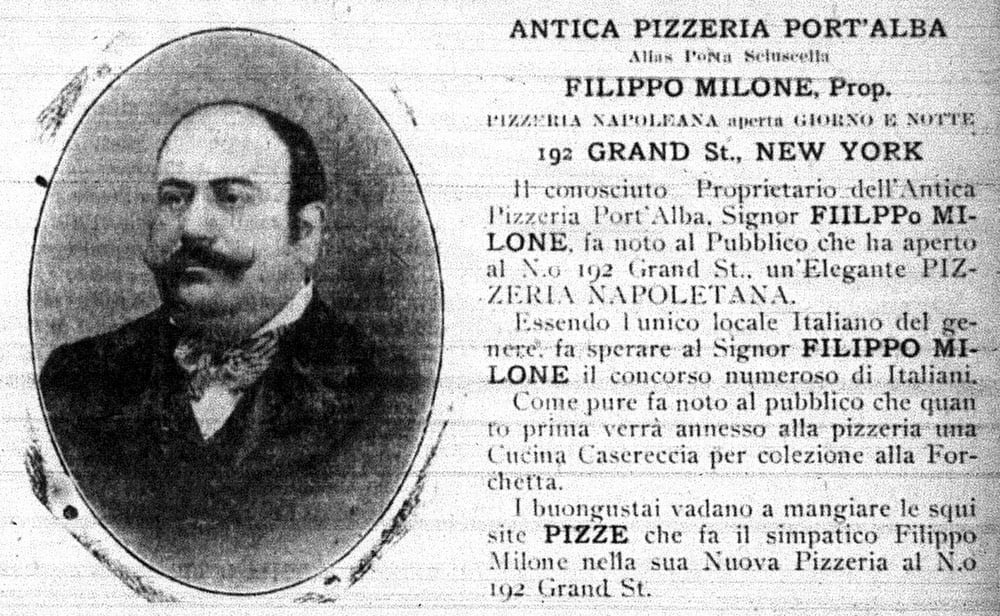
Of this forgotten older generation, one baker stands out. Filippo Milone came to New York in the late 19th century and likely established two of the most famous New York pizzerias that still exist today, Lombardi’s on Spring Street and John’s of Bleecker Street.
Regas explains, “Filippo Milone likely established pizzerias in at least six locations throughout New York City. Of these locations, three later became famous under different names: ‘Pop’s,’ ‘John’s,’ and ‘Lombardi’s.’ Pop’s in Brooklyn closed decades ago, but the other two in Manhattan still exist. Milone, a pioneer in what has become a $45 billion industry, later died in 1924, without children to preserve his story buried in an unmarked grave in Queens.”
Wow! This 1903 advertisement is for a pizzeria of Milone’s on Grand St.:
As for Lombardi’s founding in 1905, Regas has the receipts for that too:
While proof of that license has never materialized, Regas has tracked down Gennaro Lombardi’s birth record, naturalization papers, and other supporting documents that tell a different story. Gennaro Lombardi first came to America in November of 1904 at age 17, classified as a “laborer”. If he became involved with the pizzeria at 53 1/2 Spring Street in 1905, it was as an employee not as an owner. By that time, it had already been established as a pizzeria probably by Milone in 1898 but certainly by another proprietor named Giovanni Santillo who followed Milone in 1901.
This is as if some other dude we’ve never heard of wrote both the Declaration of Independence and the Federalist Papers and then handed them over to Adams Franklin Jefferson Madison Hamilton etc.
Regas is documenting his research here on an eventual book about all of this, due out sometime later this year. Boy oh boy, they’re gonna have to reprint a lot of NYC pizzeria menus with incorrect origin stories in them… (via @adamkuban)
Net neutrality has been explained using pizza at least three times. Jason flagged this dead-to-rights analogy by Craigslist founder Craig Newmark from 2006:
Let’s say you call Joe’s Pizza and the first thing you hear is a message saying you’ll be connected in a minute or two, but if you want, you can be connected to Pizza Hut right away. That’s not fair, right? You called Joe’s and want some Joe’s pizza. Well, that’s how some telecommunications executives want the Internet to operate, with some Web sites easier to access than others. For them, this would be a money-making regime.
Here is a simple metaphor: The telephone system, which has long been regulated to protect the public interest. You probably wouldn’t like it if you tried to order pizza from your favorite local place and were connected to a Papa John’s instead because it had got some special deal. Or if a Verizon telephone only connected to other Verizon phones. Obviously, there are a lot of differences between internet access and the telephone and how they work and how they are built, but the basic principle that essential communication systems ought to be non-discriminatory is the same.
However, the most deliberate and thorough consideration of Internet-as-pizza came before either of these interventions, and it came from the late Supreme Court Justice Antonin Scalia. In a dissent in 2005’s NCTA and FCC v. Brand X Internet Services’s decision, Scalia wrote:
If, for example, I call up a pizzeria and ask whether they offer delivery, both common sense and common “usage,” […] would prevent them from answering: ‘No, we do not offer delivery-but if you order a pizza from us, we’ll bake it for you and then bring it to your house.’ The logical response to this would be something on the order of, ‘so, you do offer delivery.’ But our pizza-man may continue to deny the obvious and explain, paraphrasing the FCC and the Court: ‘No, even though we bring the pizza to your house, we are not actually “offering” you delivery, because the delivery that we provide to our end users is “part and parcel” of our pizzeria-pizza-at-home service and is “integral to its other capabilities.”’… Any reasonable customer would conclude at that point that his interlocutor was either crazy or following some too-clever-by-half legal advice.
For Scalia, delivery is delivery. You buy the access to the internet — plus telephone, or cable, TV, or whatever it is you’re paying for — and you buy the access to the pipe. “It is therefore inevitable that customers will regard the competing cable-modem service as giving them both computing functionality
and the physical pipe by which that functionality comes to their computer —both the pizza and the delivery service that nondelivery pizzerias require to be purchased from the cab company.”
Like so many things, it’s a fiction to avoid regulation:
The Court contends that this analogy is inapposite because one need not have a pizza delivered… whereas one must purchase the cable connection in order to use cable’s ISP functions. But the ISP functions provided by the cable company can be used without cable delivery — by accessing them from an Internet connection other than cable. The merger of the physical connection and Internet functions in cable’s offerings has nothing to do with the “inextricably intertwined” nature of the two (like a car and its carpet), but is an artificial product of the cable company is marketing decision not to offer the two separately, so that the Commission could (by the Declaratory Ruling under review here) exempt it from common-carrier status.
Of course, getting the pizza (or the Internet) delivered to your house is the whole point, as the telecommunications companies understood full well:
The myth that the pizzeria does not offer delivery becomes even more difficult to maintain when the pizzeria advertises quick delivery as one of its advantages over competitors. That, of course, is the case with cable broadband.
Scalia was a first-rate jerk, and often extraordinarily wrong, but was generally solid on tech issues. He understood them, not in a technical way, but in a practical one. He also understood how to reason about them, both from analogy and from principle. He was never bumfuzzled, and was rarely compromised. His conservative successors haven’t proved to have the same qualities.
It’s good to look back at this, though, because it shows that we’ve been in an endless tug of war over net neutrality for more than twenty years. Even in 2014, it looked like the Obama-appointed regulators were as likely to gut net neutrality as reinforce and codify it. The new deregulation of the internet is a loss, but it doesn’t have to be a permanent one, unless we let it.
From the moment you walked in the place, you knew it was something special. You knew this was going to be something you’d remember, and it all started with the decor. The interior didn’t look like a fast food joint with it’s huge, sprawling windows, and cheap looking walls, or tiled floors. When you walked in, you were greeted by brick walls, with smaller windows, that had thick red fabric curtains pulled back, and a carpeted floor. It just felt higher-class than walking into McDonalds or Burger King.
The booths were high-backed, with thick padded vinyl seats and back rests. The high backs was also different from your usual eating out experience. These high backs gave you a sense of privacy, which was great for a date night. Also great for a date night were the candles on the tables. Those little red glass candles that were on every table, and were lit when you got to your seat. It was a little thing, but when added to everything else, it was quite the contribution. Your silverware was wrapped in a thick, cloth napkin that beat the heck out of the paper napkins everyone else was using at the time. And you could always count on the table being covered by a nice, red and white, checkered table cloth.
Pizza Hut was the #1 eating-out destination for me as a kid. My family never ate out much, so even McDonald’s, Arby’s, or Hardee’s was a treat. But Pizza Hut was a whole different deal. Did I enjoy eating salad at home? No way. But I had to have the salad bar at Pizza Hut. Did I normally eat green peppers, onions, and black olives? Nope…but I would happily chow down on a supreme pizza at Pizza Hut. And the deep dish pan pizza…you couldn’t get anything like that in rural Wisconsin, nor could you easily make it at home. Plus it was just so much food…you could eat as much as you wanted and there were still leftovers to take home. Plus, with those high-backed booths, you could play paper football without having the extra points go sailing into the next booth.
The math of why bigger pizzas are such a good deal is simple. A pizza is a circle, and the area of a circle increases with the square of the radius.
So, for example, a 16-inch pizza is actually four times as big as an 8-inch pizza.
And when you look at thousands of pizza prices from around the U.S., you see that you almost always get a much, much better deal when you buy a bigger pizza.
This is a long zoom look at how pizza gets delivered to hungry people. It starts by looking at the routes taken by a Dominos delivery person during a typical night and slowly zooms out to reveal the pizza giant’s national supply chain.
Embark with Kwon on a trip that begins with a pizza delivery route in New York City, then goes across the country to California’s Central Valley, where nearly 50 percent of America’s fruits, nuts and vegetables are grown, and into the heartland for an aerial look at our farmlands.
One thing you might not be familiar with is the fact that some NYC pizzerias use anthracite coal to cook their pizzas. (Then again, I know that Brooklyn-based Grimaldi’s has made inroads into Texas, so maybe you do know coal-fired pizza.) Pizza geeks have long been into coal-fired pizzas. The ovens cook at a hot-enough temperature that a skilled pizzamaker can create an amazing crust that is both crisp and chewy at the same time and that is not dried out and tough. Also, the way that most of these old-school coal-oven places make the pizza, they just sort of know how to make a nice balanced pie, one that doesn’t go too heavy on the sauce or pile on too much cheese.
Take five minutes to read this and you’ll be talking NYC pizza like an expert.
Why can’t you get a slice of pizza at John’s on Bleecker or Patsy’s? Allegedly because of Al Capone:
In his 1981 book on the mob called Vicious Circles: The Mafia in the Marketplace, the late Jonathan Kwitny detailed how Al Capone — who owned a string of dairy farms near Fond Du Lac, Wisconsin — forced New York pizzerias to use his rubbery mob cheese, so different from the real mozzarella produced here in New York City since the first immigrants from Naples arrived in Brooklyn around 1900.
As the story goes, the only places permitted to use good mozzarella made locally were the old-fashioned pizza parlors like Lombardi’s, Patsy’s, and John’s, who could continue doing so only if they promised to never serve slices. According to Kwitny, this is why John’s Pizzeria on Bleecker Street still has the warning “No Slices” on its awning today.
Over at Serious Eats, Kenji Lopez-Alt assures us that while you can’t make restaurant-quality Neapolitan pizza at home, you can come damn close. Best thing is, his technique doesn’t involve lining your oven with bricks and is actually as easy as making regular pizza at home.
After cooking for around a minute and a half, the bottom crust achieved the perfect degree of char-even better than what I was getting on the stone. Interestingly enough, the pan was actually cooler than the stone I was using, maxing out at around 450 degrees. So how does a 450 degree pan brown better and faster than a 550 degree stone? It’s a matter of heat capacity and density.
The heat capacity of a material is directly related to the amount of energy that a given mass of material holds at a given temperature. Even though stone has almost twice the heat capacity than steel (.2 kcal/kg C vs. .1 kcal/kg C), it loses in two ways: it is far less dense than steel, and it has a much lower rate of heat conduction than steel. The pizza cooking in a skillet is not just getting energy from the pan-it’s getting energy from the burner below the pan as it gets rapidly conducted through the metal.
It’s a clear demonstration of how when cooking foods, what matters it the amount of energy transferred, not just the temperature you cook at. The two are often directly related, but not always.
I have said it before but will repeat: I love Kenji’s nerdiness about the science combined with the ability to come up with the solution that’s easiest for non-nerds to appreciate and implement. It is a rare and wonderful thing to observe.
A round pizza with radius ‘z’ and thickness ‘a’ has the volume pi*z*z*a. That and other math jokes are available on Wikipedia. Don’t you love it when people explain jokes:
In this case, DEAD refers to a hexadecimal number (57005 base 10), not the state of being no longer alive.
It is actually pretty amazing how well the oven works. The first thing we made after pizza was a roasted chicken. I just can’t describe how amazing it was. Not to mention the pizzas. They cook in about 90 seconds, and when I pulled the first one out of the oven, and the backyard smelled like a pizzeria, we knew all the work was worth it.
Mark and I work in the same office and it’s nice to hear that his daily phone conversations about stucco, stucco suppliers, stucco styles, and stucco application techniques have resulted in success.
“Water,” Batali says. “Water is huge. It’s probably one of California’s biggest problems with pizza.” Water binds the dough’s few ingredients. Nearly every chemical reaction that produces flavor occurs in water, says Chris Loss, a food scientist with the Culinary Institute of America. “So, naturally, the minerals and chemicals in it will affect every aspect of the way something tastes.”
Update: That legendary tap water was supposedly responsible for NYC-style bagels as well until Finagle A Bagel founder Larry Smith drove some Boston tap water to NYC and compared bagels made with the water from the two cities.
“There was absolutely no difference between them,” Smith reported. “What makes the difference is equipment, process and ingredients.”
There are a lot of variables for such a simple food. But these 3 FAR outweigh the others:
1. High Heat 2. Kneading Technique 3. The kind of yeast culture or “starter” used along with proper fermentation technique
All other factors pale in comparison to these 3. I know that people fuss over the brand of flour, the kind of sauce, etc. I discuss all of these things, but if you don’t have the 3 fundamentals above handled, you will be limited.
Once the Italian immigrants brought their Naples-style pies to the States, it evolved a bit in the Italian neighborhoods of New York to something I’ve seen referred to as “New York-Neapolitan.” This is basically what all the coal-oven pizzerias of New York serve. It follows the tenets of Neapolitan style in that it’s thin-crusted, cooked in an ultra-hot oven, and uses a judicious amount of cheese and sauce (sauce which is typically fresh San Marzano tomatoes, as in Naples). It deviates from Naples-style in that it’s typically larger, a tad thinner, and more crisp.
This page generates a random pizza for you. I got a thin crust pie with red sauce, topped with mozzarella, red peppers, tomatoes, black olives, green peppers, and breaded chicken. Yum?






Stay Connected