Ok, I said no more eclipse posts (maybe) and then posted like two or three more, but really this is the last one — maybe! In 1973, a group of scientists witnessed the longest ever total solar eclipse by flying in the shadow (umbra) of the moon in a Concorde prototype for 74 minutes over the Sahara desert. From the abstract of a paper in Nature about the flight:
On June 30, 1973, Concorde 001 intercepted the path of a solar eclipse over North Africa, Flying at Mach 2.05 the aircraft provided seven observers from France, Britain and the United States with 74 min of totality bounded by extended second (7 min) and third (12 min) contacts. The former permitted searches for time variations of much longer period than previously possible and the latter provided an opportunity for chromospheric observations of improved height resolution. The altitude, which varied between 16,200 and 17,700 m, freed the observations from the usual weather problems and greatly reduced atmospheric absorption and sky noise in regions of the infrared.
Mach 2.05 = 1573 mph = 2531 km/h. 17,700 m = 58,000 ft. They added portholes to the roof of the plane for better viewing and data gathering. This page on Xavier Jubier’s site contains lots of amazing details about the flight, including a map of the flight’s path compared to the umbra, photos of the retrofitted plane, and a graph of the umbra’s velocity across the surface of the Earth (which shows that for at least part of the eclipse, the Concorde was actually outrunning the moon’s shadow).
By flying inside the umbral shadow cone of the Moon at the same speed, the Concorde was going to stay in the darkness for nearly 74 minutes, the time for astronomers and physicists on board to do all the experiences they could imagine to complete during this incredible period of black Sun. They were able to achieve in one hour and fifteen minutes what would have taken decades by observing fifteen total solar eclipses from places that would have not necessarily gotten clear skies.
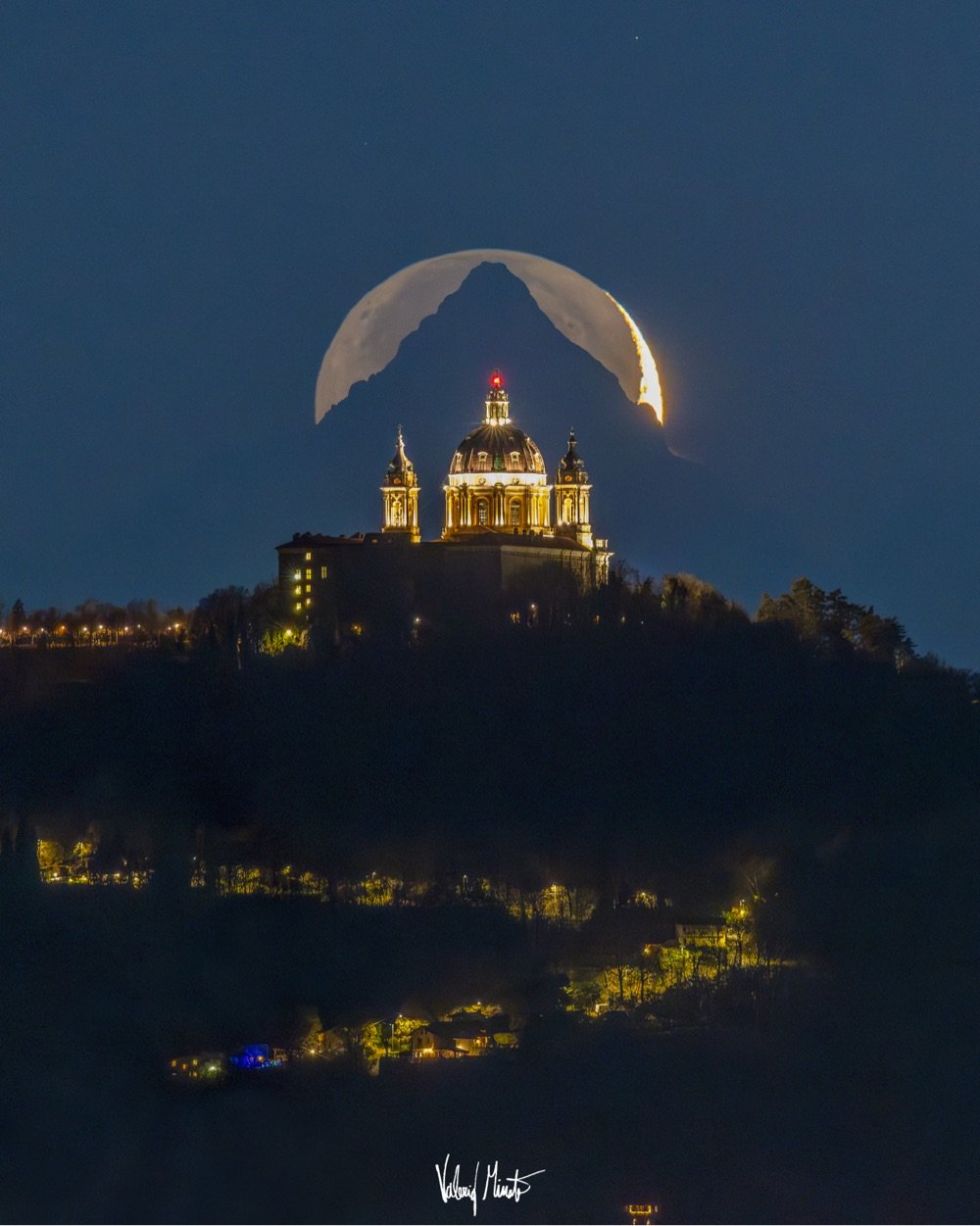
Taken in Piemonte, Italy, the cathedral in the foreground is the Basilica of Superga, the mountain in the middle is Monviso, and, well, you know which moon is in the background. Here, even though the setting Moon was captured in a crescent phase, the exposure was long enough for doubly reflected Earthlight, called the da Vinci glow, to illuminate the entire top of the Moon.
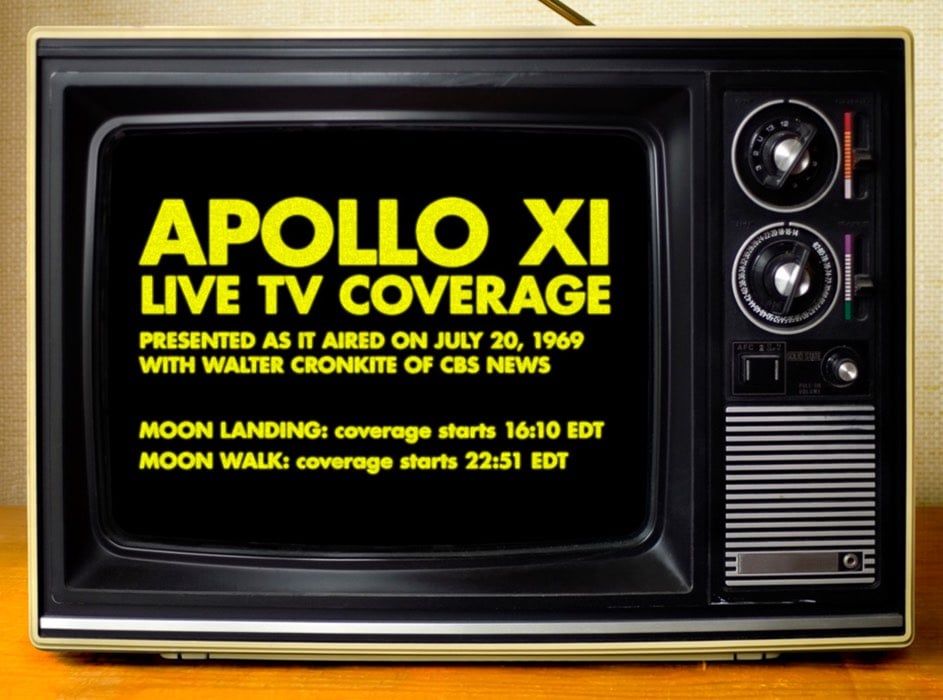
54 years ago today, on July 20, 1969, Neil Armstrong & Buzz Aldrin landed on the Moon and went for a little walk. For the 15th year in a row, you can watch the original CBS News coverage of Walter Cronkite reporting on the Moon landing and the first Moon walk on a small B&W television, synced to the present-day time. Just open this page in your browser today, July 20th, and the coverage will start playing at the proper time. Here’s the schedule (all times EDT):
4:10:30 pm: Moon landing broadcast starts
4:17:40 pm: Lunar module lands on the Moon
4:20:15 pm - 10:51:26 pm: Break in coverage
10:51:27 pm: Moon walk broadcast starts
10:56:15 pm: First step on Moon
11:51:30 pm: Nixon speaks to the Eagle crew
12:00:30 am: Broadcast end (on July 21)
Set an alarm on your phone or calendar! Also, this works best on an actual computer but I think it functions ok on phones and tablets if necessary.
Back in 2018, I wrote a bit about what to look out for when you’re watching the landing:
The radio voices you hear are mostly Mission Control in Houston (specifically Apollo astronaut Charlie Duke, who acted as the spacecraft communicator for this mission) and Buzz Aldrin, whose job during the landing was to keep an eye on the LM’s altitude and speed — you can hear him calling it out, “3 1/2 down, 220 feet, 13 forward.” Armstrong doesn’t say a whole lot…he’s busy flying and furiously searching for a suitable landing site. But it’s Armstrong that says after they land, “Houston, Tranquility Base here. The Eagle has landed.”. Note the change in call sign from “Eagle” to “Tranquility Base”. :)
Two things to listen for on the broadcast: the 1201/1202 program alarms I mentioned above and two quick callouts by Charlie Duke about the remaining fuel towards the end: “60 seconds” and “30 seconds”. Armstrong is taking all this information in through his earpiece — the 1202s, the altitude and speed from Aldrin, and the remaining fuel — and using it to figure out where to land.
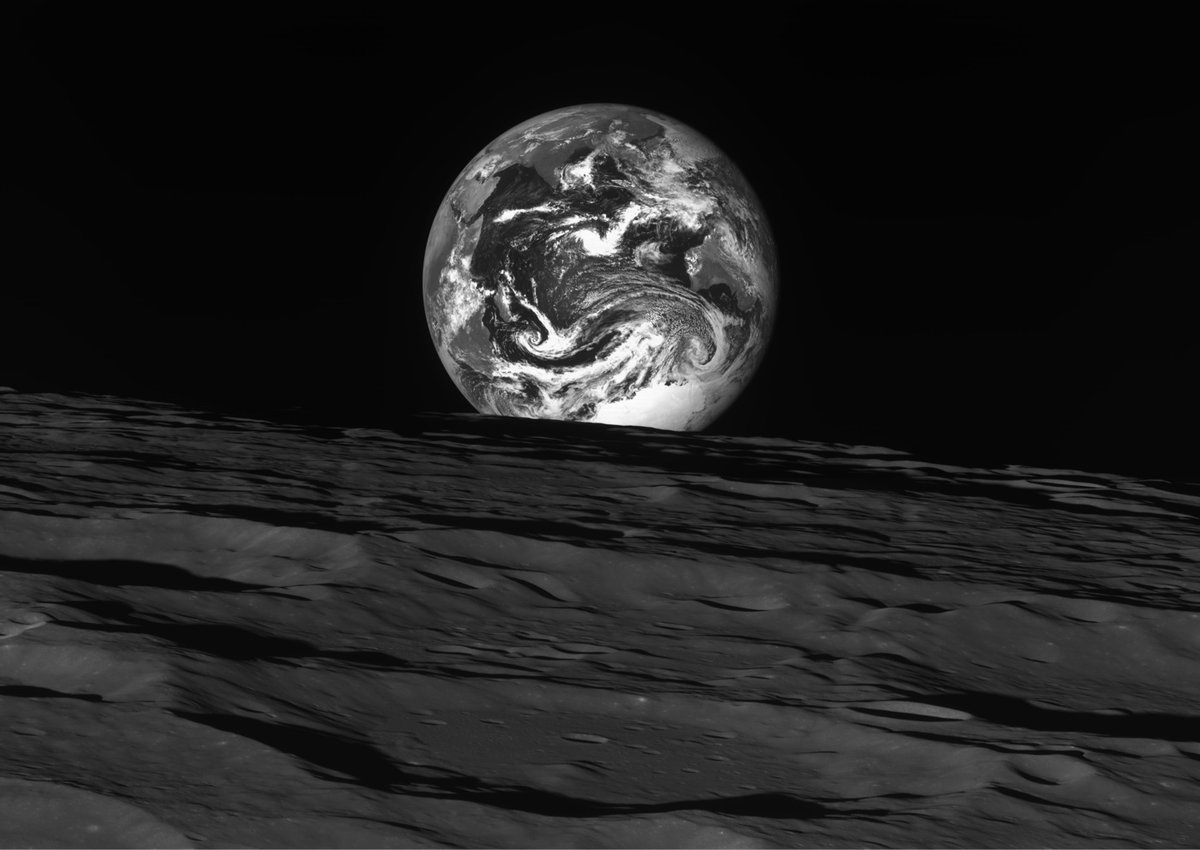
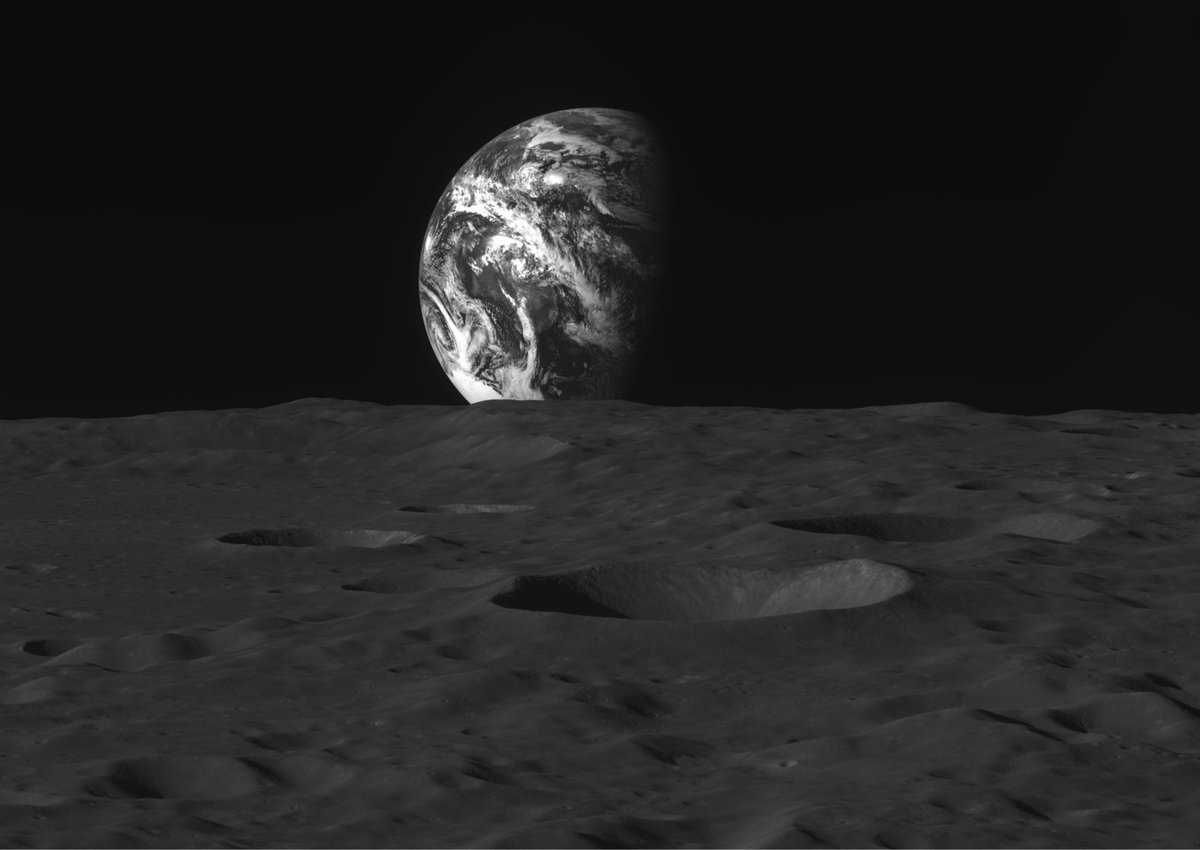
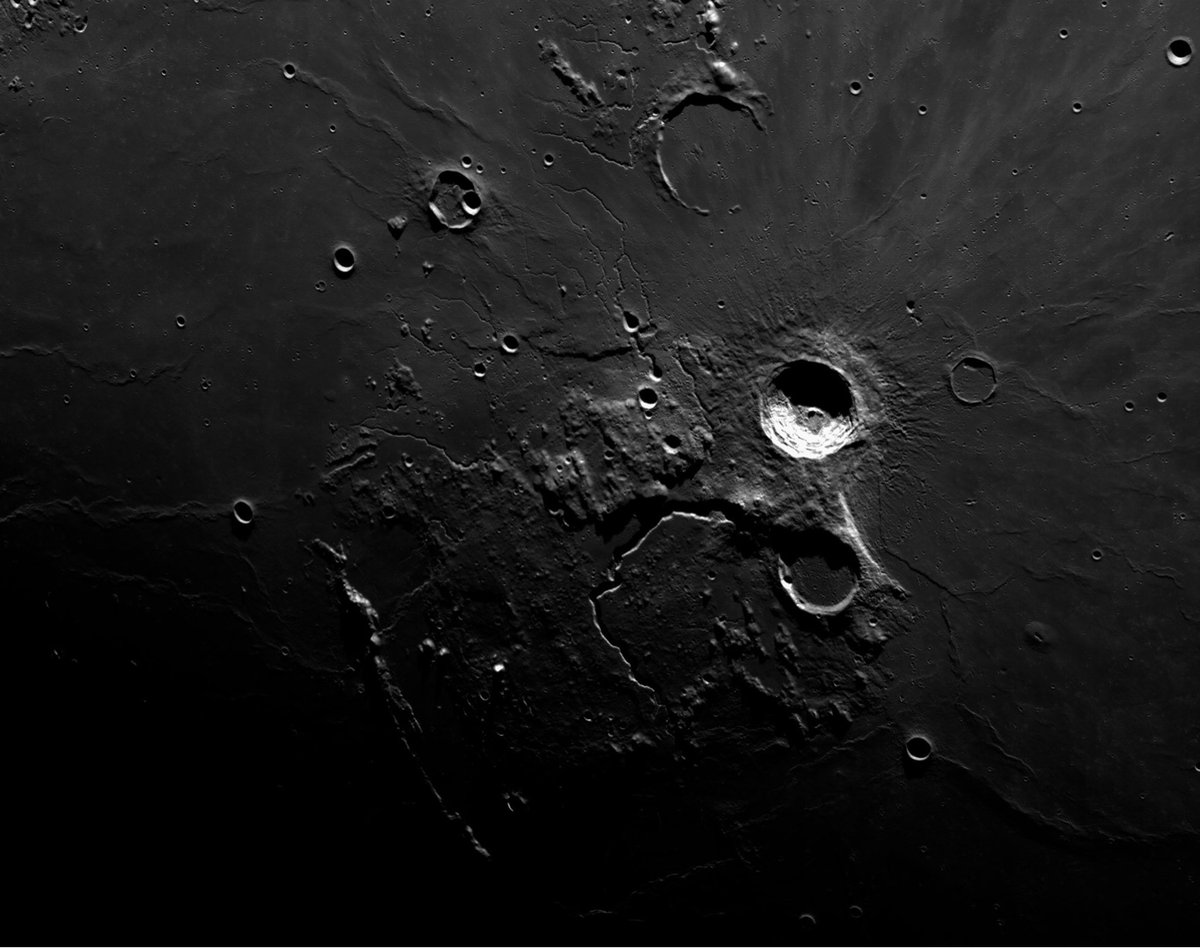
South Korea currently has a probe called Danuri orbiting the Moon at an altitude of about 62 miles above the surface. It’s just begun its mission but has already sent back some black & white photos of the Moon and the Earth, including the two above. Over at EarthSky, Dave Adalian says these shots “rival the work of legendary nature photographer Ansel Adams” and it’s difficult to disagree.
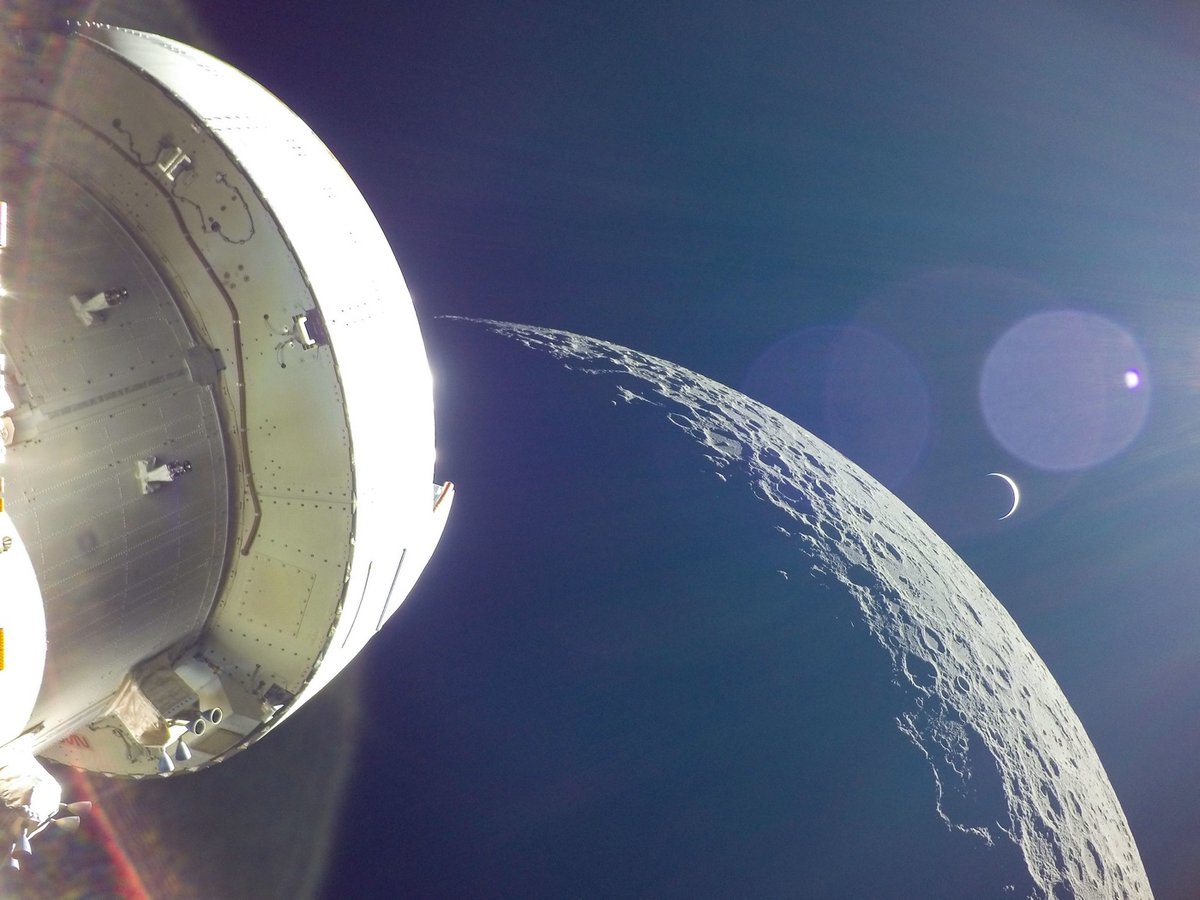
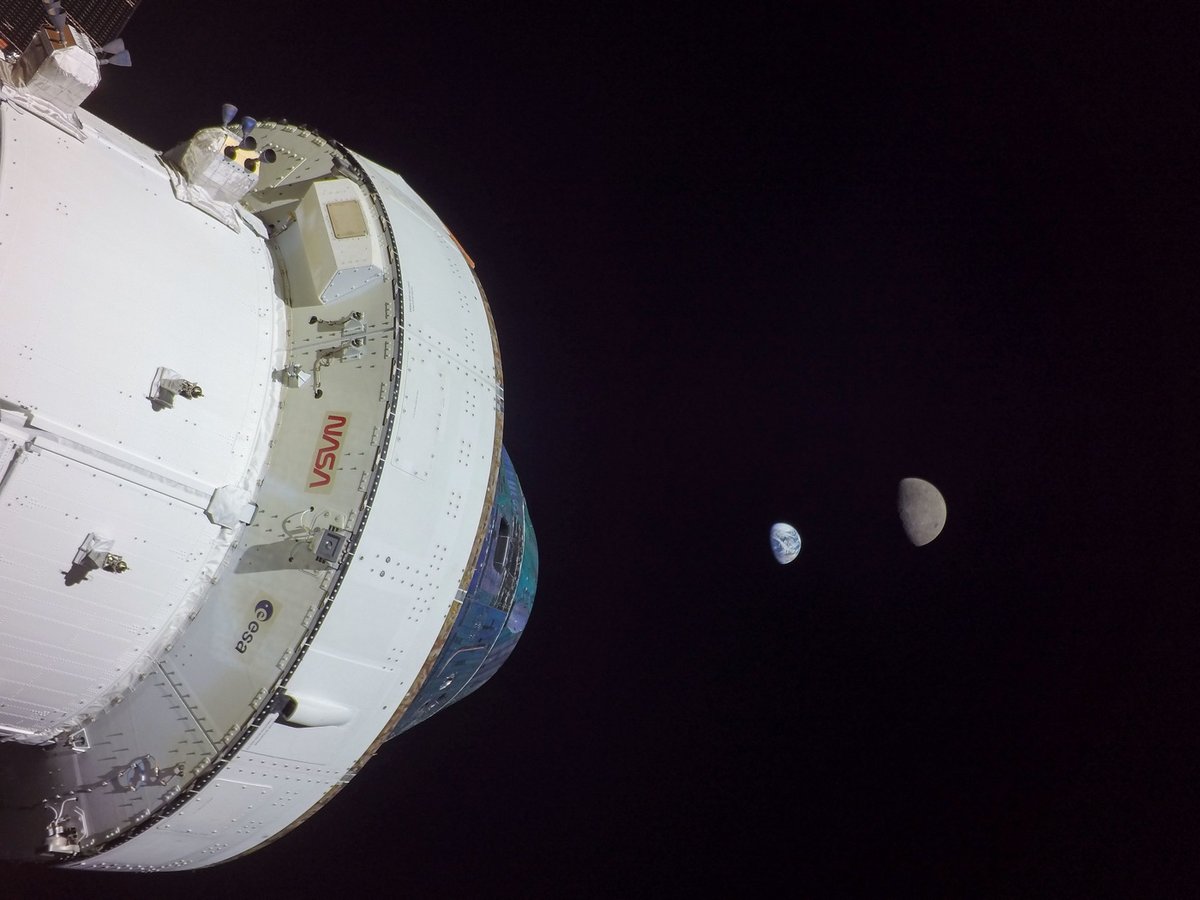
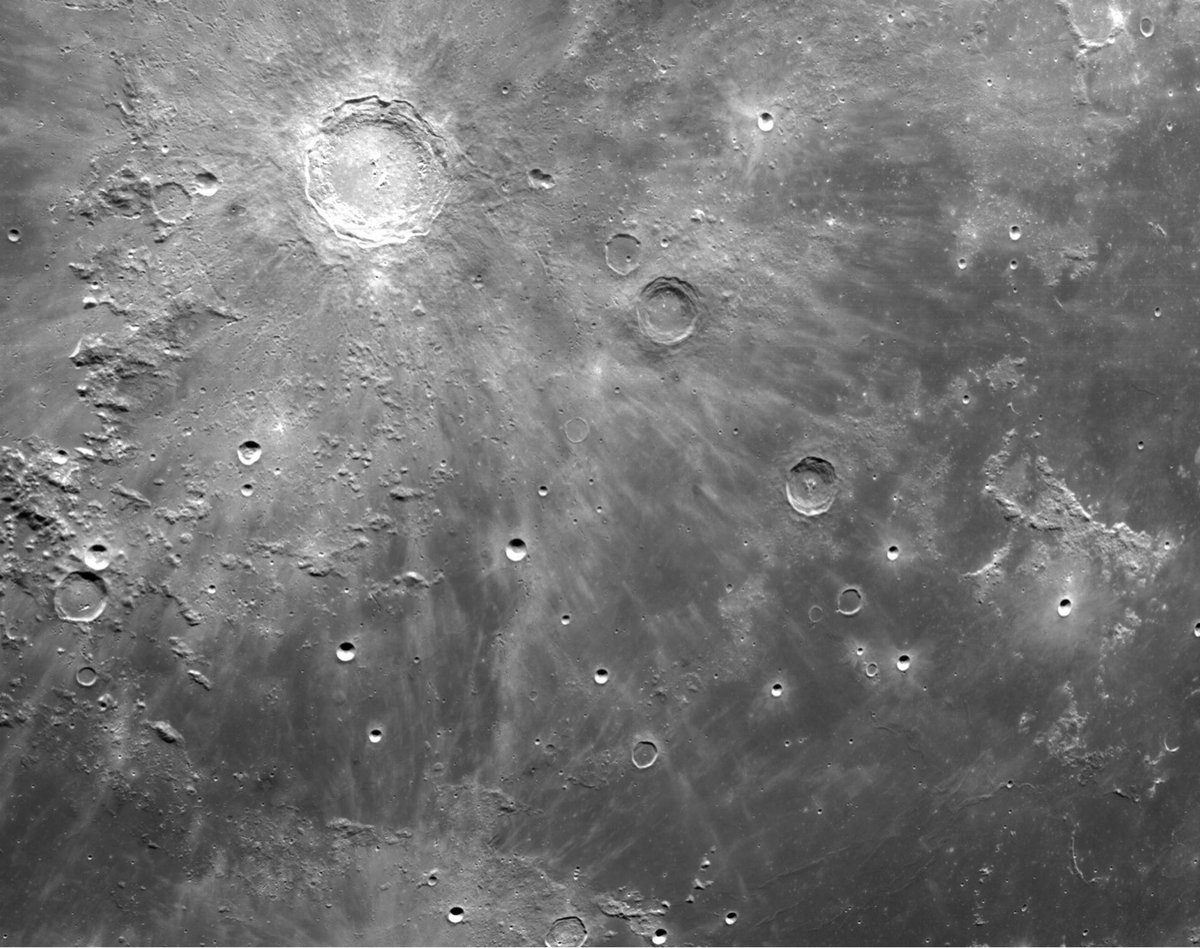
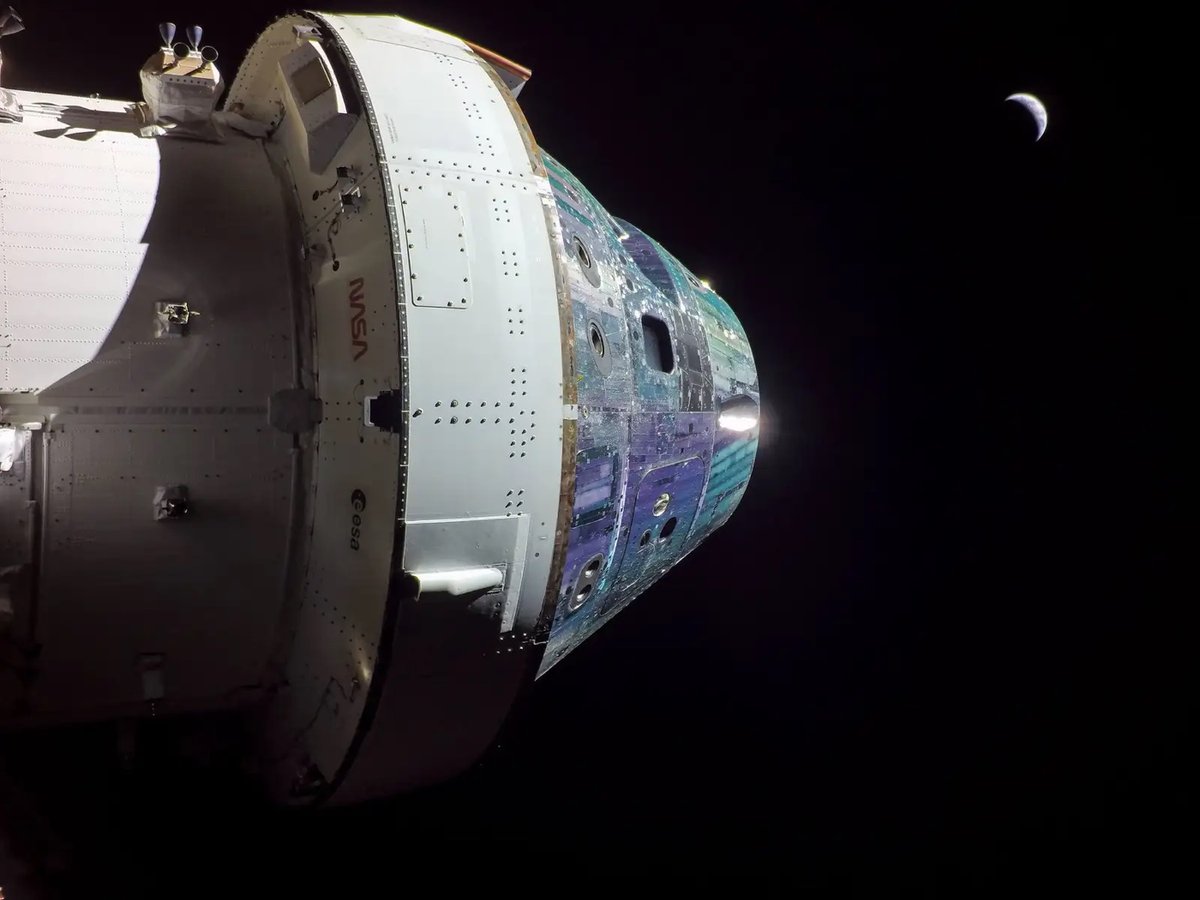
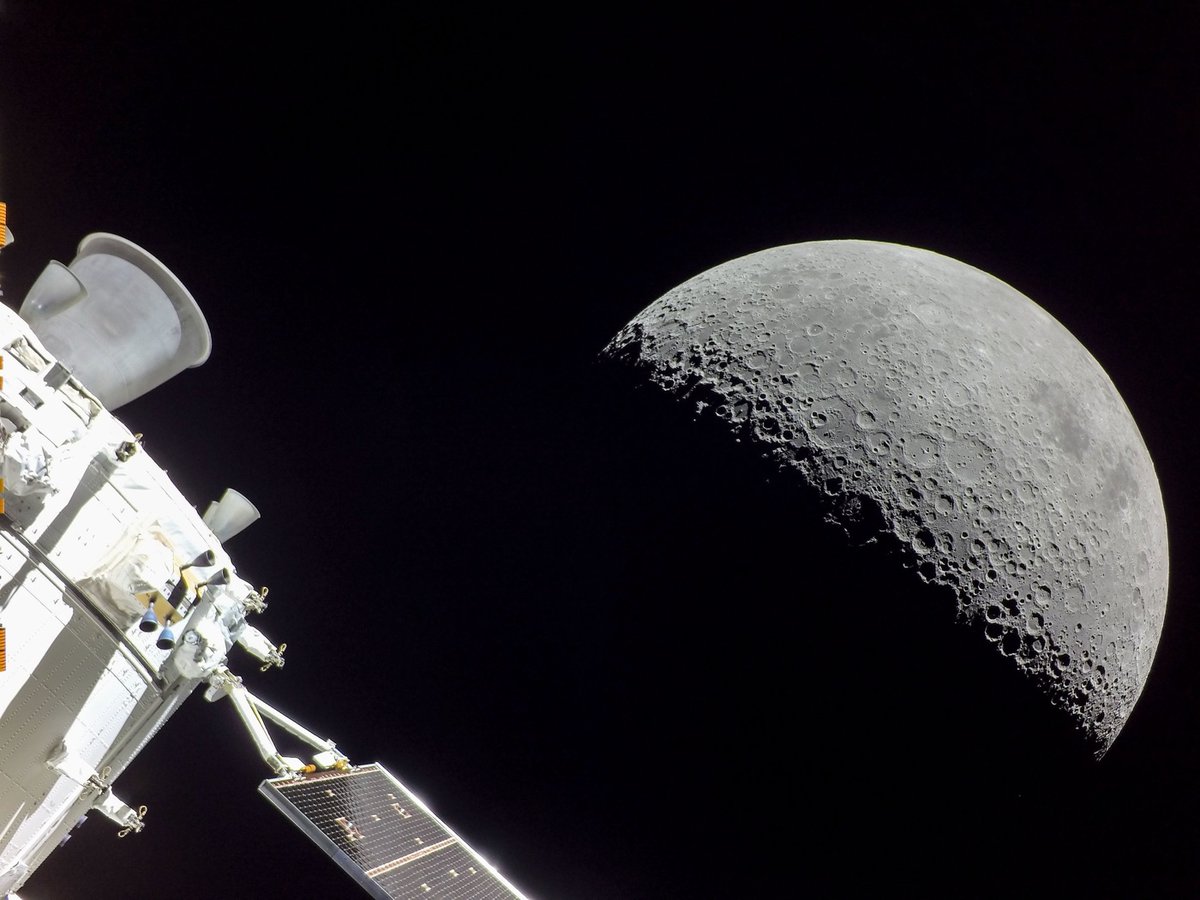
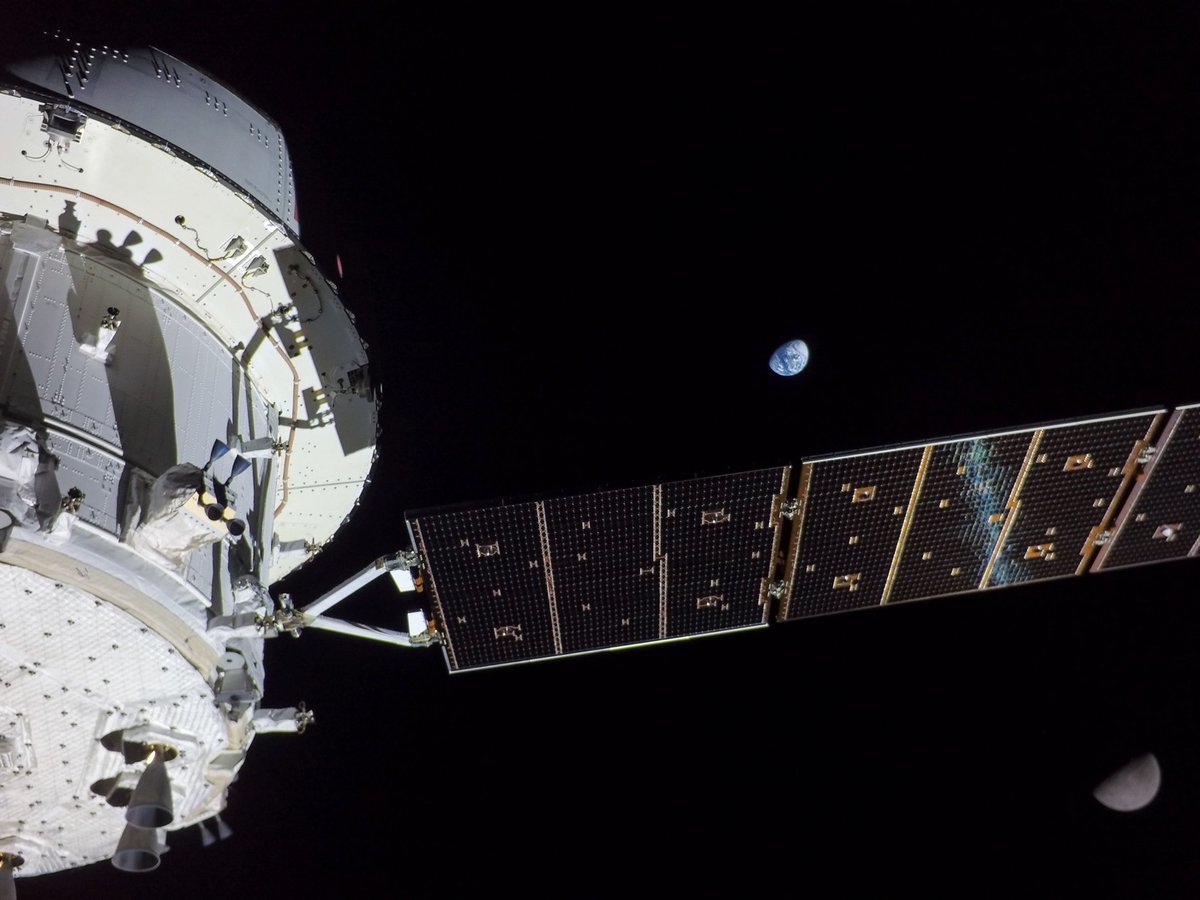
Over the weekend, NASA’s Artemis I mission returned from a 25-day trip to the Moon. The mission was a test-run of the rockets, systems, and spacecraft that will return humans to the surface of the Moon. Visual imaging has been an integral part of even the earliest space missions — strap a camera to a spacecraft, let the people see what space looks like, and they will be inspired. Well, the photographs returned by Artemis I’s Orion spacecraft have certainly been inspirational. Working from NASA’s archive of images (on Flickr too), I’ve selected some of the most interesting and dramatic photos from the mission. The one at the top, showing a crescent Earth rising over the Moon’s surface, might be one of my favorite space photos ever (and that’s really saying something) — you can see a bigger version of it here.
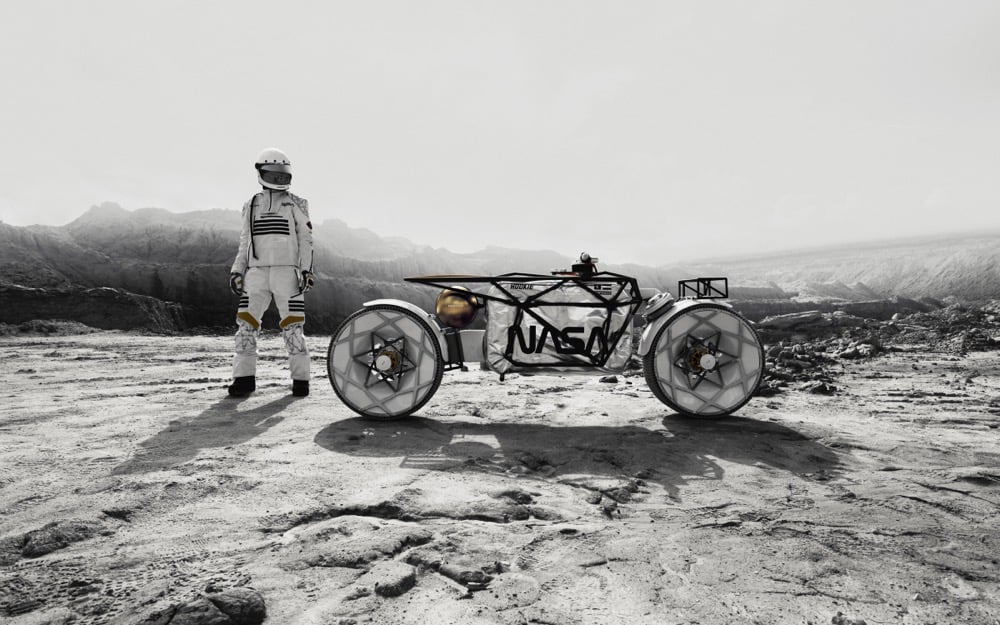
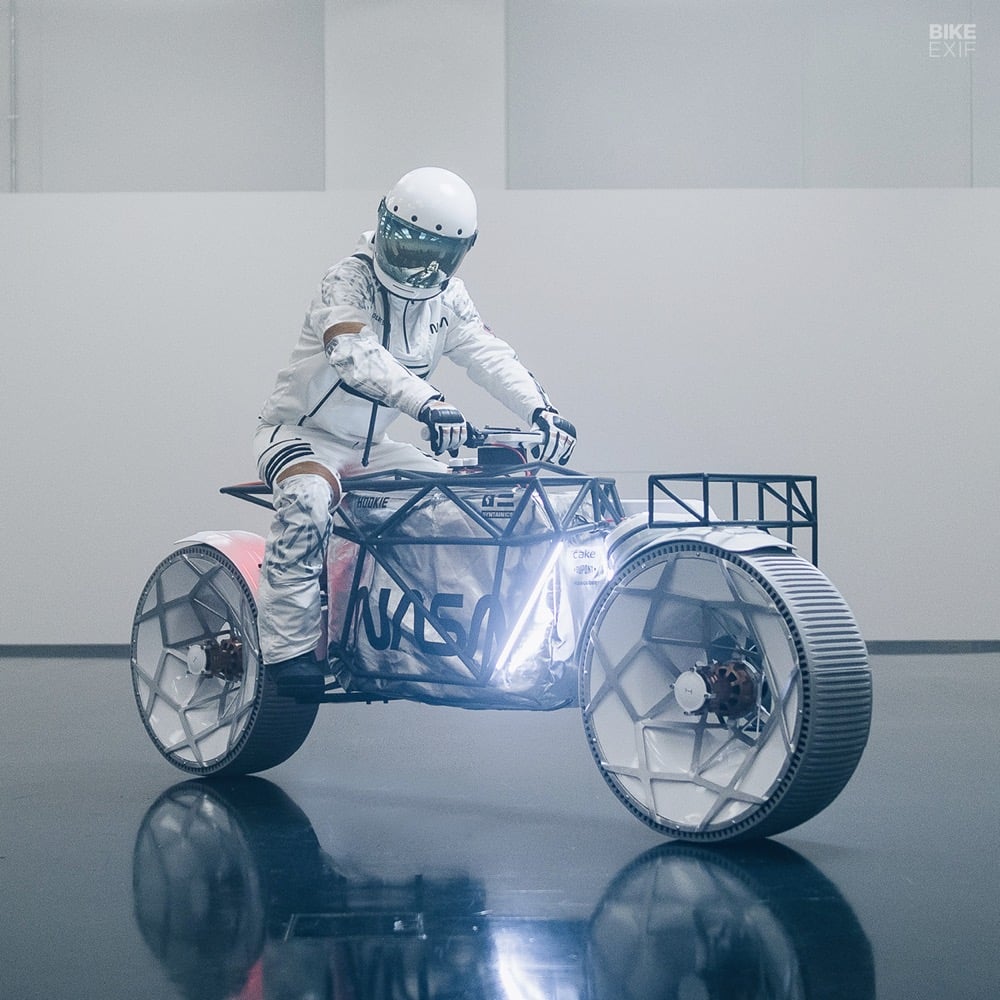
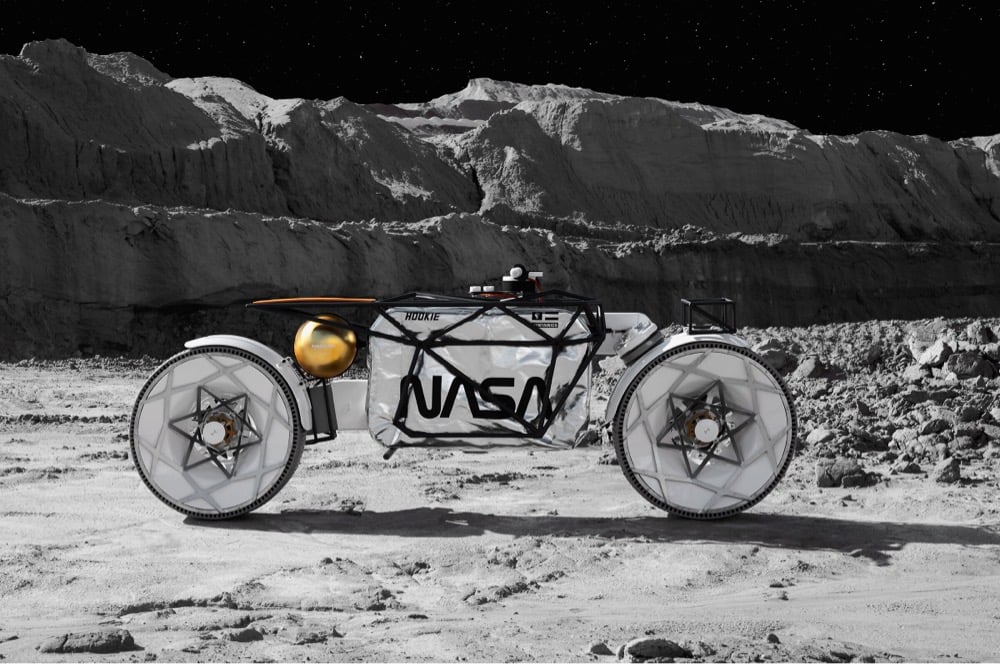
Regarding flat track racing on the moon, I would prefer some big gaps and jumps more than turning left around an oval. With almost one-sixth of Earth’s gravity, I’d need only a small bump to jump 10 meters — that would be fun! Maybe the Tardigrade inspires space-addicted people and engineers for upcoming lunar missions, and I would be more than happy to be a tiny part of that.
No doubt motivated by this month’s release of Moonfall, the latest movie from disaster shlockmeister Roland Emmerich, Kurzgesagt has made a video that shows what would happen to civilization should the Moon somehow get knocked from its orbit and head straight for the Earth. Spoiler: the Moon doesn’t even need to reach us to kill almost all life on the planet.
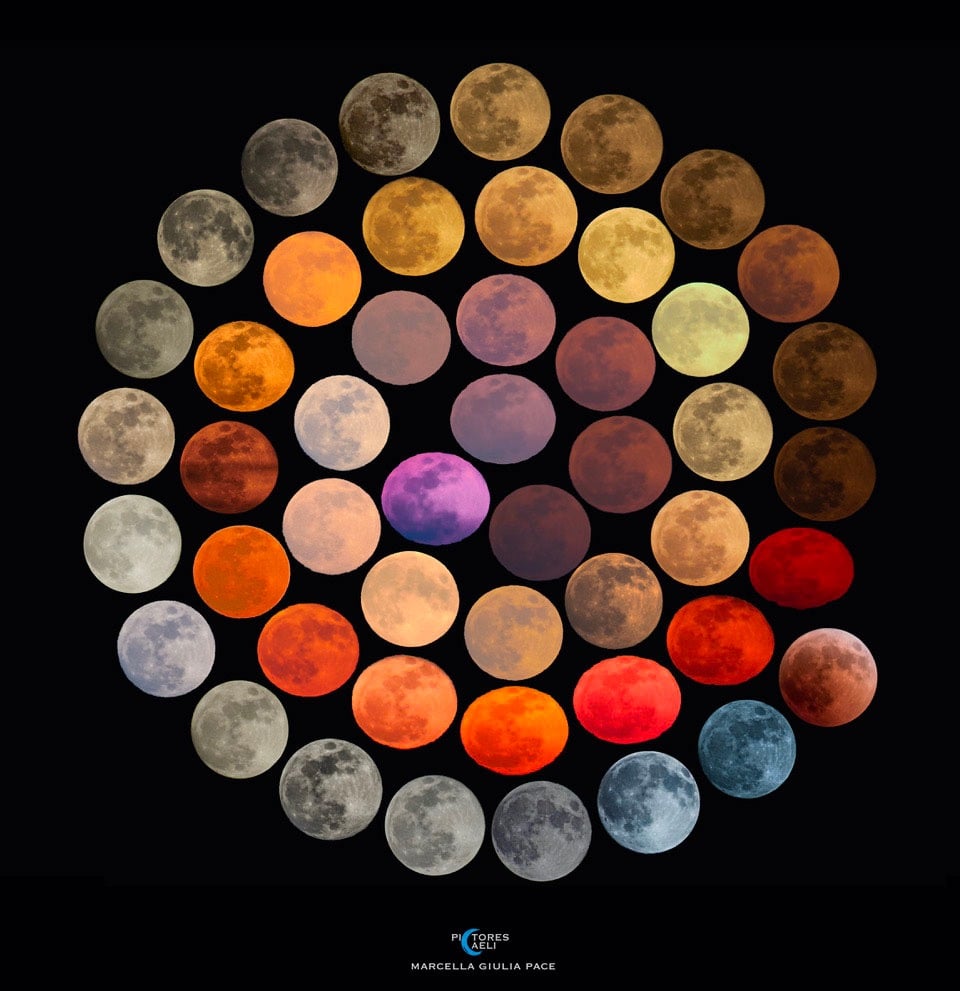
I have collected some of my Full Moon shots taken over the past 10 years. I selected the shades of color with which the Moon was filmed in front of my lens and my eyes.
The atmosphere gives different colors to our satellite (scattering) based on its height with respect to the horizon, based on the presence of humidity or suspended dust. The shape of the Moon also changes: at the bottom of the horizon, refraction compresses the lunar disk at the poles and makes it look like an ellipse.
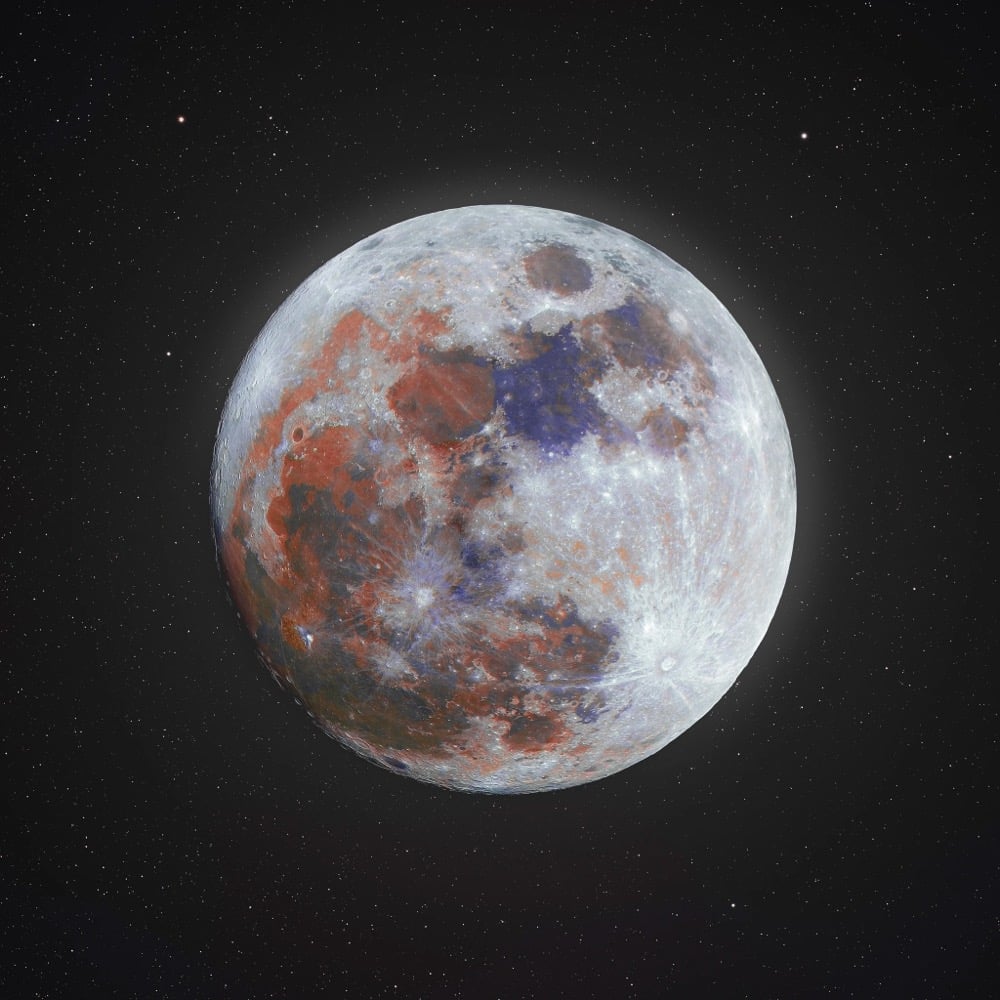
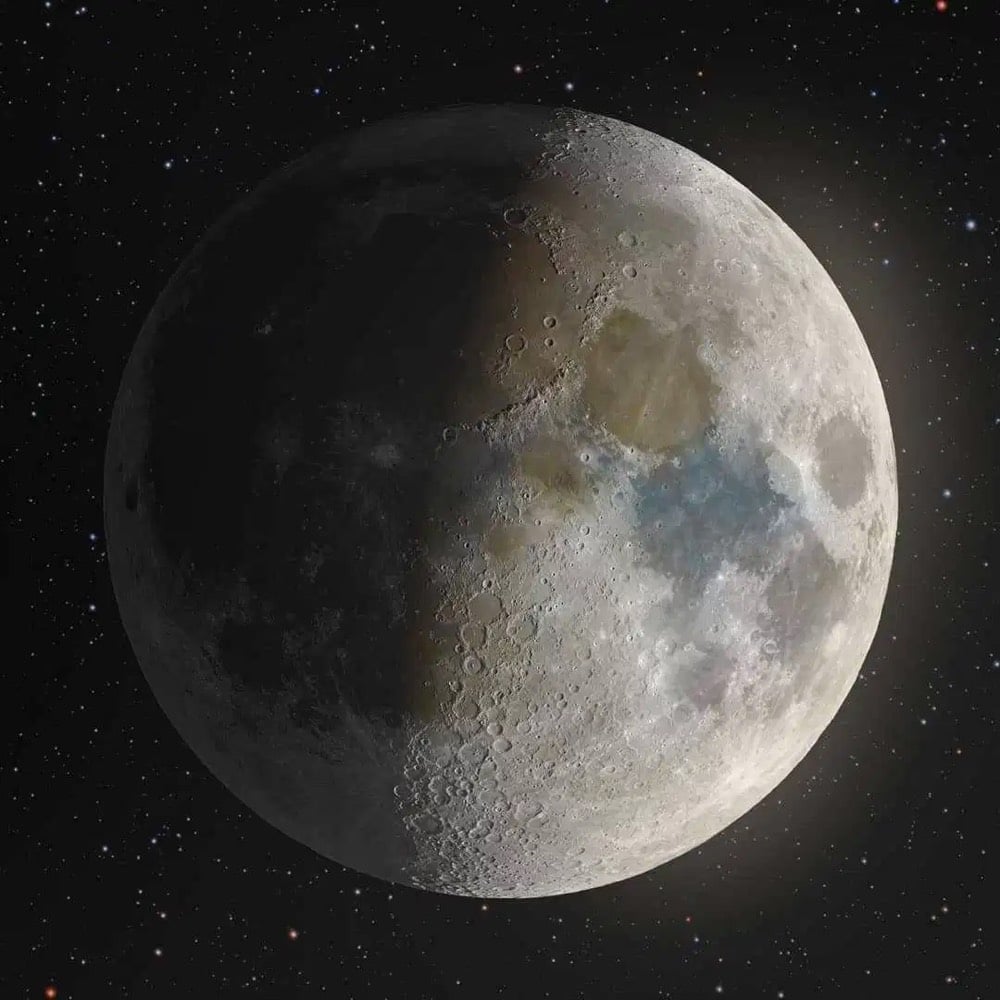
Back to this image, this was captured through a telescope and involved capturing thousands of frames to reveal the details. But what about the colors? The moon is gray, of course, but not *perfectly* gray. Some areas have a subtle blue tint, and others have a more orange tint. By teasing out those subtle colors, I can reveal the mineral composition of the moon! Blues denote titanium presence, while orange shows iron and feldspar present in the regolith. You can also see how impacts paint the surface with fresh color in the ejecta as they churn up material.
A print is available, but only for a very limited time (~6 more hours as of pub time).
Last month I shared a video of the Earth rising over the surface of the Moon captured by Japan’s Kaguya orbiter. It’s a good clip but quite short and over-narrated. Seán Doran took several Earthrise & Earthset sequences filmed by Kaguya, remastered & upsampled them to 4K resolution, and stitched them together into this wonderful video, set to music by Jesse Gallagher. One of the sequences, which begins around the 5-minute mark, captures a solar eclipse of the Sun by the rising Earth. I hadn’t seen this footage before and had to pick my jaw up off the floor — absolutely spectacular.
Captured by the Kaguya lunar orbiter on April 5, 2008, this is an HD video of the Earth rising over the surface of the Moon. Watching stuff like this always puts me in a different frame of mind. (Turn off the sound if you don’t want to hear the super-cheesy narration.)
Ariel Avissar made this 2.5-minute supercut of giant moons from movies — like E.T., The Nightmare Before Christmas, Spider-Man, The Lion King, Black Swan, Despicable Me — accompanied by Frank Sinatra’s rendition of Fly Me to the Moon.
Using images from the Kaguya orbiter, Seán Doran has constructed a 4-hour realtime orbit of the Moon. Feel free to pair with your favorite piece of relaxing music for a meditative viewing experience.
Fifty-one years ago today, on July 20, 1969, Neil Armstrong & Buzz Aldrin landed on the Moon and went for a little walk. For the 12th year in a row, you can watch the original CBS News coverage of Walter Cronkite reporting on the Moon landing and the first Moon walk on a small B&W television, synced to the present-day time. Just open this page in your browser today, July 20th, and the coverage will start playing at the proper time. Here’s the schedule (all times EDT):
4:10:30 pm: Moon landing broadcast starts
4:17:40 pm: Lunar module lands on the Moon
4:20:15 pm - 10:51:26 pm: Break in coverage
10:51:27 pm: Moon walk broadcast starts
10:56:15 pm: First step on Moon
11:51:30 pm: Nixon speaks to the Eagle crew
12:00:30 am: Broadcast end (on July 21)
Set an alarm on your phone or calendar!
This is one of my favorite things I’ve ever done online…here’s what I wrote when I launched the project in 2009:
If you’ve never seen this coverage, I urge you to watch at least the landing segment (~10 min.) and the first 10-20 minutes of the Moon walk. I hope that with the old time TV display and poor YouTube quality, you get a small sense of how someone 40 years ago might have experienced it. I’ve watched the whole thing a couple of times while putting this together and I’m struck by two things: 1) how it’s almost more amazing that hundreds of millions of people watched the first Moon walk *live* on TV than it is that they got to the Moon in the first place, and 2) that pretty much the sole purpose of the Apollo 11 Moon walk was to photograph it and broadcast it live back to Earth.
The radio voices you hear are mostly Mission Control in Houston (specifically Apollo astronaut Charlie Duke, who acted as the spacecraft communicator for this mission) and Buzz Aldrin, whose job during the landing was to keep an eye on the LM’s altitude and speed - you can hear him calling it out, “3 1/2 down, 220 feet, 13 forward.” Armstrong doesn’t say a whole lot…he’s busy flying and furiously searching for a suitable landing site. But it’s Armstrong that says after they land, “Houston, Tranquility Base here. The Eagle has landed.”. Note the change in call sign from “Eagle” to “Tranquility Base”. :)
Using thousands of original photographs taken by astronauts during the Apollo missions, motion designer Christian Stangl and composer Wolfgang Stangl worked for 18 months to create this animated short film depicting a flight to the Moon, culminating in a landing and the exploration of the surface. (via moss & fog)
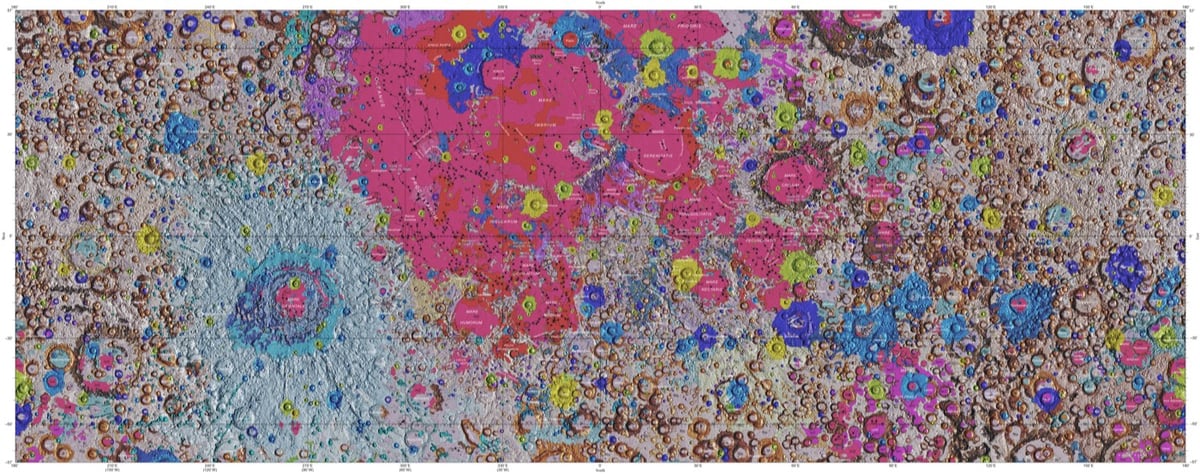
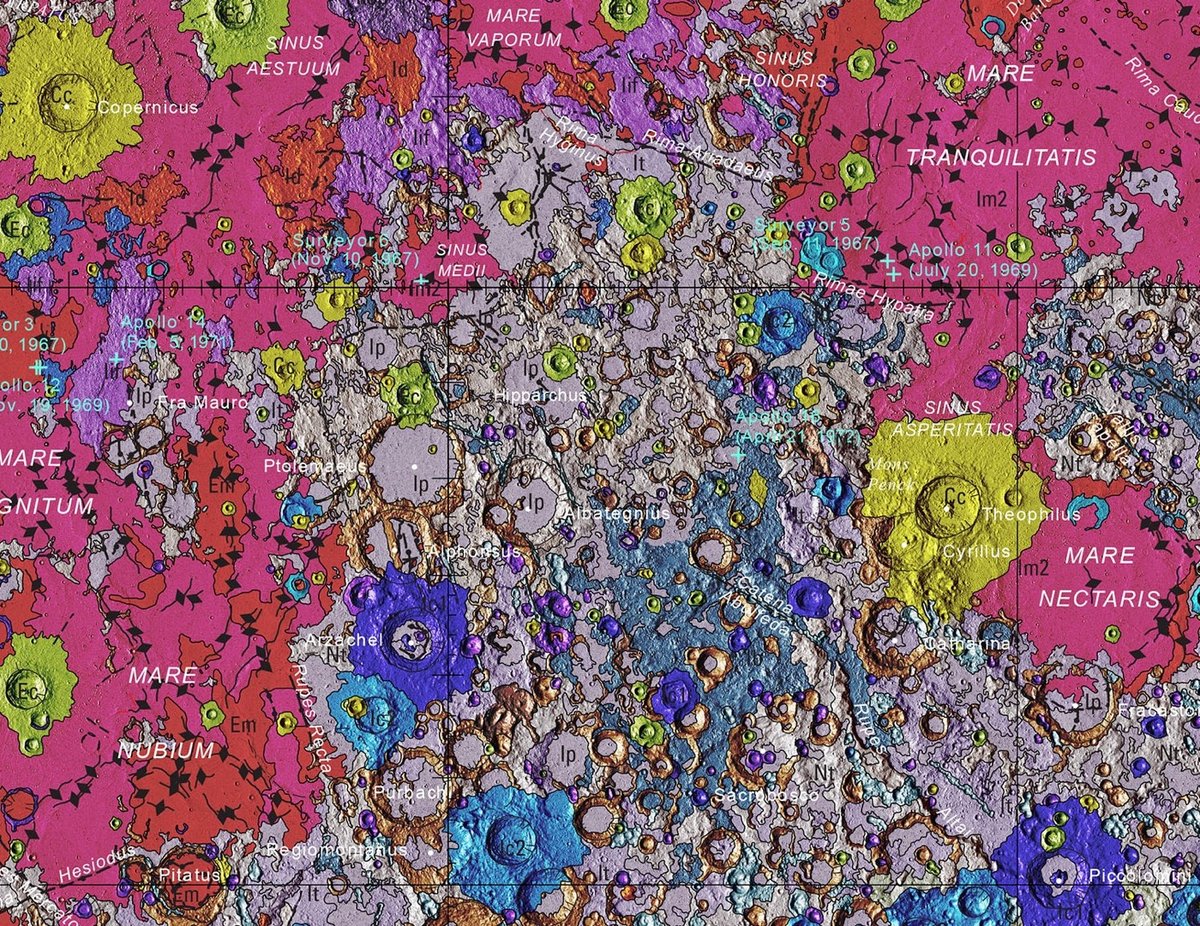
This new work represents a seamless, globally consistent, 1:5,000,000-scale geologic map derived from the six digitally renovated geologic maps (see Source Online Linkage below). The goal of this project was to create a digital resource for science research and analysis, future geologic mapping efforts, be it local-, regional-, or global-scale products, and as a resource for the educators and the public interested in lunar geology.
The map was created by the U.S. Geological Service’s Astrogeology Science Center in Flagstaff, Arizona. In collaboration with NASA and the Lunar and Planetary Institute, it combined six ‘regional’ maps of the Moon made during the Apollo era (1961-1975) with input from more recent unmanned lunar missions.
This included data on the polar regions from NASA’s Lunar Orbiter Laser Altimeter (LOLA) and close-ups of the equatorial zone from the Japanese Space Agency’s recent SELENE mission.
The two images above show the entire map and a detailed view of a single area (which includes the landing sites of 3 Apollo missions) while the video shows a rotating globe version of the map.
I do not know if hearing about other people’s quarantine experiences makes going through one yourself any easier, but the story of how NASA sequestered the returning Apollo 11 astronauts away from the rest of the world for 21 days is interesting for other reasons as well. The worry was that some sort of “moon bug” or “lunar plague” was going to make its way from the Moon to the Earth in the spacecraft or the astronauts’ bodies.
From the moment the Apollo 11 astronauts arrive back on earth from their epochal visit to the moon, they will be treated not as heroes but as bearers of the most virulent, devastating plague the world has ever known.
So NASA quarantined Armstrong, Aldrin, and Collins in a series of specially designed suits and environments until August 10, 1969. At one point, the three of them lived in a modified Airstream trailer in which the air pressure was lower on the inside than outside so if there was a leak, air would rush into the trailer, not out. Armstrong even celebrated a birthday in quarantine.
After Apollo 11, NASA did similar quarantines for 12 and 14 but abandoned them after that because they figured it was safe.
Oh, and if you were curious about the Soyuz launch yesterday that sent three astronauts to the ISS and how they were going to mitigate the chances of sending any SARS-CoV-2 up there, crews on all missions are subject to a mandatory 2 week quarantine before they leave (according to this press release).
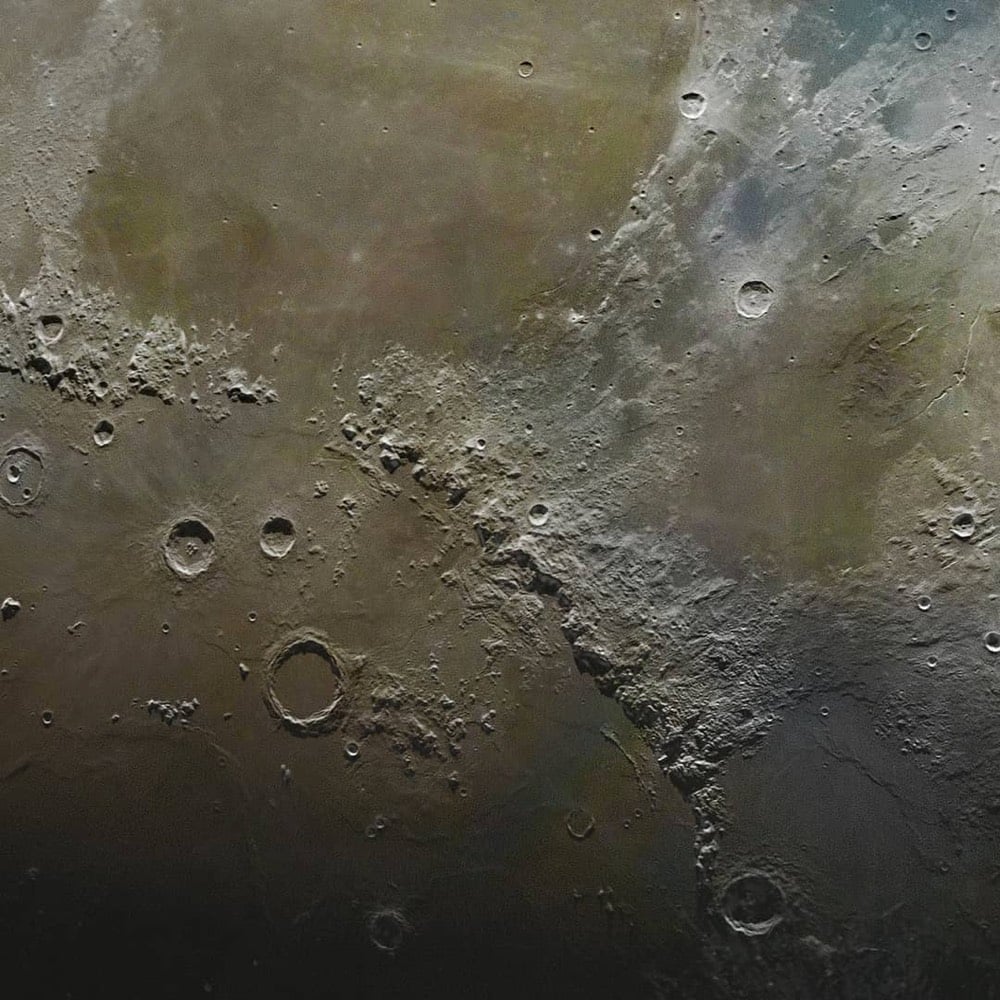
Backyard astronomer Andrew McCarthy has created some arresting images of various objects in the sky, including galaxies, planets, the Sun, and nebulas. Perhaps his favorite subject is the Moon and for one of his first images of 2020, he combined 100,000 photos to make this image of the first quarter Moon.
Some detail:
*low whistle* McCarthy uses some digital darkroom techniques to bump up the dynamic range, which he explained in the comments of a similar image.
The natural colors of the moon were brought out here with minor saturation adjustments, but those colors are completely real and what you could see if your eyes were more sensitive. I find the color really helps tell the story of how some of these features formed billions of years ago.
In one of his Instagram Stories, he shows how he photographs the Moon, including dealing with temperature changes over the course of the session — “when it’s cold, the telescope shrinks, and the focus changes”.
Before the holidays, NASA announced their plan for going back to the Moon by 2024.
With the Artemis program, NASA will land the first woman and next man on the Moon by 2024, using innovative technologies to explore more of the lunar surface than ever before. We will collaborate with our commercial and international partners and establish sustainable exploration by 2028. Then, we will use what we learn on and around the Moon to take the next giant leap — sending astronauts to Mars.
The plan involves many supply runs and a small space station orbiting the Moon so that things like rovers and lunar landers are in place when manned missions need to land on the Moon or even continue on to Mars. You can check out all of the details on NASA’s website.
For a BBC series called Earth from Space, the team at Sent Into Space attached a VR camera to a balloon and sent it up to an altitude of about 20 miles — high enough to see the blackness of space and Earth’s curvature — to take a 360° video of the total solar eclipse that occurred in August 2017. The video above is a hyperlapse of the event while this one from the BBC is slower, annotated, and in full 360° VR.
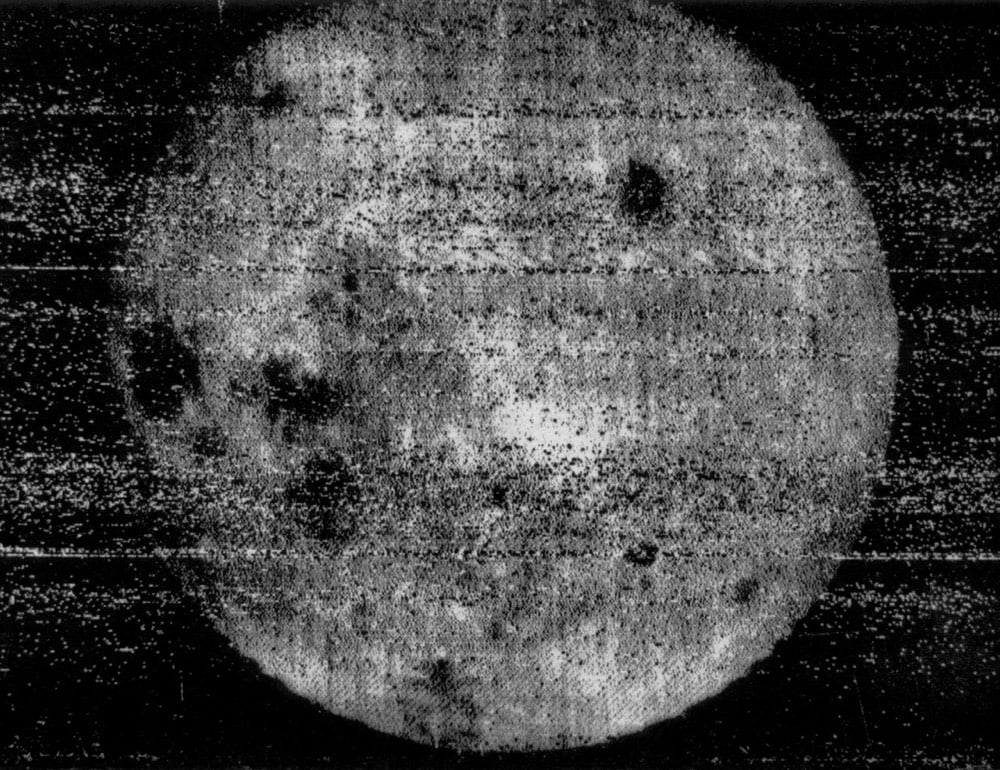
With the launch of Sputnik in 1957, the Soviet Union kicked off the Space Race and for the first several years (arguable up until the Moon landing in ‘69), they dominated the United States. One of their “firsts” in the early years was taking the first photo of the far side of the Moon 60 years ago this month.
First off, Luna 3, the first three-axis stabilized spacecraft, had to reach the Moon to take the pictures, and it had to use a little photocell to orient towards the Moon so that now, while stabilized, it could take the pictures. Which it did. On PHOTOGRAPHIC FILM.
And it gets WILDER because these photos were then moved to a little CHEMICAL PLANT to DEVELOP AND DRY THEM. That’s right, Luna 3 had a little 1 Hour Photo inside. Now you’re thinking, well, how do you get those actual photos back to the Earth?
I was away this weekend at a family function and mostly without internet access, so I didn’t get to watch the coverage of the Moon landing for the first time in more than a decade. I also didn’t get to share a bunch of links I had up in browser tabs and now I think everyone is (justifiably) tired of all the Apollo 11 hoopla, myself included. But I hope you’ll indulge me in just one more and then I’ll (maybe! hopefully!) shut up about it for another year.
It’s tough to narrow it down, but the most dramatic & harrowing part of the whole mission is when Neil Armstrong notices that the landing site the LM (call sign “Eagle”) is heading towards is no good — it’s too rocky and full of craters — so he guides the spacecraft over that area to a better landing spot. He does this despite never having flown the LM that way in training, with program alarms going off, with Mission Control not knowing what he’s doing (he doesn’t have time to tell them), and with very low fuel. Eagle had an estimated 15-20 seconds of fuel left when they touched down and the guy doing the fuel callouts at Mission Control was basically just estimating the remaining fuel in his head based on how much flying he thinks the LM had done…and again, the LM had never been flown like that before and Mission Control didn’t know what Armstrong was up to! (The 13 Minutes to the Moon podcast does an excellent job explaining this bit of the mission, episode 9 in particular.)
Throughout this sequence, there was a camera pointed out Buzz Aldrin’s window — you can see that video here — but that was a slightly different view from Armstrong’s. We’ve never seen what Armstrong saw to cause him to seek out a new landing site. Now, a team at NASA has simulated the view out of his window using data from the Lunar Reconnaissance Orbiter Camera:
The LROC team reconstructed the last three minutes of the landing trajectory (latitude, longitude, orientation, velocity, altitude) using landmark navigation and altitude call outs from the voice recording. From this trajectory information, and high resolution LROC NAC images and topography, we simulated what Armstrong saw in those final minutes as he guided the LM down to the surface of the Moon. As the video begins, Armstrong could see the aim point was on the rocky northeastern flank of West crater (190 meters diameter), causing him to take manual control and fly horizontally, searching for a safe landing spot. At the time, only Armstrong saw the hazard; he was too busy flying the LM to discuss the situation with mission control.
This reconstructed view was actually pretty close to the camera’s view out of Aldrin’s window:
You’ve heard by now that it’s the 50th anniversary of the first humans landing on the Moon. On July 20, 1969, 50 years ago today, Neil Armstrong & Buzz Aldrin landed on the Moon and went for a little walk. For the 11th year in a row, you can watch the original CBS News coverage of Walter Cronkite reporting on the Moon landing and the first Moon walk on a small B&W television, synced to the present-day time. Just open this page in your browser today, July 20th, and the coverage will start playing at the proper time. Here’s the schedule (all times EDT):
4:10:30 pm: Moon landing broadcast starts
4:17:40 pm: Lunar module lands on the Moon
4:20:15 pm - 10:51:26 pm: Break in coverage
10:51:27 pm: Moon walk broadcast starts
10:56:15 pm: First step on Moon
11:51:30 pm: Nixon speaks to the Eagle crew
12:00:30 am: Broadcast end (on July 21)
Set an alarm on your phone or calendar!
This is one of my favorite things I’ve ever done online…here’s what I wrote when I launched the project in 2009:
If you’ve never seen this coverage, I urge you to watch at least the landing segment (~10 min.) and the first 10-20 minutes of the Moon walk. I hope that with the old time TV display and poor YouTube quality, you get a small sense of how someone 40 years ago might have experienced it. I’ve watched the whole thing a couple of times while putting this together and I’m struck by two things: 1) how it’s almost more amazing that hundreds of millions of people watched the first Moon walk *live* on TV than it is that they got to the Moon in the first place, and 2) that pretty much the sole purpose of the Apollo 11 Moon walk was to photograph it and broadcast it live back to Earth.
I wrote a bit last year about what to watch for during the landing sequence.
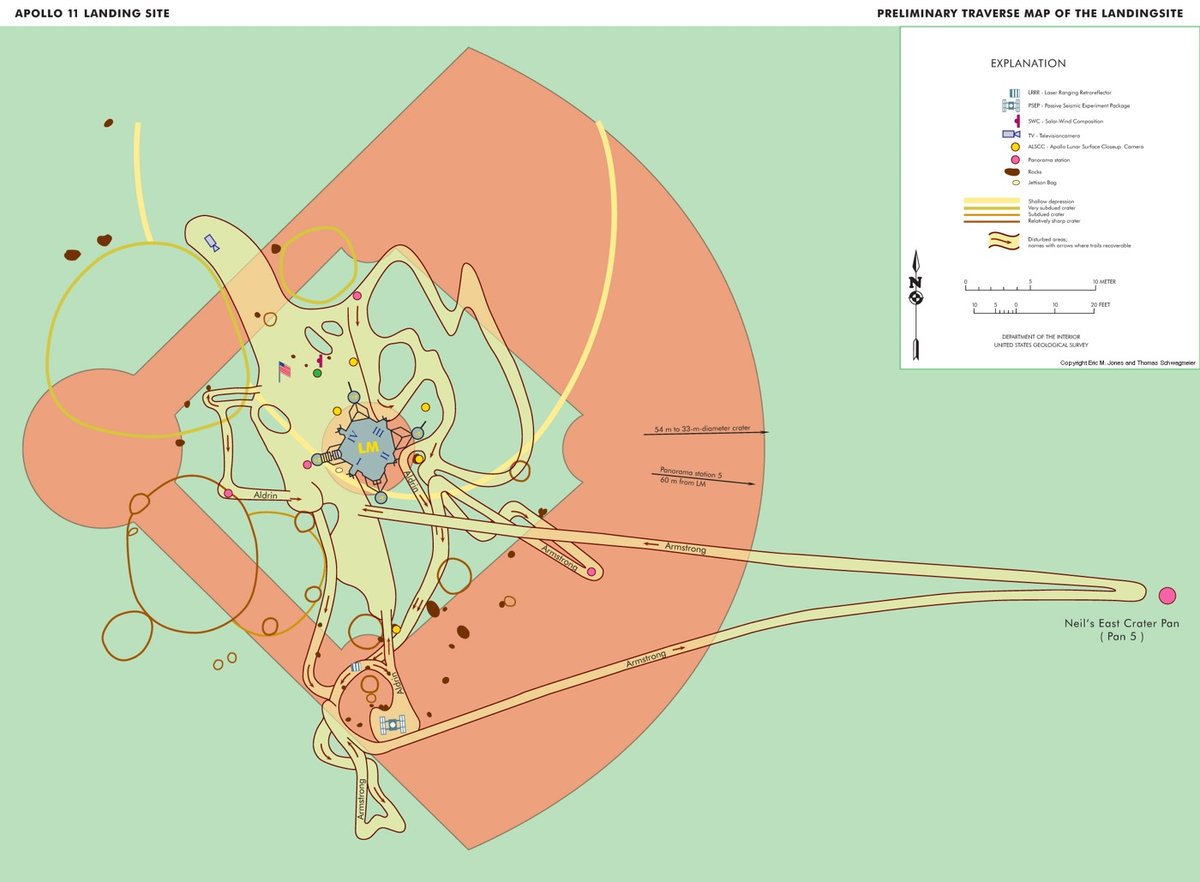
With the 50th anniversary of the first crewed landing on the Moon fast approaching, I thought I’d share one of my favorite views of the Moon walk, a map of where Neil Armstrong and Buzz Aldrin walked on the Moon, superimposed over a baseball field (bigger). The Lunar Module is parked on the pitcher’s mound and you can see where the two astronauts walked, set up cameras, collected samples, and did experiments.
This map easily illustrates something you don’t get from watching video of the Moon walk: just how close the astronauts stayed to the LM and how small an area they covered during their 2 and 1/2 hours on the surface. The crew had spent 75+ hours flying 234,000 miles to the Moon and when they finally got out onto the surface, they barely left the infield! On his longest walk, Armstrong ventured into center field about 200 feet from the mound, not even far enough to reach the warning track in most major league parks. In fact, the length of Armstrong’s walk fell far short of the 363-foot length of the Saturn V rocket that carried him to the Moon and all of their activity could fit neatly into a soccer pitch (bigger):
Astronauts on subsequent missions ventured much further. The Apollo 12 crew ventured 600 feet from the LM on their second walk of the mission. The Apollo 14 crew walked almost a mile. After the Lunar Rover entered the mix, excursions up to 7 miles during EVAs that lasted for more than 7 hours at a time became common.
The Apollo Flight Journal has put together a 20-minute video of the full descent and landing of the Apollo 11 Lunar Module containing Neil Armstrong and Buzz Aldrin on July 20, 1969.
The video combines data from the onboard computer for altitude and pitch angle, 16mm film that was shot throughout the descent at 6 frames per second. The audio recording is from two sources. The air/ground transmissions are on the left stereo channel and the mission control flight director loop is on the right channel. Subtitles are included to aid comprehension.
Today, July 2, 2019, just after 4:30pm ET, a total solar eclipse will be visible in parts of Chile and Argentina. Because most of you, I am guessing, are not currently in those parts of Chile and Argentina, the best way to watch the eclipse is through any number of live streams, three of which I’m embedding here:
I was lucky enough to see the eclipse in 2017 and it was a life-altering experience, so I’ll be tearing myself away from the USA vs England match for a few minutes at least.
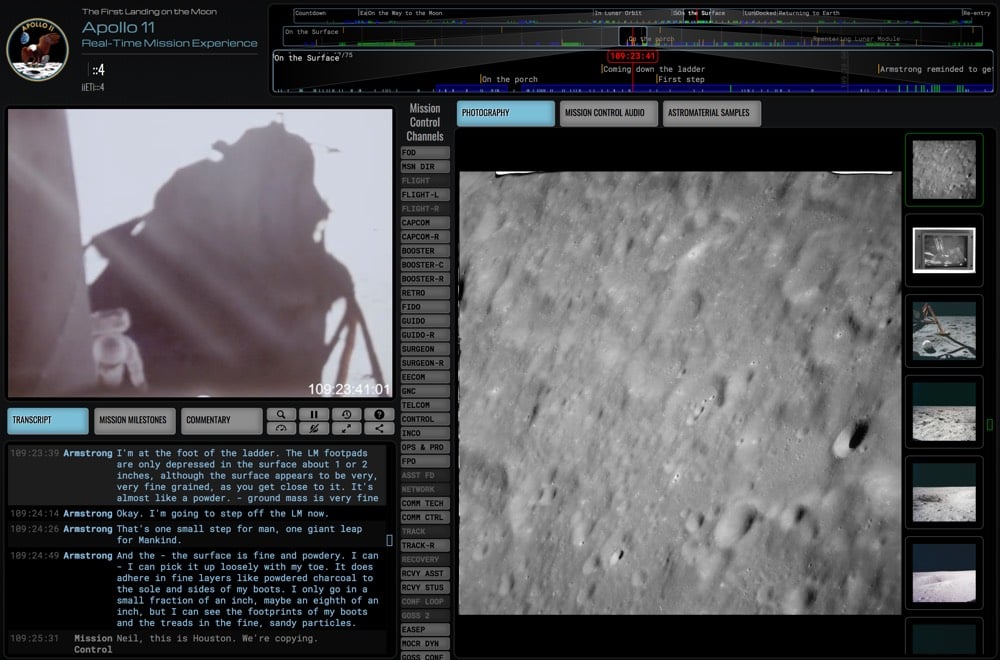
Well, this is just flat-out fantastic. Ben Feist and a team of collaborators have built Apollo 11 In Real Time, an interactive presentation of the first mission to land on the Moon as it happened.
This website replays the Apollo 11 mission as it happened, 50 years ago. It consists entirely of historical material, all timed to Ground Elapsed Time — the master mission clock. Footage of Mission Control, film shot by the astronauts, and television broadcasts transmitted from space and the surface of the Moon, have been painstakingly placed to the very moments they were shot during the mission, as has every photograph taken, and every word spoken.
You can tune in in real time beginning July 16th, watch/experience it right now from 1 minute before launch, or you can skip around the timeline to just watch the moments you want. As someone who has been hosting an Apollo 11 in real time thing for the past 9 years, this site makes me both ridiculously happy and a little bit jealous.
I’ve only ever seen footage of the first moonwalk in grainy videos as broadcast on TV, but this site shows it in the original resolution and it’s a revelation. Here’s the moonwalk, beginning with some footage of the folks in Mission Control nervously fidgeting with their hands (skip to 5:18:00 if the video doesn’t start there):
The rest of the video for the entire mission can be found here…what a trove. This whole thing is marvelous…I can’t wait to tune in when July 16th rolls around.
On what computers were like in the early ’60s and how far they had to come to go to space
It’s hard to appreciate now, but in 1961, 1962, 1963, computers had the opposite reputation of the reputation they have now. Most computers couldn’t go more than a few hours without breaking down. Even on John Glenn’s famous orbital flight — the first U.S. orbital flight — the computers in mission control stopped working for three minutes [out] of four hours. Well, that’s only three minutes [out] of four hours, but that was the most important computer in the world during that four hours and they couldn’t keep it going during the entire orbital mission of John Glenn.
So they needed computers that were small, lightweight, fast and absolutely reliable, and the computers that were available then — even the compact computers — were the size of two or three refrigerators next to each other, and so this was a huge technology development undertaking of Apollo.
On the seamstresses who wove the computer memory by hand
There was no computer memory of the sort that we think of now on computer chips. The memory was literally woven … onto modules and the only way to get the wires exactly right was to have people using needles, and instead of thread wire, weave the computer program. …
The Apollo computers had a total of 73 [kilobytes] of memory. If you get an email with the morning headlines from your local newspaper, it takes up more space than 73 [kilobytes]. … They hired seamstresses. … Every wire had to be right. Because if you got [it] wrong, the computer program didn’t work. They hired women, and it took eight weeks to manufacture the memory for a single Apollo flight computer, and that eight weeks of manufacturing was literally sitting at sophisticated looms weaving wires, one wire at a time.
One anecdote that was new to me describes Armstrong and Aldrin test-burning moon dust, to make sure it wouldn’t ignite when repressurized.
Armstrong and Aldrin actually had been instructed to do a little experiment. They had a little bag of lunar dirt and they put it on the engine cover of the ascent engine, which was in the middle of the lunar module cabin. And then they slowly pressurized the cabin to make sure it wouldn’t catch fire and it didn’t. …
The smell turns out to be the smell of fireplace ashes, or as Buzz Aldrin put it, the smell of the air after a fireworks show. This was one of the small but sort of delightful surprises about flying to the moon.
In July, American Experience will air Chasing the Moon, a 6-hour documentary film about the effort to send a manned mission to the Moon before the end of the 1960s.
The series recasts the Space Age as a fascinating stew of scientific innovation, political calculation, media spectacle, visionary impulses and personal drama. Utilizing a visual feast of previously overlooked and lost archival material — much of which has never before been seen by the public — the film features a diverse cast of characters who played key roles in these historic events. Among those included are astronauts Buzz Aldrin, Frank Borman and Bill Anders; Sergei Khrushchev, son of the former Soviet premier and a leading Soviet rocket engineer; Poppy Northcutt, a 25-year old “mathematics whiz” who gained worldwide attention as the first woman to serve in the all-male bastion of NASA’s Mission Control; and Ed Dwight, the Air Force pilot selected by the Kennedy administration to train as America’s first black astronaut.
Among the stories not usually told about the Moon missions is that of Ed Dwight, NASA’s first black astronaut trainee:
Since 2019 is the 50th anniversary of the Apollo 11 mission, there’s a *lot* of stuff out there about the Space Race and Apollo program, but this film looks like it’s going to be one of the best. The film will start airing on PBS on July 8 and the Blu-ray & DVD comes out on July 9. There’s a companion book that will be available next week.








Stay Connected