Millions of years ago, the supercontinent of Pangea slowly started to break apart into the continents we all live on today. In this video from the makers of ArcGIS mapping software, you can watch as the reconfiguration of the Earth’s land happens over 200 million years.
Once, the craggy limestone peaks that skim the sky of Everest were on the ocean floor. Scientists believe it all began to change about 200 million years ago — at around the time the Jurassic dinosaurs were beginning to emerge — when the supercontinent of Pangea cracked into pieces. The Indian continent eventually broke free, journeying north across the vast swathe of Tethys Ocean for 150 million years until it smacked into a fellow continent — the one we now know as Asia — around 45 million years ago.
The crushing force of one continent hitting another caused the plate beneath the Tethys Ocean, made of oceanic crust, to slide under the Eurasian plate. This created what is known as a subduction zone. Then the oceanic plate slipped deeper and deeper into the Earth’s mantle, scraping off folds limestone as it did so, until the Indian and Eurasian plates started compressing together. India began sliding under Asia, but because it’s made of tougher stuff than the oceanic plate it didn’t just descend. The surface started to buckle, pushing the crust and crumples of limestone upwards.
And so the Himalayan mountain range began to rise skyward. By around 15-17 million years ago, the summit of Everest had reached about 5,000m (16,404ft) and it continued to grow. The collision between the two continental plates is still happening today. India continues to creep north by 5cm (2in) a year, causing Everest to grow by about 4mm (0.16in) per year (although other parts of the Himalayas are rising at around 10mm per year [0.4in]).
To mark the 10th anniversary of their YouTube channel, Kurzgesagt has released a video timeline of the Earth’s evolution, all 4.5 billion years of it. The video is 60 minutes long, which means that each second shows about 1 million years. And it’s kind of a music video…of sorts? There’s talking but there are definitely stretches of just music and visuals…it’s not your usual science explainer video.
Hop on a musical train ride and experience how long a billion years really is. It’s the perfect background for your next party, a great way to take a break from studying, or a fascinating companion while you’re on the go.
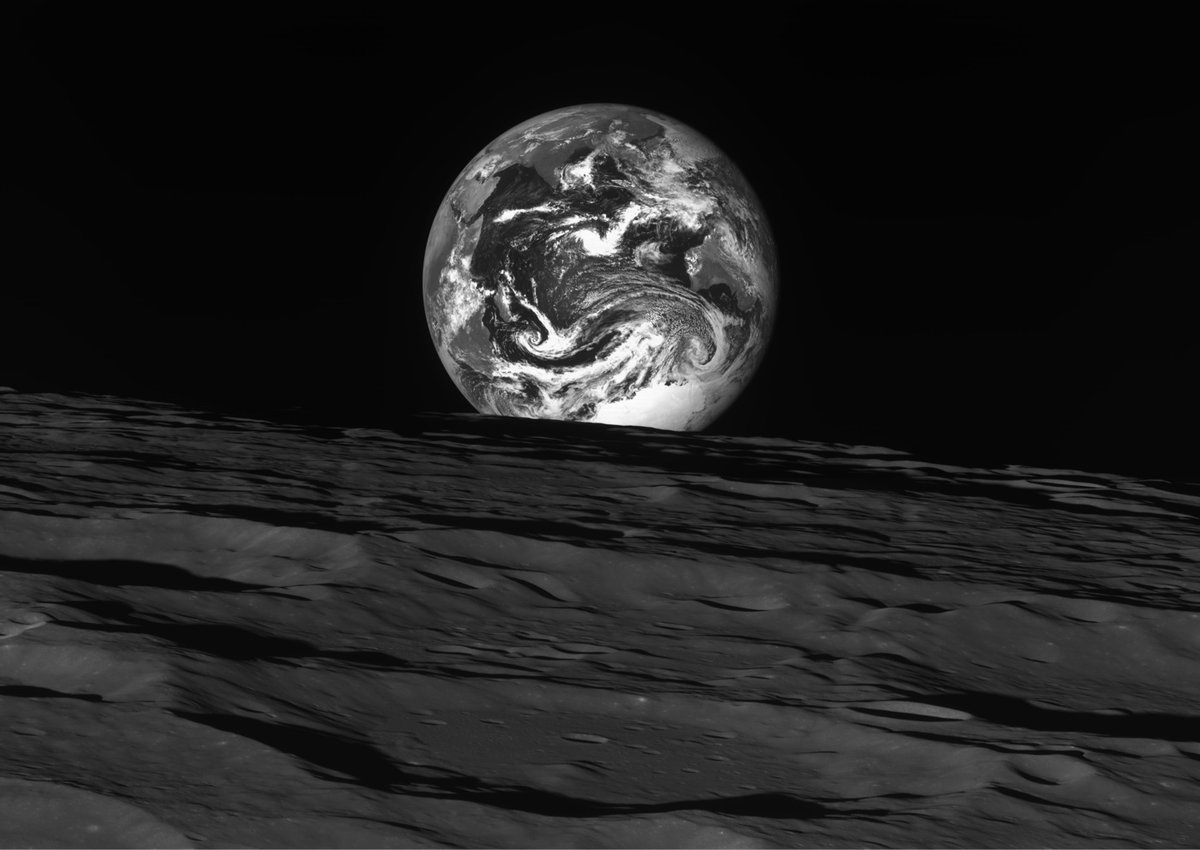
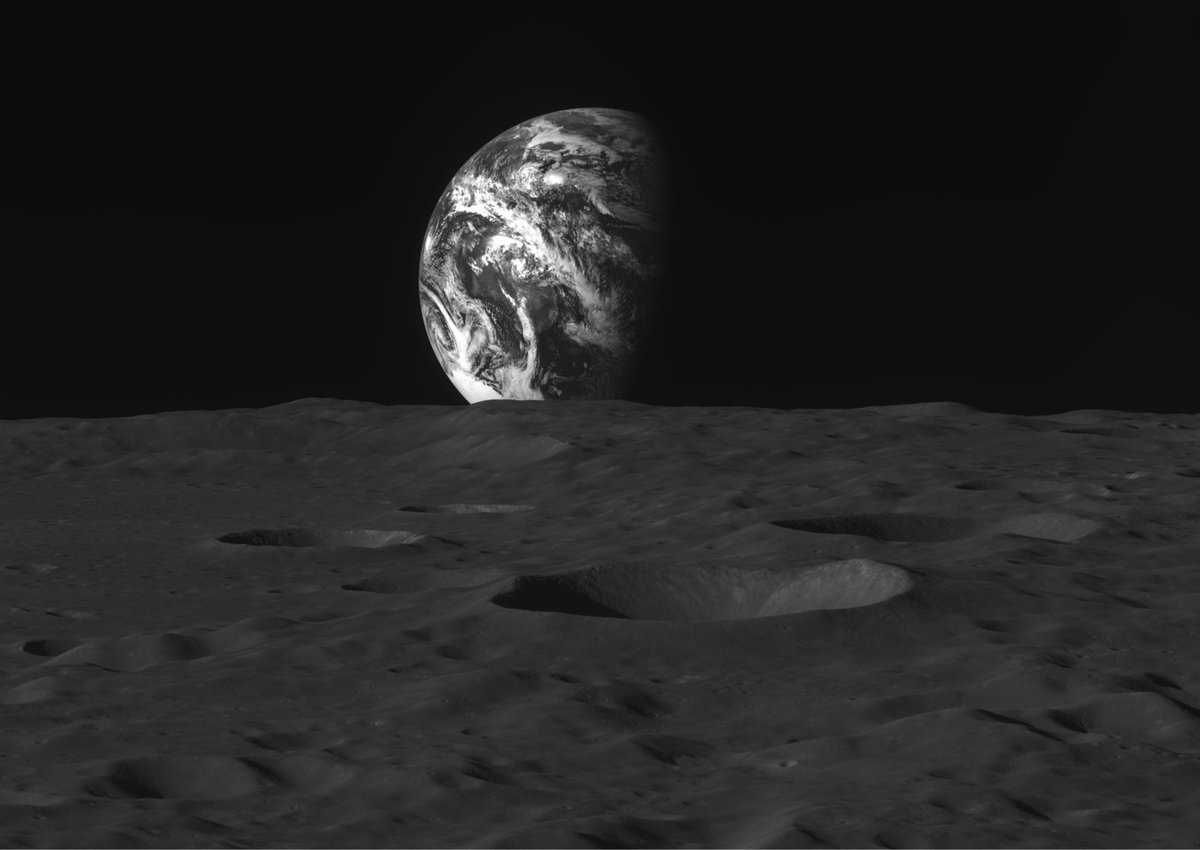
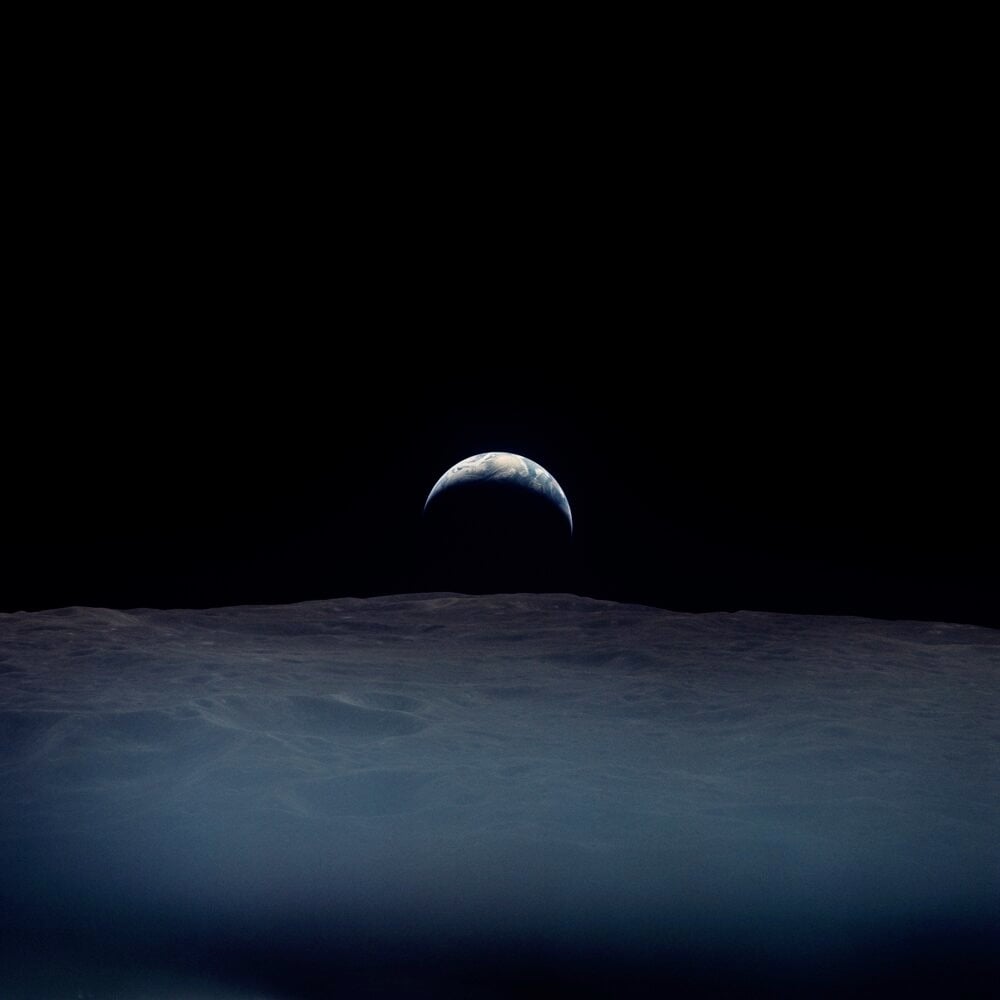
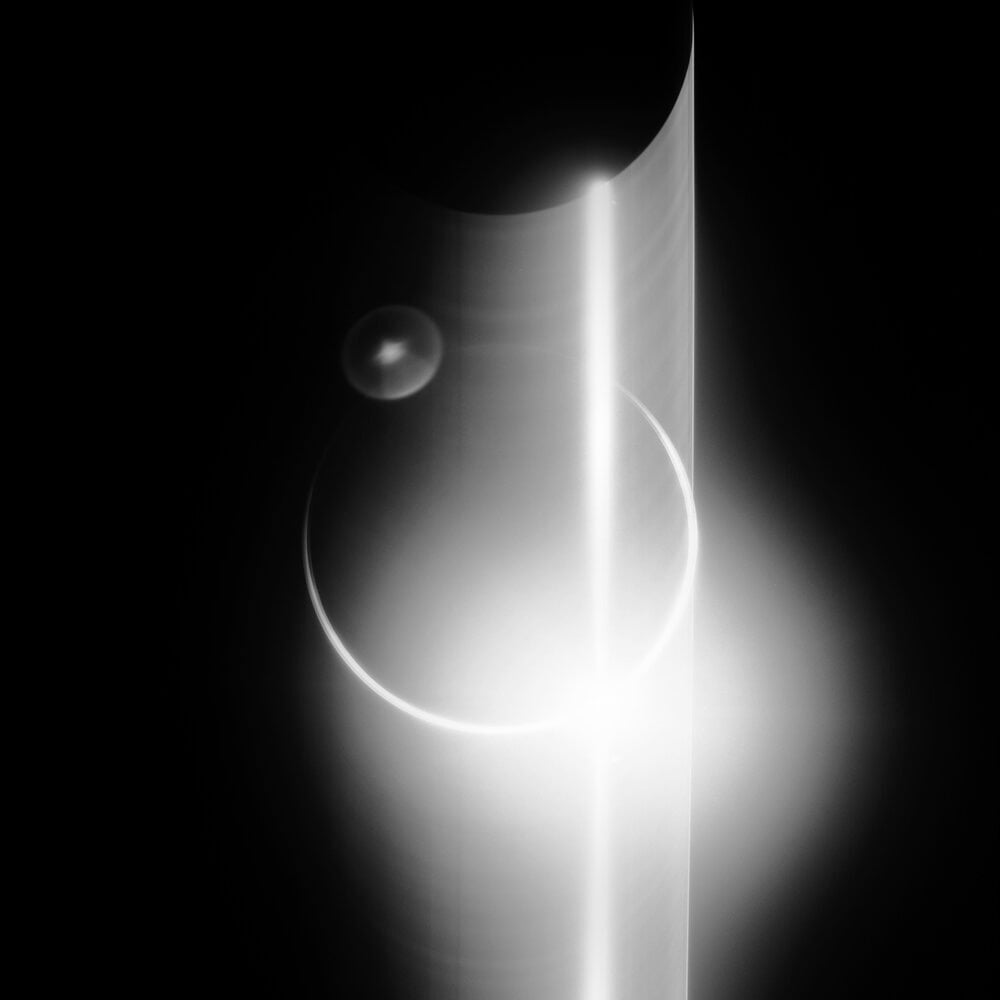
South Korea currently has a probe called Danuri orbiting the Moon at an altitude of about 62 miles above the surface. It’s just begun its mission but has already sent back some black & white photos of the Moon and the Earth, including the two above. Over at EarthSky, Dave Adalian says these shots “rival the work of legendary nature photographer Ansel Adams” and it’s difficult to disagree.
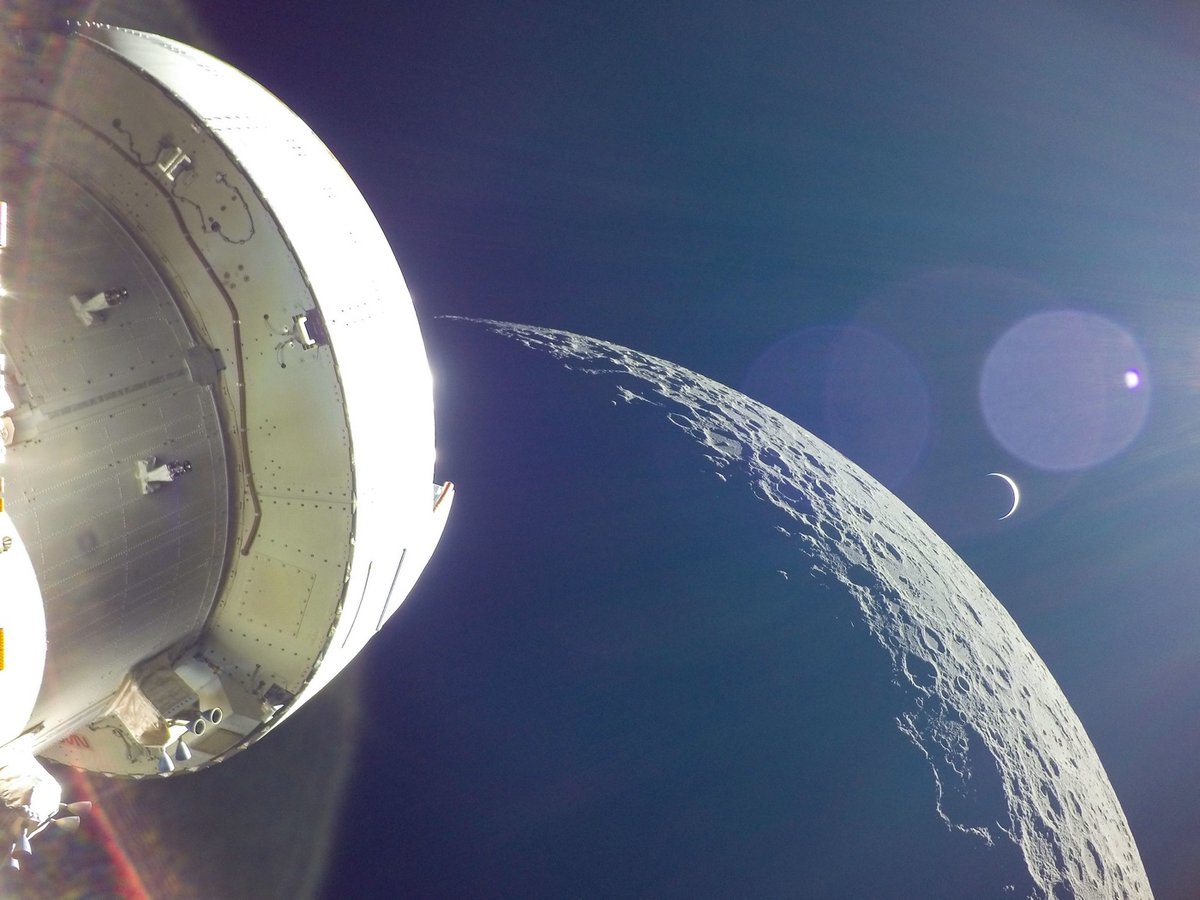
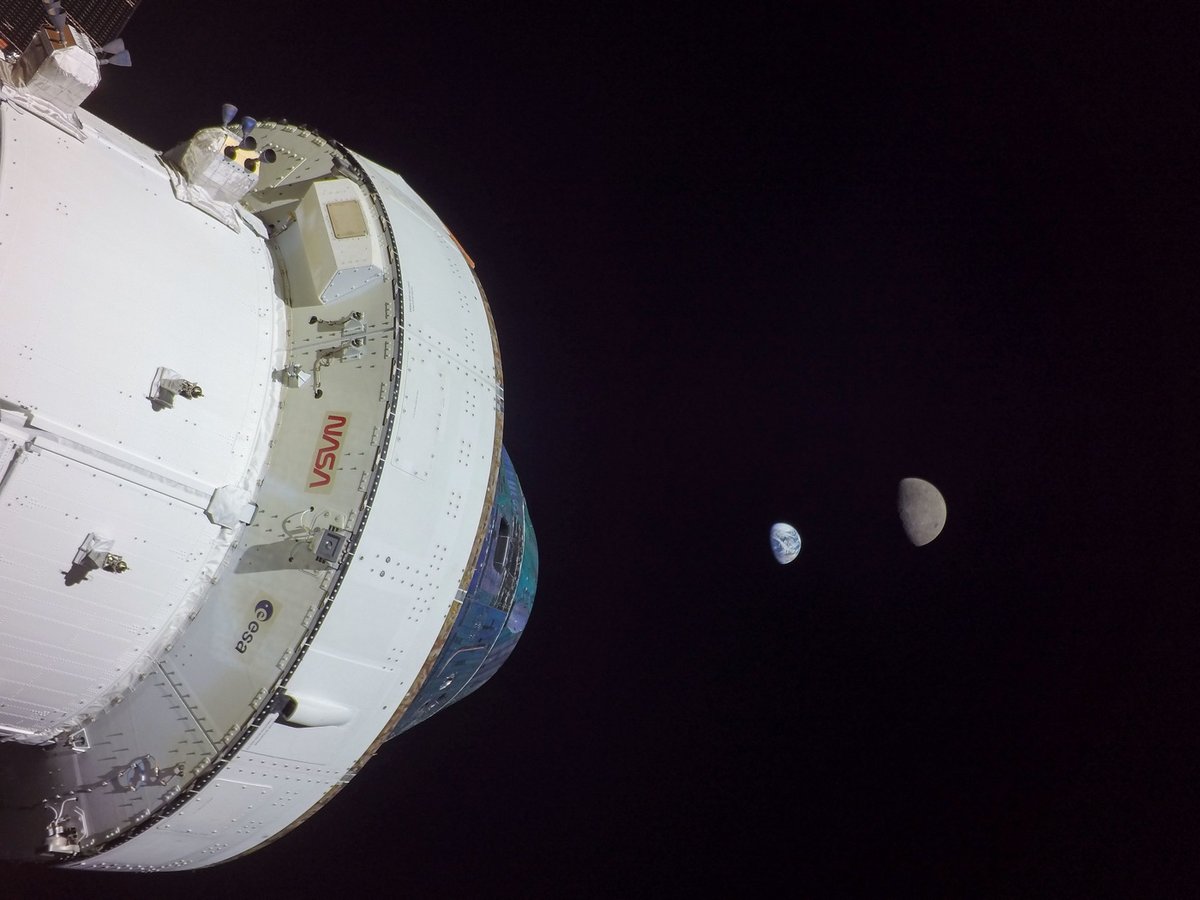
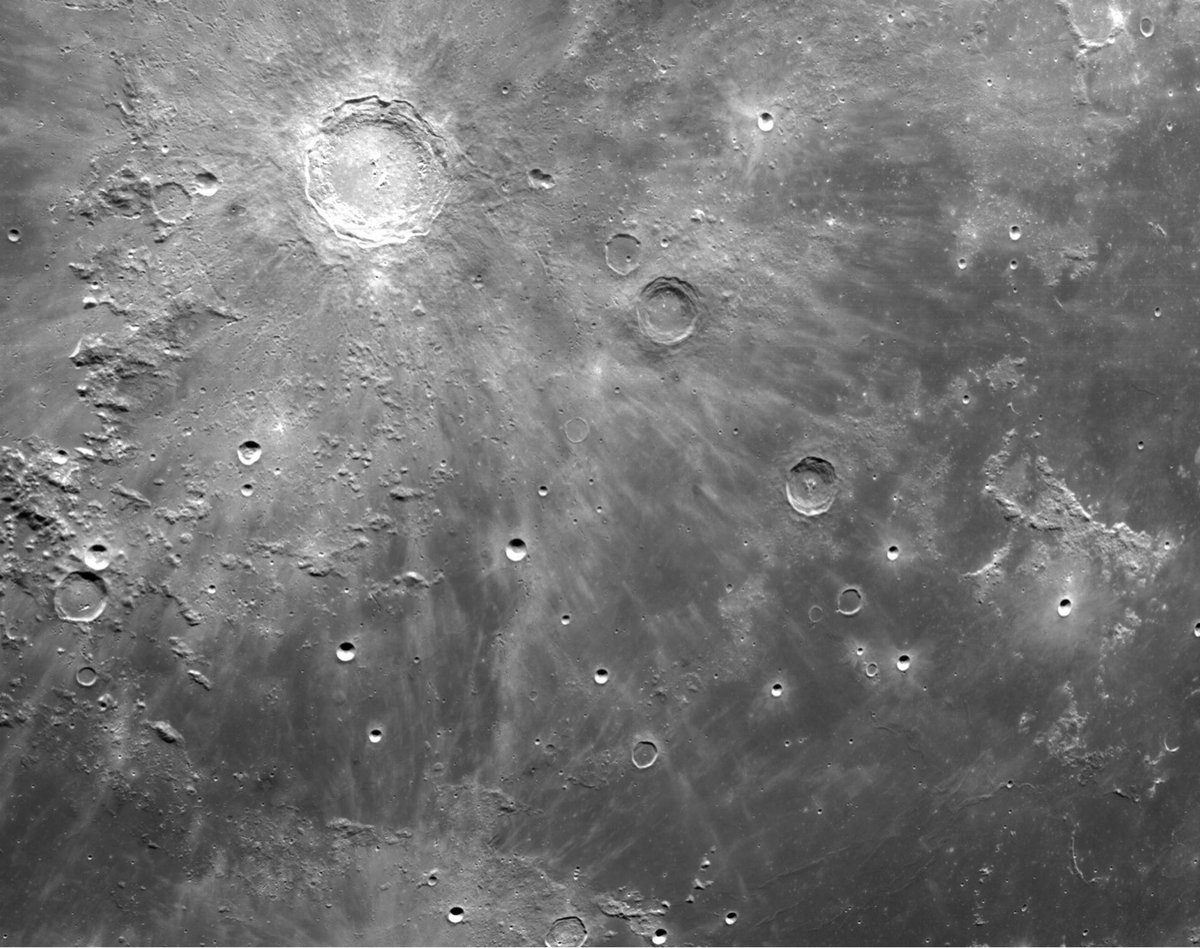
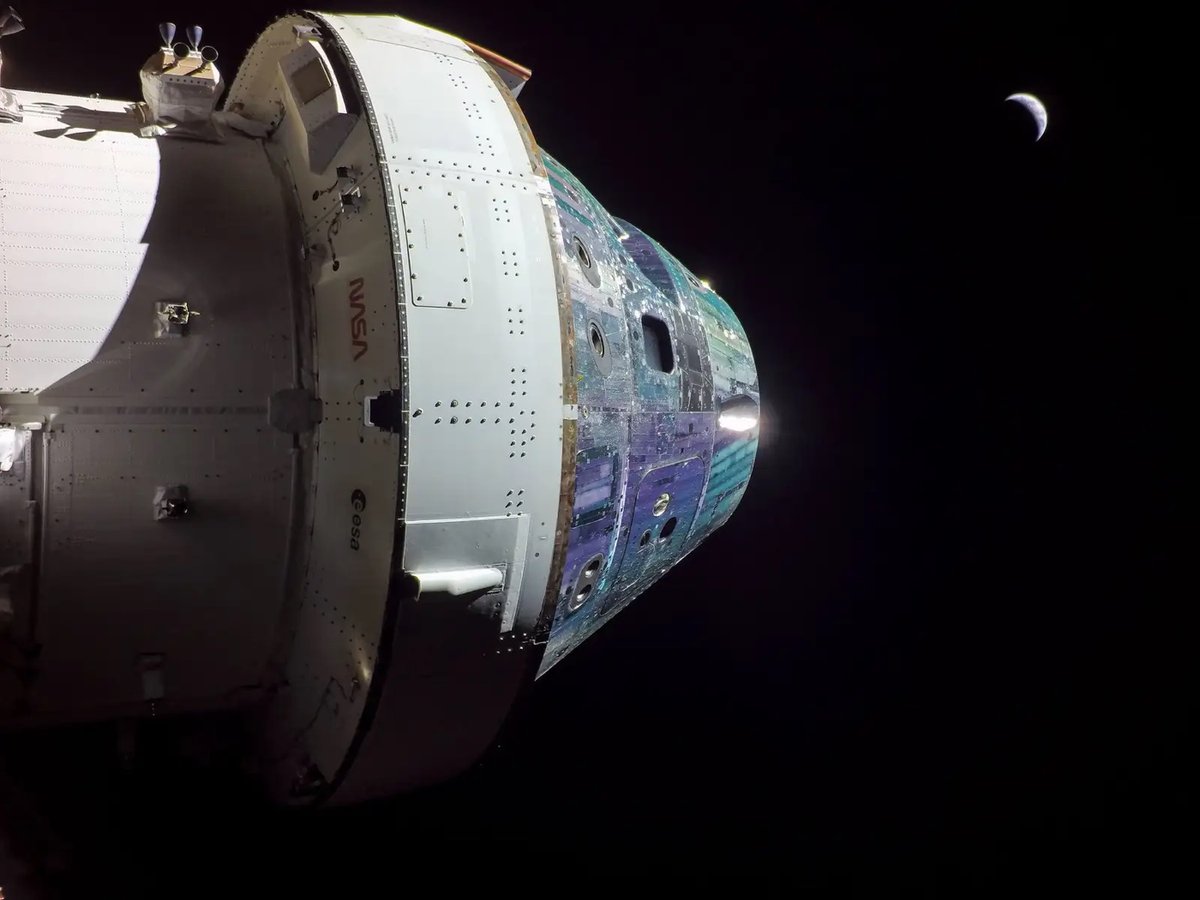
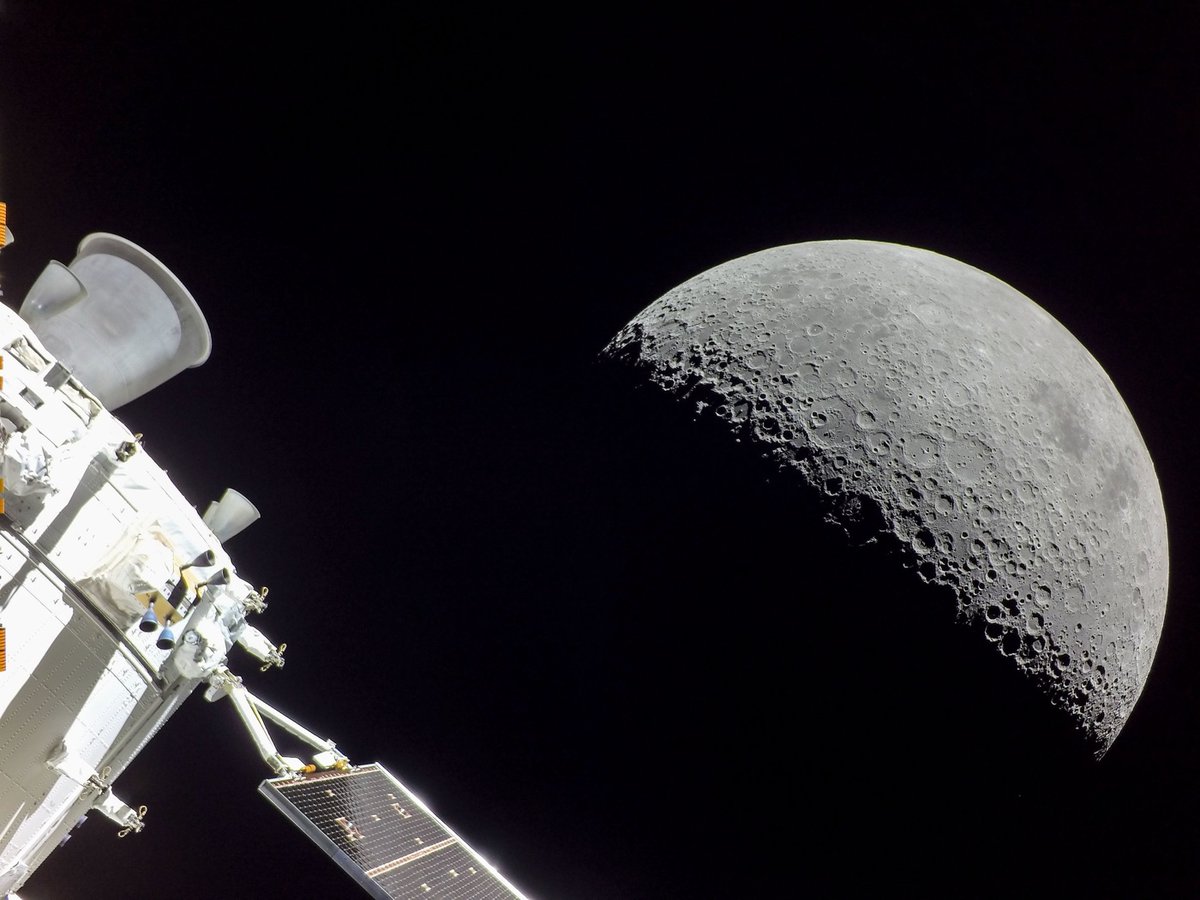
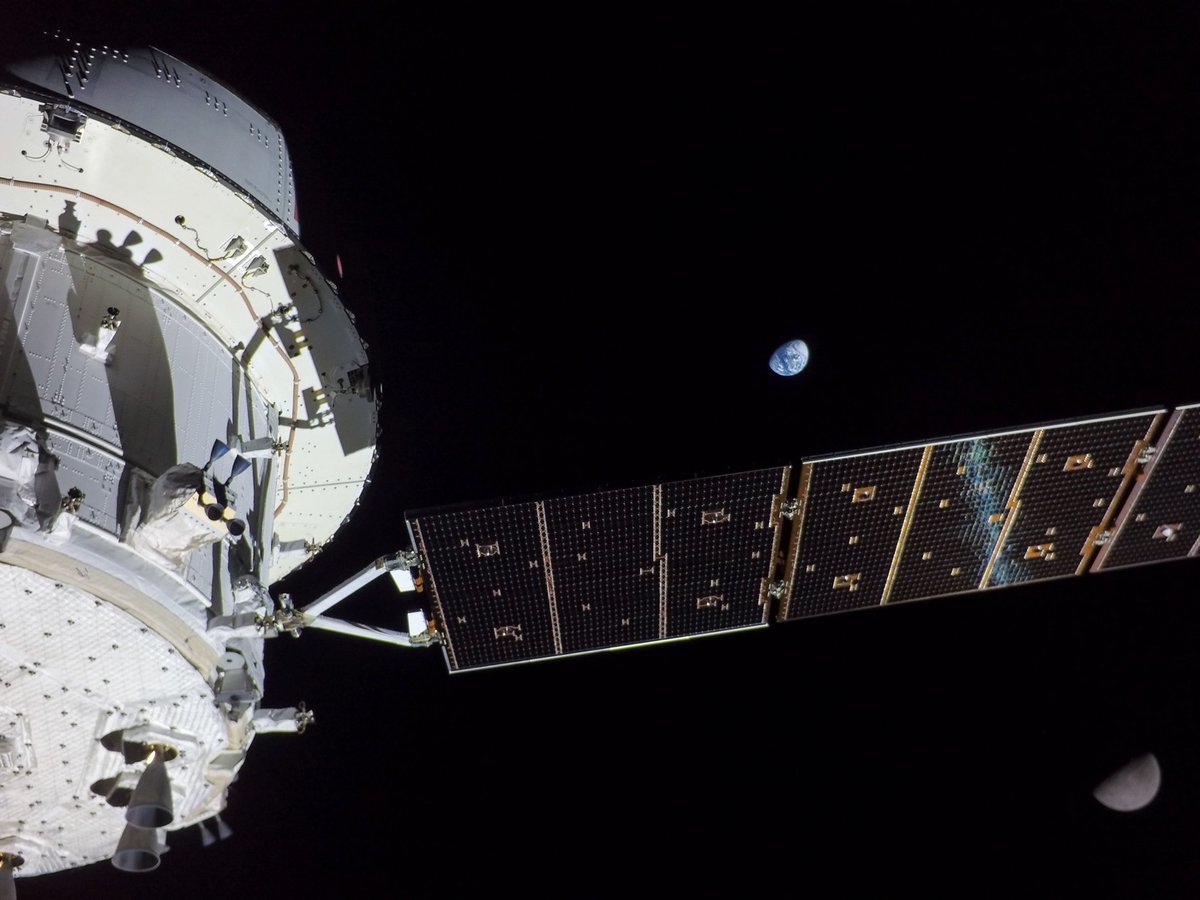
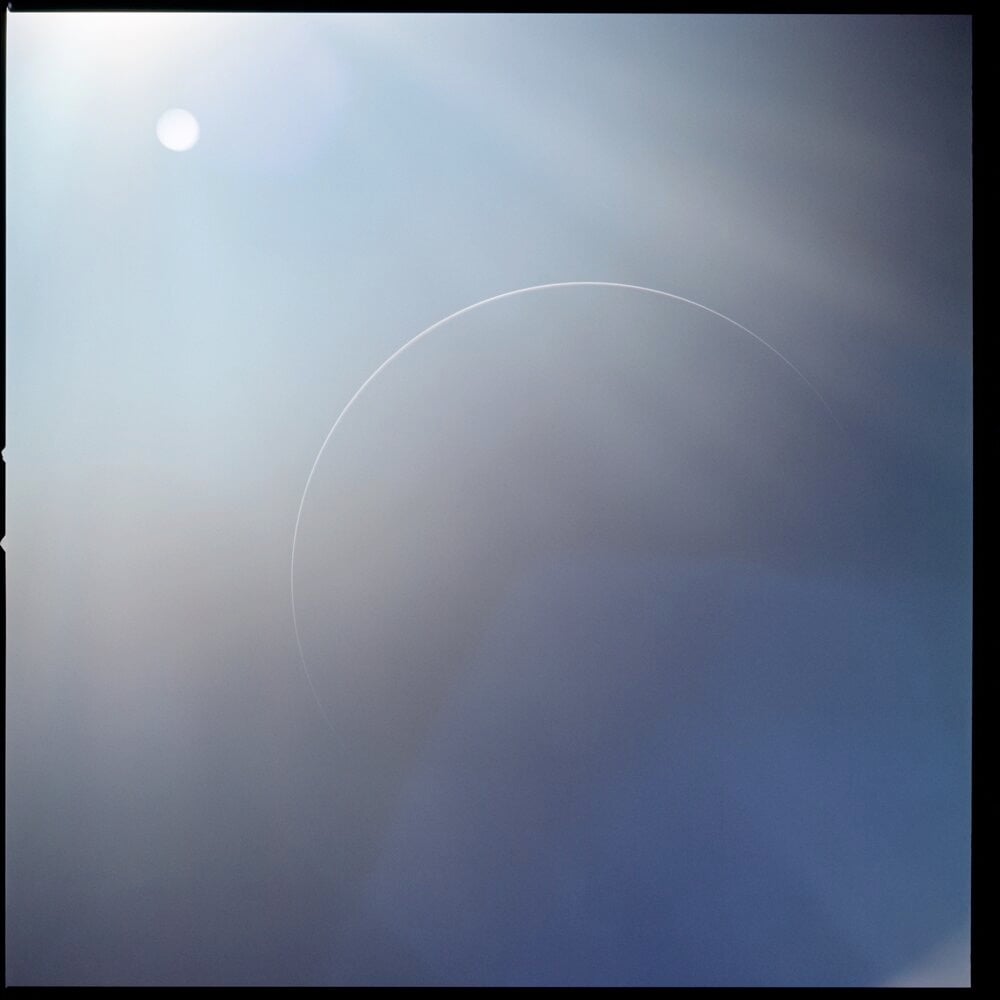
Over the weekend, NASA’s Artemis I mission returned from a 25-day trip to the Moon. The mission was a test-run of the rockets, systems, and spacecraft that will return humans to the surface of the Moon. Visual imaging has been an integral part of even the earliest space missions — strap a camera to a spacecraft, let the people see what space looks like, and they will be inspired. Well, the photographs returned by Artemis I’s Orion spacecraft have certainly been inspirational. Working from NASA’s archive of images (on Flickr too), I’ve selected some of the most interesting and dramatic photos from the mission. The one at the top, showing a crescent Earth rising over the Moon’s surface, might be one of my favorite space photos ever (and that’s really saying something) — you can see a bigger version of it here.
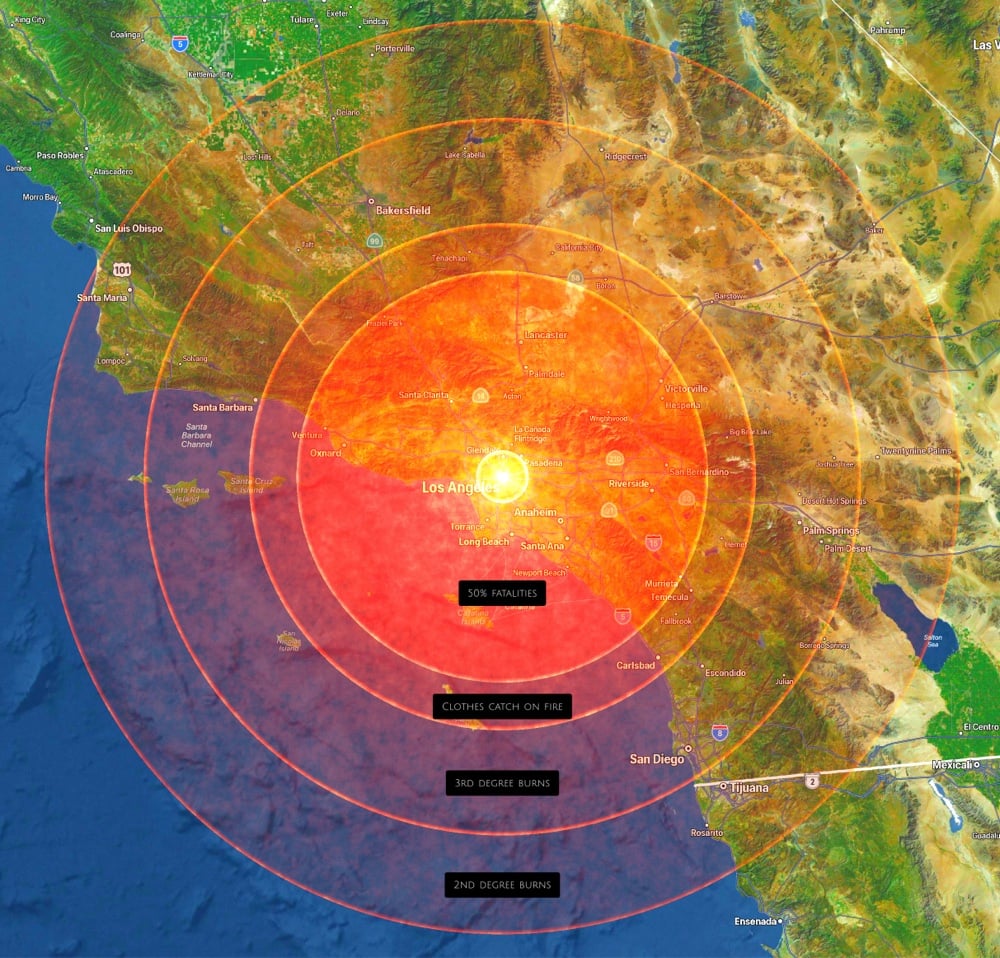
Creative coder Neal Agarwal has launched his newest project: Asteroid Launcher. You can choose the asteroid’s composition (iron, stone, comet, etc.), size, speed, angle of incidence, and place of impact. Then you click “launch” and see the havoc you’ve wrought upon the world, with all kinds of interesting statistics. I bombarded Los Angeles with an iron asteroid a half-mile across moving at 50,000 mph and the results were significant, as you can see from the fireball it created:
Some of the most interesting bits about the impact:
The crater is 2,087 ft deep.
Clothes would catch on fire within 86 miles of the impact.
An estimated 4,343,300 people would die from the 249 decibel shock wave.
Winds would reach 13,373 mph; within 105 miles it would feel like being inside an EF5 tornado.
Crikey! See also the description of the much more massive meteorite that slammed into the Yucatan peninsula 66 million years ago:
The meteorite itself was so massive that it didn’t notice any atmosphere whatsoever,” said Rebolledo. “It was traveling 20 to 40 kilometers per second, 10 kilometers - probably 14 kilometers — wide, pushing the atmosphere and building such incredible pressure that the ocean in front of it just went away.
The sound made by the Krakatoa volcanic eruption in 1883 was so loud it ruptured eardrums of people 40 miles away, travelled around the world four times, and was clearly heard 3,000 miles away.
The Earth is some 4.5 billion years old and the first life on Earth appeared 3.7 billion years ago (if not earlier). That’s a lot of time…so maybe it’s possible that a civilization existed at some point during that time and then vanished without a trace. In this video, Kurzgesagt explores the Silurian hypothesis.
When we think about alien civilizations we tend to look into the vastness of space, to far away planets. But there is another incredibly vast dimension that we might be giving too little thought to: time.
Could it be that over the last hundreds of millions of years, other civilizations existed on earth? Indigenous technological species that rose and died out? And that they or their artifacts are buried beneath our feet? What does science have to say about this and what are the implications for us?
No doubt motivated by this month’s release of Moonfall, the latest movie from disaster shlockmeister Roland Emmerich, Kurzgesagt has made a video that shows what would happen to civilization should the Moon somehow get knocked from its orbit and head straight for the Earth. Spoiler: the Moon doesn’t even need to reach us to kill almost all life on the planet.
So let’s say, for the sake of argument and against all scientific evidence to the contrary, the Earth was flat instead of being an oblate spheroid. What would life on a flat Earth be like? Well for one thing, gravity would present some challenges. From a 2018 piece by Doug Main at the Columbia Climate School:
People who believe in a flat Earth assume that gravity would pull straight down, but there’s no evidence to suggest it would work that way. What we know about gravity suggests it would pull toward the center of the disk. That means it would only pull straight down at one point on the center of the disk. As you got increasingly far from the center, gravity would tug more and more horizontally. This would have some strange impacts, like sucking all the water toward the center of the world, and making trees and plants grow diagonally, since they develop in the opposite direction of gravity’s pull.
And even more than that, gravity would tend to pull a flat disc shape back into a spheroid, so absent an intense spinning force (for which there is zero evidence) or some other completely unknown effect, a flat Earth couldn’t even exist:
For Earth to take the shape of a flat disk in the first place, gravity — as we know it — must be having no effect. If it did, it would soon pull the planet back into a spheroid.
A flat Earth would also likely not have a magnetic field (or at least one that is scientifically possible), meaning no atmosphere:
Deep below ground, the solid core of the Earth generates the planet’s magnetic field. But in a flat planet, that would have to be replaced by something else. Perhaps a flat sheet of liquid metal. That, however, wouldn’t rotate in a way that creates a magnetic field. Without a magnetic field, charged particles from the sun would fry the planet. They could strip away the atmosphere, as they did after Mars lost its magnetic field, and the air and oceans would escape into space.
Oh and no tectonic plates, volcanos, mountains, etc. Or GPS. Or weather. Or satellites. Or different night skies in, say, South Africa and Denmark. Or the Sun behaving the way it does in respect to the Earth. Or air travel. Or plant and animal life as it exists presently. To suppose a flat Earth also supposes that physics doesn’t explain our observable universe the way in which it reliably and comprehensively does. The simplest, best evidence for a round Earth is that we’re here living on it in the manner in which we are living on it.
Perhaps the most consequential day in the Earth’s recent history was when a massive asteroid struck the planet 66 million years ago. It resulted in earthquakes, tsunamis, fireballs raining from the sky, volcanoes, atmospheric heat shocks, wildfires, global winter, and the extinction of 75% of all species on Earth, including the dinosaurs. This video by Kurzgesagt leads us through what happened that day, minute by minute.
“The meteorite itself was so massive that it didn’t notice any atmosphere whatsoever,” said Rebolledo. “It was traveling 20 to 40 kilometers per second, 10 kilometers — probably 14 kilometers — wide, pushing the atmosphere and building such incredible pressure that the ocean in front of it just went away.”
These numbers are precise without usefully conveying the scale of the calamity. What they mean is that a rock larger than Mount Everest hit planet Earth traveling twenty times faster than a bullet. This is so fast that it would have traversed the distance from the cruising altitude of a 747 to the ground in 0.3 seconds. The asteroid itself was so large that, even at the moment of impact, the top of it might have still towered more than a mile above the cruising altitude of a 747. In its nearly instantaneous descent, it compressed the air below it so violently that it briefly became several times hotter than the surface of the sun.
“The pressure of the atmosphere in front of the asteroid started excavating the crater before it even got there,” Rebolledo said. “Then when the meteorite touched ground zero, it was totally intact. It was so massive that the atmosphere didn’t even make a scratch on it.”
Unlike the typical Hollywood CGI depictions of asteroid impacts, where an extraterrestrial charcoal briquette gently smolders across the sky, in the Yucatan it would have been a pleasant day one second and the world was already over by the next. As the asteroid collided with the earth, in the sky above it where there should have been air, the rock had punched a hole of outer space vacuum in the atmosphere. As the heavens rushed in to close this hole, enormous volumes of earth were expelled into orbit and beyond — all within a second or two of impact.
“So there’s probably little bits of dinosaur bone up on the moon,” I asked.
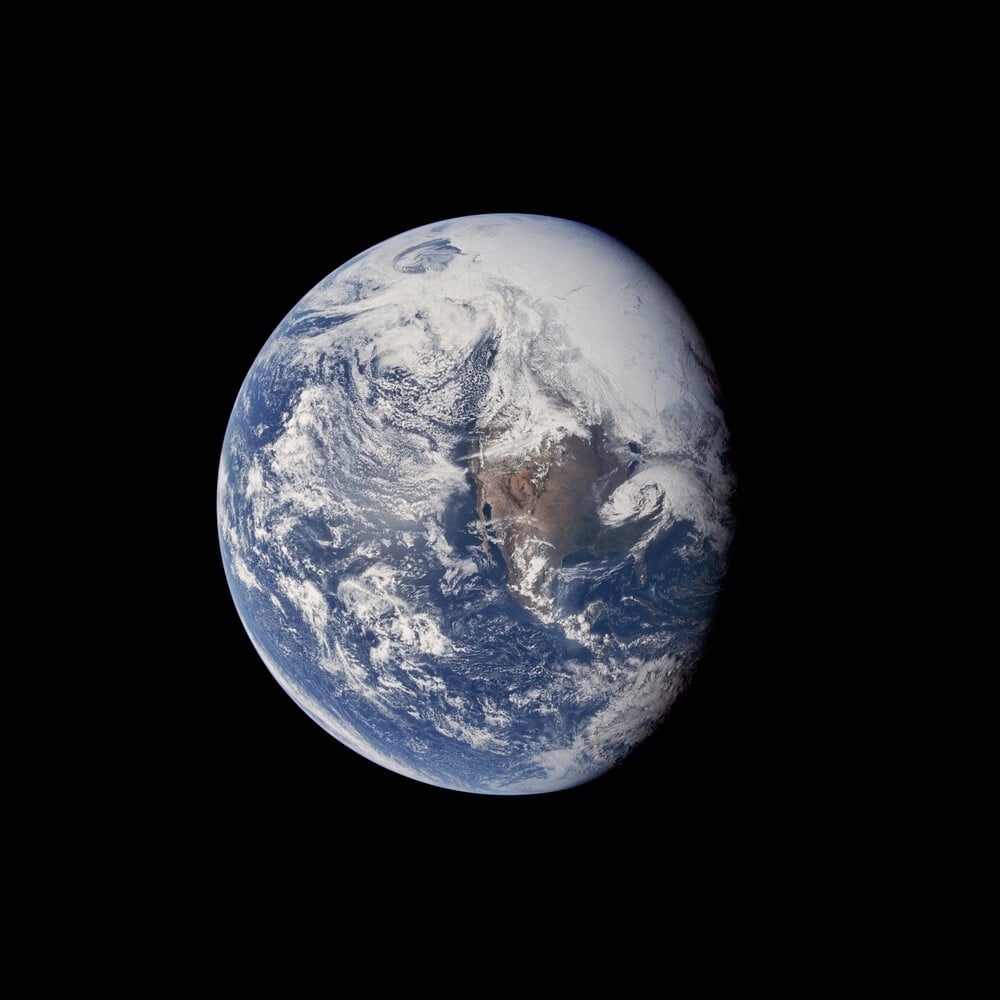
For his Earth Restored project, Toby Ord digitally remastered 50 photographs of the whole Earth taken by Apollo astronauts during their missions in the 60s and 70s.
The Apollo photographs are historic works of art. So in restoring them, I sought to bring out their own beauty. I refrained from recomposing the images by cropping, or trying to leave my own mark or interpretation. Perhaps in some cases this would make a more pleasing image, but it was not my aim.
And the Apollo photographs are also a scientific record of what our Earth looks like. In particular, what it would have looked like from the perspective of the astronaut taking the shot. So rather than pumping the saturation or adjusting the colours to what we think the Earth looks like, I wanted to allow us to learn from these photographs something about how it actually appears.
Many of these shots are new to me — the Apollo program and its scientific and cultural output continue to be revelatory 50 years later.
Update: Full resolution images are available when you click through on each photo. You may have to make your browser window wider to see the link. (thx, colin)
Last month I shared a video of the Earth rising over the surface of the Moon captured by Japan’s Kaguya orbiter. It’s a good clip but quite short and over-narrated. Seán Doran took several Earthrise & Earthset sequences filmed by Kaguya, remastered & upsampled them to 4K resolution, and stitched them together into this wonderful video, set to music by Jesse Gallagher. One of the sequences, which begins around the 5-minute mark, captures a solar eclipse of the Sun by the rising Earth. I hadn’t seen this footage before and had to pick my jaw up off the floor — absolutely spectacular.
For their latest video, Kurzgesagt ventures into What If? territory with a hypothetical exploration of what would happen if King Midas turned the entire Earth into gold. This video did not go where I thought it was going to. Ten minutes of freefall? Shrinking mountains?
Captured by the Kaguya lunar orbiter on April 5, 2008, this is an HD video of the Earth rising over the surface of the Moon. Watching stuff like this always puts me in a different frame of mind. (Turn off the sound if you don’t want to hear the super-cheesy narration.)
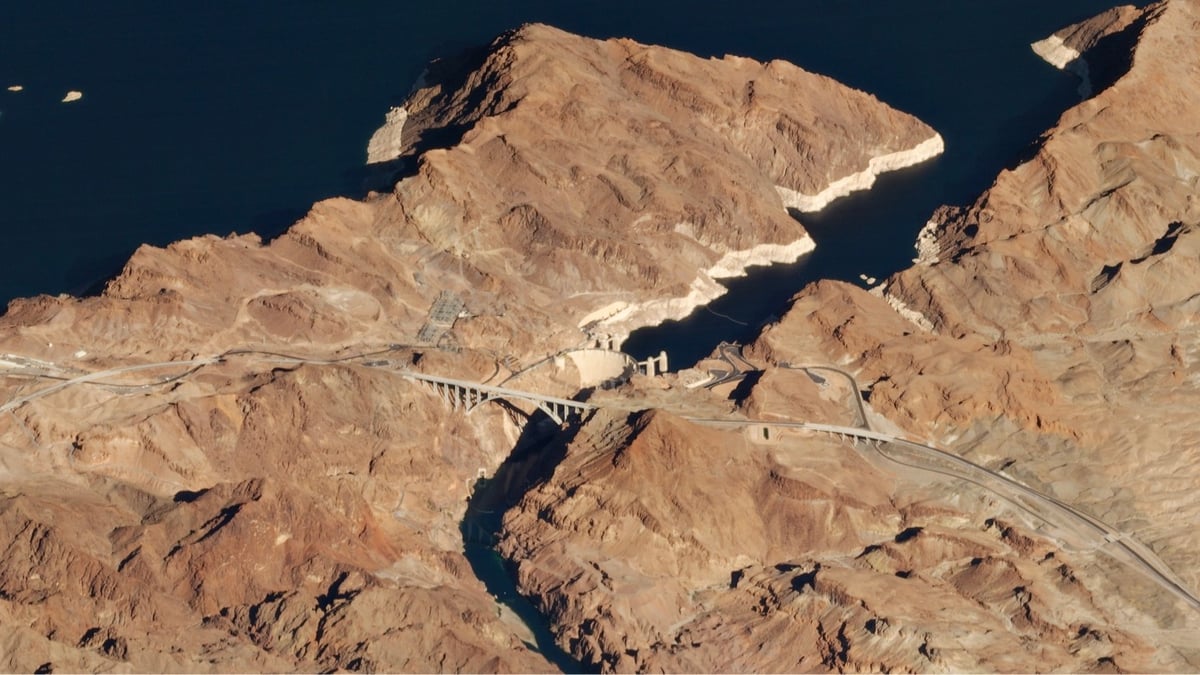
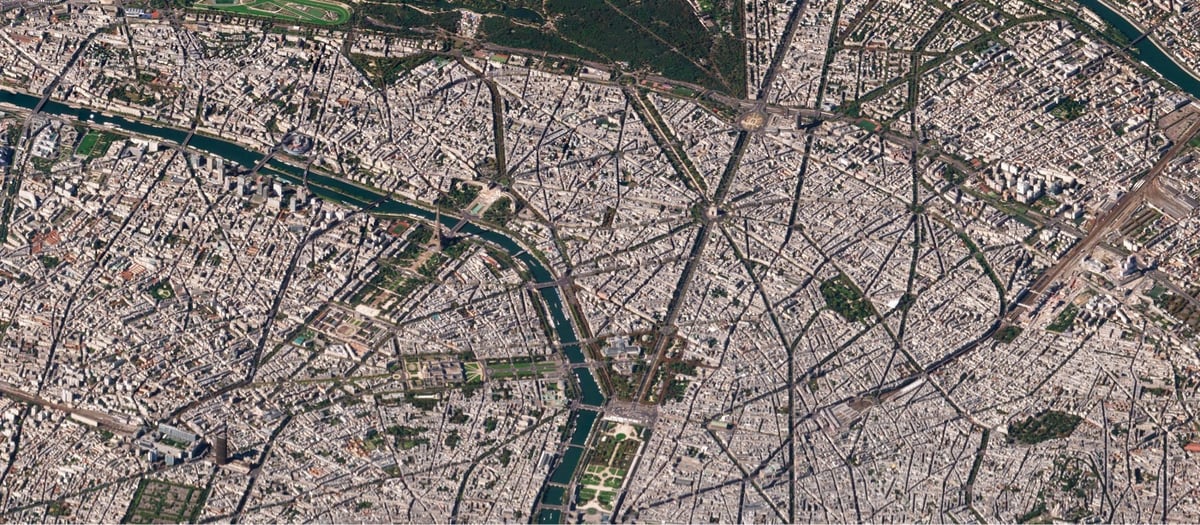
Aspreviouslydocumented, I am a big fan of satellite images taken from a low angle. Planet Labs’ Robert Simmon wrote a post that talks about the history and uses of low-angle satellite imaging and shares many examples (like the two above of the Hoover Dam and Paris).
At the Biden/Harris inauguration on Wednesday, poet Amanda Gorman, dressed in the yellow of the Sun, realigned the planets with her recitation of a poem called The Hill We Climb. In 2018 for The Climate Reality Project, riffing off of the iconic photo of the Earth rising over the surface of the Moon taken by Apollo 8 astronauts, Gorman wrote a poem called Earthrise about the climate emergency and the action we must take to end it. From the text of the poem:
Where despite disparities
We all care to protect this world,
This riddled blue marble, this little true marvel
To muster the verve and the nerve
To see how we can serve
Our planet. You don’t need to be a politician
To make it your mission to conserve, to protect,
To preserve that one and only home
That is ours,
To use your unique power
To give next generations the planet they deserve.
We are demonstrating, creating, advocating
We heed this inconvenient truth, because we need to be anything but lenient
With the future of our youth.
And while this is a training,
in sustaining the future of our planet,
There is no rehearsal. The time is
Now
Now
Now,
Because the reversal of harm,
And protection of a future so universal
Should be anything but controversial.
So, earth, pale blue dot
We will fail you not.
Watch Gorman’s recitation of it above — you might get some goosebumps. (via eric holthaus)
The Milky Way galaxy may be home to billions or even trillions of rogue planets (planets that don’t orbit stars). In this video, Kurzgesagt considers how the Earth could go rogue (by following a nearby massive star away from the Sun) and what would happen to our oceans, atmosphere, and lives if it happened.
The first part of the video is pretty bleak — “as the days turn dark, the final winter of humanity would begin” — while the second part is hopeful: we’ll be able to predict our ejection thousands of years before it happens and may be able to prepare. In light of the world’s response to the pandemic and climate change, it would certainly be interesting to see if human civilization could get it together to save itself from a cold death in outer space. I have no doubt that scientist could accurately diagnose the problem and supply solutions, but the politics would be a total mess.
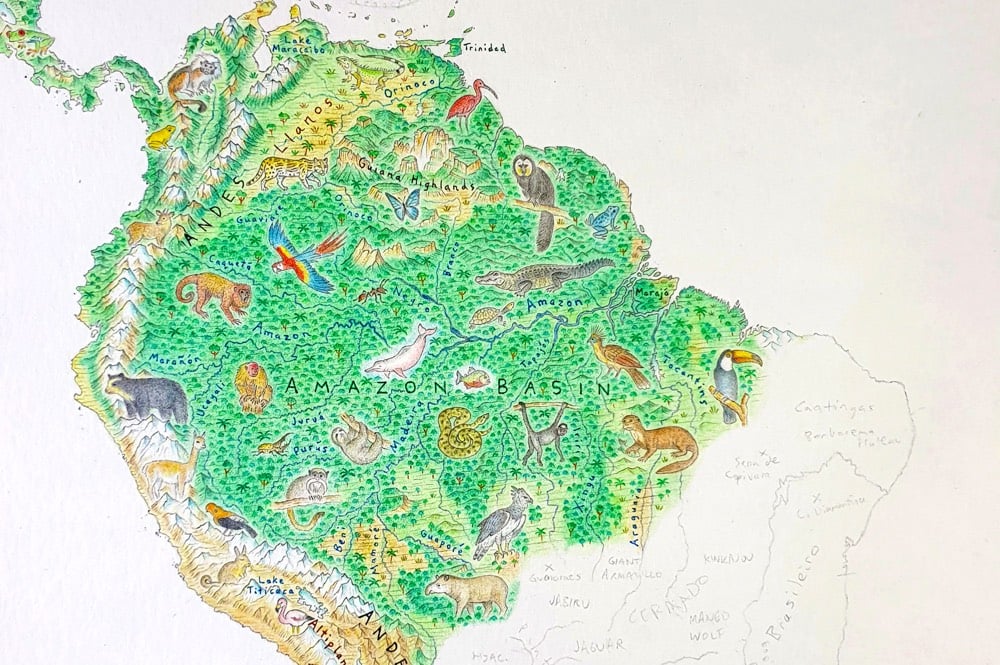
Commenced in mid-2020, this is a brand new map of the world. Rather than the endless skylines and cultural features of North America: Portrait of a Continent, I wanted the wild character of Earth to shine.
While you won’t find cities or borders on this map, you will find geographic labels. This is important. From mountain ranges to deserts, rivers to rainforests, the labels here offer a detailed, accurate outline of Earth’s natural geography.
In this unique feature documentary, titled David Attenborough: A Life On Our Planet, the celebrated naturalist reflects upon both the defining moments of his lifetime and the devastating changes he has seen. Coming to Netflix October 4 2020, the film addresses some of the biggest challenges facing life on our planet, providing a snapshot of global nature loss in a single lifetime. With it comes a powerful message of hope for future generations as Attenborough reveals the solutions to help save our planet from disaster.
In the trailer (embedded above), Attenborough says “I had the most extraordinary life. It’s only now that I appreciate how extraordinary.” In saying that, he’s speaking not only as a living legend whose long career in television and science has brought him nearly universal acclaim, but also as someone who can look back and see how recognizably and thoroughly the Earth has changed during his lifetime. The depletion of animal populations, the changing climate, the shifting habitats — he’s witnessed firsthand how much humans have fucked up the planet. We should listen to his testimony and suggestions for fixing what he calls “our greatest mistake”. I hope it’s not too late.
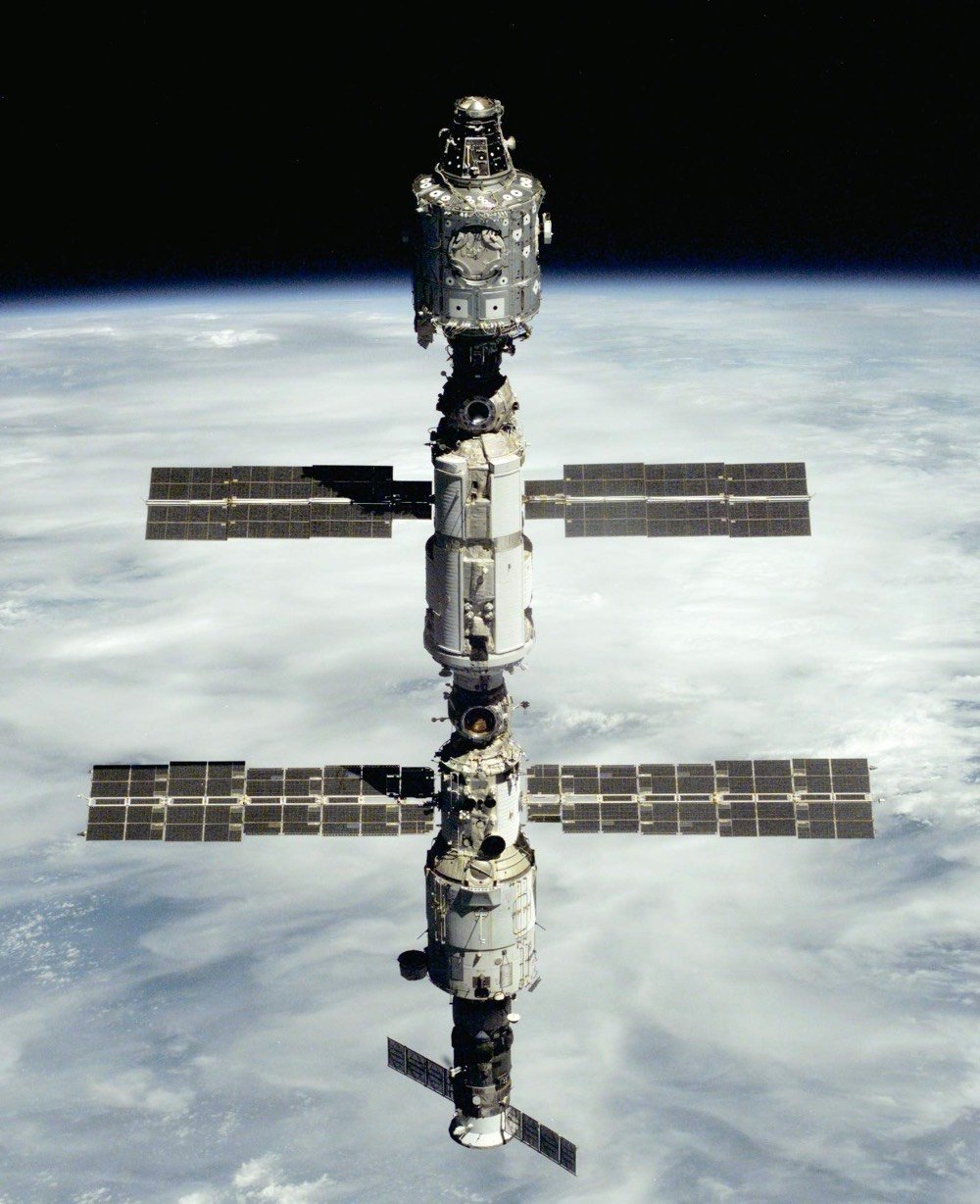
October 31, 2000 was the last day all humans were together on Earth. That day, the rocket containing the crew of Expedition 1 lifted off from the Baikonur Cosmodrome in Kazakhstan and carried them to the International Space Station for a long-term stay. Fittingly, the mission left from the same launchpad that was used to launch Yuri Gagarin into space on April 2, 1961, which was the first time in history that all humans were not together on Earth. Ever since the Expedition 1 crew docked, there’s been an uninterrupted human presence on the ISS, which may continue until 2028 or 2030, by which time there may be humans on the Moon or Mars on a permanent basis. Will humans ever be only Earth-bound again?
BTW, I guess you could argue that the ISS isn’t really separate enough from Earth or that since regular commercial airplane flights began, humans have been separate from the Earth. You could also say that at any given time, thousands of people are in the air while jumping and therefore not on the Earth with the rest of us. I don’t find any of those arguments meaningful. Perhaps someday if space travel is more routine — “just popped up into orbit to visit my daughter” — and the human population is much more distributed, these same distinctions won’t hold, but for now the ISS is definitely apart from the Earth in a way that flying or jumping are not.
Last year I posted a pair of videos showing a sky-stabilized rotation of the Earth around the starry sky. Because the Earth is our vantage point, we’re not used to seeing this view and it’s pretty trippy.
Now Bartosz Wojczyński has created a video showing full-day rotation of the Earth with footage shot in Namibia. The rotation is sped up to take only 24 seconds and is repeated 60 times to simulate about 2 months of rotation. I find this very relaxing to watch, like I’m riding in a very slow clothes dryer.
The first 30 seconds of this time lapse video provides a great look into how the 10 satellites that make up the Global Precipitation Measurement Constellation scan the surface of the Earth to provide daily global precipitation maps.
This visualization shows the constellation in action, taking precipitation measurements underneath the satellite orbits. As time progresses and the Earth’s surface is covered with measurements, the structure of the Earth’s precipitation becomes clearer, from the constant rainfall patterns along the Equator to the storm fronts in the mid-latitudes. The dynamic nature of the precipitation is revealed as time speeds up and the satellite data swaths merge into a continuous visualization of changing rain and snowfall.
In most time lapse videos you see of the night sky, the stars wheel through the sky as the heavens revolve around the Earth. But that perspective is really only valid from our particular frame of reference standing on the Earth. What’s actually happening is that our tiny little speck of dirt is twirling amid a galactic tapestry that is nearly stationary. And in the video above, you see just that…the Earth rotating as the camera lens stays locked on a motionless Milky Way. Total mindjob.
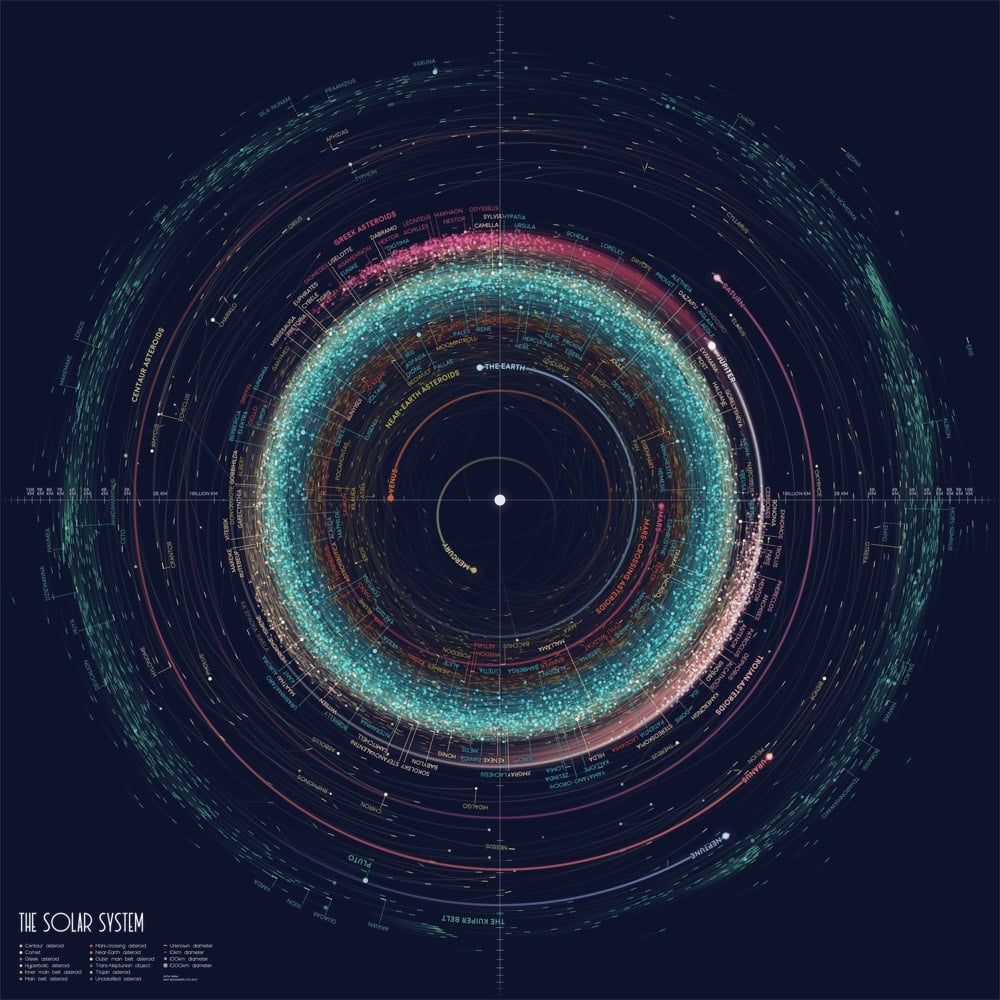
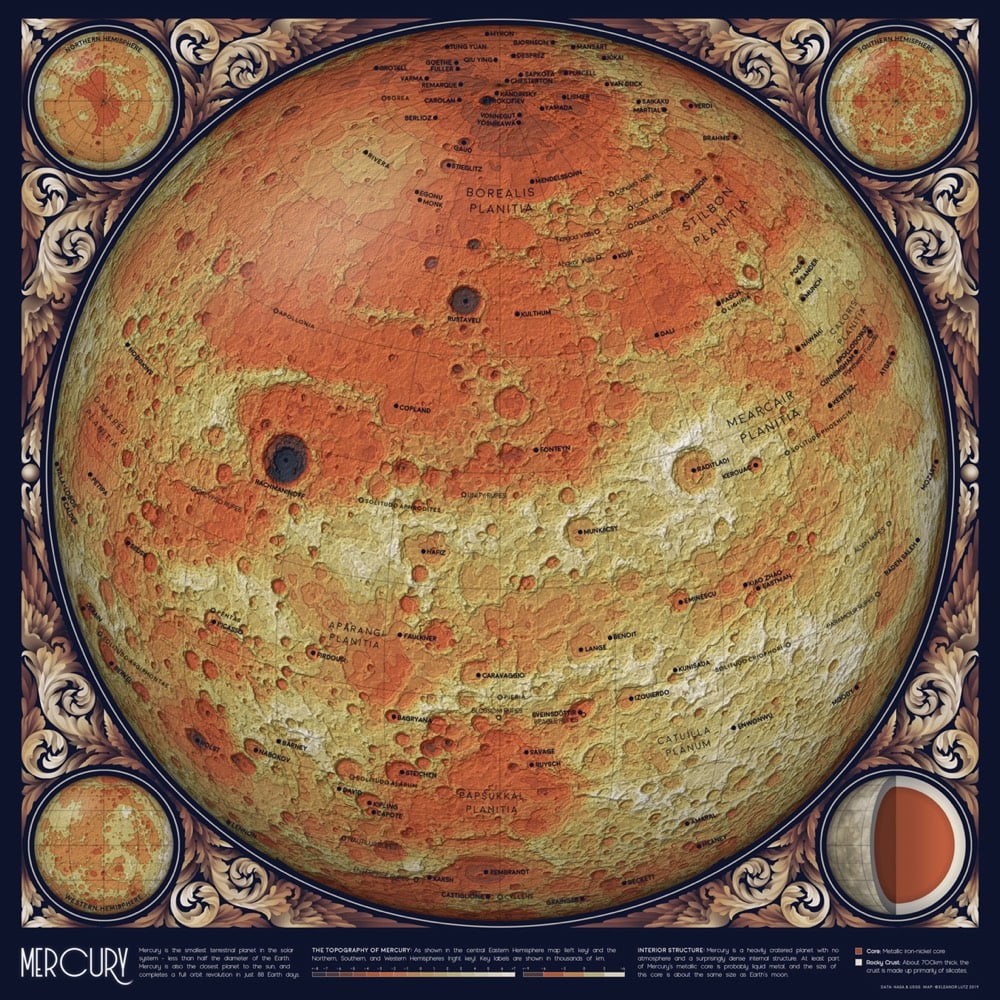
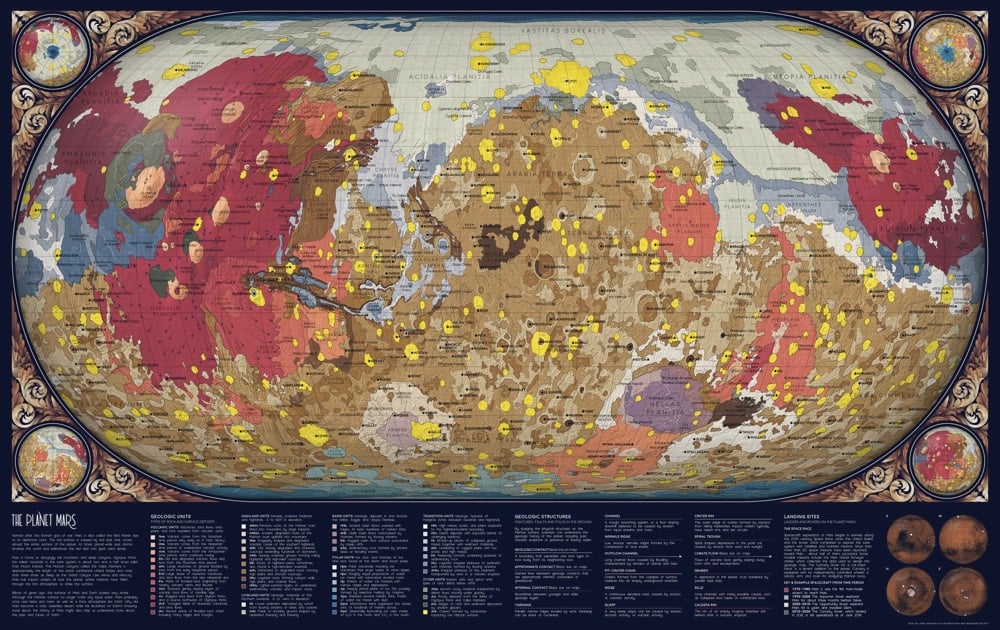
Over the past year and a half I’ve been working on a collection of ten maps on planets, moons, and outer space. To name a few, I’ve made an animated map of the seasons on Earth, a map of Mars geology, and a map of everything in the solar system bigger than 10km.
As promised, Lutz has posted the source code for each project to her GitHub account: Mercury topography, asteroid orbits. What a great resource for aspiring data visualization designers. Stay tuned to her site, Twitter, or Tumblr for upcoming installments of the atlas.
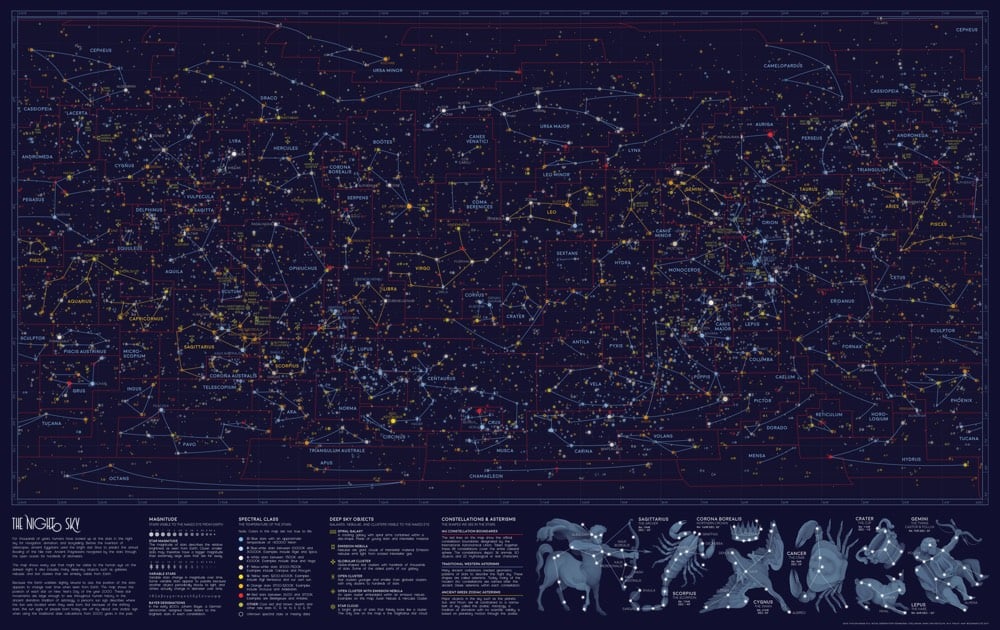
This week’s map shows every single star visible from Earth, on the darkest night with the clearest sky. The map also includes all of the brightest galaxies, nebulae, and star clusters from W.H. Finlay’s Concise Catalog of Deep-sky Objects. I illustrated the familiar Western star patterns — or asterisms — in blue and gold, as well as the scientific constellation boundaries in red.
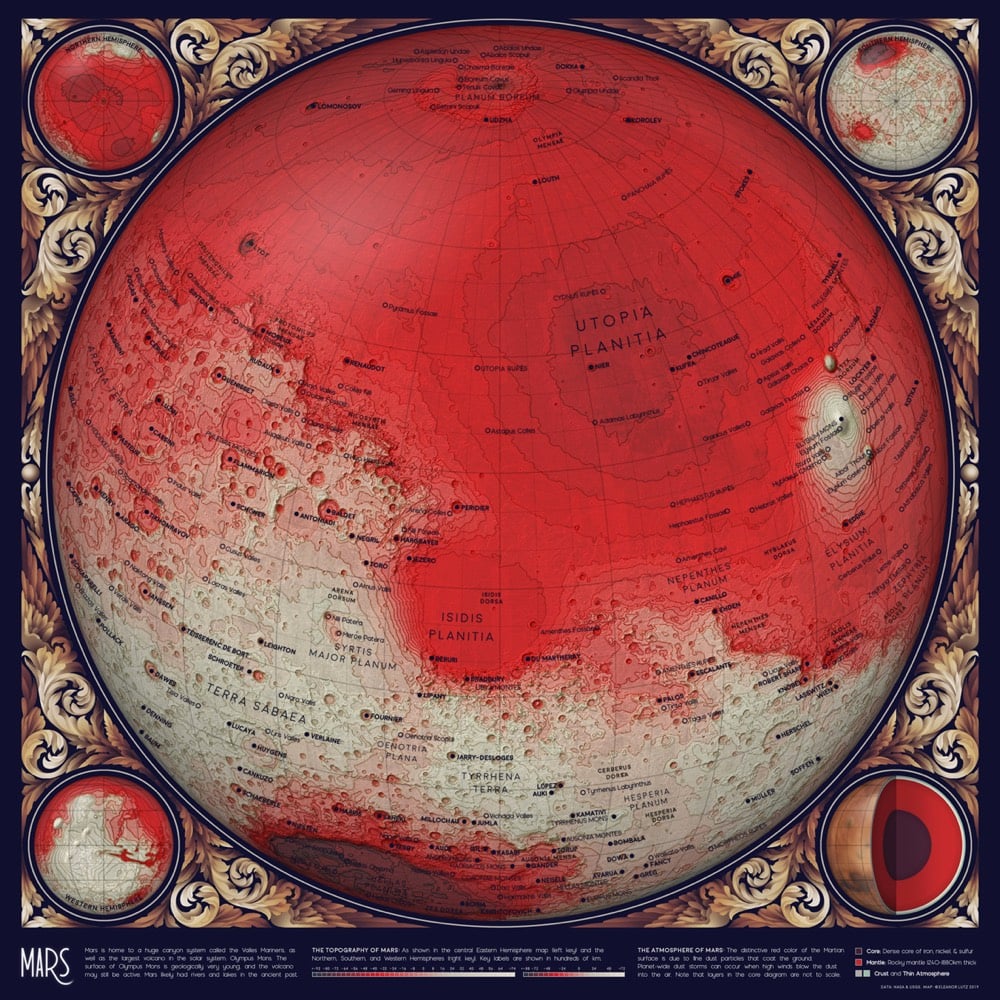
Update: Holy moly, I think Lutz’s Topographic Map of Mars might be her most beautiful one yet.
Update: I couldn’t keep up with all of Lutz’s additions to her atlas. You can check out all of the installments in the archive, including the last part (for now), The Geology of the Moon.
If you look at the orbits of the planets adjacent to the Earth’s orbit (Venus & Mars), you’ll see that Venus’s orbit is closest to our own. That is, at its closest approach, Venus gets closer to Earth than any other planet. But what about the average distance?
According to this article in Physics Today by Tom Stockman, Gabriel Monroe, and Samuel Cordner, if you run a simulation and do a proper calculation, you’ll find that Mercury, and not Venus or Mars, is Earth’s closest neighbor on average (and spends more time as Earth’s closest neighbor than any other planet):
Although it feels intuitive that the average distance between every point on two concentric ellipses would be the difference in their radii, in reality that difference determines only the average distance of the ellipses’ closest points. Indeed, when Earth and Venus are at their closest approach, their separation is roughly 0.28 AU — no other planet gets nearer to Earth. But just as often, the two planets are at their most distant, when Venus is on the side of the Sun opposite Earth, 1.72 AU away. We can improve the flawed calculation by averaging the distances of closest and farthest approach (resulting in an average distance of 1 AU between Earth and Venus), but finding the true solution requires a bit more effort.
What the calculation also shows is that Mercury is the closest planetary neighbor to every planet, on average. Also, the authors of the paper don’t explicitly mention this, but the Sun (at 1 AU) is closer on average to the Earth than even Mercury (1.04 AU).
Behind the Curve, now available on Netflix, is a 2018 documentary about the global community of people who believe that the Earth is flat. In this scene at the end of the film (um, spoilers?), a Flat-Earther named Jeran Campanella devises a simple experiment that he claims will prove that the Earth is flat…but very quickly proves the opposite:
Campanella’s reaction: “Interesting. Interesting. That’s interesting.” This is one of two straightforward experiments shown in the film that are devised by Flat-Earthers to prove the planet’s flatness that end up affirming that the Earth is indeed round (or, more accurately, an oblate spheroid).
One of the more jaw-dropping segments of the documentary comes when Bob Knodel, one of the hosts on a popular Flat Earth YouTube channel, walks viewers through an experiment involving a laser gyroscope. As the Earth rotates, the gyroscope appears to lean off-axis, staying in its original position as the Earth’s curvature changes in relation. “What we found is, is when we turned on that gyroscope we found that we were picking up a drift. A 15 degree per hour drift,” Knodel says, acknowledging that the gyroscope’s behavior confirmed to exactly what you’d expect from a gyroscope on a rotating globe.
“Now, obviously we were taken aback by that. ‘Wow, that’s kind of a problem,’” Knodel says. “We obviously were not willing to accept that, and so we started looking for ways to disprove it was actually registering the motion of the Earth.”
Knodel & Campanella are the co-hosts of a YouTube channel called Globebusters (I’m not going to link to it…YouTube’s conspiracy-minded algorithms don’t need any help) where they claim to debunk the Earth’s curvature and heliocentrism as well as discussing how NASA fakes space activities. Their failed experiments don’t seem to have diminished their Flat Earth zeal. One of their recent videos, nearly 4 hours long, is an attempt to “[debunk] the bogus claim that Globebusters proved a 15 degree per hour rotation of the Earth” and another, also almost 4 hours long, is a rebuttal to the “misrepresentation” of their views and experiments in Behind the Curve.
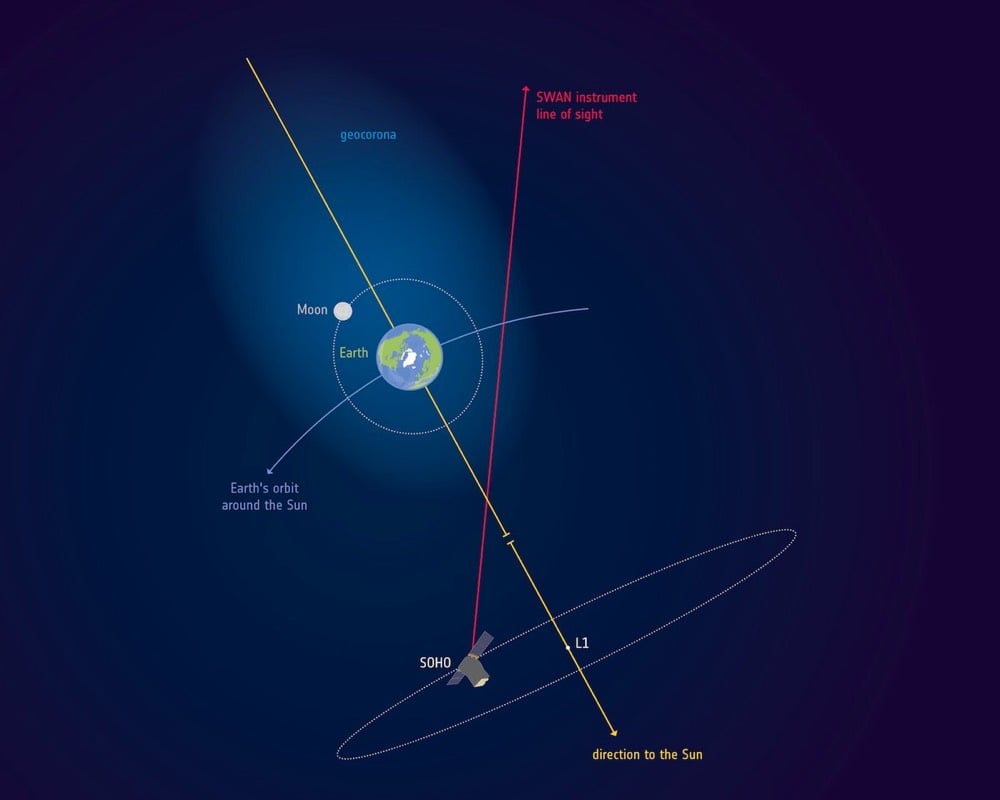
A recent analysis of data collected by the ESA/NASA Solar and Heliospheric Observatory shows that the Earth’s atmosphere is a lot larger than previously known.
A recent discovery based on observations by the ESA/NASA Solar and Heliospheric Observatory, SOHO, shows that the gaseous layer that wraps around Earth reaches up to 630 000 km away, or 50 times the diameter of our planet.
“The Moon flies through Earth’s atmosphere,” says Igor Baliukin of Russia’s Space Research Institute, lead author of the paper presenting the results.
“We were not aware of it until we dusted off observations made over two decades ago by the SOHO spacecraft.”
As you might imagine, the atmosphere gets preeeeetty thin farther from the surface of the Earth — at the Moon’s distance, the density of hydrogen atoms is 0.2 atoms per cubic centimeter.
To celebrate the 20th anniversary of the first module of the International Space Station being put into orbit, ESA astronaut Alexander Gerst shot a 15-minute time lapse video of the Earth from the ISS, long enough for two complete orbits of the planet. Landmarks along the journey are annotated right on the video and the location of the ISS is also plotted on a map in the top right corner. Love the nighttime thunderstorms over the Pacific.
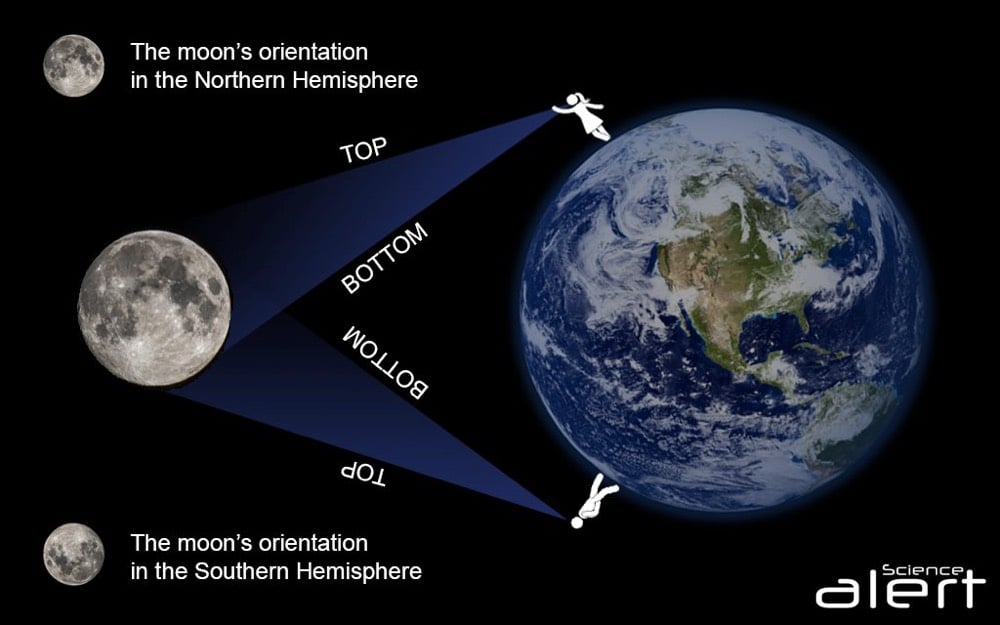
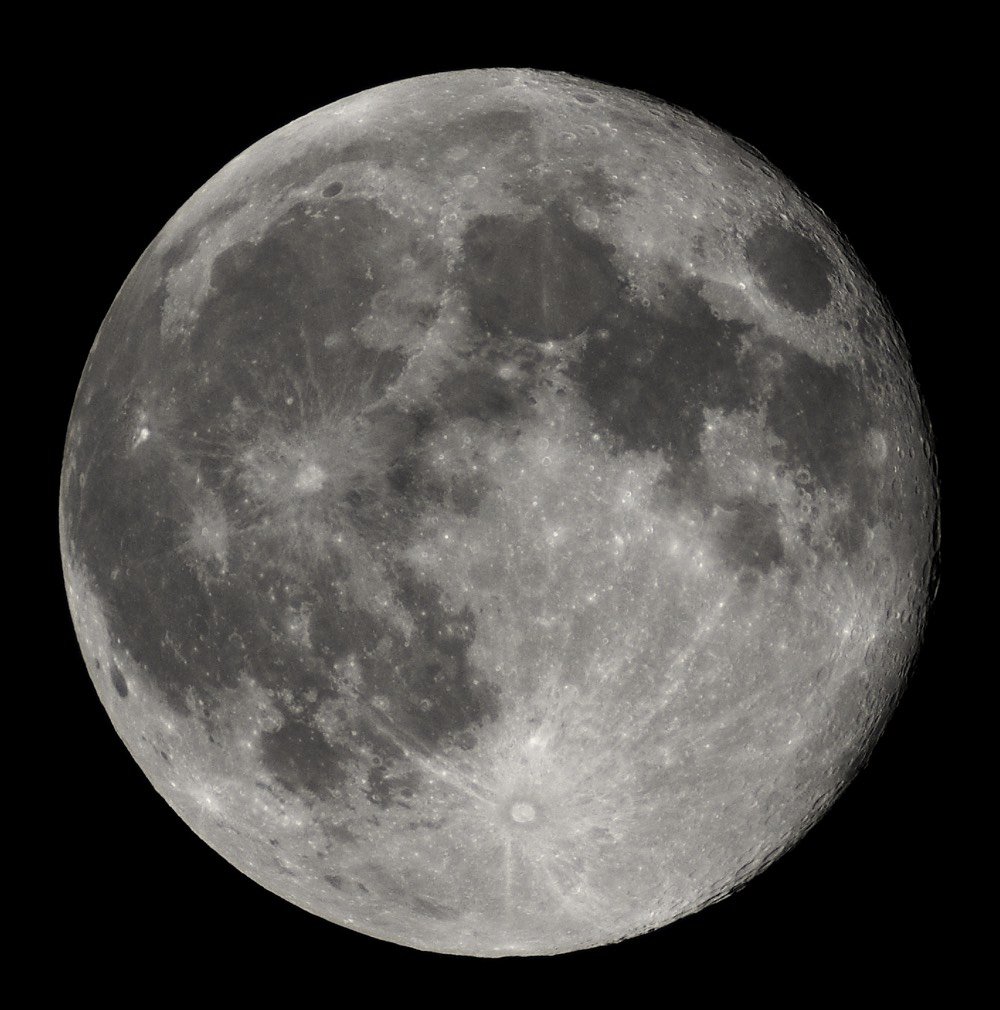
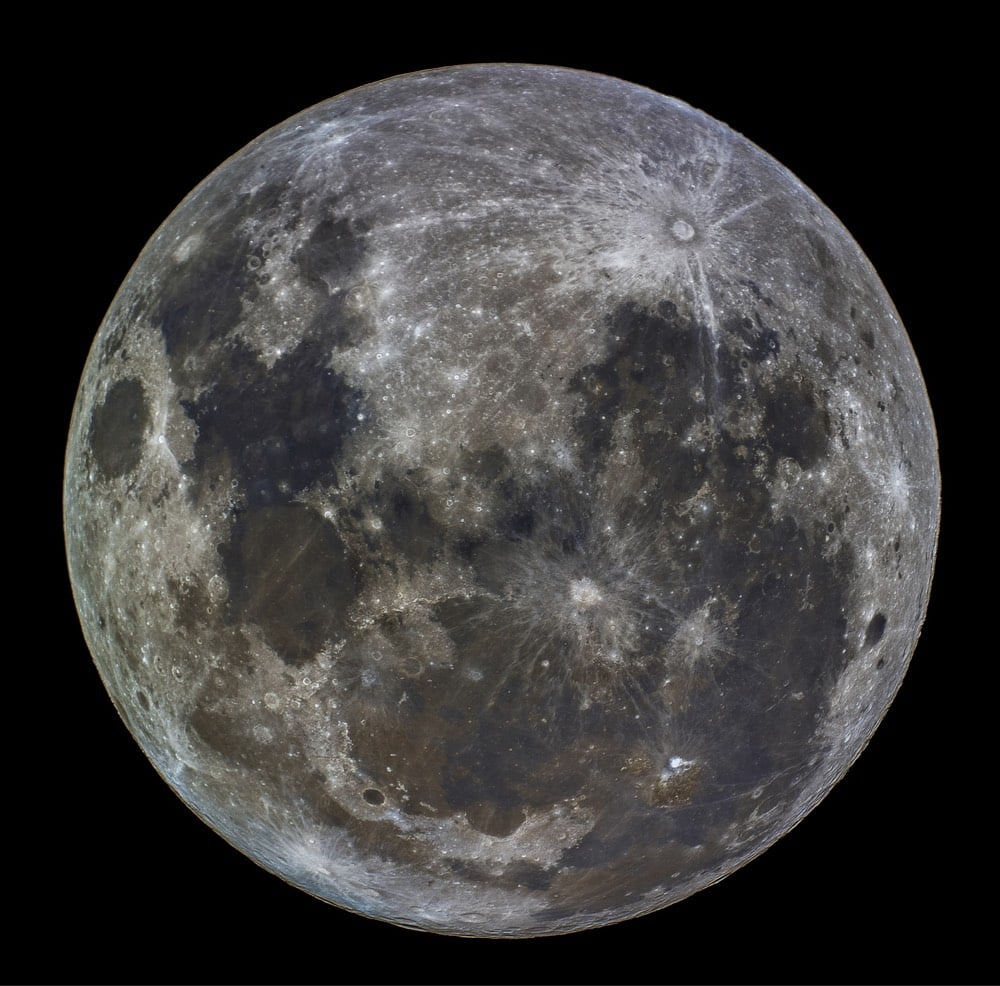
How old were you when you learned that the Moon in the Southern Hemisphere is upside down? I was today years old…this is my head exploding —> %@*&!$. Ok, the Moon isn’t upside down (that’s Northern-ist) but its orientation changes depending on if you’re north or south of the equator.
“From our perspective, the Moon and the night sky is actually rotated 180 degrees compared to our Northern Hemispherical friends,” Jake Clark, an astronomer from the University of Southern Queensland in Australia, explained to ScienceAlert.
“In the south we see the Moon’s dark ‘Oceanus Procellarum’ sea in the south-east corner compared to in the north-west corner for a northern observer.”
But why does it look like this? Well, because physically, we’re actually upside down compared to someone standing in the opposite hemisphere.
That makes perfect sense & the explanation is quite simple but it’s still messing with my head. How did I not know this? Here’s how the Moon appears in the Northern Hemisphere (from Wikipedia):





Stay Connected