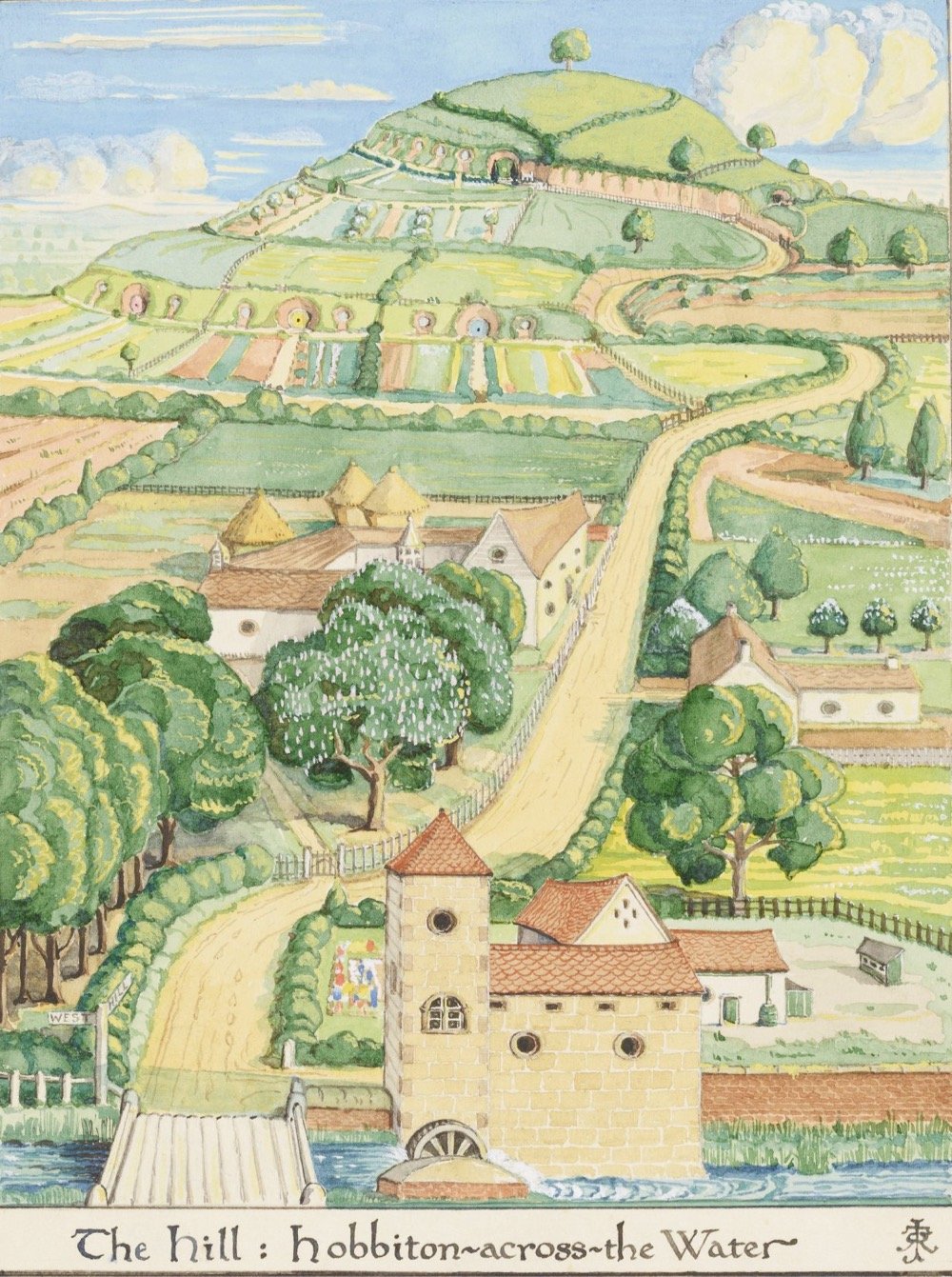
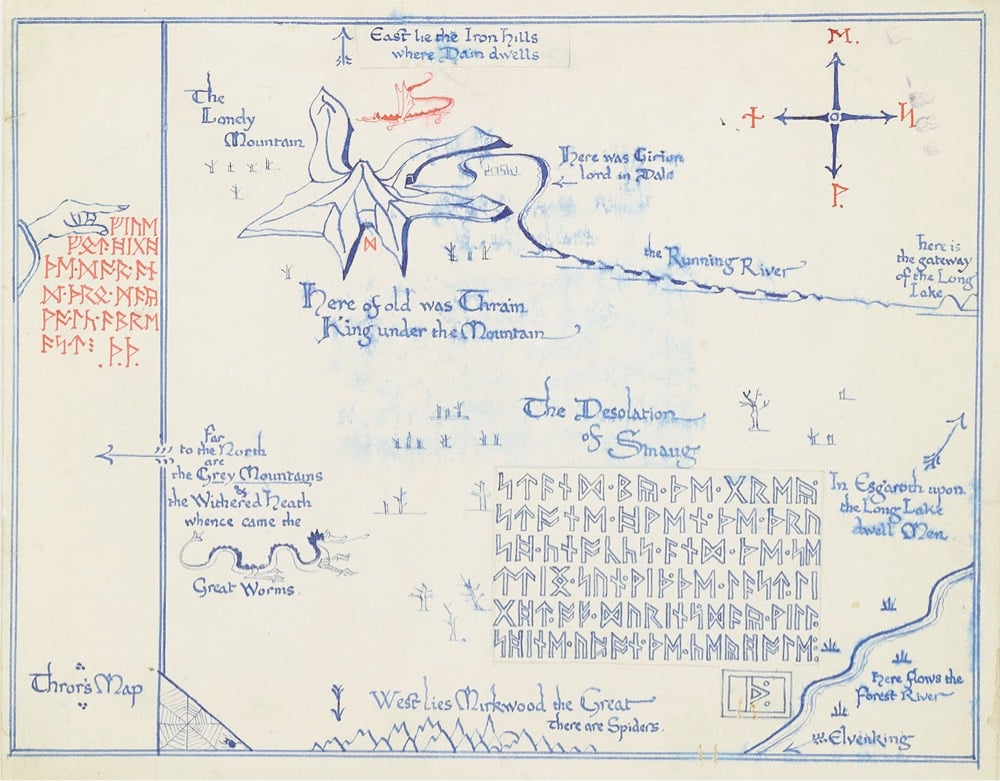
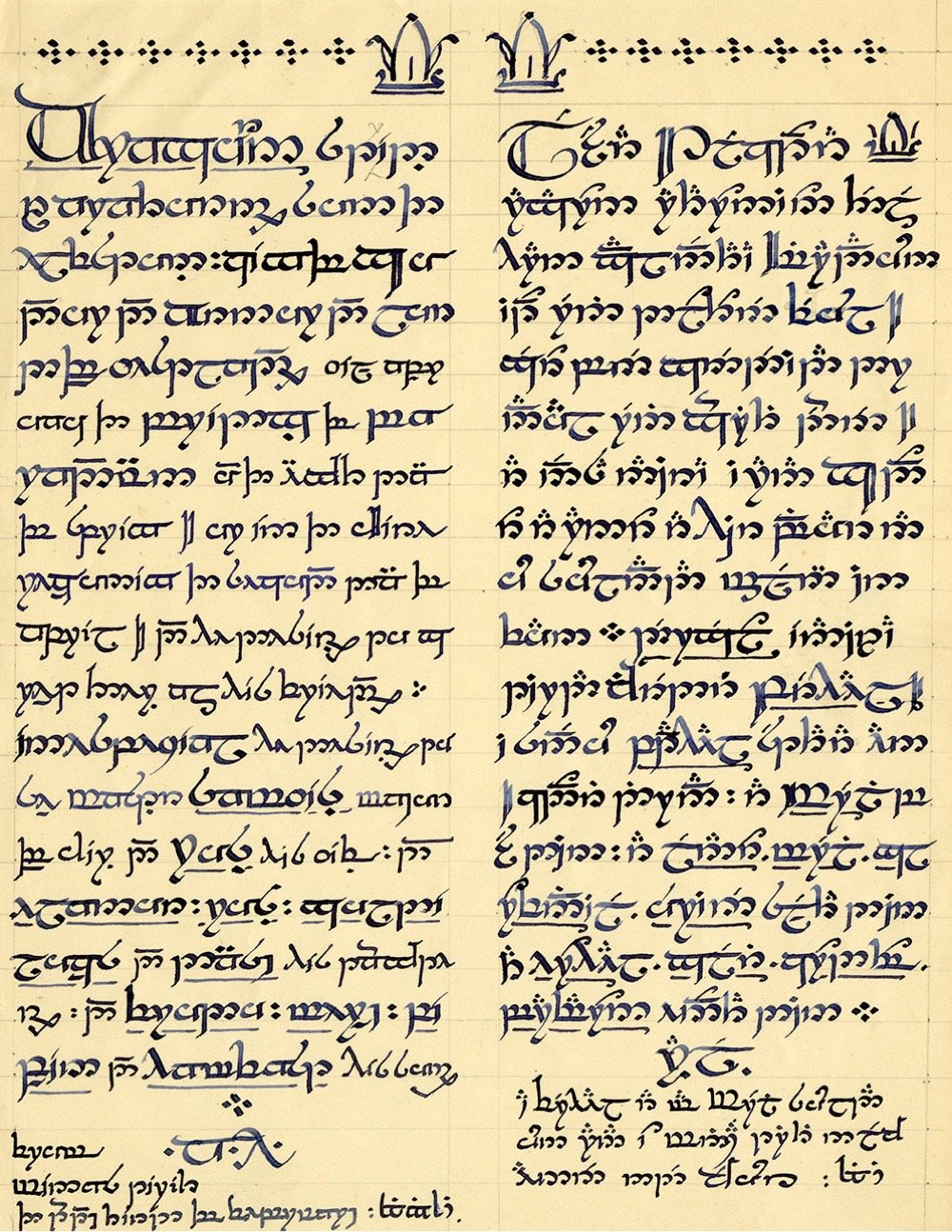
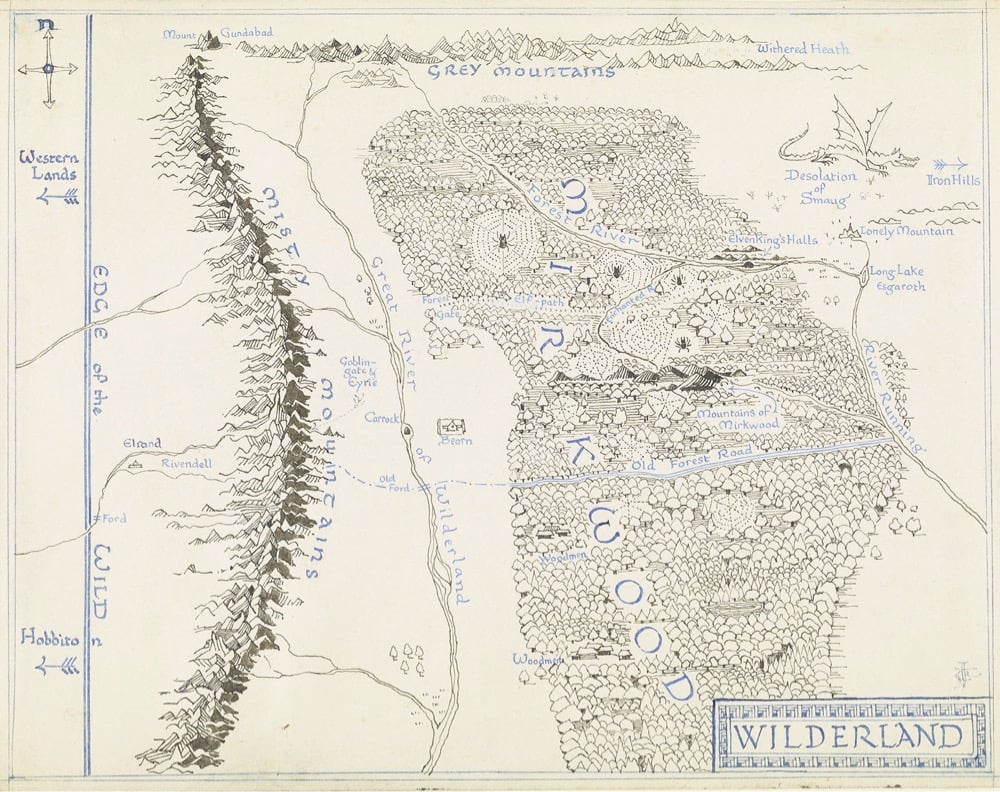
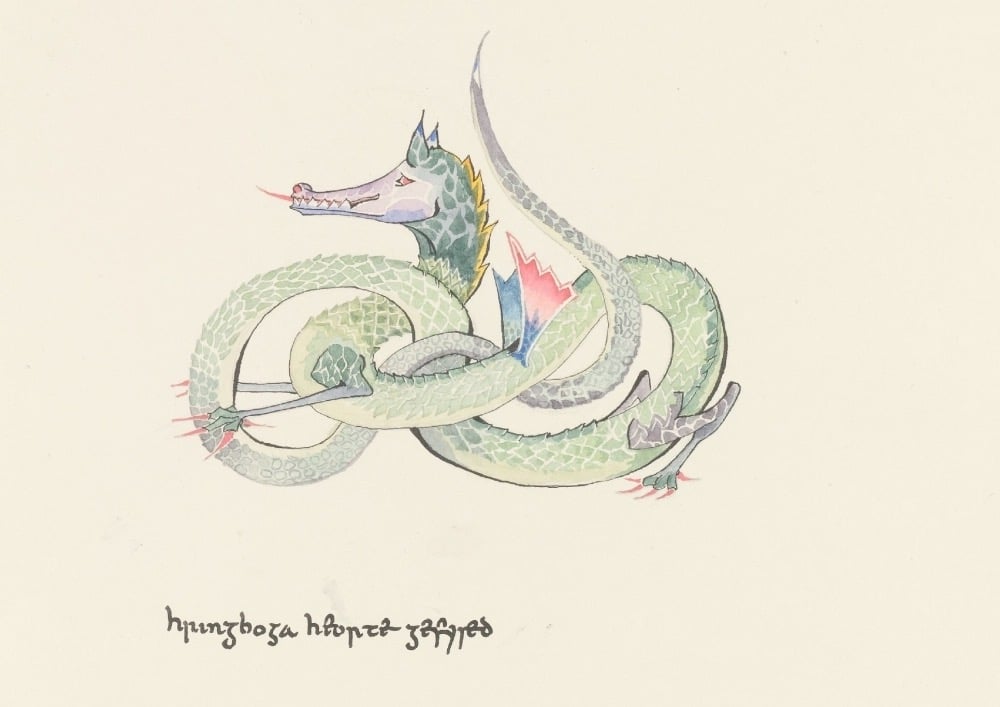
The Tolkien Estate has built a new website dedicated to J.R.R. Tolkien and it includes dozens of hard-drawn maps, illustrations, paintings, and calligraphic works done by the author in the course of writing his books. Tolkien was a talented artist and his maps and visual art were an integral part of his work. From Artnet:
Tolkien’s art and writings went hand and hand, with illustrations serving as an an integral part of his creative process. Sometimes the words would inspire the artwork, and sometimes drawing a scene would move the narrative in new directions.
The author meticulously mapped out the world of Middle Earth to ensure the accurate movements of his large cast of characters.
So many of us are struggling in isolation during the lockdown. While times are tough, I want to take you on one of the greatest fantasy adventures ever written, a 12 hour armchair marathon across Middle Earth whilst raising money for two amazing charities which are doing extraordinary work right now to help those most in need in the UK: Best Beginnings and NHS Charities Together.
He’s been going since 5am EST, so you can join in progress or rewind your way back to the beginning. The campaign has already reached its initial goal of £100,000 — you can contribute here. A “special surprise” was promised if the goal was met…I wonder if Ian McKellen or Martin Freeman will be stopping by for a chapter or two?
In 1952, a friend of J.R.R. Tolkien showed him a tape recorder, which the author had never seen before. Delighted, Tolkien sat for his friend and read from The Hobbit for 30 minutes “in this one incredible take”. The audio is split between these two videos (with visuals and music added later):
Given the circumstances, the clarity of this recording is pretty remarkable. Give it a listen for at least the first two minutes…hearing Tolkien do Smeagol/Gollum’s voice is really cool. (via open culture)
In this video about the making of The Hobbit movies, members of the film crew, including director Peter Jackson, admit that they didn’t really have a good idea of what was going to happen in the movies until they were on the set filming and that they made a lot of it up as they went along.
The above clip is from a behind-the-scenes video on the Battle of the Five Armies Blu-ray, and it features Peter Jackson, Andy Serkis, and other production personnel confessing that due to the director changeover — del Toro left the project after nearly two years of pre-production — Jackson hit the ground running but was never able to hit the reset button to get time to establish his own vision. In comparison, he spent years prepping the original Lord of the Rings trilogy, and on the Hobbit things got so bad that when they started shooting the titular Battle of Five Armies itself they were essentially just shooting B-roll: footage of people in costumes waving around swords, without any cohesive plan for how the sequence would actually play out. (A choice Jackson quote: “I didn’t know what the hell I was doing.”)
No idea why they would release a video like this which pretty much admits that the movies weren’t as good as they should have been. I mean, they still made a crap-ton of money at the box office (a combined $3 billion worldwide), so happy ending for them anyway I guess?
Someone called TolkienEditor has cut the three Peter Jackson The Hobbit movies down into a single 4-hour film and put the result up on BitTorrent. Their goal was to make the film hew more closely to the book, put the focus back on Bilbo as the main character, and to quicken the pace of the narrative.
The investigation of Dol Guldor has been completely excised, including the appearances of Radagast, Saruman and Galadriel. This was the most obvious cut, and the easiest to carry out (a testament to its irrelevance to the main narrative). Like the novel, Gandalf abruptly disappears on the borders of Mirkwood, and then reappears at the siege of the Lonely Mountain with tidings of an orc army.
The Tauriel-Legolas-Kili love triangle has also been removed. Indeed, Tauriel is no longer a character in the film, and Legolas only gets a brief cameo during the Mirkwood arrest. This was the next clear candidate for elimination, given how little plot value and personality these two woodland sprites added to the story. Dwarves are way more fun to hang out with anyway.
I enjoyed PJ’s The Hobbit, particularly the second one, but my main criticism was the lack of focus on Bilbo. I couldn’t rustle up any interest in the dwarves or their quest…they were a bunch of ex-rich dudes trying to get their money back. Bah! Martin Freeman was an amazing Bilbo and we just didn’t get enough of him. (via @tcarmody)
Here’s the trailer for the third and final movie in Peter Jackson’s The Hobbit trilogy:
The Hobbit was initially supposed to be just two films but Jackson decided to split the second film into two. From Wikipedia:
According to Jackson, the third film would contain the Battle of the Five Armies and make extensive use of the appendices that Tolkien wrote to expand the story of Middle-Earth (published in the back of The Return of the King).
The second movie was better than the first so I’m looking forward to this one. But then again, I’m totally in the tank for Jackson’s take on Middle Earth (I did the Weta Digital tour when I was in New Zealand) so I would see it even if the first two movies sucked.
In The Hobbit, Bilbo Baggins signs a contract with a company of dwarves to serve as their burglar in their quest to reclaim the Lonely Mountain from a dragon. Lawyer James Daily analyzed the contract in detail for Wired.
Even in the book’s version we see an issue: the dwarves accept Bilbo’s “offer” but then proceed to give terms. This is not actually an acceptance but rather a counter-offer, since they’re adding terms. In the end it doesn’t matter because Bilbo effectively accepts the counter-offer by showing up and rendering his services as a burglar, but the basic point is that the words of a contract do not always have the legal effect that they claim to have. Sometimes you have to look past the form to the substance.
What’s going on here? I really struggled to figure out what was happening to my own eyes and my perception that something as simple as changing a frame rate would trigger such drastic re-evaluations of cinema?
I researched on the web without much satisfaction, since few people had actually seen 48HFR. I asked a few friends in the advance cinema industry and got unsatisfactory answers. Then I was at a party with a friend from Pixar and asked him my question: why does HFR change the appearance of the lighting? He also could not tell me, but the man next to him could. He was John Knoll, the co-creator of Photoshop and the Oscar-winning Visual Effects Director for a string of technically innovative Hollywood blockbusters as long as my arm. He knew.
I saw The Hobbit at 48fps and it was a unique experience. At times, it was amazing, like you were in the movie, tromping around Middle Earth. At other times, the effect was laughably bad, like having a bunch of cosplaying dwarves in bad makeup standing around in your fluorescently lit living room. Dwalin, son of Fundin, I can see your skin cap.
In a profile this summer from Le Monde, Christopher Tolkien, the 88 year-old son of J.R.R. Tolkien blasted Peter Jackson and The Lord of the Rings / The Hobbit movies. (If you can’t speak French, you should see the translation of the profile.) Tolkien, who drew the maps for the Lord of the Rings books, has spent most of his life protecting the legacy of his father’s works, and the movies are, apparently, a bridge too far.
Invited to meet Peter Jackson, the Tolkien family preferred not to. Why? “They eviscerated the book by making it an action movie for young people aged 15 to 25,” Christopher says regretfully. “And it seems that The Hobbit will be the same kind of film.”
This divorce has been systematically driven by the logic of Hollywood. “Tolkien has become a monster, devoured by his own popularity and absorbed into the absurdity of our time,” Christopher Tolkien observes sadly. “The chasm between the beauty and seriousness of the work, and what it has become, has overwhelmed me. The commercialization has reduced the aesthetic and philosophical impact of the creation to nothing. There is only one solution for me: to turn my head away.”
Alright, the film adaptation of The Hobbit is moving forward. After Guillermo Del Toro stepped down as director a few months ago, I heard that Jackson was set to direct and that’s what’s happening. They’ve also cast the perfect Bilbo: Martin Freeman. Freeman was Tim on The Office, Arthur Dent in the Hitchhiker’s movie, and John Watson in the excellent new Sherlock series.
“Guillermo is co-writing the Hobbit screenplays with Philippa Boyens, Fran Walsh and myself, and happily our writing partnership will continue for several more months, until the scripts are fine tuned and polished” says Jackson. “New Line and Warner Bros will sit down with us this week, to ensure a smooth and uneventful transition, as we secure a new director for the Hobbit. We do not anticipate any delay or disruption to ongoing pre-production work”.
Obviously Jackson should just direct the damn thing.
Update: Hmm, I just heard from a small bird that Jackson is pretty much set to direct…just finalizing the deal with the studio. On the other hand, Jackson’s manager says that the director is committed to other directing projects. So I guess we’ll see what happens.




Stay Connected