Once, Kottke.org’s tagline was “Liberal Arts 2.0.” It’s a terrific description of everything the blog covers and how Jason covers it; unpacking the web with a humanist lens, looking for noteworthy specimens and bigger connections.
It also chimed with “Web 2.0,” which was a popular descriptive and prescriptive phrase at the time.
Tim Berners-Lee famously derided “Web 2.0” as “jargon,” claiming that the web was always intended to be a social and collaborative medium and that the things proponents of a renewal of the web wanted to emphasize were there from the start. Which is… basically accurate!
But the liberal arts badly needed (and still badly need) an update for the age of the web. So many of the big Web 2.0 projects (social networking and commerce, folksonomies, the web as a development platform) either betrayed some of their initial democratizing promises as they were taken over by giant companies, or got crowded out by the same.
And “Web 3.0” — well, the less said about that, the better. A straight marketing play that ropes together a few promising technologies with total dead ends.
Liberal Arts 2.0, though — that’s a concept that still has legs. But perhaps twenty years after Snarkmarket got rolling, and twenty-five years after Kottke.org hung up its shingle, we can propose a modest, incremental (but still significant) update: Liberal Arts 2.5.
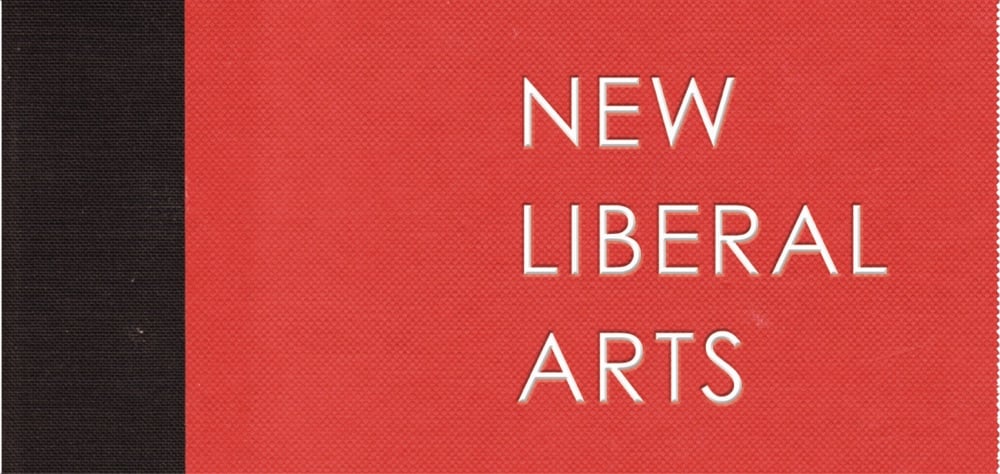
In 2009, me and my partners Matt Thompson and Robin Sloan plus a community of collaborators at my old site Snarkmarket were so struck by Jason’s idea of Liberal Arts 2.0 that we decided to make a book that outlined a series of emerging disciplines that we thought might make up a set of New Liberal Arts.
This was pre-Kickstarter, so we rolled it up ourselves. With help from Revelator Press, we created it as a limited-edition paperback book; the print run was just 200 copies, so it’s quite a collectible nowadays. Once we cleared our production costs, we also offered it as a free, Creative Commons-licensed PDF, ebook, and as plain HTML — an early example of what I later called unlocking the commons.
I’m actually quite pleased that the plain HTML version I made (and hand-edited!) so we could turn it into an ebook is still up. The PDF version we had hosted succumbed to linkrot, but it’s still available on Issuu. For fun, I just posted a copy of the original New Liberal Arts PDF on Dropbox just for readers of Kottke.org.
New Liberal Arts is the apotheosis of everything I loved about Snarkmarket. It asks big questions about the past, present, and future, including especially the past/present/future of media. It is a collaborative project we made with our community. And it’s a concrete thing we put into the world, under our own terms, that got people excited and sparked more conversations.
And it’s a conversation that I think is still going. If anything, liberal arts education is even more under attack today than it was in 2009. And between then and now, liberal arts practitioners have had to reflect on what it means to teach, learn, and operate in the world given the rapid rate of technological change — not just between now and when the medieval trivium and quadrivium were formulated, but between now and the postwar university, or even the culture wars of the 1980s and 1990s.
It’s something we need to keep rethinking continually. (And not coincidentally, “rethinking things continually” is something that the liberal arts traditionally has done extremely well.)
Here is our original list of “New” Liberal Arts:
Attention Economics
Brevity
Coding and Decoding
Creativity
Finding
Food
Genderfuck
Home Economics
Inaccuracy
Iteration
Journalism
Mapping
Marketing
Micropolitics
Myth and Magic
Negotiation
Photography
Play
Reality Engineering
Translation
Video Literacy
Contributors included myself, Matt Thompson, Robin Sloan, Andrew Fitzgerald, Gavin Craig, Diana Kimball, Aaron McLearan, Dan Levine, Theresa Mlinarcik, Laura Portwood-Stacer, Jennifer Rensenbrink, Alex Litel, Jimmy Stamp, Tiara Shafiq, Matthew Penniman, Rex Sorgatz, Rachel Leow, and Kasia Cieplak Mayr-Von Baldegg.
If you want to read more about what we had to say about any of these things, please read the book, or browse individual chapters at leisure — it’s really not very long.
But in true Snarkmarket/Liberal Arts 2.0/Web 2.0 fashion, I also want to open up this conversation to the Kottke community.
What do you think are the new liberal arts?
How do the liberal arts need to change to reflect new technologies, media ecologies, and social and political transformations (and crises)?
What do we need to hold onto from liberal arts education that’s in danger of being lost?
If you were teaching a youth today what they needed to know to be a free person in the world, what subjects would be on your curriculum?
Today, November 3rd, is my 44th birthday. Tomorrow, the 4th, is my first wedding anniversary. But today is also an important day in my personal history of the web, and I’d argue, in the history of blogging, or at least our corner of it. It’s the twentieth anniversary of Snarkmarket, founded by Robin Sloan and Matt Thompson. It’s also the fifteenth anniversary of the day I joined as the site’s third blogger, or Snarkmaster, after five years of being part of the site’s community (the Snarkmatrix). (Coincidentally, Obama was first elected President that November 4th. It was a really good couple of days.)
If you didn’t have the good fortune to read Snarkmarket while it was active, I’ll give you a quick précis. Robin and Matt both graduated college in 2002, then completed a year of journalism study at the Poynter Institute. They started Snarkmarket as a way to write about the future of media, but also to keep in touch with each other as they scattered across the country to look for jobs in media. And for over a decade, that’s exactly what they did.
Now, there were a lot (for relatively small values of “a lot”) of blogs that purported to be about the future of media in 2003. But too many of these were navel-gazing armchair speculations that were mostly about settling scores within the industries they covered.
Snarkmarket was different. (For one thing, it wasn’t really very snarky.)
Matt and Robin were two young practitioners of journalism who loved the web but largely saw it for what it was — which is to say, a set of imperfect communities and technologies that were in danger of calcifying around a limited set of interests, and in even greater danger of being dominated by big companies.
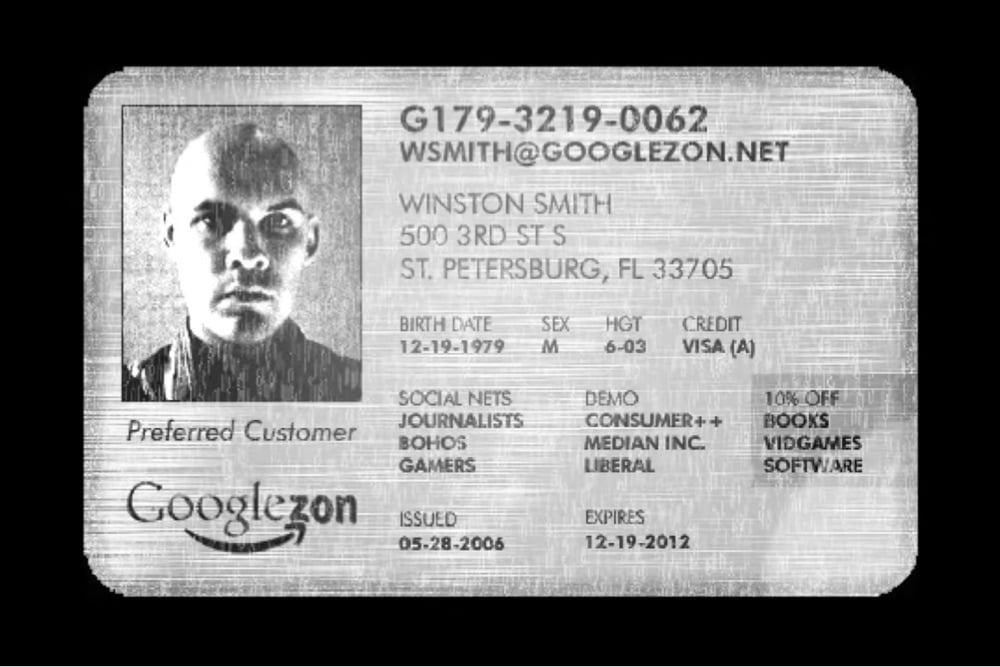
Snarkmarket’s clearest vision of this future was a Flash video released in 2004 called EPIC 2014. It imagines a future of journalism where search, social media, and personalization transform the production and consumption of news, creating an ecosystem where traditional news sources (and traditional journalistic ethics) get displaced by the new techno-capitalist hegemony. The specific predictions seem quaint now (Google buys Amazon; Apple doesn’t release an iPhone, but a WiFiPod; The New York Times goes print-only, etc.), but for the most part it describes the world we live in shockingly well.
There’s also a coda/update to EPIC 2014 called, appropriate, EPIC 2015: in this version, along with the corporate dominance, there’s democratic pushback, with people using their own devices to create and share their own content, communicating with another in a loose, messy, but ultimately humanistic way, in smaller communities united by local interests. And I would argue that this future — the flip side of what we’ve known as Web 2.0 — has ultimately come true as well.
Both videos are now marvelous time capsules. Even at their inception, they were framed as an artifacts from an imagined history at a date in the future. I think this helps to explain what made Snarkmarket so different from the much snarkier blogs about media with which it was intertwined.
Snarkmarket was never about one future of media, but a plurality of them. And it wasn’t focused on the narrow present, but the Long Now: a confluence of histories that took the past, present, and future of media (and the communities formed around media) equally seriously.
At the time, I was a graduate student at Penn, studying comparative literature. My main fields were literary theory, twentieth-century modernism, the history of the book, and cinema and media studies. I was zeroed in on the media universe circa 1450-1950. I felt that it was at this moment, when all our assumptions about books and newspapers and movies and documents as such were being washed away, that we could finally see the past as it actually was. (I still think that’s true.)
But Snarkmarket was the site and the community that most fully yanked my brain out of the past and into the present, and through that, into the future. It made me care about what was happening now not just as casual politics or lifehacks, but as an essential element in that long history. And I think — fuck it, I know it for a fact, it’s just empirically true — that talking to me helped Robin and Matt think about their present and future concerns as part of that long history too.
It’s probably too easy to say that Robin was the voice of the future, Matt of the present, and Tim of the past. We were all (and are still) continually bouncing like pinballs between all three historical perspectives. But it is nevertheless true that Robin was and is an inventor, Matt a journalist, and me a scholar. We all helped each other and our readers think through those perspectives, even if it was just in how we reframed a quick link.
I don’t know anyone today who genuinely does what we did.
The same thing happened to Snarkmarket that happens to a lot of great web sites driven by people rather than organizations. Students stop being students, junior professionals become senior ones, people start families, and all the other demands on your time become more demanding.
Also the ground moved beneath our feet. The rise of social media and Google’s embrace, extend, extinguish approach to RSS changed how news and commentary on the web was distributed.
We still had plenty of fans and friends who kept their old RSS readers active or were willing to navigate to the URL every day, but there are reasons why sites like Kottke (or Waxy.org, or insert your favorite long-running blog here) are special. It’s hard to keep something like this going unless you can make it your full-time job, and the economics of that for three people are even harder than for a sole proprietor.
And at a certain point, at a certain moment in the web’s history, you have to think long and hard about what you want to put on a blog and why. From 2003-2013, you just didn’t have to think as hard about it. The blog was your post of first resort. Now, too often, it’s the last.
There are things I would change, and things I wouldn’t. Nothing could change the fact that after five years of watching them live, I got a solid five years to be a part of my favorite band. Isn’t that what it’s like to have a website that you love?
And now that site is twenty years old. The babies who were born at the same time Snarkmarket began are now old enough to have their own thoughts about the past, present, and future of media, old enough to start thinking about graduate school, or maybe even apply to a place like Poynter and try their hand at building the future of media themselves.
Maybe one of them might meet a friend or two in school and decide they want to document that journey: write down a few thoughts, link to things they’ve read, and keep in touch with their friends.
If anyone in Gen Z is reading this, remember: it’s never too late to start a website. It doesn’t have to be perfect. It doesn’t have to get a million readers. It doesn’t have to change the world. All it has to be is a reflection on the past, a time capsule for the future — a document for the now. Your readers are out there, waiting. They’ll find you.
Hello everyone, I’ve got a bit of a treat for you. Tomorrow (Nov 3) marks the 20th anniversary of Snarkmarket, a quietly influential group blog that featured the writing of Tim Carmody, Matt Thompson, Robin Sloan, and a few other contributors. There hasn’t been much activity over there for several years, but it was a must-read for me back in the day (with a lively comments section) — you may remember the EPIC video that Robin and Matt made (oh, seeing that old design brings back memories!) or Robin’s evergreen classic on stock & flow.
Anyway, tomorrow Matt, Robin, and Tim are taking over kottke.org to celebrate their anniversary, reminisce about the Good Old Days, and perhaps opine a bit about how people relating to each other online has changed in the 20 years since the formation of the Snarkmatrix. Comments will be on and they’ll be in there mixing it up with you.
So then: I hereby declare November 3, 2023 Snarkmarket Day on kottke.org. Bake it away, toys!
Inspired by a reread of The Lord of the Rings, Robin Sloan has been reading The History of The Lord of the Rings, a four-volumebookseries that details Tolkien’s process of writing LOTR. As he read, the idea of Tolkien as Middle-earth master planner fell away and the text revealed a writer who muddles through and revises, just like the rest of us. Here’s Sloan on Tolkien’s conception of the One Ring’s backstory (“One Ring to rule them all, One Ring to find them, One Ring to bring them all and in the darkness bind them”, etc.):
In a single stroke, we get: a mythic backstory, a grand MacGuffin, a sense of language and history, the sublimely satisfying train of magic numbers - three … seven … nine … ONE! - plus something graphically weird and beautiful on the page.
It’s all just tremendous — the perfect kernel of Tolkien’s appeal.
And, guess what:
Not only was the inscription missing from the early drafts of LOTR … the whole logic of the ring was missing, too. In its place was a mess. The ring possessed by Bilbo Baggins was one of thousands the Dark Lord manufactured, all basically equivalent: they made their wearers invisible, and eventually claimed their souls. They were like cursed candies scattered by Sauron across Middle-earth.
Tolkien’s explanation of this, in his first draft, is about about as compelling as what I just wrote.
It’s fine, as far as it goes; he could have made it work, probably? Possibly? But it is not COOL in the way that the final formulation is COOL. It has none of the symmetry, the inevitability. It does only the work it has to do, and nothing else. It is not yet aesthetically irresistible.
There are several revised approaches to “what’s the deal with the ring?” presented in The History of The Lord of the Rings, and, as you read through the drafts, the material just … slowly gets better! Bit by bit, the familiar angles emerge. There seems not to have been any magic moment: no electric thought in the bathtub, circa 1931, that sent Tolkien rushing to find a pen.
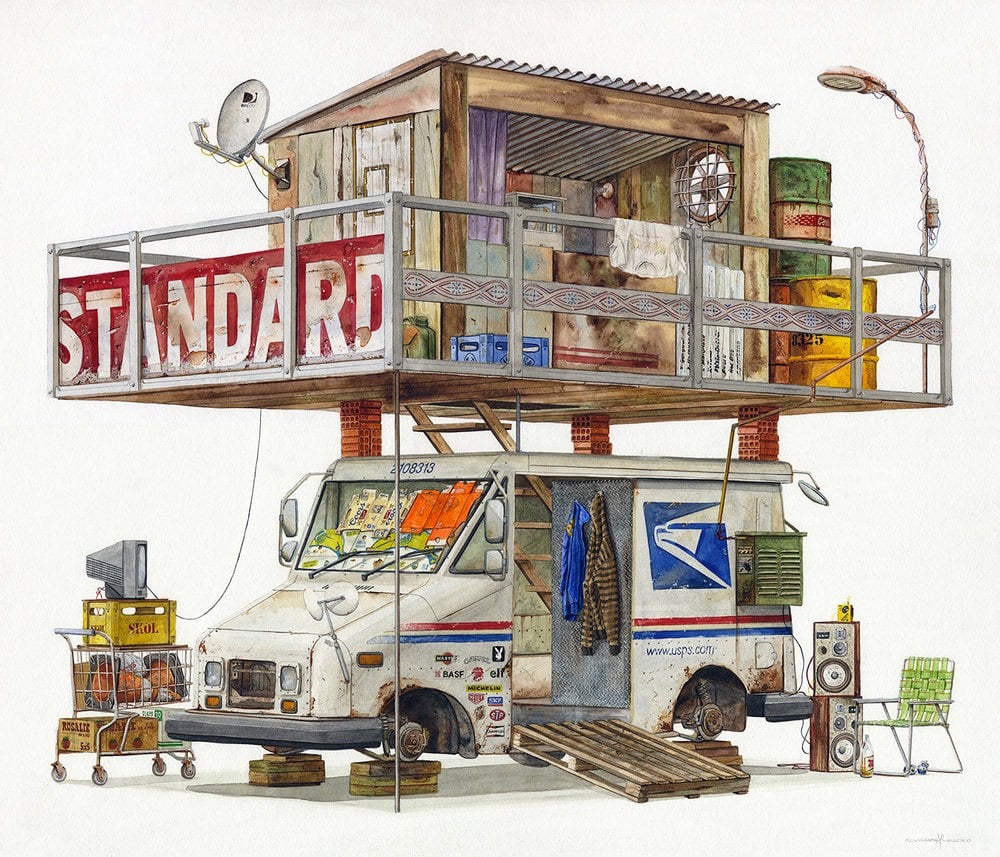
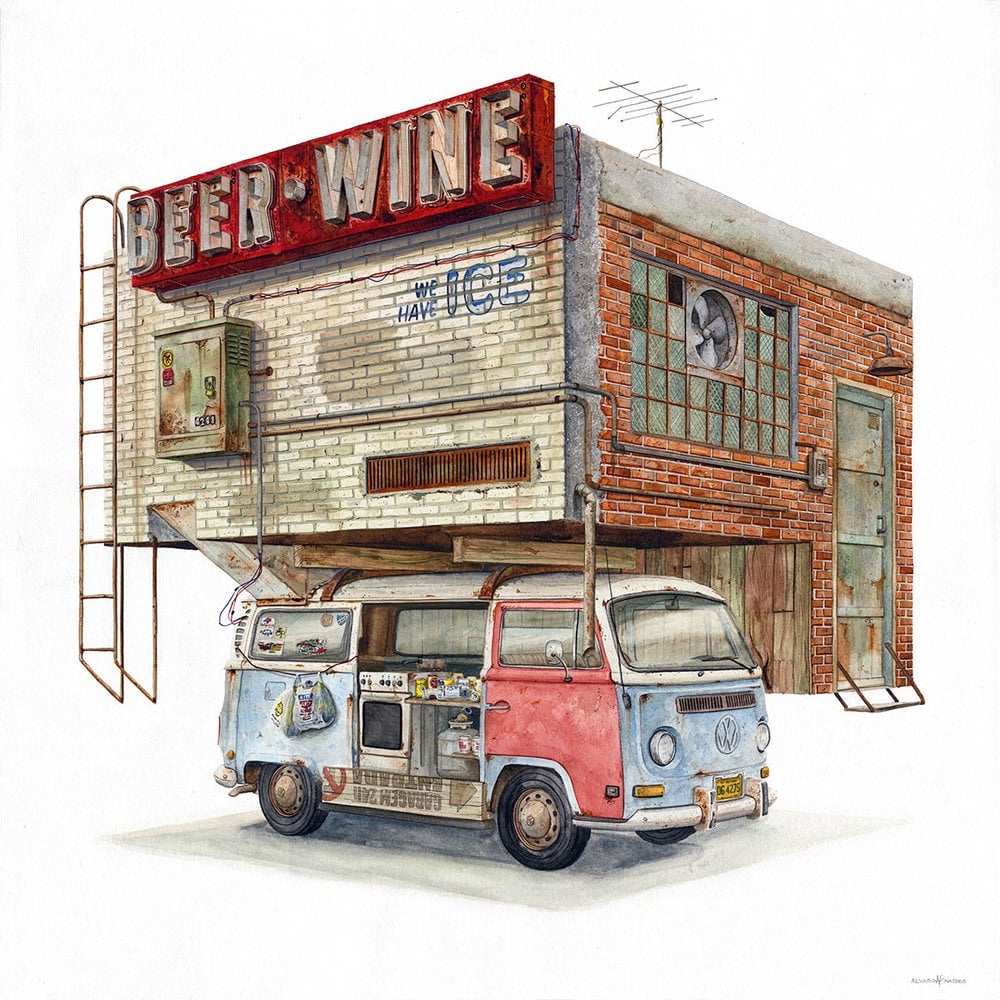
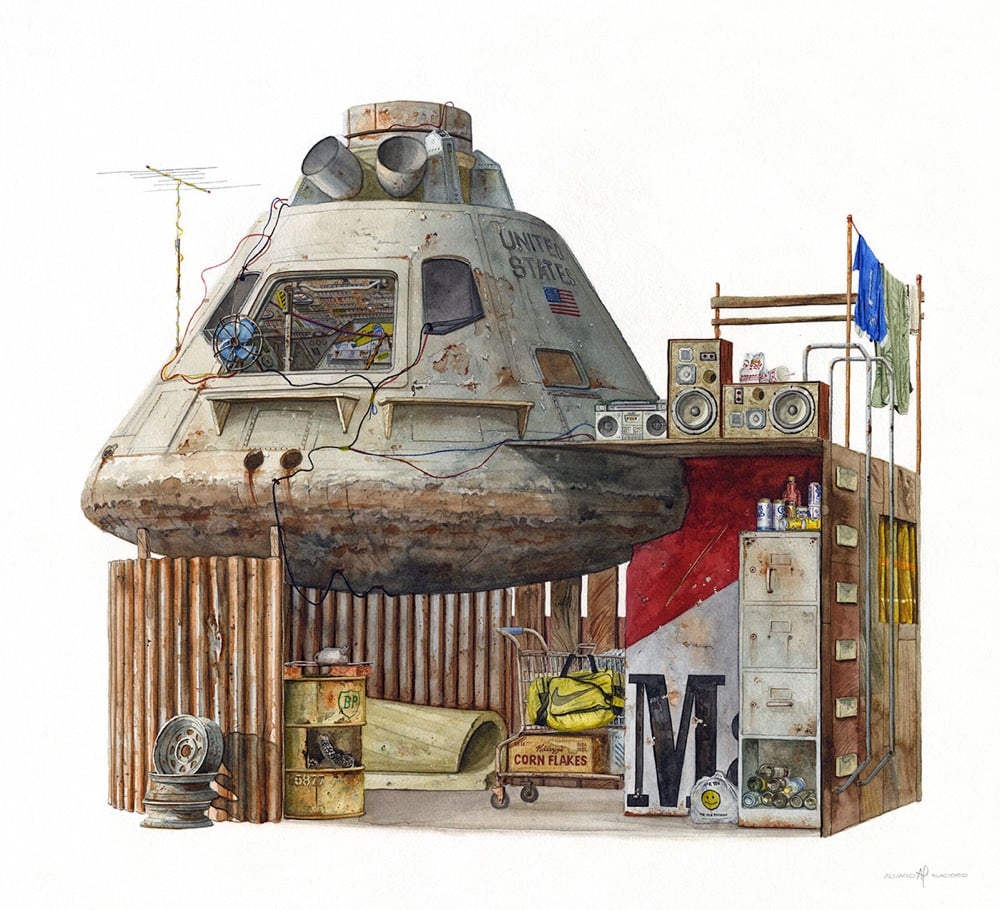
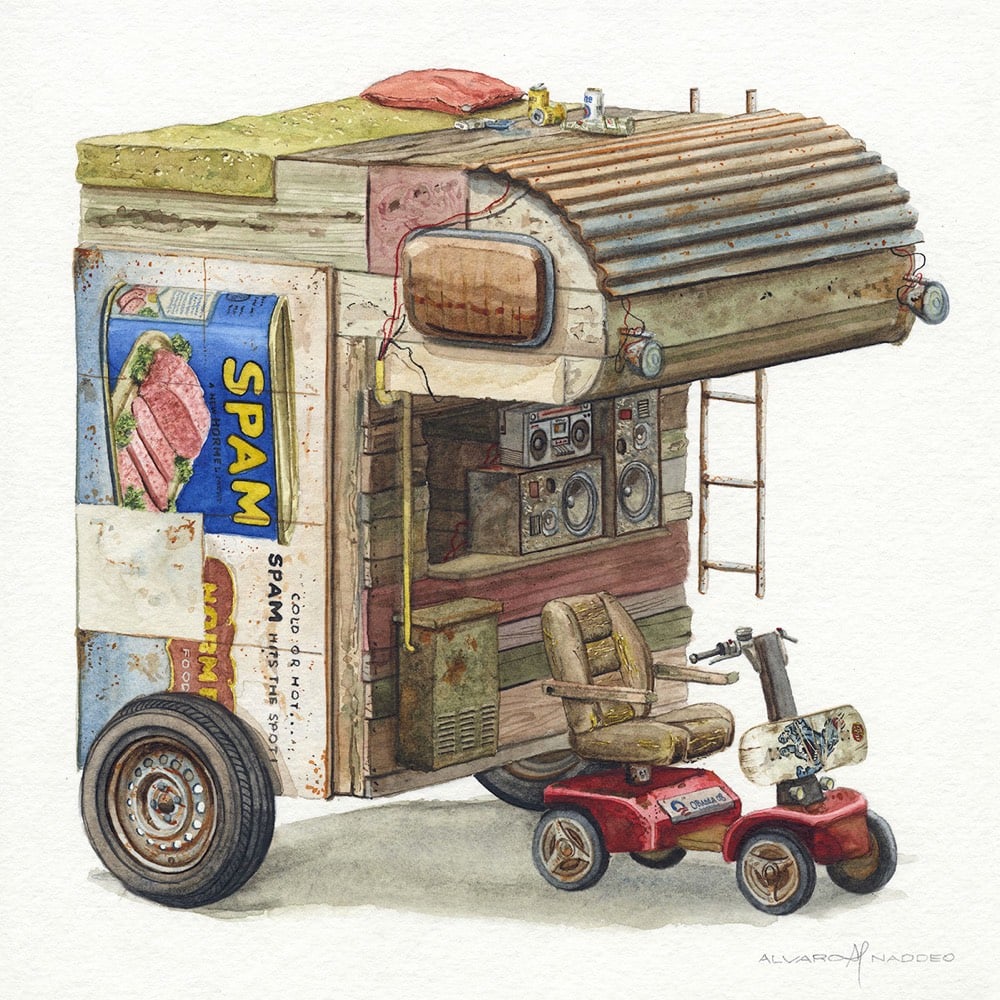
Ok, that was more than a couple. But there are so many more on his website and Instagram (including work-in-progress stuff)…check them out!
Naddeo recently shared his process for making these paintings with Colossal:
Naddeo tells Colossal that he starts with a loose sketch by hand. He then uses 3D software to help define a plausible shape for his imagined constructions, and creates a reference composition in Photoshop. After years of practice, Naddeo shares that he is able to recreate the texture, color, and shadows of various building materials like brick and concrete from memory. He uses reference photos to help flesh out small detail items, which are similarly rendered in watercolor.
A prime example of Robin Sloan’s concept of the flip-flop.
Technology is so ubiquitous now that bits of our digital interfaces make their way into real life — like people saying “hashtag” in conversation or coding error messages printed onto clothing labels. In a hilarious recent instance of this, a man showed his barber a paused video clip of the haircut he wanted, and the barber obliged, shaving the overlaid play button into the side of the man’s head.
I laughed for a solid minute when I first saw this. It’s the literal cake wrecks of haircuts. It’s also an inadvertent example of the flip-flop, Robin Sloan’s term for things moving from the physical world to the digital world and back again. The play button has been used on media players since at least the 60s, made the jump to digital interfaces sometime in the 70s/80s, and has now flipped back to analog on the side of this dude’s head.
Worse, and predictably: I’d offer my heart and it would be accepted — I knew this because I received a heart in return, sometimes a merry dance emote — and then, delighted with our teamwork, I would turn around and … get blasted in the back.
I tried this negotiation many times with no success at all and my “Is this it?” curdled into “Is this us?” These were just the rules of the game — its very design — but even so. What a dire environment. What a cruel species!
Then, one night, it worked. And, in many games since, it’s worked again. Mostly I get blasted, but sometimes I don’t, and when I don’t, the possibilities bloom. Sometimes, after we face off and stand down, the other player and I go our separate ways. More frequently, we stick together. I’ve crossed half the map with impromptu allies.
A book I think about a lot is Robert Wright’s Nonzero, in which he argues, contrary to conventional wisdom about capitalistic competition, that much of human progress comes about through cooperation and that the effect increases as the complexity of the possible cooperation increases. As Sloan notes, the brute force of 1 vs 1 vs 1 vs 1 can get a bit boring after awhile, but add a simple way to communicate with other players and suddenly there’s more you can do with the game.
Some faves are problematic; others are merely embarrassing. 1986’s Transformers: The Movie may be both, but leans towards the latter.
You have to fit into a very narrow generational window to love this movie. It was really for late Gen X/early millennial cuspers, with a little bit of a hangover into millennials proper because of home video. But for the most part, if you’re a little bit older or younger, you’re either completely baffled by this cartoon or mildly surprised that it isn’t total crap.
I saw this film in the theater with my two brothers, one older and one younger. My mom and older sister saw Ferris Bueller’s Day Off down the hall. None of us had any idea what we were in for. I would contend that of the two films, Transformers should have PG-13. Mild scatological humor is no match for beloved toys cursing and slaughtering each other.
As kids who loved the TV cartoon, we were literally invested in these characters. To the extent that a child can have net worth, a huge percentage of it was tied up in these toys, and the characters they represented. Here they are getting killed off right and left — ominous smoke pouring forth from their mouths, my god — and all Megatron can say is “that was almost too easy.”
The best analogy I can think of is this: suppose you’ve read the first three or four Harry Potter books. Those are all that’s available. You hear that there’s going to be a Harry Potter movie. But instead of a film version of the books you love, the movie busts right into the story from books 5, 6, and 7. You jump forward in time to a creeping totalitarian state, beloved characters are getting killed off right and left by Voldemort and his Death Eaters, and BAM! A half hour into the movie, Dumbledore is disarmed and blasted out of the tower.
You’re six years old, and you watch your Dumbledore die with Reese’s Pieces in your hand. Only instead of a wizard you read about in a book, he’s a robot that turns into a truck, and you have to go over your friend Davey’s house to play with him because he’s too expensive.
Then instead of a big funeral, you blast into outer space for another hour of heavy-metal soundtrack movie. More deaths. More metamorphoses. Planet-devouring robots. Cars who say “shit” and “god damn it.” “Dare To Be Stupid.”
On top of that, unlike Dumbledore’s underwhelming death in the film version of The Half-Blood Prince, the scene where Optimus Prime is killed is totally amazing.
I mean, that is almost Luke vs. Vader and the Emperor in Jedi good.
The problem with Transformers: The Movie (besides all of the problems with the movie and all the movies and TV shows that came after it) is really the toys. The whole show is designed to sell the toys. All the character deaths, the new generation introduced in the movie, and the magnificent decision to send the Autobots and Decepticons into exile in uncharted space, are all decisions made to create a market for more goddamned toys.
The toys, our physical proximity to them, the ability to shape and change them, and the ways we use them to play out narratives, are the mechanism for our affection. But they’re also intentionally disposable. It’s as far from respectable art in the traditional sense as it gets.
MovieBob’s Bob Chipman has a terrific video about this problem, specifically as it relates to Transformers: The Movie.
TL:DR — the decision to kill off most of the established characters actually forces the movie to make some compelling artistic choices. It’s a war movie where the generals and top lieutenants are killed off immediately, forcing a raw younger generation to make their own choices and mistakes. This in turn resonates with aging kids who’ve had parents die and/or split up — who have either already faced or will soon face their own traumas.
The movie’s message — terrible things will happen, not everyone will make it intact, but you can find a way to go on — becomes a resource kids draw on as they grow up. Again, very similar to Harry Potter: just for us folks who were a little too old to catch the book before our childhoods ended.
Robin Sloan is a novelist, blogger, and media inventor. He’s also like three weeks younger than I am and grew up about three miles away. Unsurprisingly, he and I had very similar reactions to Transformers: The Movie.
I mean maybe it’s cliched to say this, or impossible with any credibility, but I’m pretty sure that movie was the most emotional experience of my life inside a movie theater? I can’t remember the whole experience with total clarity, but I do remember which friend I saw it with; I also remember my initial confusion — it didn’t announce its time-shift, so any young fan of the TV cartoon was initially like, “Wait… what?” — and, of course, THE DEATH OF OPTIMUS PRIME. What do you even say? Biblical, Shakespearean, and totally sci-fi, all at once. Megaton-scale. I wonder if the people who made the movie even understood what they were doing, what impact it would have.
Looking at it as an adult today. I think the movie is astonishing. Even for all its flaws, all the rough edges in its animation, sound, script, it just does *so much more than it had to*, particularly for a movie of that kind, of that time. The scale of it… I mean have there even BEEN any other movies with planet-sized robots? Has anyone else even DARED?
Maybe that’s what makes a movie — or any piece of media? — seem special: the sense that it isn’t merely “made to spec” but rather the special product of a confluence of people who cared, for one reason or another — and with a big dollop of weird luck thrown in, always — who made something sui generis. If Transformers: The Movie belongs in any category, it’s that one: Fully Its Own Thing.
Finally: the voice acting, including Orson freaking Welles, is outstanding.
I don’t have a PS4 or Windows machine, so I can’t play No Man’s Sky (which seems to deliver on the long-ago promise of Will Wright’s Spore), but through the magic1 of Spotify, I was listening to the soundtrack this morning.
“Minecraft is a game about creation,” writes Robin Sloan. “But it is just as much a game about secret knowledge.”
There’s no official manual, so the game’s teeming network of devotees, young and old, proper publishers and web-based wildcats, have worked to create them by the score. Not just guides, but wikis, videos, hints, tricks. The rules can only be discovered by observation, reasoning, and experiment. Like science — or magic:
Imagine yourself a child. Imagine yourself given one of these books: not merely a story of exploration and adventure, but a manual to such.
Imagine yourself acquiring the keys to a mutable world in which you can explore caves, fight spiders, build castles, ride pigs, blow up mountains, construct aqueducts to carry water to your summer palace… anything.
Imagine yourself a child, in possession of the secret knowledge.
Maybe the most interesting thing about this, Robin writes, is how the game “calls forth” the books — another kind of magic. Is this a function of how much Minecraft players love the game? Or is that arcane, indirect, networked, bottomless well of knowledge, asking to be impossibly filled, what they love about it?
I think it’s the sound system in our car 2003 Volkswagen Golf TDI,” Madrigal says. “We have one of those magical devices that lets you play an iPod through the tape deck (how do those work?) — but it makes a horrible screeching noise when it gets hot.” That leaves the CD player and terrestrial radio: “We seem to rotate between the same three CDs we burned or borrowed some time ago, and the local NPR affiliate.”
Madrigal hastens to add that what he really wants is a stereo with “an aux-in so that I can play Rdio throughout the vehicle.” The problem? “I am scared of car audio guys,” he says. “I knew a lot of them in high school. They are a kind of gadgethead that just kind of freaks me out. I loathe the idea of going in there and having to explain why we have this old-ass tape deck, and then — because I don’t know any better — getting ripped off on a new stereo.
It’s either that or our cable box/DVR…that thing records about 20 minutes of HD programming and is 20 years old now. Really should trade it in for something made since Clinton left office. See also Robin Sloan’s dumbphone.
The soft, froggy voice startled me. I turned around to face an approaching figure. It was Larry Page, naked, save for a pair of eyeglasses.
“Welcome to Google Island. I hope my nudity doesn’t bother you. We’re completely committed to openness here. Search history. Health data. Your genetic blueprint. One way to express this is by removing clothes to foster experimentation. It’s something I learned at Burning Man,” he said. “Here, drink this. You’re slightly dehydrated, and your blood sugar is low. This is a blend of water, electrolytes, and glucose.”
I was taken aback. “How did you…” I began, but he was already answering me before I could finish my question.
“As soon as you hit Google’s territorial waters, you came under our jurisdiction, our terms of service. Our laws-or lack thereof-apply here. By boarding our self-driving boat you granted us the right to all feedback you provide during your journey. This includes the chemical composition of your sweat. Remember when I said at I/O that maybe we should set aside some small part of the world where people could experiment freely and examine the effects? I wasn’t speaking theoretically. This place exists. We built it.”
I was thirsty, so I drank the electrolyte solution down. “This is delicious,” I replied.
“I know,” he replied. “It also has thousands of micro sensors which are now swarming through your blood stream.”
“What… ” I stammered.
“Your prostate is enlarged. Let’s go hangout now. There’s some really great music I’d like to recommend to you.”
You could consider this a follow-up to 2004’s EPIC 2014 by Robin Sloan and Matt Thompson.
But before the party, Robin will be interviewing a variety of people over a 24-hour period and streaming the whole thing online. I am one of the scheduled interviewees and I have no idea what we’ll talk about. But because my slot is right before the party starts, after almost 20 non-stop hours of Robin interviewing people, it’s possible we’ll just change into our sweatpants, split a pint of Cherry Garcia, and spoon on the couch.
Robin Sloan has a new app, Fish: a tap essay, discussing the difference between liking something on the Internet and loving something on the Internet. It’s thoughtful and well done. And it’s something you ought to check out if you spend a lot of time on sites like this one. One way or another, you’ll have an opinion, the essay demands it, and Internet that makes you think is the best kind.
In the essay, Robin mentions the difference for him between what he likes and what he loves is if he keeps going back to it. Writing up this post, the last sentence of the first paragraph specifically, I think I might have realized for the first time that for me, the difference between a Tweet or post that I like or fave or star, or whatever, and one I love is if it makes me think. I might not ever visit that URL again, but I’ll think about it later. Again and again, maybe. I love that. Since I’m simple, I sometimes also love, vs like, remarkable animal videos.
queuenoodle is a Twitter account that will tell you when movies expire from Netflix Watch Instantly so you can, uh, watch them. Brought you by Twitter’s media pastamaker, Robin Sloan.
Love it. Robin Sloan has previously discussed this type of “production as performance” video on Snarkmarket but Pomplamoose has started using the term “VideoSong”:
This cover is a VideoSong, a new medium with 2 rules: 1. What you see is what you hear (no lip-syncing for instruments or voice). 2. If you hear it, at some point you see it (no hidden sounds).
Flow is the feed. It’s the posts and the tweets. It’s the stream of daily and sub-daily updates that remind people that you exist. Stock is the durable stuff. It’s the content you produce that’s as interesting in two months (or two years?) as it is today. It’s what people discover via search. It’s what spreads slowly but surely, building fans over time.
Nail on the head. Although I think you can also consider something like “trust” to be stock as well, in which case you can use quality flow to build up stock.
What I love about the approach is that it’s showing us a complicated, virtuoso performance, but making it really clear and accessible at the same time. It’s entertaining, but it’s also an exercise in demystification — which of course is exactly the opposite objective of every music video, ever. Their purpose has been to mystify, to masquerade, to mythologize in real-time.





Stay Connected