Ahh, it seems like only yesterday that I read the news about David Fincher’s upcoming film The Killer. And it was. So now here’s the teaser trailer — interest piqued. What will tomorrow bring?
The Killer stars Michael Fassbender and will make its premiere at the Venice Film Festival on Sept 3, then a limited release in theaters, and then will be streaming on Netflix on Nov 10. As a refresher, here’s what Fincher has been up to lately-ish: directed Mank (2020) & Mindhunter (2017-2019), executive produced Voir and Love, Death & Robots (also directed one episode). Fun Fincher Facts: he was apparently an assistant cameraman for Return of the Jedi and did “matte photography” for Indiana Jones and the Temple of Doom.
A few weeks ago, I posted about David Fincher’s new project with Netflix. Unfortunately, it’s not a third season of Mindhunter. But, here’s what it is: a 6-episode series of visual essays about movies and filmmaking, not unlike the YouTube videos I post here all the time (many of which you can find under the film school tag).
VOIR is a series of visual essays celebrating Cinema and the personal connection we each have to the stories we see on the big screen. From intimate personal histories to insights on character and craft, each episode reminds us why Cinema holds a special place in our lives.
Tony Zhou and Taylor Ramos of the dearly missed Every Frame a Painting are contributing to at least one of these visual essays, so that right here is reason enough to rejoice. VOIR drops Dec 6 on Netflix.
I always feel a little silly when I click through to watch videos with titles like “Plane Miraculously Flies To Safety After Sudden Engine Failure”, like I’m indulging in clickbait, a sugary online snack when I’m supposed to be consuming healthier fare. But my dad was a pilot when I was a kid, so I will watch any flying video that comes along (along with 35 minutes of “related videos” on YouTube…send help!)
But this one in particular is worth a look because all the drama lasts for less than a minute and the first person view from the camera (which is mounted on the pilot’s head) puts you right into the cockpit.1 One of the coolest things about wearable cameras like the GoPro is that ability to put the viewer into the action, to create a visceral sense of empathy with that person doing that thing. That pilot’s eyes are our eyes for those 60 seconds. You see the engine fail. Your arm reaches out to the controls and attempts to address the problem. You pull the plane up into a glide. You look around for somewhere to ditch. Ah, there. You turn the plane. You keep trying to restart the engine… I don’t know about you, but my palms were pretty sweaty by the time that video was over.
I’ve been paying way more attention to the different ways in which filmmakers use the camera to create this sort of empathy since watching Evan Puschak’s video on how David Fincher’s camera hijacks your eyes. The first-person camera view, where the camera moves as if it were swiveling around on a real person’s neck, is a particularly effective technique. Even if the scene in this video weren’t real, it would be difficult to convince your brain otherwise given your vantage point. (via digg)
And don’t skimp on the sound either, put those headphones on. The sound of the suddenly rushing wind after the engine quits, of gravity asserting itself, is quite alarming.↩
This is a really keen observation by Evan Puschak about the camera movement in David Fincher’s films: it mimics your eyes in paying attention to the behavior in a scene. The effect is sometimes subtle. When a character shifts even slightly, the camera keeps that person’s eyes and face in the same place in the frame, just as you would if you were in the room with them.
Tony Zhou of Every Frame a Painting looks at the constraints David Fincher chooses to operate under while shooting a film. For instance, he very rarely uses hand-held cameras.
The last half of the video featuring a breakdown of how some of Fincher’s scenes were shot is fascinating.
The soundtrack for David Fincher’s adaptation of Gone Girl is out and as with his last two films (The Social Network, The Girl with the Dragon Tattoo), the music is by Trent Reznor and Atticus Ross.
Whenever the words “Reznor”, “Fincher”, “Atticus”, and “soundtrack” get into a sentence together, you know it’s good news for your earholes. (via @arainert)
ps. Speaking of Fincher, he spoke to Disney about directing a Star Wars movie and had an interesting take on the original trilogy:
I always thought of Star Wars as the story of two slaves [C-3PO and R2-D2] who go from owner to owner, witnessing their masters’ folly, the ultimate folly of man.
The sequence for Se7en did very important non-narrative things; in the original script there was a title sequence that had Morgan Freeman buying a house out in the middle of nowhere and then travelling back on a train. He was making his way back to the unnamed city from the unnamed suburban sprawl, and that’s where the title was supposed to be — “insert title sequence here” — but we didn’t have the money to do that. We also lacked the feeling of John Doe, the villain, who just appeared 90 minutes into the movie. It was oddly problematic, you just needed a sense of what these guys were up against.
Kyle Cooper, the designer of the title sequence, came to me and said, “You know, you have these amazing books that you spent tens of thousands of dollars to make for the John Doe interior props. I’d like to see them featured.” And I said, “Well, that would be neat, but that’s kind of a 2D glimpse. Figure out a way for it to involve John Doe, to show that somewhere across town somebody is working on some really evil shit. I don’t want it to be just flipping through pages, as beautiful as they are.” So Kyle came up with a great storyboard, and then we got Angus Wall and Harris Savides — Harris to shoot it and Angus to cut it — and the rest, as they say, is internet history.
I don’t believe in decorative titles — neato for the sake of being neato. I want to make sure you’re going to get some bang for your buck. Titles should be engaging in a character way, it has to help set the scene, and you can do that elaborately or you can do it minimally.
We were exploring things like, ‘How shiny should the skin be? How visceral and uncomfortable can we make it? How abstract can we get? Is that a flower? Is it a vagina?’ — that sort of thing.
During David’s visits to the studio we would brace for impact, because he has a reputation for being incredibly picky. The first time I met him, I asked one of his friends, ‘How picky is David?’ And he said, ‘You’ve heard of pixel fuckers? Well David breaks each pixel down to its separate RGB components and fucks them one at a time.’ So there was some fear every time we would send something in, but 99% of the time we were just told to keep going.
The Social Network (2010): “You don’t get scripts like that every day. You don’t get a studio coming to you saying, ‘We just fucking love this script. Let’s make it into a movie.’ So often people are mitigating against the disaster or trying to cover the downside and saying, ‘Well, OK, look, the script is great, but…’ [‘Can you make something out of it?’] Yeah.
I have given Fincher shit about the films he’s chosen to make but it turns out that he’s better at spotting good material than I am. Go figure. (via @khoi)
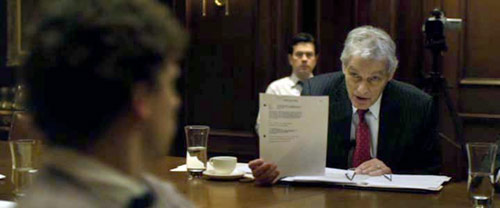
This sense of a private/public self is reinforced in nearly every scene, with the presence of a video camera (during the depositions), laptops and monitors, or other frames within frames (screens, windows, doorways, stairways, hallways) through which we can see other people going about their lives, doing whatever they’re doing. (The extras and bit players had a lot of work in this movie.)
And then there’s the guy in the white shirt who sits there behind the Winkelvii’s lawyer. He turns out to be the videographer, and he gets one big moment when the attorneys call “lunch” and he leaps up to turn off the camera and the monitor. We’re always reminded that what we’re seeing is being documented. Even the documentation is being documented: the affidavits that have already been filed, the e-mails and texts that were sent, the blog entries, the Harvard Crimson articles entered into evidence… Whenever Mark tries to claim he doesn’t remember what he may or may not have said to Erica or the Winkelvii (Armie Hammer), there’s always something there to remind him — often in words he typed and electronically transmitted himself.
This is the “guy in the white shirt” shot:
I only saw this movie for the first time about three weeks ago, but it’s stuck in my brain…I keep coming back to it. As Emerson notes (or at least strongly hints at), the story might be specifically about Facebook, but the rest of the film is more generally about the connection and alienation of being online, of being human in a hyperconnected age. Same kind of thing Caterina was getting at in her Fear of Missing Out essay, I think.
I totally didn’t know that David Fincher was directing an American version of The Girl with the Dragon Tattoo with Daniel Craig as Blomkvist. First the Facebook movie and now this. Fincher’s career continues to develop in a curious fashion.
This one’s not holding up as well as one would think. The first time I saw it, in the theater in 1999, my reaction was “eh”. The second time, on DVD a few years ago, I thought it was great. Now I’m back closer to “eh” again.
Meg woke up at 1:30am the night we saw Zodiac, unable to sleep because she couldn’t get a stabbing from the movie out of her head. To get back to sleep, she convened an impromptu cutest baby animal tournament in her head. Kittens were cuter than puppies, baby pandas beat out kittens, and so on until she eventually was able to fall back to a stab-free sleep. Just putting that out there for whenever O’Reilly gets around to releasing their Sleep Hacks book.
A peek into David Fincher’s uncompromising filmmaking process on the eve of the release of his new film, Zodiac. Jake Gyllenhaal: “David knows what he wants, and he’s very clear about what he wants, and he’s very, very, very smart. But sometimes we’d do a lot of takes, and he’d turn, and he would say, because he had a computer there, ‘Delete the last 10 takes.’ And as an actor that’s very hard to hear.”





Stay Connected