In a recent piece for The Guardian, Dave Eggers observes that we now have actual jetpacks that actually fly, an invention that was supposed to alert humanity that The Future had finally arrived,1 and no one really cares too much about them.
We have jetpacks and we do not care. An Australian named David Mayman has invented a functioning jetpack and has flown it all over the world — once in the shadow of the Statue of Liberty — yet few people know his name. His jetpacks can be bought but no one is clamouring for one. For decades, humans have said they want jetpacks, and for thousands of years we have said we want to fly, but do we really? Look up. The sky is empty.
Eggers, an avid flyer but not pilot, decided to take a jetpack flying lesson, just to see what none of the fuss is about.
When he returns and begins pouring the fuel into the jetpack, only then does it register just how dicey this seems, and why jetpacks have been slow to be developed and adopted. Though every day we fill our cars’ tanks with highly flammable gasoline, there is — or we pretend there is — a comfortable distance between our frail flesh and this explosive fuel. But carrying this fuel on your back, in a glorified backpack of tubes and turbines, brings the reality of the internal combustion engine home. Just watching the kerosene getting poured into the pack, inches from Wesson’s face, is unsettling.
And then there’s the noise:
Jarry asks if I’m ready. I tell him I’m ready. The jets ignite. The sound is like a category 5 hurricane passing through a drainpipe. Jarry turns an invisible throttle, and I mimic his movements with the real throttle. The sound grows louder. He turns his invisible throttle more, and I turn mine. Now the sound hits a fever pitch, and I feel the thrust down the back of my calves. I step ever so slightly forward, and lock my legs together. (This is why jetpack wearers have their legs stiff like toy soldiers - any deviation is quickly punished by 800-degree jet exhaust.) Jarry mimes more throttle, I give it more throttle, and slowly I leave the earth. It is nothing like weightlessness. Instead, I feel my every pound, feel just how much thrust it takes to get me and this machine to levitate.
Jarry tells me to go higher. One foot, then two, then three. As the jets howl and the kerosene burns, I hover, thinking that this is an astounding amount of noise and trouble to float 36in off the ground. Unlike the purest kinds of flight, which harness wind and master soaring, this is just brute force. This is busting through space with heat and noise. And it’s really difficult, too.
I have had one of these t-shirts in my rotation for more than 20 years now: “they lied to us / this was supposed to be the future / where is my jetpack, where is my robotic companion, where is my dinner in pill form, where is my hydrogen fueled automobile, where is my nuclear-powered levitating house, where is my cure for this disease”.↩
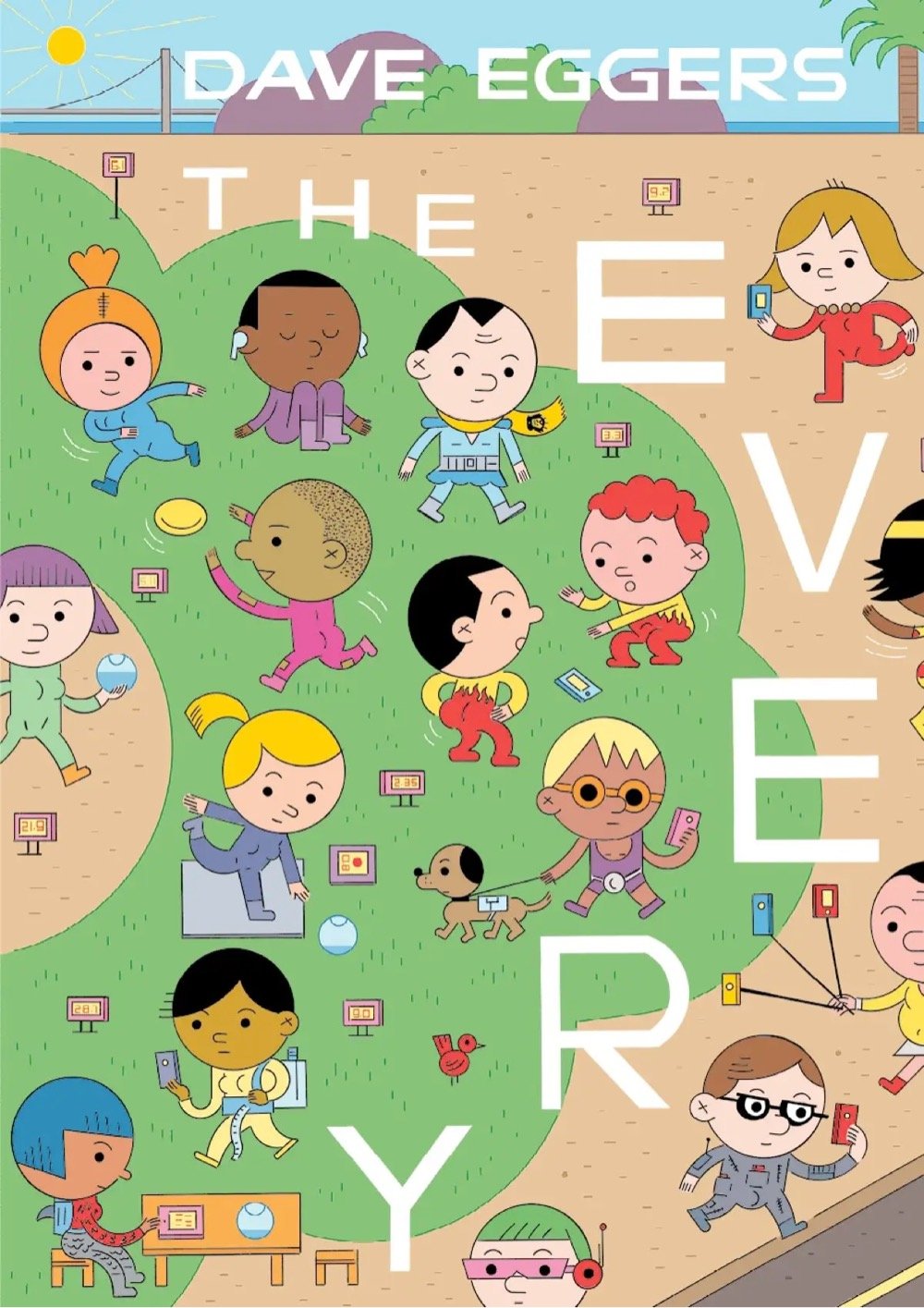
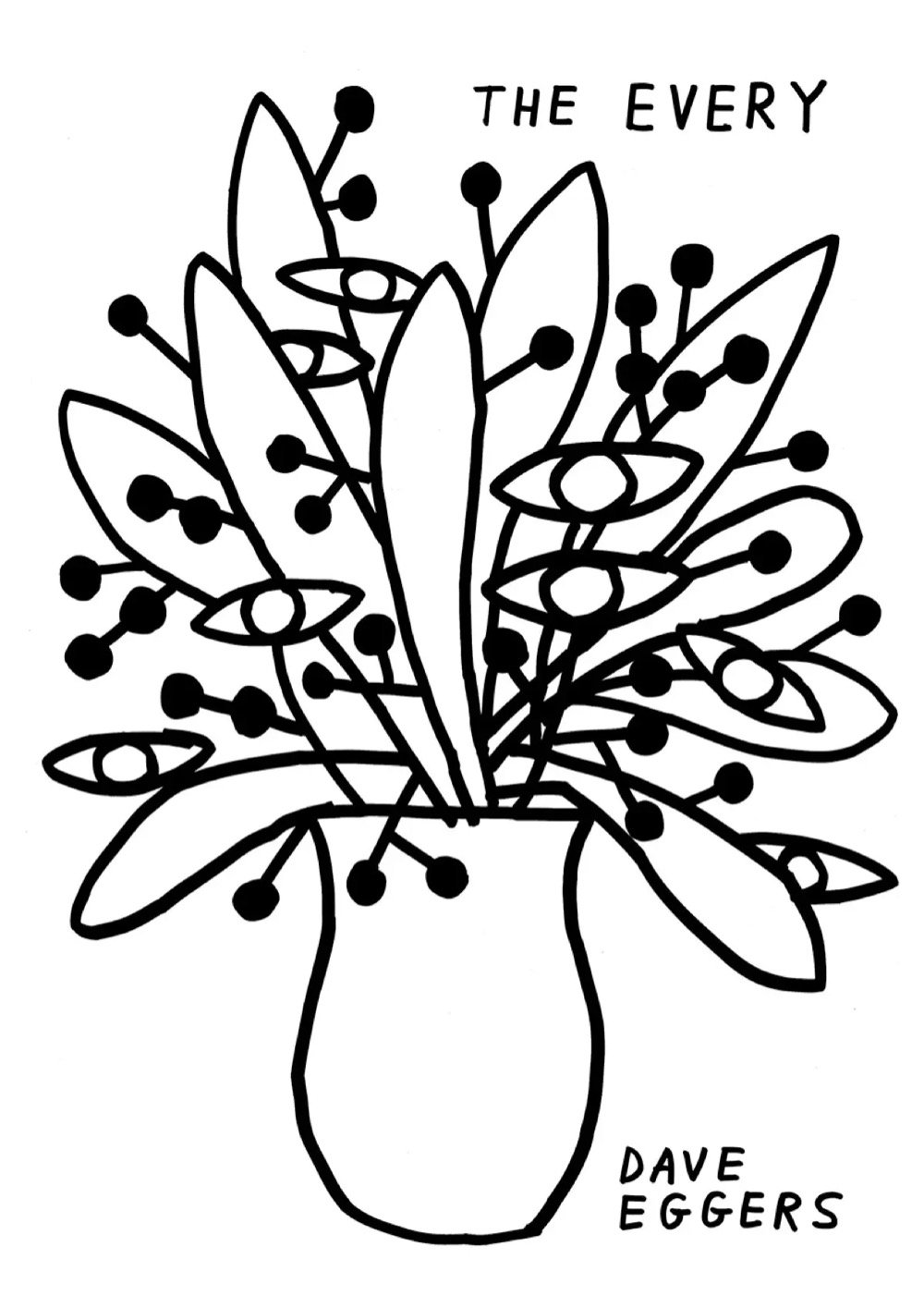
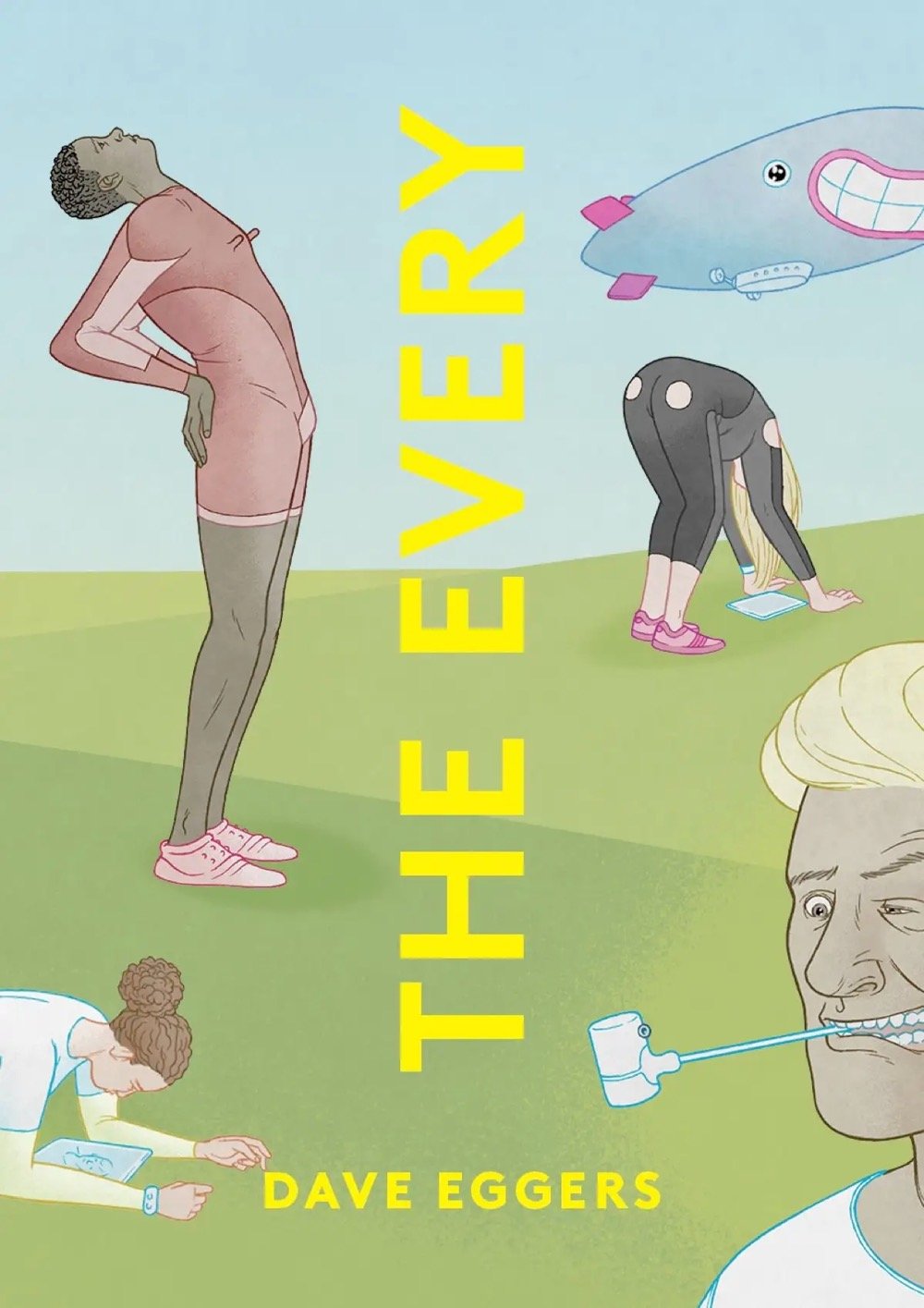
For his new book, The Every, Dave Eggers and art director Sunra Thompson are doing 32 separate covers, with more to come “in perpetuity”.
Never one to shy away from pushing boundaries, Eggers teamed up with art director Sunra Thompson for the project, who discovered that the dust jacket printer they were using could run several cover designs on one sheet of paper at once, providing the means to print dozens of different versions at the same time. Thompson decided to exploit this printing feature, enlisting a boatload of artists to design a completely new version of The Every cover.
The hardcover version of the book featuring the 32+ designs will only be available on the McSweeney’s website and in independent bookstores, which doesn’t seem to include Bookshop.org. Amazon, says Eggers, can go pound sand.
“I don’t like bullies,” Eggers wrote in an email. “Amazon has been kicking sand in the face of independent bookstores for decades now.”
The novel follows a former forest ranger and tech skeptic, Delaney Wells, as she tries to take down a dangerous monopoly from the inside: a company called The Every, formed when the world’s most powerful e-commerce site merged with the biggest social media company/search engine.
“One of the themes of the book is the power of monopolies to dictate our choices, so it seemed a good opportunity to push back a bit against the monopoly, Amazon, that currently rules the book world,” he said. “So we started looking into how feasible it would be to make the hardcover available only through independent bookstores. Turns out it is very, very hard.”
The film adaptation of Dave Eggers’ novel The Circle is moving right along. The movie stars Tom Hanks and Emma Watson (as well as John Boyega from The Force Awakens) and the first trailer was released yesterday. Looks Black Mirror-ish…I think we’ll be getting a lot of that over the next four years.
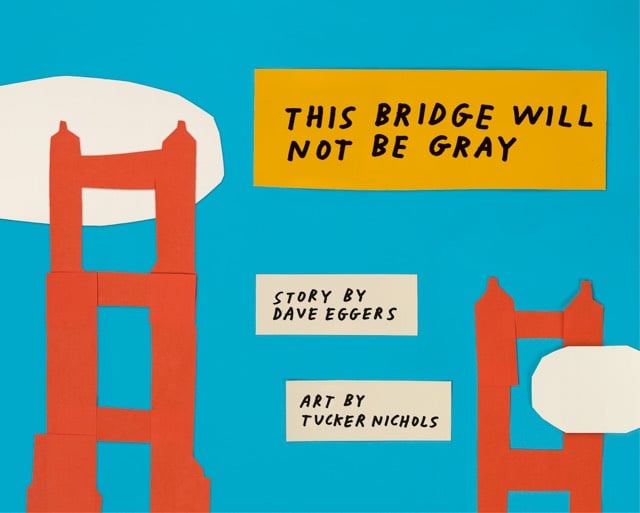
From Dave Eggers and Tucker Nichols comes This Bridge Will Not Be Gray (at Amazon), a children’s book about how the Golden Gate Bridge came to be painted orange.
In this book, fellow bridge-lovers Dave Eggers and Tucker Nichols tell the story of how it happened — how a bridge that some people wanted to be red and white, and some people wanted to be yellow and black, and most people wanted simply to be gray, instead became, thanks to the vision and stick-to-itiveness of a few peculiar architects, one of the most memorable man-made objects ever created.
The kids and I sat down with the book last week and they loved it. The pages on the design of the bridge prompted a discussion about Art Deco, with detours to Google Images to look at photos of the bridge,1 The Empire State Building, and the Chrysler Building. The next day, on the walk to school, we strolled past the Walker Tower, a 1929 building designed by Ralph Thomas Walker, one of the foremost architects of the 20th century. We were running a little early, so I stopped and asked the kids to take a look and think about what the building reminded them of. “Art Deco” came the reply almost immediately.
I’m really gonna miss reading to my kids — Ollie mostly reads by himself now and Minna is getting close — but I hope that we’re able to keep exploring the world through books together. NYC is a tough place to live sometimes, but being able to read about something in a book, even about a bridge in far-away San Francisco, and then go outside the next day to observe a prime example of what we were just reading is such a unique and wonderful experience.
We also looked at several photos of the bridge under construction, including this one of a construction worker standing on some wires near one of the towers without much separating him and the water below. I’ve heard about this gentlemen from the kids several times since. Like, “remember that guy standing on the wires when the Golden Gate Bridge was being built? I bet he isn’t scared of spiders.”↩
In 2009, Dave Eggers published a book called Zeitoun, the story of a man and his family experiencing Hurricane Katrina and its aftermath.
Through the story of one man’s experience after Hurricane Katrina, Eggers draws an indelible picture of Bush-era crisis management. Abdulrahman Zeitoun, a successful Syrian-born painting contractor, decides to stay in New Orleans and protect his property while his family flees. After the levees break, he uses a small canoe to rescue people, before being arrested by an armed squad and swept powerlessly into a vortex of bureaucratic brutality. When a guard accuses him of being a member of Al Qaeda, he sees that race and culture may explain his predicament.
The story has taken an unexpected turn since its publication. The protagonist of the story, Abdulrahman Zeitoun, is currently on trial for the attempted first-degree murder of his wife.
Zeitoun made an offer: $20,000 to kill his ex-wife, Kathy, according to Pugh’s testimony. Zeitoun instructed Pugh, who was to be released soon from jail, to call Kathy Zeitoun — Zeitoun allegedly wrote her phone number on an envelope, which was introduced as evidence — and ask to see one of the family’s rental properties. When she took him to a certain property in Algiers, he could kill her there, he allegedly said. Zeitoun also allegedly told Pugh to buy a “throwaway phone” and take pictures to confirm she was dead.
Abdulrahman Zeitoun was found not guilty Tuesday of trying to hire a hitman to kill his wife.
The verdict came from Orleans Parish Criminal District Court Judge Frank Marullo. Zeitoun, 55, had waived his right to a jury trial. He had been charged with solicitation of first-degree murder and attempted first-degree murder of his ex-wife. He was acquitted on both counts.
He’s trying to sell IT to the King of Saudi Arabia, with telepresence technology as a lure. It’s basically a way to have long-distance meetings using holograms. And Alan really doesn’t know what he’s doing. He’s like a lot of men of his generation, who were trained to sell things, to make deals over dinner, golf courses, all that. But now things are very different, and he’s adrift. I have a lot of friends who work in management and consulting and manufacturing, and they talk a lot about men like Alan, and what to do with them. Their modes of working are sometimes outdated, and they’re hard to hire because they’re very expensive. Alan’s surrounded by young people who know more about IT than he does, who work cheaper, and who assume all things are made in China. They would never see it as fiscally plausible to hire someone like Alan. He costs too much and in Alan’s case, comes with a lot of baggage.
At a recent talk, Dave Eggers again rose to the defense of newspapers and, more generally, to print on paper as a medium for communication.
“It’s too exciting and distracting online,” Eggers said. While print — especially long-form print — encourages hunkering down and cuddling up, online journalism fosters a kind of low-grade, perpetual ADD. Online, “there’s always some button that wants you to click to cat porn,” he said, as the audience laughed. “You try to read something, and it’s flashing, it’s telling you to go somewhere else.”
Time to break the ice. You hate doing interviews, don’t you? I ask, sitting down (there is no desk; he works on an old sofa). “No, not at all,” he says. There is a look of mild amazement on his face as he tells me this and it’s not disingenuous; as he will explain later, he feels a certain sense of distance from his old self. Perhaps he prefers not to remember exactly how he used to be.
Timothy McSweeney, after whom the McSweeney’s literary magazine and web site are named, died late last month.
As a young man, Timothy was an artist of tremendous talent. The canvases he leaves behind are filled with haunting and beautiful imagery. They are also filled with a palpable desire-to be heard, to connect, to be understood better by others and himself. The letters that inspired this journal’s name were a continuation of that same lifelong effort to more intimately know the world and his place within it.
Dave Eggers has written a young adult novel called The Wild Things that is based loosely on Maurice Sendak’s Where the Wild Things Are and the screenplay he co-wrote with Spike Jonze for the movie version. The New Yorker published an excerpt of the book this week.
Max left the room and found Gary lying on the couch in his work clothes, his frog eyes closed, his chin entirely receded into his neck. Max gritted his teeth and let out a low, simmering growl.
Gary opened his eyes and rubbed them.
“Uh, hey, Max. I’m baggin’ a few after-work Z’s. How goes it?”
Max looked at the floor. This was one of Gary’s typical questions: Another day, huh? How goes it? No play for the playa, right? None of his questions had answers. Gary never seemed to say anything that meant anything at all.
“Cool suit,” Gary said. “Maybe I’ll get me one of those. What are you, like a rabbit or something?”
But while I was working on the book, it was funny, because I started going in new directions, different from any of the screenplay versions, pushing it into some territory that was personal to me. So in a way the movie is more Spike’s version of Maurice’s book, and this novel is more my version.
Dave Eggers has a new book out soon called Zeitoun.
When Hurricane Katrina struck New Orleans, Abdulrahman Zeitoun, a prosperous 47-year-old Syrian-American and father of four, chose to stay through the storm to protect his house and contracting business. In the days after the storm, he traveled the flooded streets in a secondhand canoe, passing on supplies and helping those he could. A week later, on September 6, 2005, Zeitoun abruptly disappeared. Eggers’s riveting nonfiction book, three years in the making, explores Zeitoun’s roots in Syria, his marriage to Kathy — an American who converted to Islam — and their children, and the surreal atmosphere (in New Orleans and the United States generally) in which what happened to Abdulrahman Zeitoun was possible. Like What Is the What, Zeitoun was written in close collaboration with its subjects and involved vast research — in this case, in the United States, Spain, and Syria.
The book took about three years, and the Zeitouns were deeply involved in every step of the process. So we spent a lot of time together in New Orleans, and over the phone, and via email. And I was able to go to Syria and meet Abdulrahman’s family there, and spent some time with his brother Ahmad, a ship captain in Spain. Ahmad was a wealth of information and is a meticulous record-keeper. I had to get to know the whole extended family, because Abdulrahman’s life before New Orleans figures into the story, too. I had to go to Syria and see where he grew up, and visit the ancestral home of the family, on this island off the coast, Arwad Island.
Eggers also talks a little bit about the newspaper prototype that McSweeney’s is doing this fall.
We’re pluralists at McSweeney’s. We publish anything of great quality, whether that’s experimental or very traditional or somewhere in between. There is and should always be room for all approaches to writing, and whenever anyone closes the door on one — by saying, for example, that experimentation might someday “exhaust itself” (not to put you on the hotseat), it’s very saddening. And of course it ignores the entire history of all art in every form ,which is a history of constant innovation, experimentation and evolution. The person who says “Enough innovation, let’s stick with what we have and never change” is pretty much the sworn enemy of all art. Not to overstate it, of course.
While you’re there, gape at the odd choice of JPGs for pages instead of, you know, HTML. (via fimoculous)
According to this interview, Tom Tykwer, director of Run Lola Run and the recent The International, is working on a film version of Dave Eggers’ What Is the What, his semi-biographical novel about Sudanese refugee Valentino Achak Deng. (via crazymonk)
Vendela Vida, Dave Eggers, Sam Mendes, John Krasinski, Maya Rudolph, Jeff Daniels, Maggie Gyllenhaal, Allison Janney, Catherine O’Hara. Movie. Trailer.
The Wild Things novelization, Sendak says, was all Eggers’s idea. A plan had always been in place to have some kind of book come out to “add to the noise of the movie,” he says, but at first it wasn’t clear what the book would actually be. Once tie-in talk began in earnest, Sendak, who had grown close to Eggers during work on the screenplay, began a campaign to have Eggers do it, and Eggers stepped up and agreed, broaching the idea of the novel.
The 92nd St Y has put the video of a talk called The Art of the Book up on their site. The talk was held in Dec 2006 and featured Milton Glaser, Chip Kidd, and Dave Eggers with Michael Bierut moderating. You may recall that Glaser got into a bit of hot water for some comments he made about the career paths of women in graphic design.
Where the Wild Things Are is filled with richly imagined psychological detail, and the screenplay for this live-action film simply becomes a longer and more moving version of what Maurice Sendak’s book has always been at heart: a book about a lonely boy leaving the emotional terrain of boyhood behind.
Bad news from McSweeney’s: their distributor filed for bankruptcy late last year and now they’re out $130,000:
As you may know, it’s been tough going for many independent publishers, McSweeney’s included, since our distributor filed for bankruptcy last December 29. We lost about $130,000 — actual earnings that were simply erased. Due to the intricacies of the settlement, the real hurt didn’t hit right away, but it’s hitting now. Like most small publishers, our business is basically a break-even proposition in the best of times, so there’s really no way to absorb a loss that big.
To try and make up the gap, they’re having a big sale and are also auctioning off some “rare items” like original art from Chris Ware, proofs from issues, signed copies of things, a painting by Dave Eggers of George W. Bush as a double amputee, and so on. In addition to Ware and Eggers, there’s stuff from David Byrne, Nick Hornsby, and Spike Jonze. I’ve long admired McSweeney’s for their editorial and business approach…it would be a shame to see them go out of business because of another company’s financial difficulties. So give them a hand by purchasing something, if you’d like.
Took in The Art of the Book lecture at the 92nd Street Y last night. Milton Glaser, Chip Kidd (“a modern day Truman Capote” I heard him described as afterward), Dave Eggers, with Michael Beirut moderating. One of the most interesting comments came late in the proceedings from Dave Eggers, who described one of the main goals of the McSweeney’s design staff as attempting to design the books as well and as beautifully as they could as objects so that people would be compelled to save them. That way, even if people didn’t have time to read them soon after purchase, they couldn’t bear to throw/give the book away and would instead put it on their shelf in the hopes — McSweeney’s hopes, that is — that the buyer would at some point pull it down off the shelf and give it another try.
This design goal runs counter to the design process behind most contemporary book jackets, which are engineered almost entirely for the purpose of eliciting in the potential buyer a “buy me” reaction within two seconds of spotting them. McSweeney’s, as a champion of authors, wants the writing to be read while most major publishing companies, as champions of their shareholders, want books to be purchased. People buying books is important to the goal of getting the writing within them read, but McSweeney’s emphasis on designing books to last in people’s homes is a clever way to pursue that goal after the sale.
I mentioned earlier the new paperback version of Infinite Jest; here’s Dave Egger’s introduction to the new edition. “[Wallace] was already known as a very smart and challenging and funny and preternaturally gifted writer when Infinite Jest was released in 1996, and thereafter his reputation included all the adjectives mentioned just now, and also this one: Holy shit.” (thx, nick)







Stay Connected