



Odd places for good food
Ed Levine says the best gelato in NYC is being served in a tanning salon. My favorite banh mi (and perhaps the best baguette in town) can be found in the back of a jewelry store. Any other odd places to find good food?

This site is made possible by member support. ❤️
Big thanks to Arcustech for hosting the site and offering amazing tech support.
When you buy through links on kottke.org, I may earn an affiliate commission. Thanks for supporting the site!
kottke.org. home of fine hypertext products since 1998.
Ed Levine says the best gelato in NYC is being served in a tanning salon. My favorite banh mi (and perhaps the best baguette in town) can be found in the back of a jewelry store. Any other odd places to find good food?
Did you know that there’s a teensy museum on the moon?
Now I find out there was already an entire Moon Museum, with drawings by six leading contemporary artists of the day: Andy Warhol, Robert Rauschenberg, David Novros, Forrest “Frosty” Myers, Claes Oldenburg, and John Chamberlain. The Moon Museum was supposedly installed on the moon in 1969 as part of the Apollo 12 mission.
I say supposedly, because NASA has no official record of it; according to Frosty Myers, the artist who initiated the project, the Moon Museum was secretly installed on a hatch on a leg of the Intrepid landing module with the help of an unnamed engineer at the Grumman Corporation after attempts to move the project forward through NASA’s official channels were unsuccessful.
Apperceptive, the little engine that runs a large chunk of the professional blogosphere, gets a nice shout-out from Talking Points Memo’s Josh Marshall.
One other point I should note: because of our size and resources, we’ve never been able to field close to the hardware resources behind the site as would be called for with the scale of traffic we get (to give you a sense, we now regularly get traffic equal to what we got on election night 2006, and almost four times what we got on election night 2004). That’s required some custom tinkering to keep our blog train from going off the server rails. Now, we’ve gotten some nice praise recently for the stuff our team has published at TPM. But literally none of it would be possible without the engine the folks at Apperceptive have built for us that keeps the words streaming off our keyboards on to your computer screens.
Around All-Star time a couple of weeks ago, Nike released a shoe called the Nike Trash Talk, “the first Nike performance basketball sneaker completely produced from manufacturing waste”. The shoe, worn by Steve Nash in a recent game, looks a bit like Frankenstein’s monster with all the exposed stitching; it’s a beautiful shoe and I want a pair. The problem is that it’s one of those limited edition deals…which means they’re already all sold out and sitting on the shelves of sneaker collectors next to hundreds of other boxes of shoes that will never be worn. I looked on eBay and found two pair but not in my size. What are my chances of getting a pair of these at approximately retail price? I’m not looking for a collectors item…I just want to wear them!
A look at the New Yorker magazine from the 1930s and 40s: the covers, the writers, the advertising, etc.
Mr. McCain is not the first person to find himself in these circumstances. The last Arizona Republican to be a presidential nominee, Barry Goldwater, faced the issue. He was born in the Arizona territory in 1909, three years before it became a state. But Goldwater did not win, and the view at the time was that since he was born in a continental territory that later became a state, he probably met the standard.
In an NY Times op-ed piece, Michael Bloomberg says that he’s not running for President but will support a candidate with an “independent approach”.
The changes needed in this country are straightforward enough, but there are always partisan reasons to take an easy way out. There are always special interests that will fight against any challenge to the status quo. And there are always those who will worry more about their next election than the health of our country.
These forces that prevent meaningful progress are powerful, and they exist in both parties. I believe that the candidate who recognizes that the party is over - and begins enlisting all of us to clean up the mess - will be the winner this November, and will lead our country to a great and boundless future.
Scott King: How I’d Sink American Vogue. His approach would include stories like “How To Dress Angry”, “635 Poor People Upside Down!”, and “Karl Lagerfeld Discusses Various Cancers”, as well as a 14-page advertisement-free issue.
A list of the stocks that have been added to and deleted from the Dow Jones Industrial Average since 1929. Got this from What I Learned Today, which has more information about the Dow (General Electric is the only remaining member of the original 11 Dow stocks).
Are the suburbs the next slums?
At Windy Ridge, a recently built starter-home development seven miles northwest of Charlotte, North Carolina, 81 of the community’s 132 small, vinyl-sided houses were in foreclosure as of late last year. Vandals have kicked in doors and stripped the copper wire from vacant houses; drug users and homeless people have furtively moved in. In December, after a stray bullet blasted through her son’s bedroom and into her own, Laurie Talbot, who’d moved to Windy Ridge from New York in 2005, told The Charlotte Observer, “I thought I’d bought a home in Pleasantville. I never imagined in my wildest dreams that stuff like this would happen.”
James Kunstler has been saying this for ages.
The Riverdale Garden Restaurant in the Bronx is trying out a novel way of staying in business: they’re asking for their regulars to pledge $5000 in exchange for a year of free dinners.
Michael had put The Riverdale Garden up for sale for the past several months and had a buyer. However, the landlord “killed” the deal. We are now forced to close for good or rely on our best customers to put their money where their mouths are! Quite literally…….. You will be eating your investment. Bottom line is we have 12 couples so far ready to invest $5000 in dining credits, however we need 38 more.
(via eater)
A long list of obsolete skills, like “tuning in TV stations by using an antenna rotor” and “cranking up or down a car window”.
Trailer for an amazing-looking game called Crayon Physics Deluxe; it’s part Line Rider, part The Incredible Machine. Deluxe is a sequel to the more rudimentary Crayon Physics (sadly, PC-only). (via clusterflock)
A comparison of Owen Wilson’s roles in Wes Anderson films and his real-life goings-on.
Mapping the idea of “life imitating art” onto Owen Wilson’s biography and Wes Anderson’s films reveals their startling convergence. As Anderson’s works increasingly addressed themes of depression, psychiatric treatment, and “hitting bottom,” so too did Wilson’s life chart a course towards collapse. Wilson’s characters in Anderson’s early films-the sublime geniuses born of commingling depression, emotion and creativity-gradually give way to caricatured objects of psychoanalytic explication.
Photos of the exterior the Long Duration Exposure Facility.
That cylindrical object you see pictured above is a roughly school-bus sized structure which was deployed into space in 1984. It orbited the Earth for five and a half years with nothing expected of it other than to float there, getting battered about by whatever the great black yonder saw fit to throw at it. You see, every inch of its outside surface was covered with Science. 57 separate experiments, mounted in 86 trays, involving the participation of “more than 200 principal investigators from 33 private companies, 21 universities, seven NASA centers, nine Department of Defense laboratories and eight foreign countries.” Its purpose was to study the effects of space on a multitude of materials. Its name is the Long Duration Exposure Facility (LDEF) and I am deeply in love with it.
The 2007 Digital Economy Handbook is almost 200 pages of information about trends related to the internet, hardware, software, communications, digital media, ecommerce, and more. Looks like an amazing document and it’s a free download. Tons of charts and graphs and tables. (thx, jeff)
They don’t make ‘em like they used to. Sort of. According to Wikipedia, there are seven different versions of Blade Runner, from a 113-minute workprint version shown to test audiences in early 1982 to the “Final Cut” supervised by director Ridley Scott and released in late 2007. I saw the latter version1 and with the exception of Rachael’s giant shoulder pads and the slower pacing, the whole thing seemed surprisingly contemporary (or not-too-dated at least). The film has aged well, like a fine wine.
[1] Which I watched in HD on a large TV…a fantastic way to view this beautifully cinematic film. I think this is what David Lynch is taking about when he says that you shouldn’t watch movies on a “fucking telephone”. ↩
Interview with Susan Bradley, who did some graphic design and designed a typeface for Pixar’s Ratatouille. I enjoyed her response when asked about “one thing everybody should do today”:
Something backwards or something analog you’d normally computerize.
You can find out more about Susan on her site. (via waxy)
Ollie and I invented a new game last night. Actually, it’s more fair to say that he invented it and I followed along. The playing field consisted of two couches facing each other with a coffee table in between. All the furniture was raised off the ground so that the ground-level lines of sight were clear. He started by crawling around one of the couches. I gave chase and caught up with him; he saw me coming and started laughing and crawling away faster. I overtook him and he started chasing me. So I crawled around to the back of the other couch, intending to ambush him from behind. But Ollie peeked underneath the furniture, saw that I was going the other way, and turned around to catch me. There was so much laughing when he ambushed my ambush…he was just so tickled that he’d figured it out. Then it was my turn to chase him again. We played this rudimentary game of tag — chase the other person until you “catch” them and then you become the hunted — until my knees were all red and sore.
I thought kids had to be much older before they could start playing like this, much less inventing their own little games. But kids are amazing little adaptive sponges…Ollie understood the rules of the game at least as well as I did, even though we hadn’t actually agreed on any rules (or that we were even playing a game!) before starting. He just crawled off and followed his instincts.
This is going to be fun.
When you die, become an intellectual property donor.
Why let all of your ideas die with you? Current Copyright law prevents anyone from building upon your creativity for 70 years after your death. Live on in collaboration with others. Make an intellectual property donation. By donating your IP into the public domain you will “promote the progress of science and useful arts” (U.S. Constitution). Ensure that your creativity will live on after you are gone, make a donation today.
Includes a downloadable template for a sticker that you can affix to the back of your driver’s license.
There was a big bust in Chinatown yesterday…32 vendors selling counterfeit watches, sunglasses, and handbags were shut down. All up and down Canal St today, not only are the busted stores closed but all the other shops selling fake goods are shuttered as well. And not a single person asked me if I wanted to buy Juno on DVD.
What’s funny about the whole thing is how open the vendors are about what they’re selling. These are actual physical shops like the Apple Store or the Gap, not a bunch of purses out of a garbage bag set up on a rickety card table. And uniformed police are around all the time, doing absolutely nothing about it. And then all the luxury fashion houses get the mayor’s ear, he can no longer ignore the problem, and Bloomberg ends up at the scene, grandstanding for the cameras and calling the whole thing a big problem that they’re working on tirelessly. A friend said this morning it reminded him of the “dope on the table” scenes in The Wire…little more than constabulary theater.
A student fondly remembers his lying economics professor whose highly effective teaching technique involved a Lie of the Day in each of his lectures.
This was an insidiously brilliant technique to focus our attention — by offering an open invitation for students to challenge his statements, he transmitted lessons that lasted far beyond the immediate subject matter and taught us to constantly checksum new statements and claims with what we already accept as fact.
(via vitamin briefcase)
Update: Scott Berkun suggests that this technique may have originated with a 1995 Neil Postman essay.
A partial archive of the influential webzine Word. Memories flooding back. (via waxy)
Nice collection of photographs of Pakistan’s elaborately decorated motor vehicles.
The most striking thing in Pakistan is the vision of trucks and buses completely covered in a riot of color and design. They might spew diesel fumes, they may take up all of the winding, narrow, under-maintained road one is trying to negotiate, but they are certainly noticeable, like so many mechanical dinosaurs adorned in full courtship colors.
(via david archer)
Why does the woman depicted in the Mona Lisa appear to be both smiling and not smiling at the same time? The smile part of the Mona Lisa’s face was painted by Leonardo in low spatial frequencies. This means that when you look right at her mouth, there’s no smile. But if you look at her eyes or elsewhere in the portrait, your peripheral vision picks up the smile. (via collision detection)
Is George Clooney the last movie star?
The only one we have. Wow. There’s one teensy-weensy problem, though, that nobody seems to have noticed. One tiny little thing missing from the George Clooney is the World’s Biggest Movie Star storyline…nobody watches his movies.
On the other hand, Will Smith gets Oscar noms and gets people into the theater.
Some bootleg scans of these were linked around the web last week, but here’s the real thing: photos of current Hollywood celebrities photographed in scenes from Hitchcock films. Click on the photos to see the originals.
I like Tilda Swinton and all, but her performance in Michael Clayton receiving awards bugs me. She was the only prominent woman character in the movie and was the only character who was insecure, emotional, and tentative. None of the other main characters appeared unsure of themselves for even an instant, not even the crazy guy. In short, Swinton played a stereotypically weak woman in a sea of stereotypically strong men characters. Boooring. At least her character wasn’t just sexy and stupid…but is that progress?
(Warning, spoilers: One could also argue that Swinton’s takedown at the end of the film could be construed as a comment on the part of the filmmakers about the proper role of women in the executive workplace. But I wouldn’t go there.)
Music video for Orbital’s The Box from 1996. That’s Oscar winner Tilda Swinton, yo.
No spoilers, no spoilers. It appears that the very last episode of The Wire will not air a week early on HBO OnDemand like all the previous episodes have this season. Air date is Sunday, March 9…the show appears OnDemand the next day. The series finale will clock in at 93 minutes, longer by 15 minutes than last season’s finale.
<72pt text>What? Clarence Thomas hasn’t asked a question in a Supreme Court session in over two years…that’s 142 cases. Says Thomas:
One thing I’ve demonstrated often in 16 years is you can do this job without asking a single question.
(via clusterflock)
I love this little rant by Jeffrey Wells about people who don’t watch the “20 or 25 films that are somewhere between excellent, very good or good enough to watch and think about later” that are released every year.
Movies are not supposed to be pills that you take to feel better. They’re not travelling carnivals with elephants and jugglers. They’re supposed to be aesthetic journeys and emotional hikes that get us in touch with things that too many of us tend to push away (or anesthetize ourselves from) in our day to day. They’re supposed to be compressions and condensations that create indelible moments, insights and excavations into our collective soul. We’re only here for 80 or 90 years, we need to figure some stuff out before we pass on, and good movies are part of the learning-and-realizing process.
(via goldenfiddle)
On view at MoMA through May 12, 2008: Design and the Elastic Mind.
In the past few decades, individuals have experienced dramatic changes in some of the most established dimensions of human life: time, space, matter, and individuality. Working across several time zones, traveling with relative ease between satellite maps and nanoscale images, gleefully drowning in information, acting fast in order to preserve some slow downtime, people cope daily with dozens of changes in scale. Minds adapt and acquire enough elasticity to be able to synthesize such abundance. One of design’s most fundamental tasks is to stand between revolutions and life, and to help people deal with change.
I was surprised at how many of the show’s ideas and objects I’d seen or even featured on kottke.org already. But getting there first isn’t the point. The show was super-crowded and I didn’t have a lot of time to look around, but here are a couple of things that caught my eye.
Michiko Nitta’s Animal Messaging System (AMS), part of a larger project she did called Extreme Green Guerillas. The basic idea of the AMS is to use the radio ID tags worn by migratory animals to send messages from place to place. Nice map.
Molecubes are self-replicating repairing robots. Video here.
And I’ve been looking for Brendan Dawes’ Cinema Redux project for several months now…most recently I wanted to include his work in my time merge media post.
Using eight of my favourite films from eight of my most admired directors including Sidney Lumet, Francis Ford Coppola and John Boorman, each film is processed through a Java program written with the processing environment. This small piece of software samples a movie every second and generates an 8 x 6 pixel image of the frame at that moment in time. It does this for the entire film, with each row representing one minute of film time.
For more, check out the online exhibition (designed by Yugo Nakamura and THA Ltd, the folks behind FFFFOUND!). Thanks (and congratulations!) to Stamen for hosting a tour of the exhibition.
According to Wikipedia, a rent party is:
a social occasion where tenants hire a musician or band to play and pass the hat to raise money to pay their rent. The rent party played a major role in the development of jazz and blues music.
Further reading suggests that rent parties started in Harlem in the 1910s as a way to offset rising rents.
Harlemites soon discovered that meeting these doubled, and sometimes tripled, rents was not so easy. They began to think of someway to meet their ever increasing deficits. Someone evidently got the idea of having a few friends in as paying party guests a few days before the landlord’s scheduled monthly visit. It was a happy; timely thought. The guests had a good time and entered wholeheartedly into the spirit of the party. Besides, it cost each individual very little, probably much less than he would have spent in some public amusement place. Besides, it was a cheap way to help a friend in need. It was such a good, easy way out of one’s difficulties that others decided to make use of it. Thus was the Harlem rent-party born….
Jazz pianist Fats Waller was associated with these parties and lived a short but colorful life.
The ebullient young man with the dazzling jazz style was a big hit at the Sherman Hotel. His nightly audience included men with wide lapels and bulging pockets. One evening Fats felt a revolver poked into his paunchy stomach. He found himself bullied into a black limousine, heard the driver ordered to East Cicero. Sweat pouring down his body, Fats foresaw a premature end to his career, but on arrival at a fancy saloon, he was merely pushed toward a piano and told to play. He played. Loudest in applause was a beefy man with an unmistakable scar: Al Capone was having a birthday, and he, Fats, was a present from “the boys”.
The party lasted three days. Fats exhausted himself and his repertoire, but with every request bills were stuffed into his pockets. He and Capone consumed vast quantities of food and drink. By the time the black limousine headed back to the Sherman, Fats had acquired severeal thousand dollars in cash and a decided taste for vintage champagne.
I was inspired to read about rent parties and Waller by this interview with Michel Gondry, director of Be Kind Rewind. Gondry says about his film:
It’s important in the story that there’s a parallel between what’s happening in the film and what happened in the past with rent parties, which were very real. Fats Waller became the great musician he was through those parties. When someone could not afford the rent for one month, they’d make a party. You’d bring a dollar, and there would be a piano contest all night long. People making their own entertainment, that’s exactly what it is.
Here’s Waller performing one of his most well-known pieces, Ain’t Misbehavin’.
The NY Times launches TimesMachine, an alternate look into their vast online archive. It’s basically an interface into every single page of the newspaper from Sep 18, 1851 to Dec 30, 1922. The advertising on these old pages is fascinating.
Update: For whatever reason, the Times has taken TimesMachine offline.
Jad Abumrad from Radio Lab curates The Morning News’ Video Digest and selects clips from movies with good music.
You know what’s dumb about the “SoAndSo Company is the Next Google” headlines. But do you know what’s *really* dumb about the “SoAndSo Company is the Next Google” headlines? Before Google became the company whose success everyone was chasing, it was Microsoft. Before that, it was IBM. That’s it, three companies since 1960. What are the chances it’s going to happen again anytime soon? (Nothing against Etsy, but this is the one that set me off.)
Why is movie popcorn so expensive? Because it subsidizes movie prices for more movie goers. That and the theaters get to keep all the profit they make on consessions; that’s generally not true for ticket sales.
An amazingly dense infographic of box office revenues for all movies since 1986. It’s a little confusing at first because the vertical scale is basically irrelevant, but once you get the hang of things, it’s fun to just scroll through the years. Interesting stuff to look out for:
1. The gross receipts have obviously gone up in the past 11 years.
2. The summers get much more blockbustery.
3. As time goes on, movies open bigger but don’t last nearly as long in the theater as they used to. There are also more movies to choose from in 2007 than in 1986.
4. For some exceptions to the normal pattern, check out My Big Fat Greek Wedding, Juno, Dances With Wolves, Platoon, and Million Dollar Baby. (via big picture)
Just a heads up to let you know that a liveblog of the Oscars is going to be starting here in a little bit. Follow along as I follow along, if you know what I mean (and I think you do).
7:44a, Feb 25th: The Oscars are over. 20% of the nominees won. The cat threw up on the rug and Ollie’s a bit fussy this morning. We’ll see you back here next year.
11:42p: Bedtime. Last update until tomorrow morning, when I assume the Oscar ceremony will finally be over.
11:06p: None of the stories on the front page of Digg refer to the Oscars. Unsurprising that they have their heads in the sand on such an important issue.
10:47p: BREAKING NEWS: The program on ESPN2 right now is not Fisting; it’s Fishing. Fishing. Also, 1363 unread items in my RSS reader.
10:28p: Fashion update. Just took off my shirt. It’s hot in here, it’s not just me.
10:08p: Battery life at 31% and dropping.
10:00p: Just checked the movie times at the theater two blocks from my apartment. Juno at 10:50, There Will Be Blood at 10:20, Atonement at 10:30, and No Country for Old Men at 10:15 & 10:55. Michael Clayton is on Movies OnDemand for $4.99 at any time.
9:32p: Is this a good time to go to the movies? Lots of empty seats at There Will Be Blood maybe?
9:07p: My liveblogging outfit this evening: jeans by Banana Republic, long sleeve tshirt by American Apparel, socks by Wal-Mart, boxer shorts by Muji.
8:55p: What else is on right now: The Mummy on Encore, Buffy the Vampire Slayer on Fox Movie Channel, Miller’s Crossing on Encore Action, The Departed on Cinemax, episode #8 of The Wire on HBO, the Masterpiece version of Pride and Prejudice on PBS, Bulls vs. Rockets on ESPN, Godfather II on AMC, and Born Into Brothels is just ending on IFC but Spanking the Monkey starts in 20 minutes.
8:43p: Non-ceremonial bulletin: I’ve turned on the comments.
8:34p: I’m told that the ceremony has started.
7:58p: The Oscars have not started yet.
Trailer for Indiana Jones and the Kingdom of the Crystal Skull redone in the style of a circa-1980s movie trailer.
If adventure has a name, it must be: Indiana Jones.
Proust Was a Neuroscientist is the story of how eight writers and artists anticipated our contemporary understanding of the human brain. From the preface:
This book is about artists who anticipated the discoveries of neuroscience. It is about writers and painters and composers who discovered truths about the human mind — real, tangible truths — that science is only now rediscovering. Their imaginations foretold the facts of the future.
I enjoyed the book quite a bit so I sent the author, Jonah Lehrer, a few questions via email. Here’s our brief conversation.
Jason Kottke: Your exploration of the intersection of neuroscience and culture begins with Proust; you were reading Swann’s Way while doing research in a neuroscience lab. Where did the idea come from for a collection of people who anticipated our modern understanding of the human brain? How did you find those other stories?
Jonah Lehrer: The lab I was working in was studying the chemistry of memory. The manual labor of science can get pretty tedious, and so I started reading Proust while waiting for my experiments to finish. After a few hundred pages of melodrama, I began to realize that the novelist had these very modern ideas about how our memory worked. His fiction, in other words, anticipated the very facts I was trying to uncover by studying the isolated neurons of sea slugs. Once I had this idea about looking at art through the prism of science, I began to see connections everywhere. I’d mutter about the visual cortex while looking at a Cezanne painting, or think about the somatosensory areas while reading Whitman on the “body electric”. Needless to say, my labmates mocked me mercilessly.
I’m always a little embarrassed to admit just how idiosyncratic my selection process was for the other artists in the book. I simply began with my favorite artists and tried to see what they had to say about the mind. The first thing that surprised me was just how much they had to say. Virginia Woolf, for instance, is always going on and on about her brain. “Nerves” has to be one of her favorite words.
Kottke: Which of your characters did you know the least about beforehand? Even a seeming polymath like yourself must have a blind spot or two.
Lehrer: Definitely Gertrude Stein. I actually found her through William James, the great American psychologist and philosopher. She worked in his Harvard lab, published a few scientific papers on “automatic writing,” and then went to med-school at Johns Hopkins before dropping out and moving to Paris to hang out with Picasso. So I knew she had this deep background in science, but I had only read snippets of her work. I then proceeded to fall asleep to the same page of “The Making of Americans” for a month.
Kottke: Are there other characters that you considered for inclusion? If so, why weren’t they included?
Lehrer: Lots of people were left on the cutting room floor. I had a long digression on Edgar Allen Poe and mirror neurons. (See, for instance, “The Purloined Letter,” where Poe has detective Dupin reveal his secret for reading the minds of criminals: “When I wish to find out how wise, or how stupid, or how good, or how wicked is any one, or what are his thoughts at the moment, I fashion the expression of my face, as accurately as possible, in accordance with the expression of his, and then wait to see what thoughts or sentiments arise in my mind or heart, as if to match or correspond with the expression.”) I also had a chapter on Coleridge and the unconscious, but I think that chapter was really just me wanting to write about opium. But, for the most part, I can’t really say why some chapters survived the editing process and others didn’t. I certainly mean no disrespect to Poe. If they let me write a sequel, I’ll find a way to include him.
Kottke: I noticed that three out of the eight main characters in the book are women. Surveying the usually cited big thinkers of the 19th and 20th centuries, it would have been easy to write this book with all male characters. Is there an implicit statement in there that science would be better off with a greater percentage of women participating?
Lehrer: While I certainly agree with the idea that the institution of science would benefit from more female scientists, I didn’t choose these female artists for that reason. I don’t think you need any ulterior motive to fall in love with the work of Virginia Woolf and George Eliot. Their art speaks for itself. That said, I think the psychological insights of women like Woolf were rooted, at least in part, in their womanhood. Woolf, for instance, rebelled against the stodgy old male novelists of her day. Their fiction, she complained, was all about “factories and utopias”. Woolf wanted to invert this hierarchy, so that the “task of the novelist” was to “examine an ordinary mind on an ordinary day.” There’s something very domestic about her modernism, so that the grandest epiphanies happen while someone is out buying flowers or eating a beef stew. Women might not be able to write novels about war or politics, but they could find an equal majesty by exploring the mind.
Plus, I think Woolf learned a lot about the brain from her mental illness. As a woman, she was subjected to all sorts of terrible psychiatric treatments, which made her rather skeptical of doctors. (In Mrs. Dalloway, she refers to the paternalistic Dr. Bradshaw as an “obscurely evil” person, whose insistence that the mental illness was “physical, purely physical” causes a suicide.) Introspection was Woolf’s only medicine. “I feel my brains, like a pear, to see if it’s ripe,” she once wrote. “It will be exquisite by September.”
Kottke: Are there other books/media out there that share a third culture kinship with yours? I received a copy of Lawrence Weschler’s Everything That Rises: A Book of Convergences for Christmas…that seems to fit. Steven Johnson’s books. Anything else you can recommend?
Lehrer: I’ve stolen ideas from so many people it’s hard to know where to begin. Certainly Weschler and Johnson have both been major influences. I’ve always worshipped Oliver Sacks; Richard Powers has more neuroscience in his novels than most issues of Nature; I just saw Olafur Eliasson’s new show at SFMOMA and that was rather inspiring. I could go on and on. It’s really an exciting time to be interested in the intersection of art and science.
But I’d also recommend traveling back in time a little bit, before our two cultures were so divided. We don’t think of people like George Eliot as third-culture figures, but she famously described her novels as a “a set of experiments in life.” Virginia Woolf, before she wrote Mrs. Dalloway, said that in her new novel the “psychology should be done very realistically.” Whitman worked in Civil War hospitals and corresponded for years with the neurologist who discovered phantom limb syndrome. (He also kept up with phrenology, the brain science of his day.) Or look at Coleridge. When the poet was asked why he attended so many lectures on chemistry, he gave a great answer: “To improve my stock of metaphors”. In other words, trying to merge art and science isn’t some newfangled idea.
—
Thanks, Jonah. You can read more of Lehrer’s writing at his frequently updated blog, The Frontal Cortex.
An annotated list of the top ten cinematographic moments in film in 2007: part 1 and part 2.
The shot that stuck out in my head the very first time I saw the film spoke to me so deeply that I referenced it in my initial review: “A few years trickle by as Plainview adds onto his enterprise until finally, oil. A black-tarred hand reaches to the sky and suddenly you sense the influence of Stanley Kubrick on the film. Like the apes who discovered weaponry in “2001: A Space Odyssey,” Plainview has come upon the object that will dictate America’s destiny for the next century and more.” I don’t thiink I could say it any better now.
(via house next door)
1. See a map of the world made out of musical notes.
2. Now, listen to the map.
Update: I misread the text associated with the second link…the music does not correspond to the notes on the map. But anyone wants to give it a shot, send along an MP3 of your recording. (thx, bill)
The programmers profiled in the 1986 book, Programmers at Work…where are they now?
Bill Gates. Then: founder of Microsoft, popularizer of the word “super”. Now: richest guy in the world. After a stint in the 90s as pure evil, semi-retired to focus on philanthropic work.
The deliverymen at Saigon Grill won their lawsuit against the restaurant’s owners. The employees claimed that they were underpaid ($120 for 75 hours per week!), were fired, and then picketed the restaurant for months.
Twenty-eight of the deliverymen were fired during the next two days, in violation of a federal law prohibiting employers from “retaliating against workers for engaging in concerted activity for mutual aid and protection.” As the lawsuit dragged on, diners arriving at the Saigon Grill locations were forced to cross picket lines of angry, unemployed workers.
We live near the Greenwich Village location (the enthusiastic chants of the picketing deliverymen could be heard from our living room) and didn’t order from them or visit the restaurant during the strike. Assuming the workers are hired back and the restaurant reinstates delivery, we’re looking forward to ordering from them again and doling out some big tips.
Buzzfeed has started collecting their trends onto tag pages; my favorite tag so far is No One Cares…it’s a collection of the trends that people weren’t interested in reading, like Pancake Day, Chinese People Using the Internet, and Carl Sagan Blog-A-Thon. Come on! What’s wrong with thozzzzzzz…
Profiles of 5 New Yorkers that dress in only one color.
Why gray?
I actually wore turquoise for eight years, but last September, I switched to gray. I’d had a bad year and needed to get out of it.That’s a big switch.
I like everything to be clean, and gray is clean. Gray is between black and white, so it’s a noncolor, almost. I feel messy and unclean if I wear other colors.Where do you shop?
I make all my own clothes. I can’t wear anyone else’s.What about shoes?
That’s hard because even the soles of my shoes have to be gray or white. I get annoyed if the soles are black.
Oh, The Onion: Pornography-Desensitized Populace Demands New Orifice To Look At.
Earlier this week, Toshiba announced that they would no longer be manufacturing or marketing HD DVD players, which effectively ended the HD disc format war going on between HD DVD and the victorious Blu-ray format. Later that day, author and tech gadget enthusiast Steven Johnson twittered the following:
Chuckling at the fact that the ENTIRE PLATFORM died a month after I bought my HD-DVD player.
Thinking that it would be interesting to hear the tale of an early adopter in the age of hyper-obsolescence, I sent Johnson a few questions that he was kind enough to answer.
Jason Kottke: Warner Brothers went exclusively Blu-ray on January 4. When did you buy your player?
Steven Johnson: Basically our old DVD player broke, and so I figured we might as well buy a next generation player if we were buying a new one. Being the renowned technology futurist that I am, I analyzed the marketplace and decided that the HD-DVD/Blu-ray standoff was going to be around for a long time, and so I might as well just pick one and go with it. I think I had HD-DVD in my head because I had been thinking about buying the XBOX-360 HD-DVD accessory, so that’s what I bought. Right around December 20th I think.
Kottke: The pace of HD DVD’s collapse was dizzying, even by contemporary standards. How do you feel about owning a brand new piece of obsolete technology? You’re an early adopter…is this just how the game is played, even at this fantastic velocity?
Johnson: I thought it was pretty funny. I mean, the Betamax adopters at least had a few years to nag their VHS friends about the better picture quality, before the format died a slow death. But HD-DVD — they just took it out back and shot it! I think that’s what’s so striking about this. I can’t remember a standards war where the winner was crowned so definitively. For a few weeks there, I felt like the technology world was taunting me for my decision: I got email from Netflix saying that they were NEVER going to buy another HD-DVD again.
The consolation prize is that Apple introduced HD rentals with the AppleTV — which we also have — right as HD-DVD was dying, so I might be able to bypass Blu-Ray altogether, just out of spite.
Kottke: Do you think Blu-ray will achieve the popularity that DVDs did or is the age of shuttling bits around on silver platters over?
Johnson: I really hope so. I’ve been using the new Apple TV version for the past 48 hours, and the whole HD movie rental process is just completely painless, other than the fact that they should give you 48 hours to watch the movie once you’ve started it. (By the way, I don’t think enough people have commented on that Take Two upgrade: it is basically an entirely new product, and Apple just gave away the upgrade for free — I think as an implicit acknowledgment that the first iteration wasn’t fully baked. Still, how cool.)
Kottke: So you’re the owner of a machine that will perform its task perfectly for many years to come but is de-facto useless because you can’t buy any new media for it beyond the ~400 currently available titles. Is this becoming a more commonplace situation for consumers?
Johnson: Yes and no. There are more new standards proposed, and new innovations, and thus more obsolescence, but more and more of the new standards are coming in the form of software not hardware, so the transitions aren’t nearly as painful as my HD-DVD misadventure. My AppleTV box that I bought last year wouldn’t let me watch HD movies or browse Flickr photos, but after twenty minutes of a software update, I can now enjoy both with ease. I think that experience is probably going to be more commonplace than my getting burned buying into the wrong silver platter.
—
Thanks, Steven.
Some cultures use whistling languages to communicate when regular speech becomes ineffective over large distances. From Wikipedia:
Whistled languages are normally found in locations with difficult mountainous terrain, slow or difficult communication, low population density and/or scattered settlements, and other isolating features such as shepherding and cultivation of hillsides. The main advantage of whistling speech is that it allows the speaker to cover much larger distances (typically 1 - 2 km but up to 5 km) than ordinary speech, without the strain (and lesser range) of shouting. The long range of whistling is enhanced by the terrain found in areas where whistled languages are used.
Here’s an mp3 of two men communicating via whistling. It sounds very much like R2-D2.
Interview with Michel Gondry on his new movie, Be Kind Rewind.
I hate cynicism. I wipe it from me. I don’t like cynical people. I don’t like cynical movies. Cynicism is very easy. You don’t have to justify it. You don’t have to fight for it.
Gondry also did a hilarious remake of the film’s original trailer.
Update: Maybe Gondry got the premise for the movie from an old Nickelodeon show called Amanda, Please! Or not.
A series of posts by Mark Bernstein on what he calls NeoVictorian Computing. Some interesting thoughts in there; here’s a taste:
We software creators woke up one day to find ourselves living in the software factory. The floor is hard, from time to time it gets very cold at night, and they say the factory is going to close and move somewhere else. We are unhappy with our modern computing and alienated from our work, we experience constant, inexorable guilt.
and also:
Everyone has pretty much the same computer. Your computer is my computer. Nobody is really very happy about their computer; the very best minds in the field walk around with old Dells or MacBooks, just like your grandmother. Almost everyone has pretty much the same software.
Oh, and:
We sound unhappy. Our best Web discourse (Tim Bray and John Gruber and Joel Spolsky and Scott Rosenberg, for example) focuses relentlessly on what a few vendors are doing, and often pleads with those vendors for small favors: new DRM policies for our iPods, or better perspective in the application dock. Our worst discourse (usenet, slashdot, valleywag, the comment section of any popular tech blog after comment #12) is consistently puerile; it’s often hard to imagine that these are written by scholars, scientists and engineers, and petulant children.
I think that last sentence is supposed to end “not petulant children”, but you get the idea. (via scott rosenberg)
Paula Scher argues that the design of advertising has gotten a lot better in recent years but that the graphic design community isn’t paying too much attention.
I’m not sure that the graphic design community as a whole is paying any attention to this. I don’t see very many speakers from the advertising community invited to speak at design conferences (except for the very few who lead branding groups at agencies and in some circles they are still considered the enemy). I don’t read about it on design blogs, and I’m not seeing books published about it. I’m not seeing advertising, in any form, turn up in any design museum exhibitions, not at the Modern, not at the Cooper-Hewitt. The Cooper-Hewitt National Design Museum has an annual designer award category for Communication Design and I’ve never seen an advertising person nominated since the award’s inception.
(via quipsologies)
Job opening: the Charles Simonyi Professorship in the Public Understanding of Science at Oxford will be vacant in September 2008. If you apply and get it, you will be succeeding Richard Dawkins, who has reached the university’s mandatory retirement age.
An extensive collection of cheat sheets for programming languages and applications. There are 10 PHP cheat sheets alone and more for related things like Drupal and CakePHP.
Did Alexander Graham Bell drink Elisha Gray’s telephone-flavored milkshake?
On May 22, 1886, The Washington Post published a shocking front-page scoop: Zenas F. Wilber, a former Washington patent examiner, swore in an affidavit that he’d been bribed by an attorney for Alexander Graham Bell to award Bell the patent for the telephone over a rival inventor, Elisha Gray, who’d filed a patent document on the same day as Bell in 1876.
Even though Bell has been legally vindicated on this issue, Seth Shulman’s new book, The Telephone Gambit, suggests that he did in fact steal a key idea from Elisha Gray. (via house next door)
O’Reilly Media and Wolfram Research are going to be collaborating on a web version of Mathematica.
Called “Hilbert” after the influential German mathematician, David Hilbert, the newly licensed software will be browser accessible and, utilizing AJAX technologies, will emulate the desktop version of the software with remarkable fidelity. “The magic of AJAX will allow OST to combine or ‘mash-up’ Mathematica with other web-based technologies to deliver and support high quality science and mathematics courses online such as the Calculus&Mathematica courses currently taught through NetMath at the University of Illinois and other universities,” explains Scott Gray, Director of the O’Reilly School of Technology.
Hilbert should be available before the end of the year.
Photos of kids with their science experiments, including Juicy Beans, Garlic: The Silent Killer, and Extreme Wood.
Jourdan Dunn was the first black model to walk the catwalk for Prada since Naomi Campbell in 1997. “Wow, it’s been a while” is right.
Ok, now we’re getting meta up in this piece. Scott took all the Single Serving Sites in my list and made a Single Serving Site that cycles through them. Here’s a SSS that lists other SSS. Additionally, there’s a Wikipedia entry.
Update: Ho, ho, not so fast. The Wikipedia page for Single Serving Sites has been flagged for speedy deletion for several reasons:
This article or other page provides no meaningful content or history, and the text is unsalvageably incoherent. It is patent nonsense.
It is blatant advertising for a company, product, group, service or person that would require a substantial rewrite in order to become an encyclopedia article.
Not notable: definition of days-old neologism; not covered anywhere except a popular blog and a few less-popular ones.
Heh.
Interview with a man who cut off his right hand in a staged accident because he felt that having “two hands was a defect in my body”.
So it’s irrational, but is it insane? It’s true that a major amp makes your body less functional, so how can it be sane to do it? For me, I think the answer is in what I was going through before my amp. I was so consumed by the drive to lose my hand that I could scarcely function.
Now I’ve totally lost the desire to amputate anything. I’m totally used to doing things with a hand and a stump. It’s true I need to ask for help like once a day, that I’m a bit slower at dish washing, keyboarding, and stuff like that, but is that worse than being seriously overweight, or being short of breath from smoking, or even trying to walk in stiletto heels?
Somewhat related: a demonstration video of Dean Kamen’s mechanical arm, which he calls the Luke Arm after Luke Skywalker’s sophisticated mechanical arm in the Star Wars movies. (via waxy)
Photos of all 521 chairs at the Visual Studies Workshop building. This would make a great poster, not unlike the Vitra Design Museum Chairs poster.
Nice interview with John Gruber, proprietor of Daring Fireball. His explanation of how he selects links could easily double for mine:
As for what I link to and what I don’t, it’s very much like Justice Stewart’s definition of obscenity: “I know it when I see it.” There’s a certain pace and rhythm to what I’m going for, a mix of the technical, the artful, the thoughtful, and the absurd. In the same way that I strive to achieve a certain voice in my prose, as a writer, I strive for a certain voice with regard to what I link to. No single item I post to the Linked List is all that important. It’s the mix, the gestalt of an entire day’s worth taken together, that matters to me.
Interesting explanation of Prince Rupert’s Drops with accompanying video demonstration.
The very high stress within the drop gives rise to unusual qualities, such as the ability to withstand a blow from a hammer on the bulbous end without breaking, while the drops will disintegrate explosively if the tail end is even slightly damaged. When this happens, the large amount of potential energy stored in the drop’s crystalline structure is released, causing fractures to propagate through the material at very high speed.
I did research on glass back in college but I never heard anything about this.
A list of 22 film remakes that are dramatically different than the originals.
A map of a family’s movements around the living room while watching TV for an hour. Would be nice to see an animation of the same data.
Kooky video by Chip Kidd in which he does impressions of people interpreting odd bits of text. The Wicked Witch of the West reciting Psalms 23 is my favorite. The video is in support of Kidd’s new book, The Learners, out today. (via towleroad)
Thanks to an avalanche of email, I’ve added a bunch of new items to the Single Serving Sites listing. Now please stop emailing me suggestions!! ;)
The conventional theories in economics and politics contend that people act rationally. Elizabeth Kolbert reviews a pair of books that suggest that’s not really the case.
Some of these heuristics were pretty obvious — people tend to make inferences from their own experiences, so if they’ve recently seen a traffic accident they will overestimate the danger of dying in a car crash — but others were more surprising, even downright wacky. For instance, Tversky and Kahneman asked subjects to estimate what proportion of African nations were members of the United Nations. They discovered that they could influence the subjects’ responses by spinning a wheel of fortune in front of them to generate a random number: when a big number turned up, the estimates suddenly swelled.
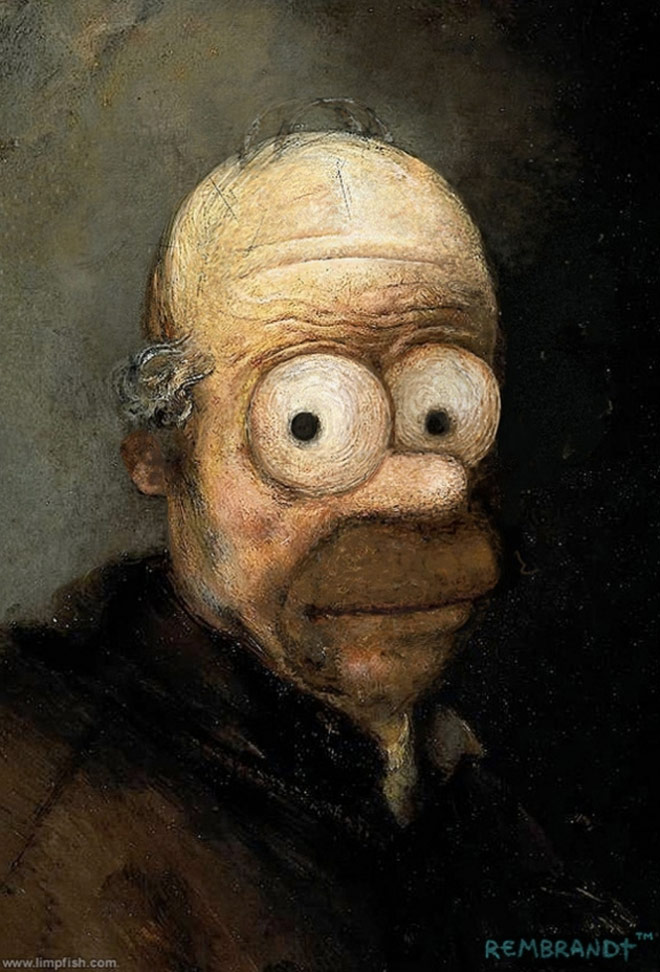
This portrait of Homer Simpson painted in the style of Rembrandt is strangely mesmerizing. Can’t look away from those giant eyes.
The other day I posted a link to an article about Hervé This that mentioned how to unboil an egg.
He explains that when an egg is cooked, the protein molecules unroll themselves, link up and enclose the water molecules. In order to ‘uncook’ the egg, you need to detach the protein molecules from each other. By adding a product like sodium borohydride, the egg becomes liquid within three hours. For those who want to try it at home, vitamin C also does the trick.
Michael Pusateri tried it out (using vitamin C) and it didn’t work so well.
The egg was whole and appeared completely unaffected. The texture of the egg outside felt normal and in no way ‘unboiled’. While I am a professional engineer, I am a amateur scientist. There are several reasons this process might not have unboiled the egg.
Any molecular gastronomists out there want to give this one a shot?
HD DVD is officially pronounced dead, having died last month when Warner switched to Blu-ray. You all can go out and buy Blu-ray players now. (And wow, that happened quickly.)
Update: Combining two recent trends on kottke.org: Hillary Clinton Is Your New HD DVD Player. (thx, raza)
This photo shoot of Lindsey Lohan as Marilyn Monroe only serves to underscore how unlike (and inferior) Lohan is compared to Monroe. Lohan is the Meet the Spartans version of Monroe. Some of the originals are here, lots more thumbnails here. NSFW.
Update: Here’s an accompanying article. And Goldenfiddle had this to say:
This is, without a doubt, the saddest, stupidest, ugliest, most pointless thing ever. Bert Stern should be ashamed of himself.
Apparently, the Dribble-Drive Motion offense is all the rage in the high school and college basketball. The DDM is:
a high-scoring scheme featuring four perimeter players and a host of innovations. Unlike Knight’s classic motion offense (which is based on screens) or Pete Carril’s Princeton-style offense (which is based on cuts), Walberg’s attack was founded on dribble penetration. To Calipari, at least, it embodied two wholly unconventional notions. One, there were no screens, the better to create spacing for drives. Two, the post man ran to the weak side of the lane (instead of the ball side), leaving the ball handler an open driving path to the basket.
The Boston Celtics use a variant of DDM as well.
Gelf Magazine enlisted the help of ZEUS, a football game analyzing computer, to see which NFL coaches called the worst plays at critical times during the 2007 season.
On average, suboptimal play-calling decisions cost each team .85 wins over the course of the season.
In particular, the world champion Giants should have won another game had they called the right plays at the right times. ZEUS also analyzed play calling in “hyper-critical” situations (those fourth-down decisions with five or fewer yards needed for the first down) and found that on average, teams made the wrong calls more than 50% of the time. Here’s an interview on the results with the guys behind ZEUS.
Interview with book cover designer Peter Mendelsund. I will read any interview in which the subject replies “I still don’t know” when asked how they got their job. I really like what I’ve seen of Mendelsund’s work (sorry…his site resizes the browser window…no, wait, I’m not sorry, *he* should apologize for that); his cover for War and Peace is lovely.
Adam Shepard had $25 and the clothes on his back. As a challenge, he set himself a year to get an apartment, a car, and $2500 in savings.
To make his quest even more challenging, he decided not to use any of his previous contacts or mention his education. During his first 70 days in Charleston, Shepard lived in a shelter and received food stamps. He also made new friends, finding work as a day laborer, which led to a steady job with a moving company.
The whole thing is recounted in Shepard’s book, Scratch Beginnings: Me, $25, and the Search for the American Dream. (via cyn-c)
Lately I’ve noticed a pattern of people building Single Serving Sites, web sites comprised of a single page with a dedicated domain name and do only one thing. Here are a few examples:
Barack Obama Is Your New Bicycle showcases all the lovely things that the presidential candidate has done for you.
Sometimes Red, Sometimes Blue. Sometimes the page is read, sometimes it is blue.
Check out Is Lost a Repeat? if you need to know if the upcoming episode of Lost is a rerun.
D-E-F-I-N-I-T-E-L-Y helps you spell definitely correctly.
Now you can find out quickly from anywhere in the city or world: What Color Is the Empire State Building?
Khaaan! The classic William Shatner and his rage!
Is It Christmas? (thx, michael & andy)
Misanthropebook, a Facebook parody.
Status page for the overburdened microsocial site: Is Twitter Down? (thx, kevin)
Find out, Are We At War With Iran? (thx, kevin)
The Abe Vigoda status page. Currently alive. (thx, peter)
Gods Damn It, a Battlestar Galactica in-joke.
You can do anything at ZOMBO.com. (thx, edward)
The classic You’re The Man Now Dog! (thx, jordan)
Purple has a FAQ page but it’s a SSS in spirit. (thx, mike)
Oh, it’s Yet Another Useless Web Site. (thx, mike)
You Sneezed! blesses you.
Use Is Paris In Jail Right Now? to see if Ms. Hilton is a free woman or not. (thx, lex)
Are you tired? Tell them why. (thx, kathi)
Am I Awesome? Very. (thx, jared)
Hypnotoad! (thx, chris)
Fuck the Sound, which is, I’m told, “IRC quotes (some NSFW) by an Autechre fanboy from Romania”. (thx, huphtur)
Gentle advice to those who ask dumb questions: Just Fucking Google It. (thx, michael)
Do websites need to look exactly the same in every browser?
It’s not Lupus, it’s never Lupus. Some House-related thing? (thx, sharelle)
Beth Cherry keeps a single page blog with no archives. (thx, malcolm)
We Need More Lemon Pledge. Not sure what this is. (thx, zach)
From the same person: Illegal Tender Terms of Service and These are the rules.
No Time For Love, Dr. Jones. Indy, you scoundrel. (thx, wade)
And several more: Is It Tuesday?, The Internet Fire Log, Let’s Turn This Fucking Website Yellow, iiiiiiii, Instant Rimshot, It Will Never Be the Same, Thank You Andy Warhol, Free Bill Stickers, raquo, The Last Page of the Internet, Thanks Ants, Is The Apple Store Down?, What Is My IP?, Hillary Clinton Is Your New Bicycle, John McCain Is Your New Bicycle, Michelle Obama Is Your New Bicycle, The Daily Nice, Defiant Dog, Hillary Clinton Is Your New HD DVD Player, and Spinning Beach Ball of Death.
Update: Ha! Alright, this got outta hand in a hurry. There are like 400 emails in my inbox, each with several Single Serving Site suggestions. I quickly went through them all, pulled out the notable ones, and called it good. Thanks to everyone who sent in suggestions.
Rex Sorgatz interviews Adrian Holovaty about Everyblock, a site that “aggregates piles of local information, like restaurant reviews and crime stats, which are then displayed block-by-block”.
On a completely different note, it’s been a challenge to acquire data from governments. We (namely Dan, our People Person) have been working since July to request formal data feeds from various agencies, and we’ve run into many roadblocks there, from the political to the technical. We expected that, of course, but the expectation doesn’t make it any less of a challenge.
I believe that Everyblock will be most successful not through the utility of its site but if it can get more civic and federal agencies to release more structured data about what’s going on in our cities and country. It is *our data* after all.
Nice TV ad for the Madrid Metro…a view of the city from underground.
The fellow/lady behind the excellent Strange Maps blog is doing a book, The Atlas of Strange Maps. In my mind, I have pre-pre-ordered this book…I hope it gets the well-designed cover it deserves.
If you’ve already seen King of Kong: A Fistful of Quarters, I’d suggest reading Jason Scott’s pair of posts about the movie. In The King of Wrong, Scott suggests that the filmmakers left out crucial details and fudged others in order to make the actual events fit the story they were trying to tell.
What I’m saying here is that a good percentage of what makes the documentary “good” are made up conflicts, inaccurate reporting, smoothed-over narratives that are meant to make you root for one side or hate the other, when in fact reality doesn’t hold up to these allegations. The whole point of the narrative is that Steve is wronged, denied his rightful place in the record books because of internal machinations. But he had the championship for 3 years! He had played Billy one-on-one. Billy was not on this campaign to cut Steve off at the knees at every turn so to humiliate him and dismiss him, to his own aggrandizement.
In a follow-up post, Scott elaborates on his poor opinion of the film, drawing upon his experience making a documentary about another nerd subculture, the BBS.
Is Billy Mitchell “real”? I have no doubt that he says things that are over the top. I have no question that he goes off the rails on certain subjects. I also know that if you interview people for hours on end, at various days, you will get some pretty crazy stuff. How you choose to deal with that stuff is a little bit of who you are as an interviewer and editor and director. There’s no question you can “filter for crazy”, or “filter for nice”, or filter for whatever the hell you wish to. I never claim that Billy’s not capable of throwing out whoppers. I’m saying that when you lace his words with an implication of malice, of cheating, of lying to stay on top, then you are moving into caricature and needless trashing of a real person to achieve your goals. Chasing Ghosts has Billy Mitchell and a whole other range of players, and gives you the story without turning the whole experience of video games, and arcades, into a petty small-minded pissing match.
Scott nearly comes off as holier-than-thou about the standards that documentary filmmakers should be held to, but he clearly put his money where his mouth is when filming his BBS documentary. After a rough interview with Thom Henderson, a controversial figure in the compression software community, which interview caused Henderson to recall, with pain, a particularly difficult period in his life, Scott offered him the chance to edit it out of the movie…and something else too:
But you know, when I put together the ARC-ZIP episode (later renamed COMPRESSION) and sent it to him to see, I told him flat out. “If you’re not comfortable with this, if you don’t like it, let me know and it won’t go in.” He wrote back and said he and his wife were fine with it. I then told him I was giving him irrevocable, permanent rights to the film such that he could distribute and copy and even sell it however he pleased. He’s the only other person besides myself with any rights to my films. He has it for download from his site to this day.
I enjoyed King of Kong, but reading that some of the movie’s tension was manufactured sure takes the polish off of it for me.
Update: The Onion AV Club has an interview with Billy Mitchell about the movie and his take on it.
I invited [Steve Wiebe] to the Classic Gaming Expo, 2004. I invited him there, and I went up to speak onstage, as I do at each expo there. When I went up and spoke onstage, I called him to the stage, in order to honor him. I unveiled the poster in his honor, honoring his accomplishments. I did that in 2004. He was onstage with me. And I’m sorry to tell you that you can’t see that, ‘cause they forgot to put that in the movie.
Demo film of the Polaroid SX-70 made by Charles and Ray Eames but set to a soundtrack of The Cramps performing Garbageman. Wot? (via spurgeonblog)
In an anonymity experiment, Catherine Price attempts to recover some of her privacy by living off the information grid.
Pay for everything in cash. Don’t use my regular cellphone, landline or e-mail account. Use an anonymizing service to mask my Web surfing. Stay away from government buildings and airports (too many surveillance cameras), and wear a hat and sunglasses to foil cameras I can’t avoid. Don’t use automatic toll lanes.
For the bit about the cellphone, I’m surprised that she didn’t slip it into an antistatic or other foil-lined bag while it wasn’t in use.
Photos by Taryn Simon of hidden and unfamiliar places in the US, like the marijuana crop grow room at the National Center for Natural Products Research in Mississippi. Here’s a somewhat overlapping selection of photos at Wired and another at The Morning News, which includes a great letter from Disney denying Simon access to their theme park’s underbelly.
After giving your request serious consideration, even though it is against company policy to consider such a request, it is with regret that I inform you that we are not willing to grant the permission you seek…As you are aware, our Disney characters, parks and other valuable properties have become beloved by young and old alike, and with this comes a tremendous responsibility to protect their use and the protection we currently enjoy. Should we lapse in our vigilance, we run the risk of losing this protection and the Disney characters as we know and love them…Especially during these violent times, I personally believe that the magical spell cast on guests who visit our theme parks is particularly important to protect and helps to provide them with an important fantasy they can escape to.
The first trailer for Indiana Jones and the Unfortunately Titled Movie Kingdom of the Crystal Skull is available…in HD even.
He explains that when an egg is cooked, the protein molecules unroll themselves, link up and enclose the water molecules. In order to ‘uncook’ the egg, you need to detach the protein molecules from each other. By adding a product like sodium borohydride, the egg becomes liquid within three hours. For those who want to try it at home, vitamin C also does the trick.
That’s from an article on Hervé This, a French chemist whose medium is food.
Simple little web page: What Color is the Empire State Building? Includes an explanation of why…today it’s red/pink/white for Valentine’s Day.
Giles “Finds it hard to write a meaningful bio, despite being a professional writer for some 15 years now. That’s horrifying. It’s frightening.” Turnbull on the difficulty of writing one’s own biography. Having to write three-line bios is at least 33% of the reason I stopped speaking at conferences. (The other two-thirds: a) I don’t like speaking at conferences, and b) conference organizers stopped asking me to speak.)
Fixing Democracy, answers to the following question:
It’s the morning after the election. The president elect calls you up and says, “You know, after this grueling, absurd campaign, I now see that the state of our democracy is something we have to grapple with right away. What should I do?”
Respondents include Bill Bradley, Hendrik Hertzberg, and Dahlia Lithwick. (via snarkmarket)
A list of ten things that won’t Change no matter who get elected President.
10. The primary system: Sure, the early primaries give a handful of white, rural voters disproportionate influence over the election and state caucuses make Tammany Hall look like a golden age of democratic participation, but they’re an entrenched part of party politics at this point and it’s not wise to mess with them. Just ask the Democrats in Michigan or Florida.
Do We Really Want Another Black President After The Events Of Deep Impact?
Related: the latest episode of This American Life leads with a fascinating piece about how the funny happens at The Onion. In a lovely paradox, it turns out that the process of making funny things isn’t all that amusing…the sound of silence following the recitation of a funny possible headline in the writers’ room is deep and unnerving. (thx, marshall)
Usually the combination of “Hollywood” and “Oscars” is enough to scare me off a story, but this short examination of how good actors become movie stars was pretty interesting. Of his sudden stardom, Jack Nicholson said:
I remember when that happened to me. I’d been working for 12 years, and then the part in “Easy Rider” changed my life. Very few people have ever had the experience where they sit back and say, “I am a movie star.” I knew it at the first showing of “Easy Rider” at the Cannes Film Festival by how the audience reacted to the movie. A lot of people would say, “I know I’m a movie star, but, oh, I wonder what’s going to happen…” I knew it then: I was a movie star. And it was great.
The story is part of the recent NY Times Magazine package on the breakthrough movie stars of 2008. The photographs of the chosen stars by Ryan McGinley are notable as well for “their attempt to wrestle the Hollywood photoshoot beast away from its recent hyper-produced overwrought incarnation”.
Richard Mosse’s Air Disaster, a series of photographs of air disaster simulations, on-the-ground training exercises for airport fire-fighting crews. BLDGBLOG has a short interview with the photographer.
The firemen have put out the fire in seconds. That’s their job, after all. They do this with decisive brevity and great courage, sometimes walking right into flames — but it doesn’t make for an easy photograph. It’s all a bit like the sexual act: the flames come up and men run in and spray everything with a high power water hose and then it’s all over.
The Adam Baumgold Gallery is currently showing a series of drawing by Chris Ware, Drawings for New York Periodicals. His series that ran in the NY Times and his Thanksgiving New Yorker covers are included. Feb 1 - Mar 15, 2008. (thx, evan)
Regarding the graph of technological adoption I linked to the other day, I wrote the graph’s creator** a little note, wondering if he’d done a version comparing the adoption rates directly (like this home run leaders chart). He hadn’t, but he whipped one up quick and sent it to me…which saved me a lot of time in Photoshop.
I can’t post it (the Times has legal dibs on it), but according to the graph (which Nicholas admits is more “guesstimate-y” than the one that ran in the Times), the five technologies that made it into 80% of US households the quickest were (with the rough year of initial availability in parentheses):
1. radio (1922)
2. microwave oven (1972)
3. VCR (1979)
4. color TV (1960)
5. cellphone (1983)
The internet has not yet reached the 80% mark and it may move into the top 5 when it does. And the way the cellphone trend is going, it might be the first to 90%. Anyway, it’s interesting that the common belief is that technology is being adopted faster and faster by Americans these days but that radio was adopted faster than anything else on the chart.
** One Nicholas Felton, who you may recall from his lovely personal annual reports.
Evolutionary biologist Olivia Judson speculates about the Tyrannosaurus rex’s sexual equipment.
We now have a robust understanding of how sexual pressures — the pressures to find, impress, and seduce a mate — influence the evolution of males and females. So much so that if you tell me a fact, such as the average size difference between males and females in a species, or the proportion of a male’s body taken up by his testes, I can tell you what the mating system is likely to be. For example, where males are much bigger than females, fighting between males has been important - which often means that the biggest males maintain a harem. If testes are relatively large, females probably have sex with several males in the course of a single breeding episode.
(thx, bill)
Not much to say about this but this “I Love You, but You Love Meat” headline is best said aloud in Barney’s singsong voice.
Ok, there’s a bit more to say. When Meg and I first started dating, she was an almost-vegan (she ate fish and maybe eggs (I forget)). Now she eats meat and cheese and the like with greater zeal than I do. Sometimes I feel as though encouraging her to abandon veganism was my greatest contribution to our relationship; that we enjoy eating similar things has made things a lot easier.
Oh, and I love the word “vegangelical”…reminds me of Buzzfeed’s vegansexuals trend.
The quintessential modern parental dilemma: What do you do with the kids when mommy and daddy need to meet up with their WoW guild to do raids?
We have two small children who need to eat dinner and raids start at 5pm. Ack! How are we going to make dinner?! There are no problems with the kids running around playing and such while we raid. They’re already used to that, they play in the computer room and we can get them things that they need (you know, cups of juice, snacks, what have you) when we have breaks. Before it was easy because if I was running an instance and in the middle of combat my husband might be in a a space between pulls where he could safely go afk for 30 seconds you know. But now we’ll be on the same schedule essentially. We both play support classes too (he’s a holy priest, I’m a resto druid) so the guild ideally would want us to both be in a forty man raid. It’s not like we can easily switch off any raid nights other than say, ZG and AQ20 runs.
(via cyn-c)
Quick hitter from Radiolab as a preview of the new season: composer David Lang talks about a piece of music he made for a morgue. Appropriate listening for the crappy rainy day here in NYC. Hopefully the weather will be better for Radiolab’s live premiere of their fourth season on Feb 21 at the Angelika.
Missed this a couple of months ago: the shortlisted passages in the Bad Sex Award 2007 competition.
She nods and smiles. She is absurdly beautiful. I start to slip off my jeans and I feel her gaze as I stand in my bra and pants. Why am I embarrassed about taking off my clothes right in front of a robot? I pull the dress over my head like a schoolgirl, untie my hair, and sit down. She is smiling, just a little bit, as though she knows her effect.
To calm myself down and appear in control I reverse the problem. ‘Spike, you’re a robot, but why are you such a drop-dead gorgeous robot? I mean, is it necessary to be the most sophisticated machine ever built and to look like a movie star?’
Nice design of a lens cleaning tissue packet.
Firstly, there’s a thumbprint placed at the bottom where they want you to put your thumb so that the tissues don’t fly away in the wind when you open it up. The thumbprint is in blue, as if it had been manually printed in finger-print ink directly onto the card.
Spore will be out for the PC, Mac, Nintendo DS, and mobile phones on September 7.
How nine cities from around the world are cutting their energy usage.
For cities, the motivation is twofold. All the hand-wringing over climate change has prompted more cities to do their part to contain greenhouse-gas emissions that most scientists believe are causing global warming. In the U.S., more than 700 mayors have signed an agreement to try to follow the Kyoto Protocol’s goal of reducing greenhouse-gas emissions — even though the Senate has rejected the treaty.
The other major motivation for cities: energy costs, which have more than doubled since 2000. Strapped for cash, municipalities are scrambling to save as much money on energy use as they can.
Jürgen Stumpf owns three wine bars in Berlin that operate on the honor system.
For the price of 1 euro (about $1.50), you rent yourself a glass and get to sample as many of the wines as you want. At the end of the night you throw some bills or coins into a big jar, the amount based on what you think is fair.
Short interview with photographer Helmut Newton.
Q: Your about to be published autobiography stops in 1982. What have the readers missed?
A: Nothing! People who reach their goals are very uninteresting. What could I have written about the last 20 years? I met a lot of awfully boring Hollywood bimbos. I earned a lot of money. I fly only first class.
NSFW if tasteful nudes aren’t safe to view at your place of employ. Oh, and here’s another interview with Newton with a bit more about his work.
Speaking of mining the archives of kottke.org, I just found this post that quotes a message board post by Ben Affleck about why he posts his thoughts to the web:
I think there is some responsibility on the part of those folks who benefit from the attentions of some section of the public to be responsive to that group.
It’s worth noting that Affleck was one of the first celebrities to post online in a bloggish manner…he’d answer people’s questions on his site’s message board. (His site is now dead, but a couple of instances of the board were collected by archive.org.)
I remember one post of his in particular (which I can’t find on archive.org). Ben was up late, at like 3am, playing Everquest (or maybe Ultima Online?) because he was addicted and couldn’t stop. He also mentioned that he was essentially playing the game instead of being in bed with his girlfriend at the time, Gwyneth Paltrow.
Periodic table of rejected elements, including Belgium, Antipathy, Visine, and Antigone. (via del.icio.us via kottke.org 8 years ago (it’s the time of year for recycled links, I guess))
Pop quiz, hotshot. There’s a bomb on a bus. Once the bus goes 50 miles an hour… Who fares worst health-wise, diet soda drinkers or fried food eaters? Surprisingly, researchers have found a correlation between diet soda consumption and metabolic syndrome.
The one-third who ate the most fried food increased their risk by 25 percent compared with the one-third who ate the least, and surprisingly, the risk of developing metabolic syndrome was 34 percent higher among those who drank one can of diet soda a day compared with those who drank none.
What I Learned Today did some further digging and found a different study that links diet soda consumption and obesity.
For diet soft-drink drinkers, the risk of becoming overweight or obese was:
- 36.5% for up to 1/2 can each day
- 37.5% for 1/2 to one can each day
- 54.5% for 1 to 2 cans each day
- 57.1% for more than 2 cans each day.
If HD DVD wasn’t dead before, it probably is now. Netflix has announced that it will stop carrying HD DVDs by the end of 2008 in favor of Blu-ray discs.
Since the first high-definition DVDs came on the market in early 2006, Netflix has stocked both formats. But the company said that in recent months the industry has stated its clear preference for Blu-ray and that it now makes sense for the company to initiate the transition to a single format.
However, with online movie rentals/purchases gaining momentum, it’ll be interesting to see just how long Blu-ray can stay in the lead before selling bits on pieces of plastic becomes outdated. (via nelson)
Update: Best Buy is going to start recommending Blu-ray to its customers. (thx, fletcher)
Last week, Rex Sorgatz reviewed the 15-year-old first issue of Wired; lo and behold, Wired founding editor Louis Rossetto sent him a lengthy response that’s a whole lot more interesting than the original review (sorry, Rex).
This beta was a full-on 120 page prototype, with actual stories re-purposed from other places, actual art, actual ads (someone quipped that it was the ultimate editor’s wet dream to be able to pick their own ads), and then all the sections and pacing that was to go into the actual magazine. The cover was lifted from McLuhan’s The Medium is the Massage; it was the startling black and white image of a guy’s head with a big ear where his eyes should have been. The whole thing got printed and laminated in a copy shop in Berkeley that had just got a new Kodak color copier and rip. Jane, Eugene, and I went in when the shop closed on Friday evening and worked round the clock through the weekend. Took 45 minutes to print out one color page! We emerged Monday morning with the prototype, which we had spiral-bound in a shop in South San Francisco, before we boarded a plane for Amsterdam to present it to Origin’s founder and CEO Eckart Wintzen, to see if he would approve the concept, agree to advertise in the magazine, and then give us the advance we crucially needed to keep the project alive.
Obituary of Charles Fawcett, who led an “unlikely” and “unbelievable” life.
In Paris Fawcett also took part in the rescue of a group of British prisoners-of-war who had been placed under French guard in a hospital ward by the Germans. By impersonating a German ambulance crew, Fawcett and a comrade marched in at 4am and ordered the French nurses to usher the PoWs out into the yard. “Gentlemen,” he announced as he drove them away, “consider yourself liberated.”
“You’re a Yank,” said a British voice.
“Never,” came Fawcett’s lilting southern burr, “confuse a Virginian with a Yankee.”
He also romanced Hedy Lamarr, starred in movies with Sophia Loren, and got married a few times:
In three months at the end of the war, Fawcett married six Jewish women who had been trapped in concentration camps, a procedure that entitled them to leave France with an automatic American visa.
(via cyn-c)
Did you know that Paris Hilton has a movie out? Yeah, no one else cares either. The Hottie & the Nottie opened this weekend and took in only $230 per screen.
That means that, based on an $8 average ticket price, 29 paying customers showed up at each location over the 3-day [weekend]. In a country that seems fascinated with Paris Hilton, only 3,219 unlucky Americans will have been suckered into seeing Hottie by Monday morning.
Emphasis mine.
In a map of the Republik van Nieuw Nederland, Paul Burgess imagines that the Dutch never gave up their New World possessions and a republic formed centered around New Amsterdam.
New Amsterdam never gave way to New York. The Dutch kept the whole of their North American colony out of the hands of the perfidious English, in fact. New Netherland today constitutes a thriving Republic stretching from the Atlantic coast to Quebec, dividing New England from the rest of the United States.
See also Melissa Gould’s map of Neu York, which imagines Manhattan as a post-WWII Nazi possession.
The milkshake line from There Will Be Blood came from a transcript that PT Anderson found of the 1924 congressional hearings over the Teapot Dome scandal.
Anderson concedes that he’s puzzled by the phenomenon — particularly because the lines came straight from a transcript he found of the 1924 congressional hearings over the Teapot Dome scandal, in which Sen. Albert Fall was convicted of accepting bribes for oil-drilling rights to public lands in Wyoming and California.
In explaining oil drainage, Fall’s “way of describing it was to say ‘Sir, if you have a milkshake and I have a milkshake and my straw reaches across the room, I’ll end up drinking your milkshake,’ ” Anderson says. “I just took this insane concept and used it.”
(via observations on film)
Starbucks is switching from T-Mobile to AT&T as their wireless provider. Access will be cheaper and Starbucks Card holders will get a couple hours of free wifi a day. (via fimoculous)
It seems like I’m always looking for this graph comparing the adoption rates of different technologies (cars, microwaves, color TVs, cellphones, etc.). No more…it’s posted here for my future reference.
The referring article on the differences between what people spend and what people earn is worth noting as well.
If we compare the incomes of the top and bottom fifths, we see a ratio of 15 to 1. If we turn to consumption, the gap declines to around 4 to 1. A similar narrowing takes place throughout all levels of income distribution. The middle 20 percent of families had incomes more than four times the bottom fifth. Yet their edge in consumption fell to about 2 to 1.
At 1 o’clock on a bright October afternoon, I’m standing in a convenience store parking lot five miles east of Martinsville, Va. In the 24 hours before the green flag drops on the Subway 500, I need to find a ride to the speedway and a $75 ticket to the sold-out race. Problem is, all I have on me is $20, a cell phone and a camcorder. And I’m not allowed to use any media connections to get into the race-or so much as mention the letters ESPN (at least not in that order).
(via memeticians)
Polaroid is going to stop manufacturing film for their instant cameras, which they stopped making a year ago.
The company, which stopped making instant cameras for consumers a year ago and for commercial use a year before that, said today that as soon as it had enough instant film manufactured to last it through 2009, it would stop making that, too. Three plants that make large-format instant film will close by the end of the quarter, and two that make consumer film packets will be shut by the end of the year, Bloomberg News reports.
Hopefully someone else will pick up where they left off; Polaroid is willing to license the manufacturing technology to other companies. (via clusterflock)
Video of a debate between Christopher Hitchens and Rabbi Shmuley Boteach on the topic of “Does God Exist?”
New extended trailer for Pixar’s Wall-E that reveals a bit more of the story and a new character.
Update: The trailer is offline. Awaiting the official release.
Speaking of podcasts, The New Yorker has a couple of interesting ones on iTunes: readings from the Fiction section and from the weekly Comment essay in Talk of the Town.
Radiolab has been getting some love from quite a few of the sites I read (Snarkmarket originally turned me on to the show), so I thought I’d offer mine as well. I don’t listen to the radio or to podcasts, but lately I’ve made an exception for Radiolab. It’s about science, the editing is wonderful and unique, Jad Abumrad is one of the best radio voices I’ve ever heard, and to top it off, their shows are really fascinating.
Their show on Memory and Forgetting from last June is particularly good. If you don’t have time for the whole thing, the Adding Memory (especially Joe Andoe’s story) and Clive segments are almost must-listens.
You can listen to Radiolab on their site, on a variety of US radio stations, as a podcast, or though iTunes.
Update: Radiolab did a session at the Apple Store in Soho about their editing process and thought process. (thx, dan)
Jason Polan, who you may remember from the series of drawings he did of every piece of art in the MoMA, has a unique 20x200 offering available. The larger editions are drawings and copies of his hand while the $2000 edition of 2 is described thusly:
I will come to your house and shake your hand. Two of these interactions will be available. After I meet you I will give you a certificate, to be signed by both you and me, stating the authentification of the encounter. This artwork is a collaboration between you and me. You will also receive a photograph that is taken the moment of our meeting.
20x200 curator Jen Bekman has more on this offering.
Jason’s work is about a lot of lofty ideas, but those ideas are grounded in the most mundane of media and happenstance. The ideas center around his ambitions to interact authentically with both the media he chooses to work in and the collectors who buy his work.
Surprisingly, the Jumping Frenchmen of Maine Disorder is a real, no-fooling psychological behavior. Here’s an abstract from Neurology magazine briefly describing it:
The “Jumping Frenchmen of Maine” were described by George Beard in 1878. They had an excessive startle response, sometimes with echolalia, echopraxia, or forced obedience. In 1885, Gilles de la Tourette concluded that “jumping” was similar to the syndrome that now bears his name. Direct observations of jumpers have been scarce. We studied eight jumpers from the Because region of Quebec. In our opinion, this phenomenon is not a neurologic disease, but can be explained in psychological terms as operant conditioned behavior. Our cases were related to specific conditions in lumber camps in the 19th and the beginning of the 20th century.
(thx, nathan)
Why I love Wikipedia, reason #4193: the entry for buttock cleavage. Also called the “coin slot”, “builder’s bum”, “plumber’s butt”, or “Dagenham smile”.
As we look forward to baseball season starting up, we look back at Stephen Jay Gould remembering the New York teams of his youth.
Thus, I can watch Roger Clemens striking out 15 Mariners in a brilliant one-hitter and place his frame right on top of Don Larsen pitching his perfect game (27 Bums up, 27 Bums down) in 1956. And I can admire the grace of Bernie Williams in center field, while my teenage memories see Mantle’s intensity, and my first impressions of childhood recall DiMaggio’s elegance, in exactly the same spot. I can then place all three images upon the foundation of my father’s stories of DiMaggio as a rookie in the 1936 Series, and my grandfather Papa Joe’s tales of Babe Ruth in the first three New York Series of 1921-1923.
(thx, matt)
Imagined slogan of the Golden Rule Lumber store we passed in the car today: “Give lumber unto others as you would have lumber given unto you.”
Kevin Kelly has written a thoughtful post about how to make money in a world where the rules are:
When copies are super abundant, they become worthless.
When copies are super abundant, stuff which can’t be copied becomes scarce and valuable.
He then lists eight reasons why people pay money for things that could be free, one of which is immediacy:
Sooner or later you can find a free copy of whatever you want, but getting a copy delivered to your inbox the moment it is released — or even better, produced — by its creators is a generative asset. Many people go to movie theaters to see films on the opening night, where they will pay a hefty price to see a film that later will be available for free, or almost free, via rental or download. Hardcover books command a premium for their immediacy, disguised as a harder cover. First in line often commands an extra price for the same good.
Some really nice looking stamps done in the style of Otl Aicher.
The experimenters used functional magnetic resonance imaging (fMRI) to scan the brains of Harvard and other Boston-area students while showing them pictures of other college-age people whom the researchers randomly described as either liberal northeastern students or conservative Midwest fundamentalist Christian students.
The study concludes that the secret to getting along with someone that you perceive as an outsider is to find some common ground so that your brain will accept them as someone with similar circumstances.
This is not new advice. Yet it is heartening to see that it is firmly grounded in distinct patterns of neural activity. There may be a brain basis for reacting with prejudices for those that seem different. But there’s also a brain basis for overriding those differences and seeing outsiders as more like us.
David Galbraith expands upon what this means for society at large:
In other words, a civilized society depends not on the people who are currently the most civilized, but those who are most willing to accept change, as social or cultural groupings change, split or coalesce. Inevitably this means reasonable people rather than faithful people.
A list of Cartoon Girls I Wanna Nail. And it’s on Geocities, no less…I had no idea that was still around and operational. Maybe this is the only page left, the end result of Yahoo’s $3.6 billion investment.
Update: The site above is currently down. Fun fact: I first linked to this almost 9 years ago. (thx, everyone)
Update: Geocities is gone but Reocities archived the Cartoon Girls I Wanna Nail page. Our shared cultural heritage is safe.
Why take the hands-off approach to management?
Taking someone else’s idea and increasing the quality by 5% occurs at the price of a 50% decrease in their commitment to execution.
More at the Harvard Business blog, which adds:
One of the greatest leaders I know once said, “Achievement was about me. Leadership is about them.”
I’ve never wanted to be a manager…maybe I’m just too selfish?
Rebecca Mead on young composer Nico Muhly in the New Yorker.
When Muhly composes, the last thing he thinks about is the actual notes that musicians will play. He begins with books and documents, YouTube videos and illuminated manuscripts. He meditates on this material, digesting its ironies and appreciating its aesthetics. Meanwhile, he devises an emotional scheme for the piece-the journey on which he intends to lead his listener. Muhly believes that some composers of new music rely too heavily on program notes to give their work a coherence that it might lack in the actual listening. “This stupid conceptual stuff where it’s, like, ‘I was really inspired by, like, Morse Code and the AIDS crisis,’” he says.
A sampling (no pun intended) of Muhly’s music is available on the New Yorker site and on his personal site (which seems to be in a similar vein to The Believer and McSweeney’s Store, design-wise).
NOTE: don’t read any further if you haven’t watched episode 6 of The Wire’s 5th season. SPOILERS.
I’ve been meaning to write a post on my thoughts about season 5 of The Wire but luckily Heaven and Here beat me to much of what I was thinking. The highlights:
Too many characters, too many stories, too much telling and not enough time for showing, which is why it feels more like a conventional TV show than in years past.
Unnecessary cameos. What is this, a reunion tour? Hi Nicky, hi Randy! (Although I think the Randy thing is interesting in relation to his dad…did Cheese get the way he is through a similar trajectory? And I suspect that Randy will come back into play…the season 4 kids are the only ones, besides the drug dealers themselves, who have any evidence of wrongdoing by Marlo, et. al.)
How are they going to wrap this up? I don’t care what happens to Carcetti or McNulty or Freamon or Daniels and we’re obviously going to get some sort of closure on either Omar or Marlo, but if they leave the Dukie, Bubs, and Michael threads significantly hanging, I’m gonna be pissed. (Prediction: if Marlo gets got, it will come from within…either Chris or Michael or both.)
The whole McNulty/Freamon thing: blah. Same thing with the newspaper angle…not as interesting as I thought it was going to be.
But all the rest of the seasons started slow and built into something…they coalesced. Maybe this one will as well?
The only thing I really like about McNulty’s manufactured investigation is how it affects so many different things in the system. Carcetti running for governor on the homeless issue. The newspaper switching their focus from the schools to the homeless. All the little things that pull resources and energy away from the Marlo Stanfield case. Pulling Kima off her triple. Motivating Bunk to reopen the case files on the bodies in the vacants. Everything is connected, unexpectedly.
Oh, and I love the “Dickensian” stuff in the newsroom…it’s Simon’s little shoutout/fuck you to the real media’s coverage of the show, frequently called Dickensian. Heaven and Here on the term’s misuse:
Something that has been bothering me about the deluge of stories on the show lately (which is , as Shoals said to me earlier today, “split now between nay-sayers and people drowning in their own adulation,”) is the loose use of the term “Dickensian.” Some stories are simply grabbing onto the upcoming plotline of the Sun editor assigning a story on “Dickensian” kids, but more often than I like, I see lazy writers using Dickens as a sort of shorthand for intricacy, urban despair, and nightmarish institutional breakdown, as if he owned the patent on all that.
Maybe much of the media criticism we were promised in season 5 is meta?
What do you get when you cross an ouroboros with a Möbius strip?
M.C. Escher knew: The dreaded Mouroboröbius!
Video of the world’s fastest clapper. What a showman!
Update: And this guy can do the hambone (“a rhythmic knee and chest slapping motion”) pretty damn fast. (thx, alesh)
Andy Baio tracked the airplane on a treadmill problem back to a July 2005 posting on the PhysOrg site.
Update: He’s traced it further back now…to a Russian forum in 2003.
I enjoy movies based on real-life events because of the post-movie Google/Wikipedia binge. You start at the Wikipedia page for the movie in question and work your way out from there. In this case, I read about convicted spy Robert Hanssen and the agent who helped catch him, Eric O’Neill, who has his own web site and a wife who’s prettier than the actress who plays her in the film, surely a rarity. The most interesting aspect of such research is the differences between the real-life events and the filmed narrative. It’s fun to think about why those changes were made and how it made the narrative better or worse.
Show your PPPPRIDE and buy yourself a FFFFOUND! TTTT-SHIRT. [Ok, knock that off. -ed]
Matt Webb recently gave a talk at Web Directions North 2008 about movement as a metaphor for thinking about the Web. The slides take awhile to get through properly but it’s worth the effort. Some interesting points:
The meat of what Matt is getting at with his movement metaphor is contained in two systems he refers to in the talk. The first is the internal combustion engine:
To my mind, this is a more beautiful Rube Goldberg machine: the internal combustion engine.
Intake, compression, power, exhaust.
So what’s happening here. It needs a spark to get going, just like a message-board community online. And then it keeps cycling, and almost as a side-effect it outputs mechanical motion which goes to the wheels. But another side-effect of the process is that the motion also provides the intake stroke to start the cycle again. It’s self-perpetuating, just you use the energy from breakfast to go and make dinner, and you use the energy from supper to go and get breakfast again.
And the second is David Allen’s Getting Things Done:
The cleverness of GTD is not that it’s a system for achieving tasks. It’s that it’s a system for keeping you motivated to run the system for achieving tasks. It helps you start. It gives you reasons to continue. It helps you start again with a blank slate if you get overwhelmed, you know, to get back on the wagon.
It contains small and big rewards.
What’s more, it has a catchy name which advertises itself, and it’s easy to grasp too so when you tell your friends about it they remember it. So it’s a system that contains its own growth cycle too. Very clever.
A hardware API is like a software API for hardware (duh). Matt and his partner are working on a radio for the BBC which has a hardware API. For example, they’re planning on having different parts for the radio that hook together using magnets, much like Apple’s MagSafe power connector.
Snap is a proposal for syndicating actions. Instead of using RSS for passive input (news reading, blog reading, etc.), Snap imagines using an RSS-esque reader for doing things (purchasing books, managing todo lists, posting to blogs, etc.) without using a proper browser. Matt wrote a whole bunch more on Snap here.
But my main takeaway from Matt’s talk is his process for thinking about, describing, and explaining things. He uses idea scaffolding and metaphor.
So one of the way I work, being not-a-designer, is to use a lot of metaphors. Metaphors are a great sort of idea scaffolding.
I start by saying, as the Web is to cities, so weblogs are to Catalhoyok. Or, so this online social music website is to the London underground system. Or, so this repository of scientific papers is to Borges’ infinite library.
You know, so you make the analogy and then extend the metaphor. The consequence would be this, the consequence would be that. It’s a way to provoke creative thinking.
I’ve observed that there’s much resistance in contemporary society to simply trying out ideas to see if they work. It seems more important to many people to know who they are and what they believe. New ideas are either accepted or rejected and then those choices are vigorously defended. If it’s going to help you figure something out, why not look at a problem from every possible angle? Working on kottke.org is a big part of my process of idea scaffolding. I don’t necessarily agree or disagree with everything I link to1 but reading articles and then describing them to others is a good way to continually wonder, “Gosh, isn’t it interesting to think about the world this way?”
[1] I often get email from people saying that a particular idea expressed in some article that I’ve linked to is wrong and that I should alert my readers or remove the link. To which my response is a lusty hell no. What’s the big deal? It’s just an idea; it’s not going to hurt you. ↩
A collection of time-lapse movies of people playing Wii. One fellow plays for quite some time while holding a newborn baby.
Slideshow of lobby cards from a collection assembled by late screenwriter Leonard Schrader. Here’s a companion article about the collection’s discovery.
Screenwriter Leonard Schrader’s secret collection consisted of lobby cards, which were used to promote films in movie theaters from the silent era through the 1960s. Typically issued as a set of eight sequential 11”-by-14” mini-posters depicting scenes from a film, they pre-dated trailers as a promotional device. They were low tech even by 20s standards, but in a black-and-white era, they made up for it with their flashy graphics, riotous colors, and over-the-top salesmanship.
Many photographers, curators, bloggers, etc. answer the question: What makes a good portrait?
I do have specific ideas of what a good portrait may consist of, but I am often amazed at the portraits I come across that do not abide by any of these “rules.” Many of these images are truly spectacular. And it further reminds me that good art is made up of many things, and this question can almost never really be answered, at least not with any certainty.
B&H is selling a used Canon Super Telephoto 1200mm lens for $99,000.
As for image quality, even wide open it’s quite lovely. Stopped down to f/8 and f/11 it’s actually quite remarkable. How remarkable? From midtown Manhattan we were able to read the street signs on the corner of JFK Boulevard East and 43rd St. in Weehawkin New Jersey when viewing image files at pixel resolution.
The lens weighs 36 pounds and there are probably less than 20 of them in existence. (thx, rob)
Update: Carl Zeiss designed a 1700mm lens for a 6x6 medium format camera. It weighs 564 pounds! (thx, jonathan, who notes that it looks like a Star Trek shuttle)
Update: There’s also a Nikon 1200-1700mm lens and a Nikon 2000mm lens. (thx, markus)
Update: Canon even made a 5000mm lens. (thx, sadat)
Update: Ok, last one and then we’re on to telescopes. (I’m kidding…please do not send me links to telescopes.) The Panavision 300x HD Lens…2100mm. (thx, philip)
Simple but maddening Flash game: Spin The Black Circle. (via waxy)
Someone made a video overlay of the 134 times it took him to get through one level of hacked version of Mario World. (Note: the original video was taken down so the embed is a similar video.)
Oh, and how that relates to quantum mechanics:
But, we can kind of think of the multi-playthrough Kaizo Mario World video as a silly, sci-fi style demonstration of the Quantum Suicide experiment. At each moment of the playthrough there’s a lot of different things Mario could have done, and almost all of them lead to horrible death. The anthropic principle, in the form of the emulator’s save/restore feature, postselects for the possibilities where Mario actually survives and ensures that although a lot of possible paths have to get discarded, the camera remains fixed on the one path where after one minute and fifty-six seconds some observer still exists.
Some of my favorite art and media deals with the display of multiple time periods at once. Here are some other examples, many of which I’ve featured on kottke.org in the past.
Averaging Gradius predates the Mario World video by a couple years; it’s 15 games of Gradius layered over one another.

I found even the more pointless things incredibly interesting (and telling), like seeing when each person pressed the start button to skip the title screen from scrolling in, or watching as each Vic Viper, in sequence, would take out the red ships flying in a wave pattern, to leave behind power-ups in an almost perfect sine wave sequence. I love how the little mech-like gunpods together emerge from off screen, as a bright, white mass, and slowly break apart into a rainbow of mech clones.
According to the start screen, Cursor*10 invites the you to “cooperate by oneself”. The game applies the lessons of Averaging Gradius and multiple-playthrough Kaizo Mario World to create a playable game. The first time through, you’re on your own. On subsequent plays, the game overlays your previous attempts on the screen to help you avoid mistakes, get through faster, and collaborate on the tougher puzzles.
Moving away from games, several artists are experimenting with the compression of multiple photographs made over time into one view. Jason Salavon’s averaged Playboy centerfolds and other amalgamations, Atta Kim’s long exposures, Michael Wesley’s Open Shutter Projekt and others. I’m quite sure there are many more.
Dozens of frames of Run Lola Run racing across the giant video screen in the lobby of the IAC building.
The same kind of thing happens in this Call and Response video; 9 frames display at the same time (with audio), each a moment ahead of the previous frame.
Related, but not exactly in the same spirit, are projects like Noah Kalina’s Noah K. Everyday in which several photos of the same person (or persons) taken over time are displayed on one page, like frames of a very slow moving film. More examples: JK Keller’s The Adaption to my Generation, Nicholas Nixon’s portraits of the Brown sisters, John Stone’s fitness progress, Diego Golberg’s 32 years of family portraits, and many more.
Update: Another video game one: 1000 cars racing at the same time. (thx, matt)
Update: More games: Super Earth Defense Game, Time Raider, and Timebot. (thx, jon)
Update: Recreating Movement is a method for making time merge photos (thx, boris):
With the help of various filters and settings Recreating Movement makes it possible to extract single frames of any given film sequence and arranges them behind each other in a three-dimensional space. This creates a tube-like set of frames that “freezes” a particular time span in a film.
How You See It overlays three TV news programs covering the same story. (via waxy)
Update: James Seo’s White Glove Tracking visualizations. The Slinky one is mesmerizing once you figure out what to look for. Seo also keeps a blog on spilt-screen media.
Photo of audio amplifiers used to listen for approaching aircraft. A precursor to radar.
John Allen Paulos has 12 irreligious questions for the candidates. Among them:
Is it right to suggest, as many have, that atheists and agnostics are somehow less moral when the numbers on crime, divorce, alcoholism and other measures of social dysfunction show that non-believers in the United States are extremely under-represented in each category?
How would you suggest that we reason with someone who claims that his or her decisions are informed, shaped, even dictated by fundamental religious principles, which nevertheless can’t be probed or questioned by those who don’t share them?
(via 3qd)
When you take a picture with an S.L.R., there is a distinctive sound, somewhere between a clatter and a thump; I worship my beat-up Nikon FE, but there is no denying that every snap reminds me of a cow kicking over a milk pail. With a Leica, all you hear is the shutter, which is the quietest on the market. The result — and this may be the most seductive reason for the Leica cult — is that a photograph sounds like a kiss.
That’s Anthony Lane in the New Yorker.
Leica is offering a “perpetual update program” for its M8 digital camera.
In keeping with these proud traditions, but now in the age of digital technology, Leica introduces it’s perpetual update program which makes the LEICA M8 a digital camera in which, uniquely, owners will be able to incorporate the latest refinements and developments in technology. While other digital cameras quickly become outdated and are replaced by new models, Leica’s new concept allows it’s customers to invest in the photographic equipment they need sure in the knowledge that they will not miss out on improvements and technological developments in the future.
The first upgrade adds a hard-to-scratch sapphire glass LCD screen cover and a quieter shutter.
Update: Just to be clear, the upgrade program costs money. According to Gizmodo, the first upgrade is $1800. On the plus side, each time you upgrade, they extend the warranty on the whole camera for two years.
The winners of this year’s DWR’s Champagne Chair Contest have been announced. The winning chairs are more professionally designed as the years go on.
Super Tuesday Surprise: Leading Minsk Newspaper Endorses Candidates in US Presidential Race.
The Democrats have now only two candidates who stand to chance against this powerful phalanx: Barack Obama, senator of City Chicago and nephew of Saddam Hussein; and Hillary Rodham Clinton, organizer of popular solidarity-building women’s breakfasts for discussion of hair-hygiene and of place of woman in American politics, and only official wife of number-one enemy of Serbs and all Slavic peoples, Bill Clinton.
Also: “The Woman: it is also Person!”
How To Survive in Prison as an Innocent Man Convicted of a Sex Crime, written by an innocent man convicted of a sex crime. This is an odd article, at once full of good advice, hints of mental instability, and defensiveness. In a section outlining the importance of regular exercise, he suddenly switches gears to:
Not only do we prisoners have to stick together, but we men must also join forces in our fight against feminism.
Exercise regularly, keep healthy, stay away from drugs, and keep your mind sharp. And ps, down with the feminists!! (via cyn-c)
In tied football games, the team that wins the coin toss often wins the game. Are there better ways to decide overtime games?
Dueling Kickoffs: To begin overtimes, each team will kick off to each other on consecutive plays. The team that advances the ball furthest will have possession at the point on the field where the ball was advanced. Sudden death is preserved.
Several very cool animations, graphs, and photos of Northern Hemisphere sea ice coverage are available from The Cryosphere Today. Among them: ice coverage time-lapse from 1978-2006 and 2007’s ice retreat (the greatest ever recorded). (via ben saunders)
A series of four lectures on physics, specifically quantum electrodynamics, by Richard Feynman. Only Part 1 is available on Google Video and the rest are in streaming Real format (blech)…hopefully they too will make their way onto Google Video.
Update: Another lecture by Feynman, this one about Elementary Particles and the Laws of Physics.
Update: I got an email from the nice folks at Vega Science Trust asking me to change the wording of this entry with regard to encouraging people to put these copyrighted videos up on Google Video. Fair enough…what I really meant by that is I wish the videos were presented in a more useable manner than RealVideo format. If there’s one thing that YouTube has shown us more than anything, it’s that people find watching video in embedded Flash players really convenient.
This video is too long and come frontloaded with too much explanation, but like a jelly doughnut, there’s some goodness in the middle.
Basically, I simulate clocks as living organisms. Selective pressure is focused on their ability to accurately tell time. NO goal is imposed on the design (you can tell this because every simulation ends with a differently constructed clock). And it works. Clocks evolve through a series of transitional forms: Pendulum, Proto-clock, 1-handed Clock, 2-handed Clock, 3-handed Clock, and 4-handed Clock. Gradually the complexity is built up.
Doctors and researchers are investigating the source of a new disease caused by aerosolized pig brains.
Their working hypothesis is that the harvesting technique — known as “blowing brains” on the floor — produces aerosols of brain matter. Once inhaled, the material prompts the immune system to produce antibodies that attack the pig brain compounds, but apparently also attack the body’s own nerve tissue because it is so similar.
(via frontal cortex)
If you can even read this, sorry for the downtime on kottke.org this morning (and, from what I can tell, last night too). My robot and someone else’s robot are chatting away gaily and no one else seems to be able to get a word in edgewise. We’re hoping they quiet down soon. If you need your kottke.org fix before that happens, I’ll be standing on the corner of Canal & Bowery in Manhattan handing out slips of paper with cool URLs on them.
Update: Ok, things seem to be a little better.
The Tempest Prognosticator is a barometer filled with leeches. When the leeches become agitated because of a change in pressure, they wiggle around, causing a bell to be rung. Ringing bell = storm’s a comin’. Reminds me a bit of the weather rock…”if rock is wet, it is raining”. (thx, shay)
Probably 10 of you will understand this: openlog is still operational. (More info.)
Jamie Zawinski reckons that Bill Murray re-lived February 2nd for at least 4 years in Groundhog Day.
Update: The screenwriter for Groundhog Day says that Phil Conners’ day lasted “about ten years”. (via waxy)
Eddie Adams, who won a Pulitzer Prize for his famous photo of General Nguyen Ngoc Loan shooting a Viet Cong prisoner, wishes he had never taken the photo.
The general killed the Viet Cong; I killed the general with my camera. Still photographs are the most powerful weapon in the world. People believe them, but photographs do lie, even without manipulation. They are only half-truths. What the photograph didn’t say was, “What would you do if you were the general at that time and place on that hot day, and you caught the so-called bad guy after he blew away one, two or three American soldiers?”
(via times online)
Which actors would play the designers in Graphic Design: The Movie? Maybe Phillip Seymour Hoffman as Michael Bierut, Massimo Vignelli played by Sean Connery (Connery won’t do the Italian accent though), and Julie Christie as Paula Scher.
Sarah Silverman would like her boyfriend Jimmy Kimmel to know…well, just watch. (via davenetics)
An official decision has been reached in the Long Bet between Dave Winer and Martin Nisenholtz of the NY Times. The bet was made in 2002 when Winer asserted that:
In a Google search of five keywords or phrases representing the top five news stories of 02007, weblogs will rank higher than the “New York Times” Web site
Winer won the bet but it’s worth noting that the Times has a growing stable of good blogs itself. (via workbench)
Bookmarked for some weekend reading: The History of Visual Communication…from rocks and caves to the avant-garde to the computer. (via girlhacker)
Great Improv Everywhere prank, 200 people frozen in Grand Central for 5 minutes. Watch the video. (via waxy)
Microsoft wants to buy Yahoo! for $44 billion. This sounds like a horrible deal…big mergers/acquisitions like these often don’t work well.
A series of photos by Alexei Vassiliev, along with some introductory text about his “anonymous portraits”.
Armed with only a hand-held 35mm film camera, and using available artificial light, Russian photographer Alexei Vassiliev has created a series of stunning portraits of anonymous 21st century urban dwellers. A very slow shutter speed allows him to capture rich colors and blurred human gestures to create iconic images that evoke the essence of modern humanity without much of the detail.
Reminds me of a favorite photo of mine, a picture I took of Meg in Ireland with a fogged up lens.

Stay Connected